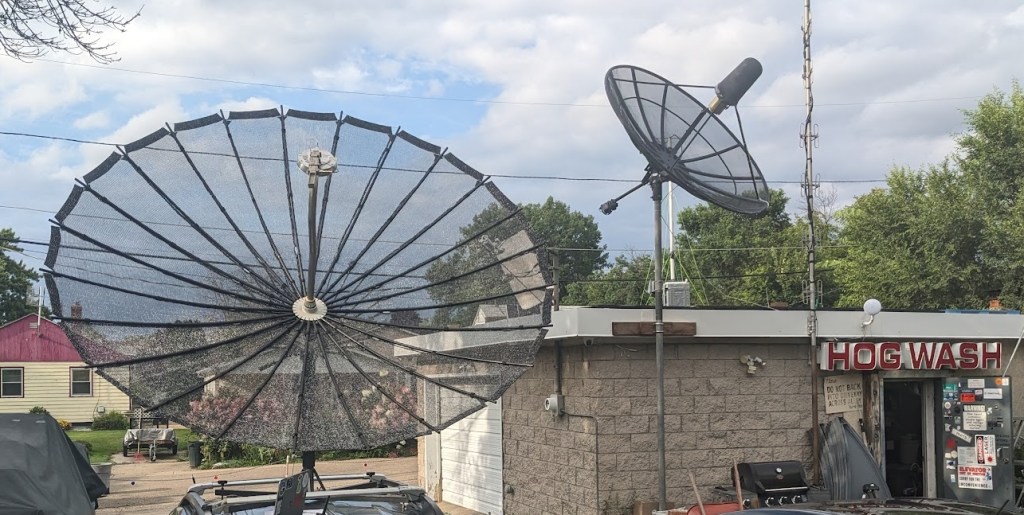
I discuss a variety of satellite and radio projects on my YouTube channel. Satellite tech has become the most popular topic on my channel, even though it’s not what I initially started with! I often get questions from viewers along the lines of “how do I get started in this hobby?”. Personally, I bought the cheapest possible Software-Defined Radio (SDR) and just started messing with it! I’ve since moved on to slightly better SDRs, but there’s a lot you can do with just a $15-$20 unit from eBay and some creativity.
I usually try to include links and details in the descriptions of my videos, but I don’t always make “how-to” or instructional videos. Usually when I film a project, I’m learning right as I’m doing the project, and viewers are seeing me develop a skill as I do it. This isn’t the most efficient way to teach something, as I make plenty of mistakes along the way! My personal learning style involves a LOT of trial-and-error. My projects also involve a significant amount of dumpster-dived material and equipment, so it can be hard to make a “parts list” for someone to replicate what I did!
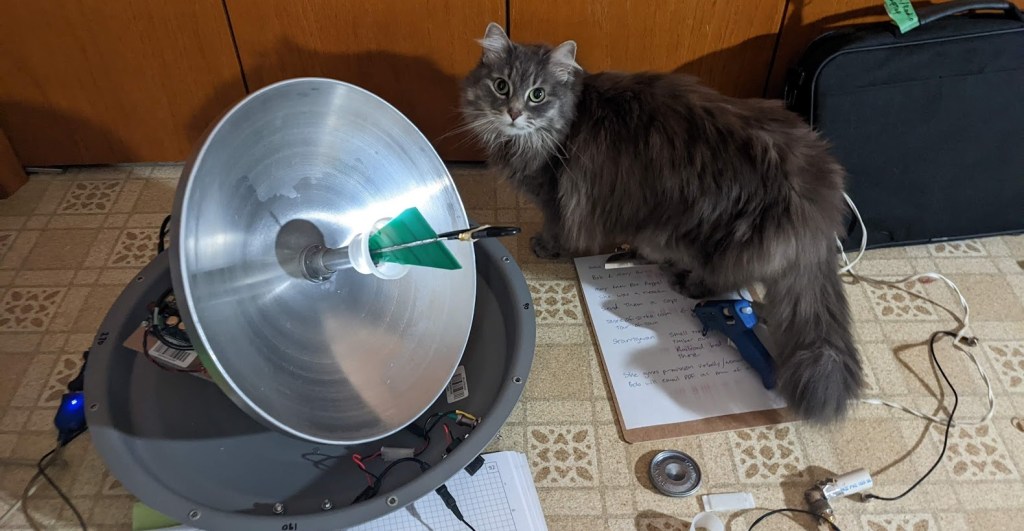
If you are just starting out with the amateur satellite hobby, there are a couple directions you can go. If you’re an amateur (ham) radio operator or just into listening to radio traffic, you can get into amateur repeater satellites pretty easily. The International Space Station is the most powerful and easiest to start with. Some info about that is in the list below.
If you want to start tracking and decoding weather satellites, the low-Earth-orbit Meteor series is probably the easiest to start with. Previously some of the US NOAA satellites used VHF, but the ones with this capability have been retired, so some of the info about them is outdated. As of early 2026, Meteor M2-3 and M2-4 can be received on VHF frequencies with a Software-Defined Radio. Images can be decoded with simple software like SatDump. Once you’re experienced with VHF you can upgrade to the L-band signal available from the same satellites (and some others), although this takes a little more effort and equipment.
If you want to try geostationary satellites, the GOES series (in the Western hemisphere) is a great place to start. However, you will need to find or make a satellite dish slightly larger than what’s normally found on houses today. More info and links are below.
The list below is my attempt to compile helpful resources and links related to satellite experimenting, “hacking”, or other hobby-level activities. Some of these are things I’ve written or filmed, and some are links that have helped me learn.
——————————————————-
“How-To” style videos that I’ve made:
Basics of VHF weather satellites (NOTE! The NOAA series is now retired): https://www.youtube.com/watch?v=icADyjm3PBE
Basics of L-band weather satellites (the next step in difficulty, but still not too hard): https://www.youtube.com/watch?v=w5DyJHMw7aY
How to hack Winegard brand portable satellite dishes: https://www.youtube.com/watch?v=6kQa6nfUkIs
How to listen to the International Space Station’s amateur radio repeater: https://www.youtube.com/watch?v=4TRrqPqxpe8
How to find free satellite dishes: https://www.youtube.com/watch?v=_qX30ayOcDU
TLDW: Craigslist, Facebook Marketplace, and estate sales/auctions are great places to try! You can also contact local TV stations and ask if they have old ones. Or you can post on a classified site offering to remove old unwanted dishes from someone’s yard.
——————————————————-
Other articles or software I’ve written:
A how-to article I wrote about turning small satellite antennas into radio telescopes / microwave imagers: https://saveitforparts.wordpress.com/2024/03/19/my-mini-radiotelescope-made-it-into-the-amsat-journal/
My Winegard microwave radio telescope program: https://github.com/saveitforparts/Carryout-Radio-Telescope/
My Dish Tailgater microwave imager program: https://github.com/saveitforparts/Tailgater-Microwave-Imaging
——————————————————-
Links that have helped me:
Satellite tracking and prediction info, probably the #1 site that I use on a regular basis! https://www.n2yo.com/
A great site for visualizing orbits: https://sky.rogue.space/
Starter guide to VHF weather satellites (NOTE! The NOAA series that used VHF are now retired): https://noaa-apt.mbernardi.com.ar/guide.html
More technical info on the APT format used by some weather satellites: https://open-weather.community/open-weather-apt-guide/
Info on receiving Russian “Meteor” satellites (currently the easiest place to start): https://blog.chaospixel.com/linux/2019/12/receive-meteor-satellite-images-with-rtlsdr-gqrx-linux.html
Good basic intro to receiving US weather satellites (NOAA VHF series are retired, but GOES is still available): https://hamsignal.com/blog/this-is-major-tom-to-ground-control
Step-by-step guide to geostationary weather satellites like GOES and GK-2A: https://www.rtl-sdr.com/rtl-sdr-com-goes-16-17-and-gk-2a-weather-satellite-reception-comprehensive-tutorial/
USRadioGuy has some great stuff! His whole site usradioguy.com is super useful. This is his page on Geostationary satellites: https://usradioguy.com/goes-satellite-imagery-reception/
USRadioGuy’s page on low-earth-orbit weather satellites: https://usradioguy.com/noaa-apt-reception/
SGCDerek’s guide to HRPT satellite signals: https://sgcderek.github.io/blog/beginner-hrpt-guide.html
Various satellite frequencies and info: https://uhf-satcom.com/satellite-reception/uhf
More satellite frequencies: https://www.satdump.org/Satellite-List/
Even more satellite frequencies: https://sgcderek.github.io/satfreq/
Using a Raspberry Pi computer for automated (low-earth-orbit) weather satellite downloads: https://www.instructables.com/Raspberry-Pi-NOAA-Weather-Satellite-Receiver/
How to make a DIY motorized satellite tracker (rotor): https://www.sarcnet.org/rotator-mk1.html
International Space Station radio repeater info: https://www.ariss.org/current-status-of-iss-stations.html
CHIRP software for Baofeng and similar radios: https://chirp.danplanet.com/projects/chirp/wiki/Home
Improved squelch settings for Baofeng radios: https://www.miklor.com/COM/UV_Squelch.php
Commercial / TV Satellite info: https://www.lyngsat.com/
Another TV satellite resource: https://www.satbeams.com/
This is a great site for aiming dishes at geostationary satellites: https://www.dishpointer.com/
S-band satellite info (more challenging, and something I’m still learning!): https://www.a-centauri.com/articoli/the-definitive-s-band-satellite-guide
An open source Cubesat project that invites people to set up their own receiver stations: https://wiki.satnogs.org/Main_Page
How to make a simple Yagi antenna for ham radio satellites: https://www.instructables.com/The-Tape-Measure-Antenna/
How to modify GPS antennas for L-band use: https://wiki.muc.ccc.de/iridium:antennas
Making a “cantenna” for GOES: https://lucasteske.dev/2016/10/goes-satellite-hunt-part-1-antenna-system/
3D-printable helical antenna feeds: https://www.thingiverse.com/thing:4980180
Homemade QFH antenna for NOAA and Meteor satellites: https://usradioguy.com/wp-content/uploads/2020/05/20200307-How-To-Build-A-QFH.pdf
Good source of SDR project ideas: https://www.rtl-sdr.com/
——————————————————-
Products and devices I’ve used:
(These affiliate links give me a little kickback from Amazon if you buy from them)
RTL-SDR that I’ve used for many projects: https://amzn.to/3BK54nU
Nooelec VHF filter / amplifier for weather satellites: https://amzn.to/4haNp96
Nooelec L-band Low-Noise Amplifier and Filter: https://amzn.to/4dP8Auf
Combination dish and radio setup for GOES and L-band satellites: https://amzn.to/3YdsiKD
(I have not personally used this entire combo, but I’ve heard good things about it).
Higher-end HackRF One SDR with more features: https://amzn.to/3BL0Zj3
——————————————————-
Useful (and mostly free!) software:
SatDump is probably the single most useful program for decoding almost any satellite signal you’ll come across: https://www.satdump.org/download/
SDR++ is a powerful interface for Software-Defined Radios: https://www.sdrpp.org/
I used to prefer GQRX, and still use it on some computers, as it’s a simpler SDR interface: https://www.gqrx.dk/
MMSSTV for decoding Slow-Scan Television images: https://hamsoft.ca/pages/mmsstv.php
GOEStools for Geostationary Operating Environment Satellites: https://github.com/pietern/goestools
Raspberry-NOAA is a great program for setting up a dedicated NOAA / Meteor downloading station using a Raspberry Pi computer: https://github.com/jekhokie/raspberry-noaa-v2
——————————————————-
Other places to learn:
Reddit has some decent forums for beginners:
https://www.reddit.com/r/amateursatellites/
https://www.reddit.com/r/RTLSDR/
There’s a group chat for the SatDump software: https://matrix.to/#/#satdump:altillimity.com
——————————————————-
Some other videos I’ve made on specific satellite projects (not as much how-to, more of me just messing around):
An automated satellite tracker made from an old security camera pan/tilt mount: https://www.youtube.com/watch?v=8Gz17Mv7RU0
Pirate radio on UHF military satellites: https://www.youtube.com/watch?v=HT2i7mFpFxM
GOES weather satellites:
With a modified TV dish: https://www.youtube.com/watch?v=EK8mFrxxSbY
With a slightly larger TV dish: https://www.youtube.com/watch?v=cb8taCjVigA
SSTV / Cubesat: https://www.youtube.com/watch?v=WRl7ewRimIM
Using an umbrella as a satellite dish: https://www.youtube.com/watch?v=zM84sSXFL0Y
Detecting Starlink beacons: https://www.youtube.com/watch?v=5cwEkhFdXGw
Raspberry-NOAA and QFH antenna setup for VHF weather satellites: https://www.youtube.com/watch?v=WM99A1uUprQ
Hacking a Winegard Trav’ler RV dish: https://www.youtube.com/watch?v=sn-Ayr4j6Ac
Microwave imaging with a hacked TV dish: https://www.youtube.com/watch?v=lVOTZxNCgTM
——————————————————-
Hopefully this has been somewhat useful! You can always email me (gabe@saveitforparts.com) although I don’t always reply in a timely manner!
 Saveitforparts