Funter Bay Fishermen

May 15, 2013

As mentioned once or twice before, my Dad, Phil Emerson, began hand trolling in Southeast Alaska in the early 1970s, after building a small boat at Funter Bay. Donna, my Mom, fished with him for a few years (he had upgraded to a larger boat by then). Dad’s uncle Robert Emerson also lived at Funter Bay and fished for many years, as did his son Joe. Dr. Joe Riederer also fished around Funter and built a cabin there when I was younger. Our Neighbor Joe Giefer also trolled.

Compiling a full list of people who fished commercially in and around Funter Bay over the past decades is likely impossible, but there are a few fishermen I’ve been able to find reference to. One great source are the notecards left by Captain Lloyd “Kinky” Bayers. His extensive material on SE Alaska marine history fills multiple collections at the Alaska State Library, some of them can be found here. My parents also provided some of the information, passed on from other residents of Funter Bay at the time they moved there. The Merchant Vessel registration lists are again helpful in determining vessel and ownership details.

Funter Bay serves as a convenient harbor for fishing the junction of Lynn Canal, Chatham Strait, and Stevens Passage.  Geologist John Mertie reported around 1919 that Funter Bay was a busy harbor where many fishing boats took refuge during the sudden gales and heavy fogs characteristic of the area. Capt. Bayers himself took shelter at Funter on occasion while working on the Estabeth and later while running the mail boat Forester. Hand trollers who fished from small open boats in the summer would often stay in tents or small cabins on the beach in Funter Bay. Those with larger boats would live on board, anchoring or tying to one of the docks during bad weather.

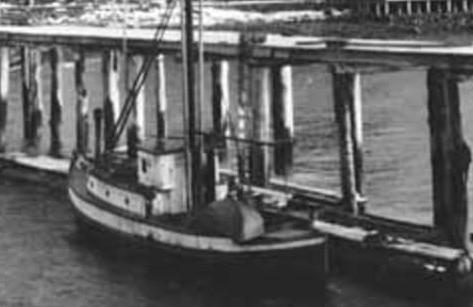
Salmon troller at Funter around 1920 (Winter & Pond):
troller

Some of the people listed below lived at Funter permanently. Some may have been part time or summer residents, and some may have merely passed through. Hand trollers are especially hard to find, because their small boats often had only numbers like T-105, rather than names, and did not have commerce dept. registry numbers. I have provided what details I can find.

Alvin Weathers fished around Funter before 1920 and through the mid 1930s. I believe this was the same Al Weathers I previously mentioned, who was arrested for fish piracy with his brother Ike Weathers in 1919.

The “Weathers Boys” came to work in the Treadwell mines around 1915, and a 1916 article in the Daily Alaska Dispatch mentioned that they were looking for an island to homestead and trap. They seem to have turned to piracy soon afterward. In July of 1918 Al and Ike were charged with robbing a trap south of Point Retreat. The trap watchman, F.C. Wright, was accused of aiding them, but was cleared. The brothers managed to get off that time due to lack of evidence. After being convicted of the July 1919 cannery tender attack, Al and Ike were sentenced to 4 years in Washington state. Their boat in 1919 was the 37′ Diana, it was purchased by Chas Goldstein after their conviction. Ironically, by September the Diana was being used as a cannery tender.

In 1934, Al had the 32ft vessel Ace. In 1935 he bought the Al Jr, a brand new (built 1935) 40′ fishing boat with a 35hp diesel and a crew of 3 (per Merchant Vessel registry). Al may have owned a house on Fritz Cove Rd around 1935.

Another local fisherman and occasional fish pirate was “Humpy Nils” Landin, who had the 41ft vessel North Shore in 1935, fishing between Juneau and Hoonah. He and Nels Ludvigson of the vessel Pilgrim were sent before a grand jury for fish piracy in July of 1919.

The trial transcripts and appeals court documents from some of these cases are a wealth of information. In a 1920 appeals case, the US attorney cross-examines O.E. Bennett, a local fish buyer accused of aiding pirates. Bennett admitted that he had moored his fish buying scow at “Pirate Cove” near Swanson Harbor, but denied that he was specifically buying from pirate boats or that he knew which boats were pirates. Some of the commonly known pirate boats listed by the attorney were;  The Diana, the Thalia, the Juneau, the May, and the Pilgrim.

Kinky Bayers’ notes mention many other names of pirates operating in the Juneau area, as late as 1940. Much of the information implies that convictions were hard to get, except in extreme cases like the Weathers’ where shots were fired at cannery personnel. He mentions that in 1924,  at least 30 boats were known to be pirates, and multiple canneries had agreed not to buy fish from any of them.

In September of 1919 a 40′ gas boat named Sandy sank in Juneau, the owner was reported to be at Funter Bay (As previously mentioned, there was another Sandy built at Funter in 1919, which also sank in Juneau while smuggling moonshine in 1928). One of these may have been a fishing boat.

In October of 1924, Peter Hobson of the Myrtle pulled two trollers off the rocks outside Funter Bay; The Skip Jack, with Matsu Samato, his wife and 5 children, and the T-115, with two unnamed men. Damage to the boats was minor.

J. Kikuchi, a Japanese fisherman, was reported missing and feared drowned in July 1926, after his troller was found circling aimlessly off Funter Bay and towed in by other fishermen.

In December of 1927, many Juneau boats were reported storm-bound at Funter for 9 days, including the Pacific and the Alpha. The T-203, also known as the Buster, drifted into Funter Bay with owner A. Waara missing. (A different Buster than the cannery tender which sank the previous year at Funter).

The troller Gloria (probably a 39′ boat from Sitka) was operating around Funter Bay in 1928, when the crew rescued Dr. W.F. Good of the Anna Helen (a traveling dentist’s office, which caught fire outside the bay).

Emil Samuelson of the halibut boat Dixon operated around Funter Bay. He rescued the crew of the cannery tender Anna Barron when she sank at Point Couverden in 1930, and brought them back to Funter Bay.

Fred Patrick of the vessel Fearless lived in Funter Bay in the 1930s. He was a fairly unlucky fellow.

Harold Tipton may have been a Funter Bay fisherman, he has the distinction of being shot in the foot by Fred Patrick in 1931. He may be the same person mentioned here.

“Funter Bay Pete” (Pete Brynoff or Brynolf), owned the troller T-3802. In August of 1934 his boat broke down off Rocky Island, and Al Weathers towed him to Swanson Harbor. In the 1940 census there is a 72 year old Peter Brynolf listed as living at Fritz Cove Rd in Juneau, born about 1868 in Sweeden. He died in 1943.

The Fremont was listed as fishing around Funter Bay in the winter of 1936.

Geo Ford had a troller which sank at Funter Bay in 1938.

A.F. Bixby homesteaded at Funter Bay in the 1930s. This may have been Al F. Bixby whose family is mentioned in the Bayers notecards, his wife died in July of 1939. I am not sure if they fished or not.

Hal Hibbs lived at Funter Bay in the 1940s, and owned the F/V Mary Ann.

Elmer P Loose who owned the Nimrod and the Sally Ann, lived at Funter in the 1960s.

Ray Martin fished out of Funter Bay in the 1960s with the vessel Vermont, he and his wife Marge were the prior owner of our house.

Wilfred A “Bill” Young. owned the troller Lollypop in the 60s and early 70s. He and his wife Wanda lived next door to our house, and my Dad originally came to Funter to help work on Bill’s house.

Harold Hargrave owned the vessels Janet, Merry Fortune, and Selig No. 1 in 1955. He later had the Mattie W. He was also the postmaster at Funter for some time, and lived near the cannery with his wife Mary. I will probably detail them more later.

James Hay had the vessel Janet and lived at Funter in 1945. From 1948 to 1951 the boat was listed as belonging to Anna Hargrave, then Harold Hargrave in 1952.

Gunner Ohman and wife Lazzette lived on the East shore of Funter in a log cabin that Gunner had built. He worked various jobs around the bay, including hand trolling (more on them later).

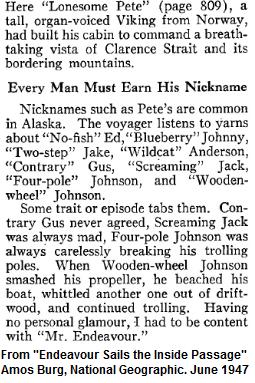
“Screaming Jack Lee” was a Funter Bay fisherman (probably a hand troller) who lived in a tent or vacant buildings in various places around Funter Bay. Harvey Smith’s description of him (via my Dad) was that he talked to himself a lot and you could hear him yelling all over the bay, screaming at his tools or his firewood for “fighting” him. A 1945 National Geographic article mentions some nicknames of Alaskan fishermen, and describes a “Screaming Jack” who got the nickname because he was always mad.
nat geo 2

A fellow nicknamed “Shorty” had a log cabin and was supposedly building a fishing boat at Funter Bay, but forgot to leave room for the propeller shaft and left when someone pointed this out (photos of his cabin are in this post).

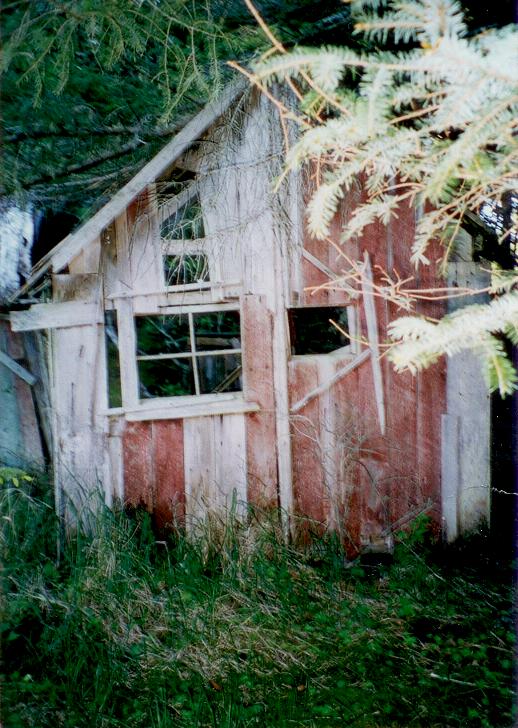
The Keelers (Floyd and George?), possibly an uncle and nephew, had a cabin near Clear Point. There were apparently several cabins here which were used by hand trollers. The Keelers might also have had a cabin near Hawk Inlet, and were also involved with logging. Part of one cabin by Clear Point was still standing in the late 90s and still showed some of the red paint.

0a-keeler 0a-keeler2

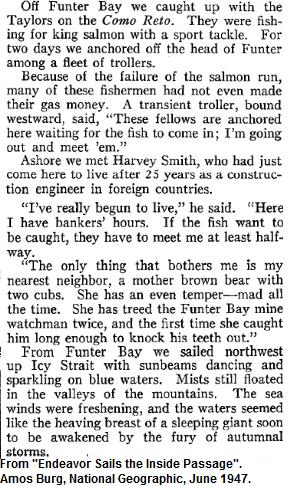
Excerpt from a 1947 National Geographic article mentioning Funter Bay:
Nat Geo

I may come across more information in the future and make an additional post or update this one. As always, if I have omitted or mistaken anything, please feel free to email me and let me know!


Funter Bay History: Shorty’s Cabin

May 14, 2013

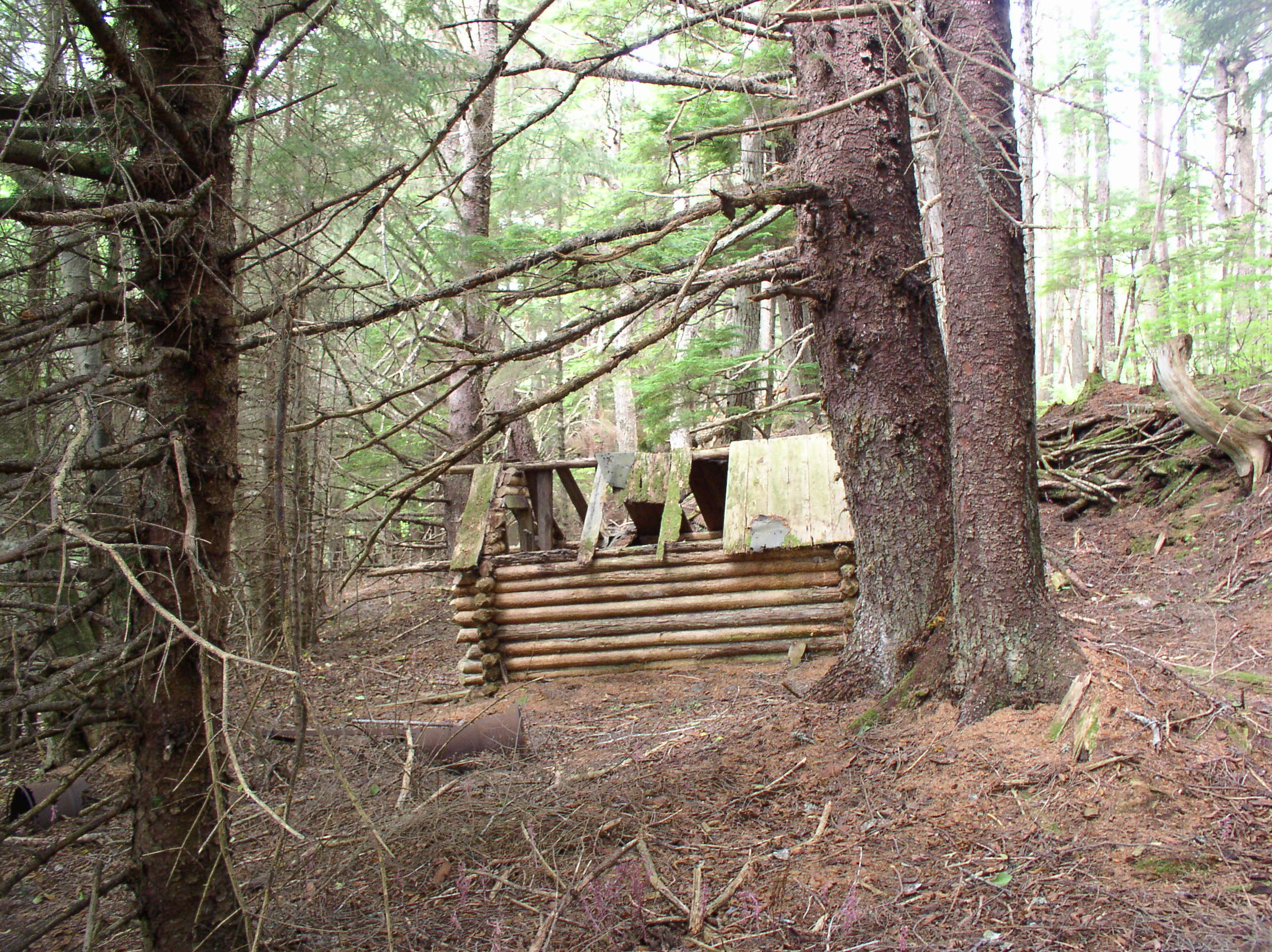
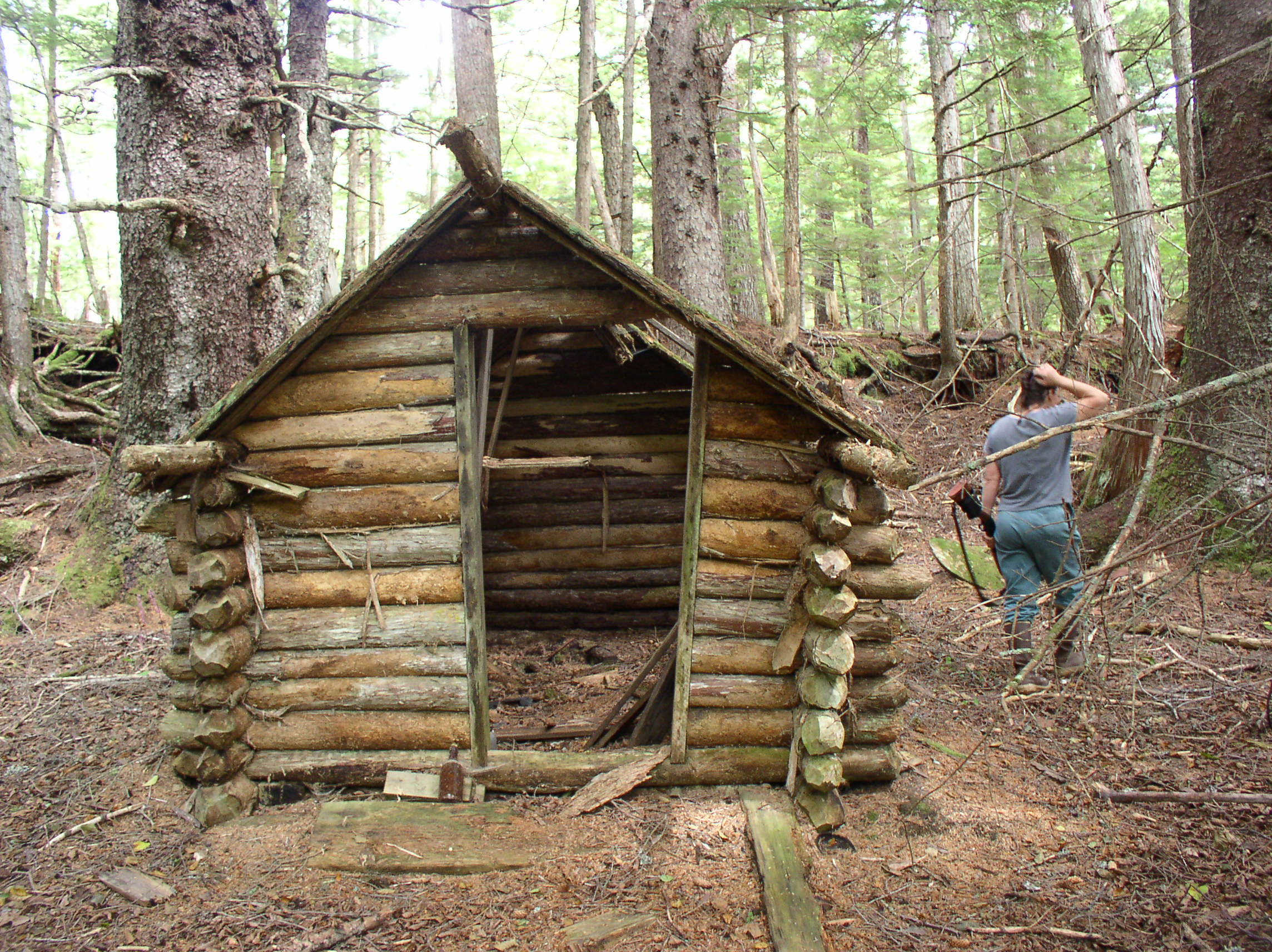
Hiding in the woods near Second Creek is this tiny log cabin, locally known as “Shorty’s Cabin”

OLYMPUS DIGITAL CAMERA

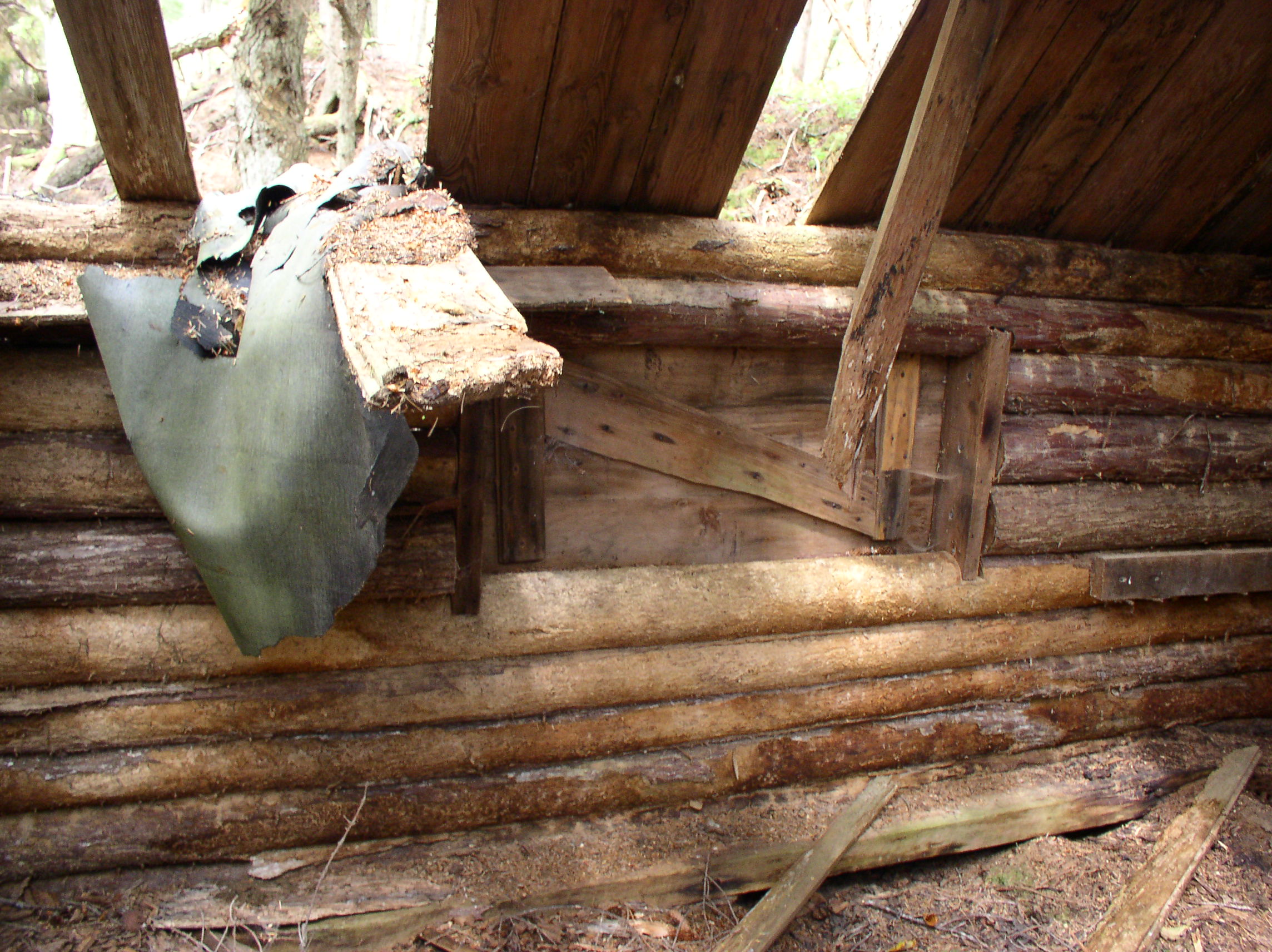
Obviously “Shorty” was a smaller fellow, the cabin is barely 6′ high. It had a single window (now boarded up), a door, a stove, and the remains of a bed. Between the stove and the bed, nearly the entire floor space would have been taken up.

The cabin had a layer of tarpaper over the wooden roof, which helped waterproof it, but tarpaper is easily torn by falling branches or hail, so it would not have been a very permanent solution.  The roof is already half gone.

Window, bedframe (on floor), and tarpaper:
OLYMPUS DIGITAL CAMERA

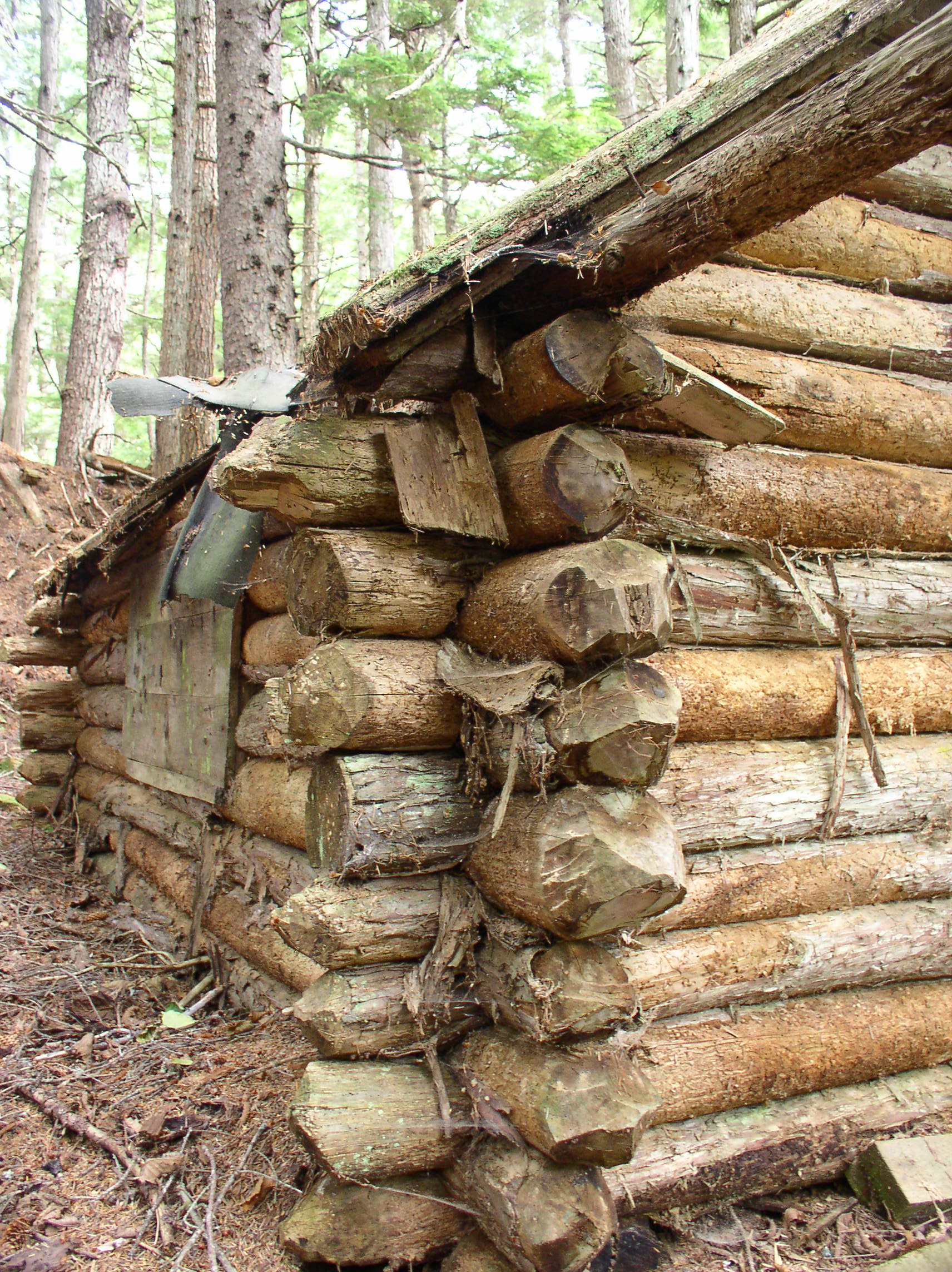
Some more views of the cabin:OLYMPUS DIGITAL CAMERA OLYMPUS DIGITAL CAMERA OLYMPUS DIGITAL CAMERA

Close-up showing the axe and saw work on the logs:
OLYMPUS DIGITAL CAMERA

Closer close-up showing worm trails in the logs where the bark has fallen off:OLYMPUS DIGITAL CAMERA

As the story goes, Shorty was a cook at Hawk Inlet (either the mine or cannery there), got tired of his job, and quit to become a fisherman. He moved to Funter Bay and built the cabin, then began constructing a boat. He was well along in the boat building, when a visitor stopped by and remarked that the boat had no shaft alley (the trough or groove where the tail shaft would run from the engine to the propeller). Shorty gave up in disgust at his shoddy design, jumped on the next mail boat to Juneau, and was never heard from again.

What appears to be part of a boat hull, perhaps Shorty’s failed project:
OLYMPUS DIGITAL CAMERA

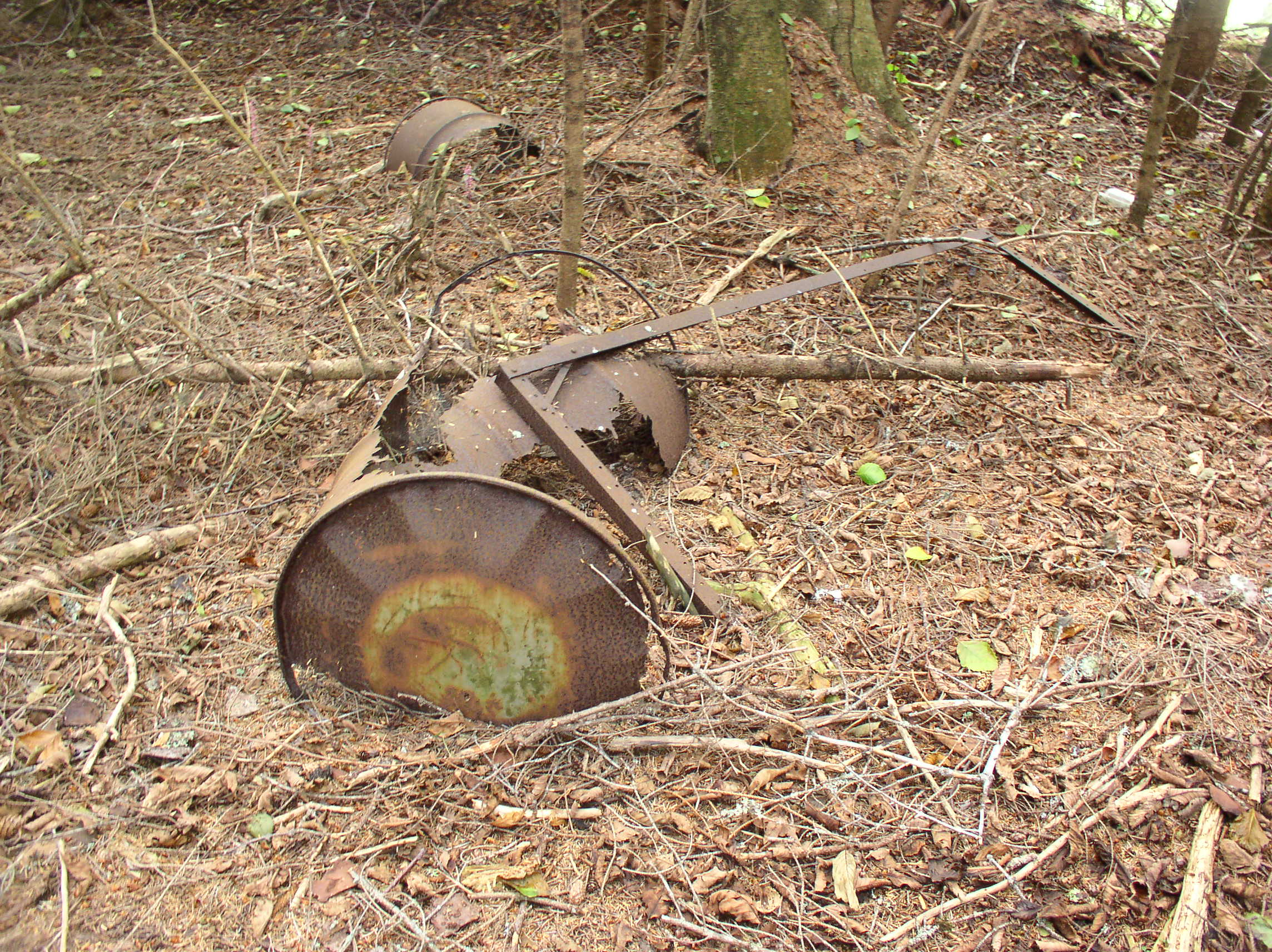
Other artifacts and debris scattered around include some metal drums, one may have been a barrel stove:OLYMPUS DIGITAL CAMERA

Shorty’s kettle:
OLYMPUS DIGITAL CAMERA

Shorty’s boots:   OLYMPUS DIGITAL CAMERA

Here’s Dad in front of Shorty’s cabin in the ’70s, when the roof was in better condition! Shorty's Cabin

I am not sure who “Shorty” really was, there were a number of people with that nickname in the area in the early-mid 20th century, including a dairy farmer, a butcher, and a suspected bank robber. So far I’ve been unable to find anything more on the “Shorty” of Funter Bay.


Funter Bay History: Dick Willoughby’s Exploding Raven

May 13, 2013

Richard “Uncle Dick” Willoughby (1832-1902?) AKA “The Professor”, was apparently quite the local character. Known for various pranks and tall tales, he left a lasting impression on the history and geography of Southeast Alaska (he has both a street and an island named after him).

willoughby

Dick had a cabin at Funter Bay and did some prospecting in the area, locating several claims around the bay in 1887 and even starting a small mining company. An apparently successful prospecting method was to carry a metal rod with a carbon tip. Willoughby would prod through the mossy muskeg layer covering much of Admiralty Island, hoping to find shallow bedrock. After some practice, he claimed to be able to tell the difference between quartz and other rocks by feel. Even after selling many of his mining claims, Dick spent much of his later life at Funter Bay.

Willoughby also prospected and explored around Glacier Bay and other parts of Southeast Alaska. Around 1885, he claimed to have photographed a “phantom city” above Muir Glacier. He made some money selling copies and guiding tours to see this supposed mirage (which no one else ever glimpsed, and was later revealed to look remarkably like Bristol, England). The ever-reliable and never-sensationalist Popular Mechanics magazine swallowed the bait with a full article in 1897, although most people list it as an obvious fake. As late as 1928, cruise ship passengers were still looking for the phantom city!
An 1887 Juneau Free Press article claims that Dick Willoughby had dug up “The Devil’s Skeleton”. Willoughby was occasionally mentioned in the papers as finding “monster bones”, as well as various mammoth skeletons, often around Glacier Bay.  He apparently had a “museum” in Juneau where you could “see the elephant” for 50 cents admission.

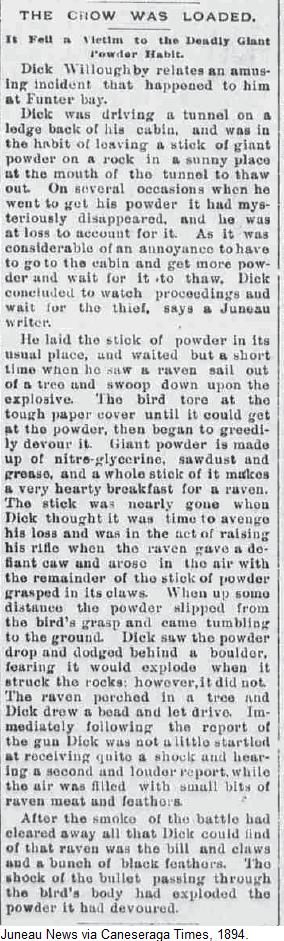
To get back to the title of this post, below is an anecdote from his time at Funter which appears (with slightly different details) in several period newspapers:

exploding raven

A slightly different version is mentioned here, in which Dick’s cabin at Funter falls victim to the nefarious bird. Who knows how much, if any, truth this story contains!

Chapter 7 of the 1909 book Through The Yukon and Alaska is devoted to Dick Willoughby.

A fairly comprehensive obituary of Mr. Willoughby is here.


Funter Bay History – More Fish Traps & Fish Pirates

May 8, 2013

This began as a dry discussion of trap types, and ended up with gun fights, legal battles, piracy, and everything else that goes with Alaskan fishing!

As mentioned before, the Funter Bay cannery operated mainly with fish traps (vs fishing boats). These traps were designed to intercept salmon as they returned to spawning streams, penning them in large fixed nets until they could be scooped out.

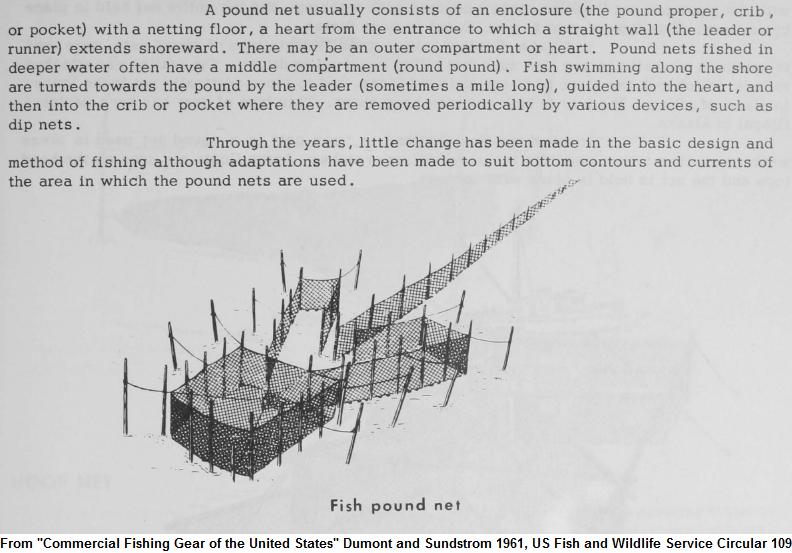
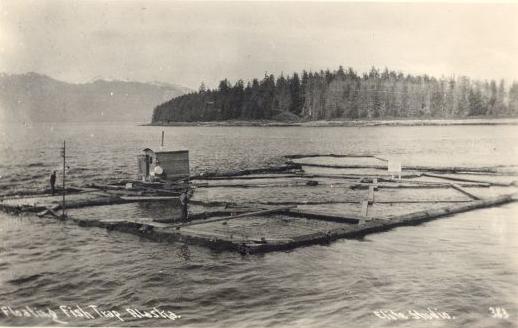
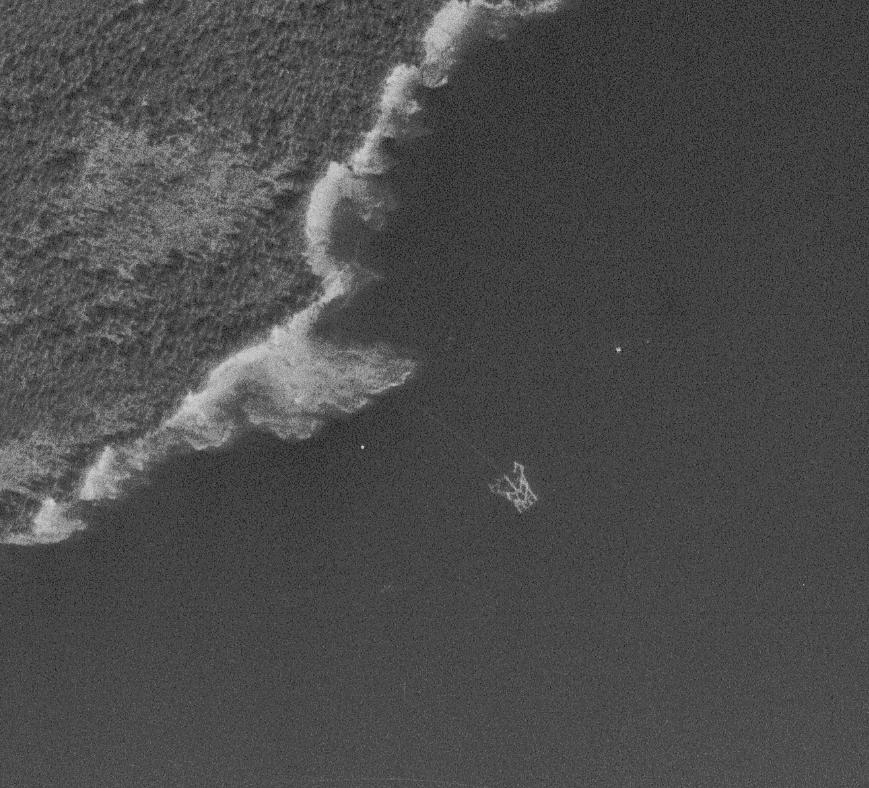
There were two types of fish trap used in the Funter Bay area. “Pound Nets” hung from fixed pilings driven into the sea bottom. Many of these pilings had to be replaced each season, as the winter storms would knock them loose. “Floating Traps” had nets hung from a latticework of floating logs, and were used in deeper water or locations with rocky bottoms. These traps were towed into protected coves for winter storage. Both types of trap would be located a few hundred feet offshore, with a “leader” strung towards the beach (and sometimes a “Jigger” extending seaward) to intercept passing salmon. This page has some more explanation and diagrams.

Pound Net:
pound trap

Floating Trap:
floating trap

These images show one of the Thlinket Packing Co’s pound-type traps near Funter Bay (Trap #7):

Trap 7 trap 7-2

My first post on Funter Bay History shows Trap #6 at the Kittens (islands), also of the pound type.

Here is an example of a floating trap. The structure on top is the watchman’s shack:floating trap 2

As mentioned, watchmen on the traps were an attempt to prevent trap robbing or “Fish Piracy” at remote traps, which was quite common. Independent fishermen hated traps, which they (correctly) felt were taking too many salmon. Many fishermen felt that fish in a trap were fair game, and that trap robbing did not “cost” anything to the trap owner. In fact, the pirates would often sell the stolen fish to the same company that owned the traps! The problem became so bad that the governor of Alaska dispatched surplus navy boats to combat pirates, and the Thlinket Packing Co hired WWI veterans to serve as armed guards.

pirates2

In July of 1919, the Weathers brothers, Al and Ike, along with Ernest Stage, were charged with assault and attempted robbery in a fish piracy case. The trio were accused of using the gas boat Diana to attack Hoonah Packing co’s tender Forrester near Funter Bay. Captain Alfred Knutson testified that his boat came under fire by the trio. Thlinket Packing Co trap watchman Ted Likeness was a witness. Earnest Stage was initially arrested for stealing $10 worth of fish from Funter Bay. Al Weathers was found guilty and given 4 years in jail, with the jury recommending clemency due to his young age.

pirates3

Info on the USS Marblehead.

Photo of a WWI sub chaser in Alaska.

Fish piracy was reduced by 1925 after several canning companies joined together to patrol the area.

“Fish piracy, or the robbery of fish traps, which in previous seasons was bitterly complained of by salmon canners in southeastern Alaska, was reduced to a minimum during the season of 1925. This was accomplished chiefly through the maintenance of a patrol organized by the larger canners and operated under the supervision of deputy United States marshals. A number of cruising boats were engaged in this patrol and covered waters in the vicinity of Icy Strait, Niblack, Street Island, Behm Canal, Kanagunut, Rose Inlet, Dall Head, Hidden Inlet, Union Bay, and the west coast of Prince of Wales Island.” From Bureau of Fisheries report, 1926.

Some more information on fish piracy can be found here (restoring a patrol boat), here (the story of a miner turned pirate), and here (mentioning the piratical family history of Ketchikan’s mayor).

In addition to battling pirates, salmon packing companies were also fiercely competitive with eachother, vying for the same salmon runs, the most desirable trap locations, and the best land for canneries. An extreme example of this was “trap jumping”, similar to the phenomenon of mine claim jumping where one prospector would steal the land or resources of another. More details shortly…

Pound net traps often had a watchman on shore, vs floating traps with their onboard housing. As I previously noted, the Thlinket Packing Co acquired land via the homestead act from which to base their traps (although the person filing for the homestead would usually not be the one living there!). I showed a survey of cannery owner J.T. Barron’s “homestead” in this post. Below is a survey of the “homestead” at a trap site south of Funter:
Robertson Homestead

This homestead (located at Lizard Head point just South of Funter) was fairly openly a front for cannery development, being transferred very quickly to T.P.Co owner James Barron. Barron had previously held a lease from the Alaska Packers Association for a trap they installed in 1908 at Lizard Head, and was moving to acquire the shore and upland to support this site.

“…On or about the first day of March, A. D. 1911, for value received, the said V. A. Robertson conveyed by good and sufficient deed in writing the above-described tract, lot or parcel of land embraced within said U. S. Nonmineral Survey No. 804 aforesaid to James T. Barron.”

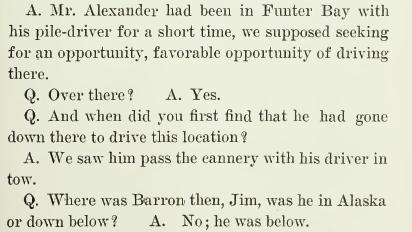
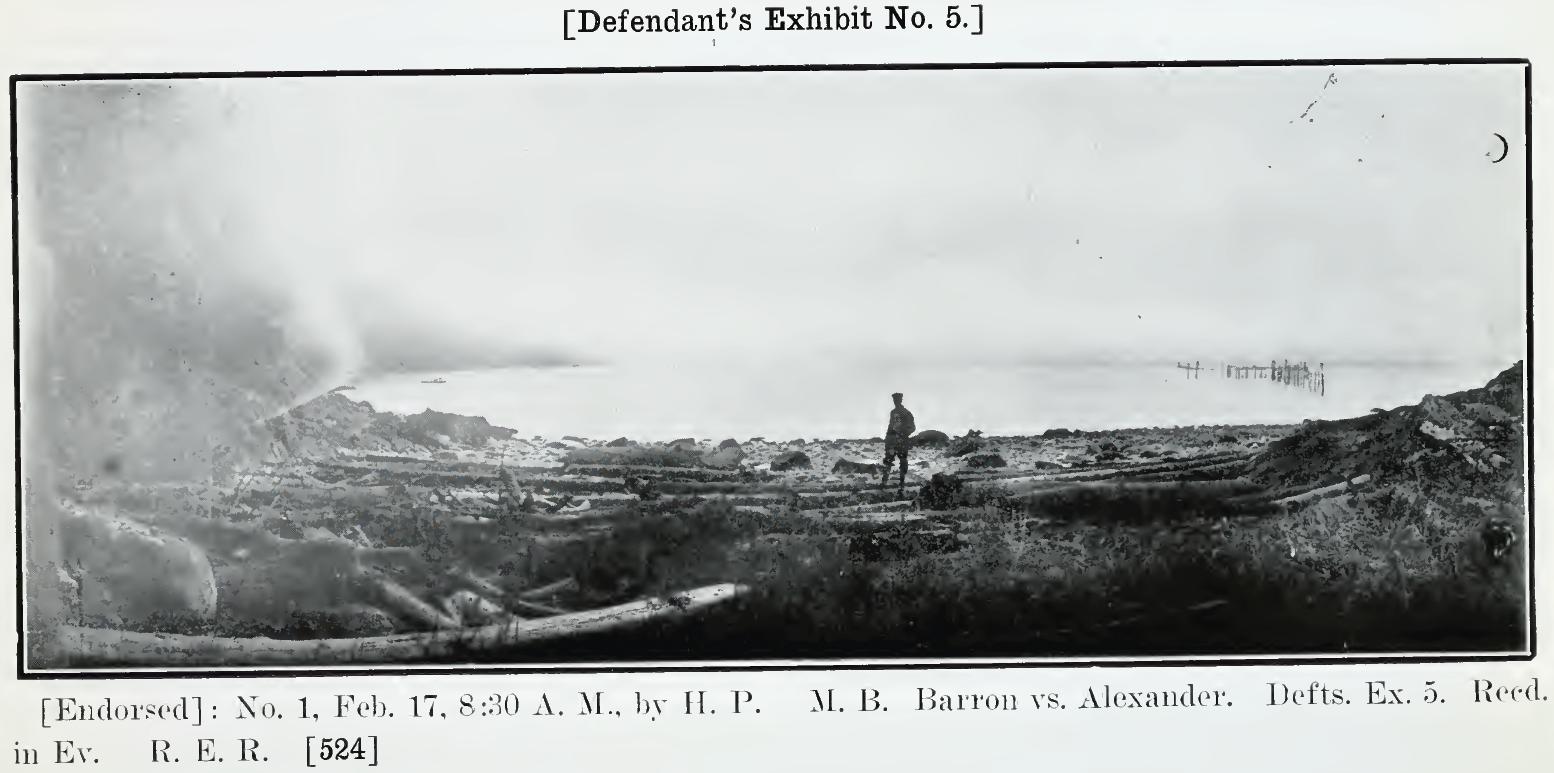
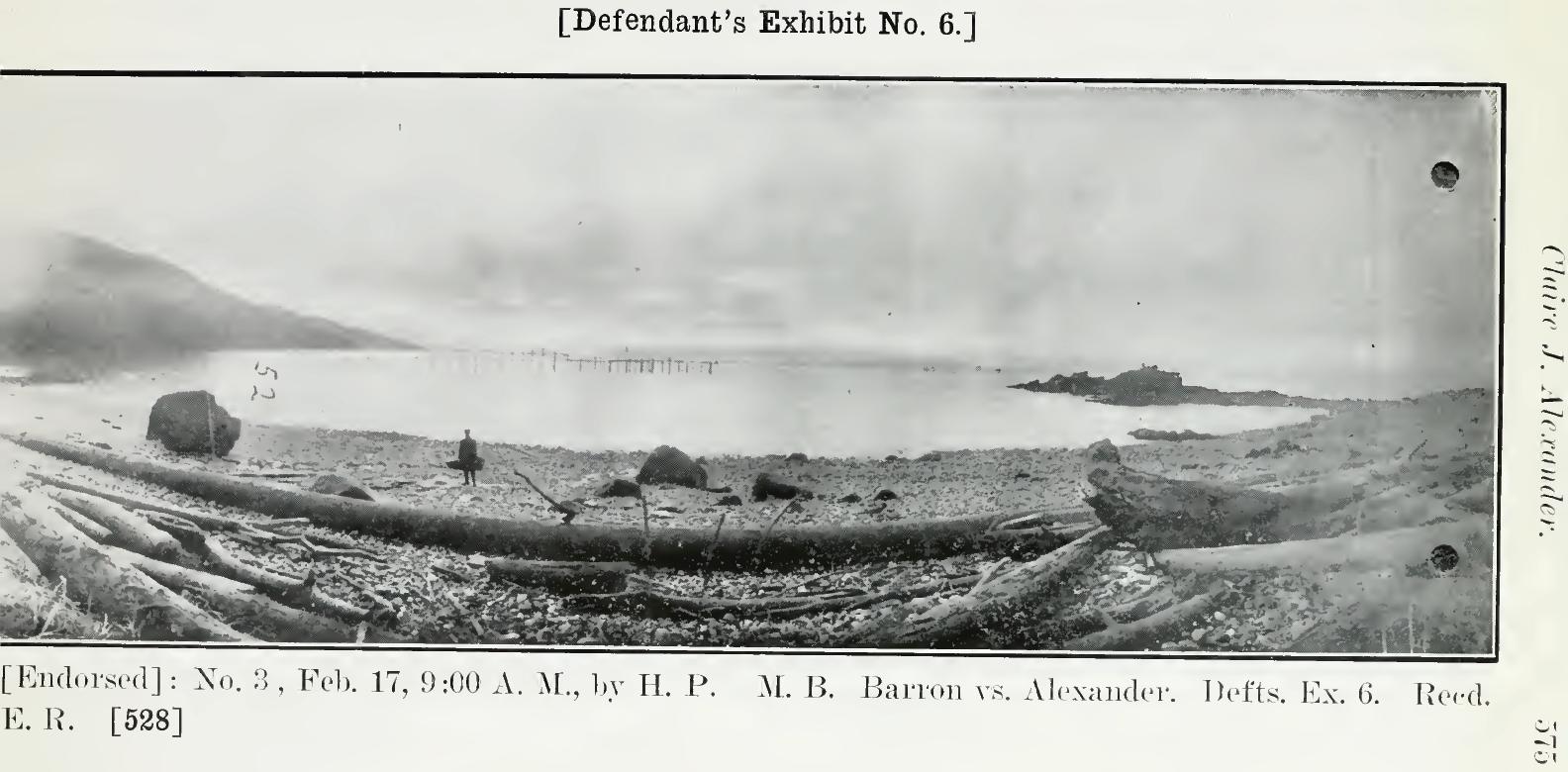
However, before the Thlinket Packing Co could finish building their trap, Clarence J. Alexander, AKA “Claire Alexander” of the Tee Harbor Packing Co swooped in and installed his own, thus “corking off” Barron. He had previously worked on the pile-driving crew for the Alaska Packers Association, and knew exactly where the trap should go. Alexander even used some of the pilings that Barron had already driven! Barron sued, and some of the court documents are online (part 1 and part 2).

Perhaps Mr. Alexander’s “opportunity” was when Barron left the state?:
pile driver

Claire Alexander’s fish trap shown in front of Barron’s Lizard Head property, from court documents:
Alexander's trap

Barron’s initial letter to Alexander:
Trap Jumping

In the court case, Barron testified not that he planned a trap (as indicated by his letter and other testimony), but that he wanted to use the site as a temporary mooring for boats. He mentioned that it was too hard to tow loaded scows to Funter Bay against a North wind. He complains that Alexander’s trap blocks his water access. Alexander claimed he had no knowledge of Barron’s so-called homestead and didn’t notice any development at the site (despite incorporating Barron’s pilings into his trap). The court found against Barron and ruled that Alexander’s trap did not block Barron’s access to his property.

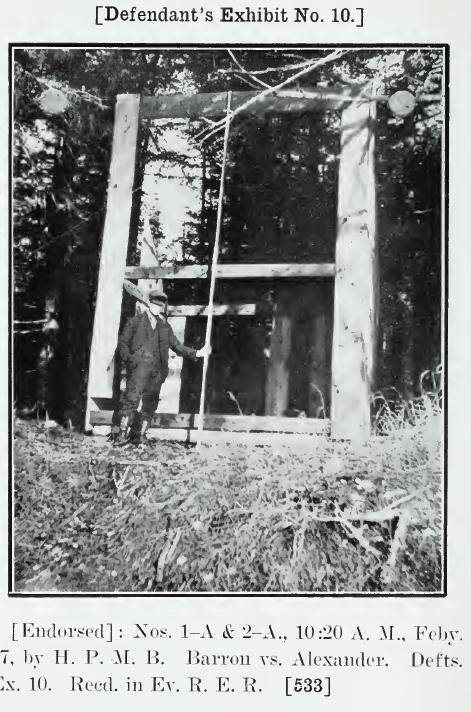
Some 1911 photos from the Lizard Head trap site, including the beginnings of the T.P. Co. watchman’s cabin:
Lizard Head 1911 1 Lizard Head 1911 2

Barron's cabin at Lizard Head 1911

Claire Alexander would go on to found the Hoonah Packing Co a few years later, and his trap at Lizard Head was still in place, in the same configuration, in 1948.

Laws regarding fish traps tended to fluctuate. Traps were originally fairly unregulated, and canneries would often place them directly in stream mouths, intercepting the entire spawning population until the “run” of salmon was destroyed. Later regulations placed limits on where traps could be located, when they could operate, how long the jiggers could be, etc. By the 1940s, the salmon population had declined so much that trap catches were fairly low, but the price of salmon had risen enough to keep traps cost-effective. When Alaska became a state in 1959, traps were outlawed entirely, leading to the closure of many canneries (other methods of fishing were not efficient enough for the size and type of these operations).

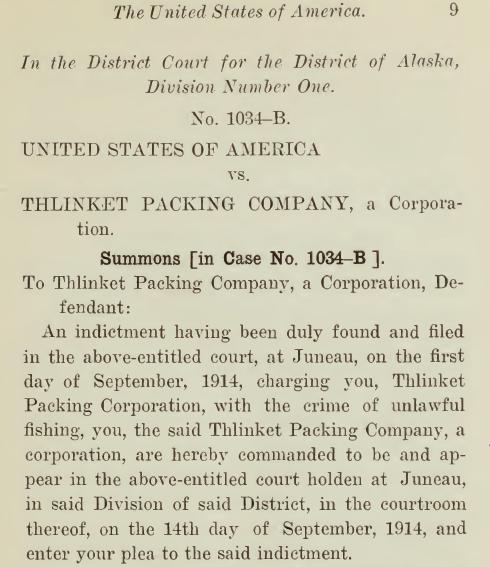
The Thlinket Packing Co (and later owners of the cannery) occasionally ran afoul of fish and game regulations.

TP Co Unlawful Fishing Summons

TP Co Unlawful Fishing Count 1

“During the season of 1926, four salmon traps were seized in south-eastern Alaska for illegal fishing during the weekly closed period. … A trap of P. E. Harris & Co., near Hawk Inlet, and one of the Alaska Pacific Fisheries, near Funter Bay. were seized on July 11. On trial the watchmen were found not guilty, but the traps were still in the custody of the United States marshal at the end of the season.” Bureau of Fisheries report, 1927.

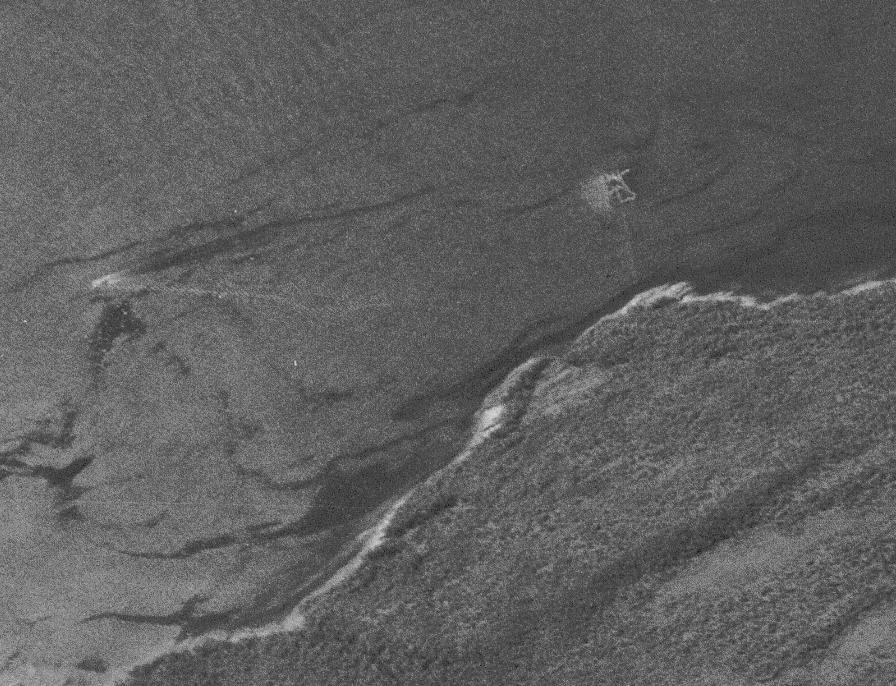
I came across a set of 1948 aerial photos of Funter Bay while looking for another map (from http://earthexplorer.usgs.gov/). The original is linked in my post on Funter Bay maps, below are a few excerpts showing fish traps around the bay in 1948.

A trap outside the south shore of Funter Bay (possibly pound net trap #7) Note the wake of the boat, possibly a cannery tender, leaving the trap:
trap aerial 1

C.J Alexander’s pound net style trap at Lizard Head in 1948, looking a little worse for wear. The trap has the same approximate layout as shown in the 1911 diagram (inset), but the line of pilings for the lead going to shore has vanished.
alexander 1948

A number of traps seem to have been abandoned by the Thlinket Packing Co at this point. There is no sign of Trap #6 at the Kittens in the 1948 aerials. Several of the floating-style traps are also sitting on the beach or drawn up in shallow coves where they would go dry at low tide. More traps are visible operating and in place along the shore between Funter and Hawk Inlet, but I’m not sure which companies were operating these.

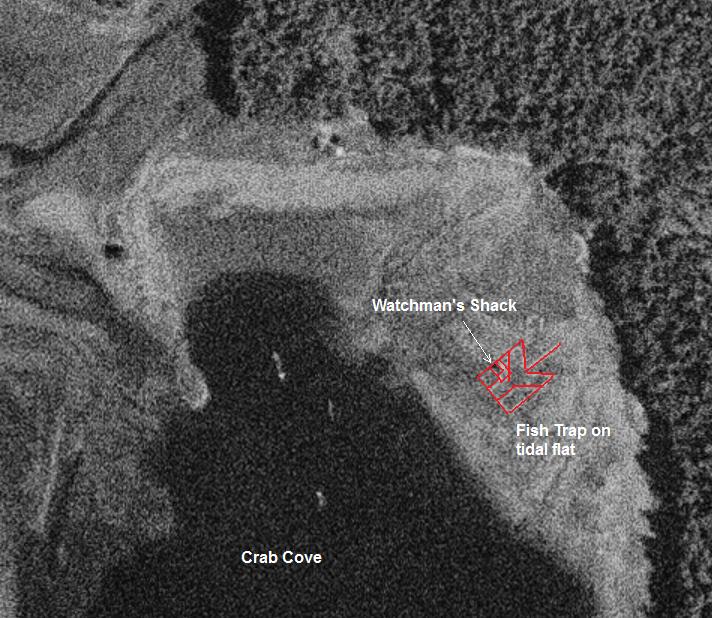
Fish trap on the beach in Crab Cove:
trap1

Crab Cove trap logs outlined to be more visible:
trap2

You can see the shadow of the watchman’s shack, this might have been the shack that became the entry of our house, as mentioned in an earlier post. Our neighbor Harvey Smith also had a few sheds that were the right size to be trap watchman’s shacks, I might detail those later on.

Floating trap in place along the Admiralty Island shore south of Funter Bay, with buoyed lead net going to shore:
floating trap 3

Down at the other end of the bay, we can see a jumble of pickup sticks on the estuary between Ottesen and Dano creeks, near the sandy beach. A few hints of the outline of a trap are visible, this might be one or more damaged or disintegrating traps:
trap aerial 2

Here is the cannery site and Scow Bay with the scows visible on slipways:
cannery aerial 1948

And finally, back to the present day: here’s a trap log washed up at the sandy beach, probably from one of the traps seen above. You can see various bolts and hardware that connected the trap logs together:
OLYMPUS DIGITAL CAMERA


Funter Bay History: The misadventures of Fred Patrick

April 30, 2013

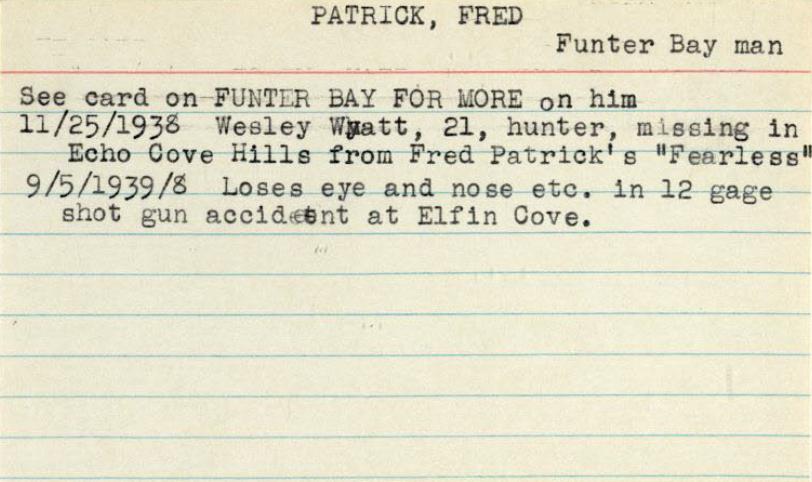
This guy seems to have lived an “interesting” life… I came across his name several times in old newspaper archives and notes on local history. The Kinky Bayers note cards mention him several times. Fred Patrick owned the fishing vessel Fearless and resided in or fished out of Funter Bay in the 1930s.

As previously mentioned, in October of 1938: Geo. Ford’s troller was found sunk in Funter Bay, he and Fred Patrick were missing for three days but turned up at Funter.

fred2

He seems to have had bad luck with guns: In October of 1931, Fred Patrick shot Harold Tipton in the foot during a drinking bout at Funter. In September 1939, Fred Patrick lost an eye and his nose when a shotgun went off in his face at Elfin Cove (also from Kinky Bayers notes).

fred3

fred1

Iin 1934, Fred Patrick was part of a march of unemployed men on the federal building in Juneau, demanding food benefits.

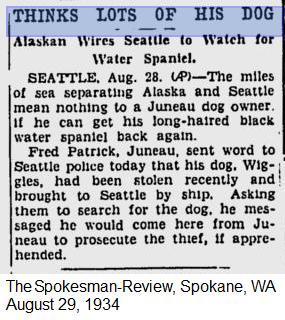
Fred’s dog Wiggles was stolen in 1934.

dog

Fred’s boat was disabled in Echo Cove in 1938, and a hunter who was on board went ashore, never to be seen again.

The Fearless was a 33ft fishing boat built in 1916 at Berkely, CA. It had a 60hp gas engine and a crew of one. Reg. # 237891. Owner in 1942 was Fred R. Patrick of Juneau. In 1945 the boat is listed as abandoned.

That’s all I’ve been able to find so far on the (mis)adventures of Fred, if anything more turns up I will update this!


Funter Bay History – Barron Family

April 26, 2013

Here are a few more details on the Barron Family, who started the cannery at Funter Bay.

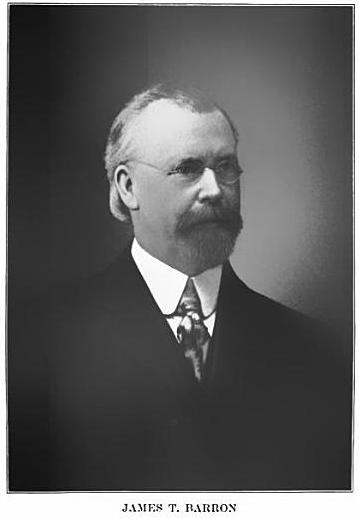
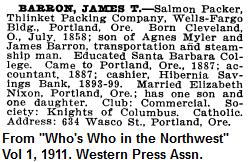
Thlinket Packing co founder James T Barron of Portland was born in Cleaveland OH July 8, 1858. Parents were James Barron of Clonmel, Ireland (1828-1890) and Agnes Myler of Ireland (ca 1831-1910). Agnes’ father was Andrew Myler. Both James’ and Agnes’ families immigrated to the US when they were young children. James Sr. owned and operated barges on the Erie canal and moved to the Pacific coast in the 1860s, where he owned steamships, warehouses, and other transportation properties. (source 1) (source 2)

JT Barron

James T Barron attended St. Mary’s and Santa Clara colleges, then worked as an accountant (with sidelines in beekeeping) until becoming secretary of the Hibernia Savings Bank in 1893. In 1899 he started the Thlinket Packing Co. He quickly sold his first two canneries to finance the new cannery at Funter Bay in 1902, but then bought back some of the interest in the earlier canneries when they went bankrupt (mentioned previously). He remained involved in the Hibernia Savings bank. He was described as a member of various professional and social clubs and organizations around Portland.

Whos who

J.T. Barron married Elizabeth Nixon in 1890. Her parents were Robert Nixon and Anna (Hogan) Nixon, both natives of Ireland. Robert Nixon was killed during the Civil War while serving in New Hampshire’s volunteer regiment.

James and Elizabeth seem to have had a comfortable household in Portland, living at 634 Wasco St (near downtown). They were occasionally mentioned in the local paper for such notable things as parties and car ownership, and they could apparently afford two maids in 1916.

help wanted

James and Elizabeth’s children were Robert J. Barron (1896-1917), Anna Maria Barron (b 1894), and Agnes Elizabeth Barron (1897-1898). Both Robert and Anna had cannery boats named after them.

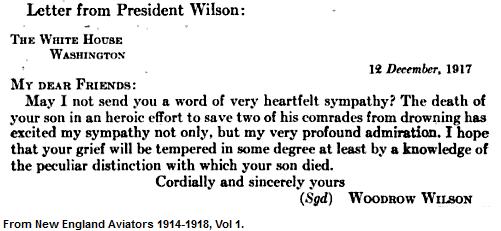
As previously mentioned, Robert Barron entered the Army Aviation Training Corps on June 3rd,  1917. At Age 22 he had already become Vice President of the Thlinket Packing Co under his father. Shortly after his enlistment, on August 21 or 22 (records conflict) of that year, Robert was killed while attempting to save fellow cadets from an aircraft accident. During landing practice near Chandler Field, two cadets had been thrown from a Hydroplane (an early type of floatplane) into the rough water of the Delaware River (ref). Robert attempted to swim to their aid, but was overcome by the current and drowned. He was applauded as a hero and given a full military funeral of a ranking officer. Everman Field at Fort Worth Texas was renamed “Barron Field”, and the mountain above Funter Bay in Alaska was named Mount Robert Barron in his honor. Woodrow Wilson sent a letter of condolence to James and Elizabeth.

Wilson

Robert Barron’s Grave

Robert’s Funeral notice.

Anna Barron married Thomas Martin Fitzpatrick (1882-1948) in 1914, and had 5 children including James Barron Fitzpatrick (1916-1992), Adrian Thomas Fitzpatrick(1926-1977), and Robert Barron Fitzpatrick (1921-1979).

James Barron Fitzpatrick seems to have been the chairman of the Portland City club in 1952. He was married to Elizabeth Rae Lansworth (1924-1988) and had 9 children.

Here is J.T. Barron’s gravestone. and Elizabeth Barron’s.

I ran out of steam on tracking the Barron family farther, this became one of those recursive research topics where one thing leads to another, and suddenly I have half the family history of someone who was previously just a name. If I happen across more information I’ll see about updating this.