Taking apart & moving a fast food playland

February 6, 2021

This was one of the bigger projects I’ve been involved in recently! My friend Carl (link to his website) got this massive playland for free from a defunct Burger King. A few friends got together and helped take it apart in the three days we were given before the building was boarded up. We moved the whole thing out to Sandland where it’s stored for the winter. Next spring we’ll start re-assembling it outside (we checked and the manufacturer says it’s UV-resistant).


More Silly DIY “Weapons”

February 3, 2021

Recently I built a couple more “dangerous” things. Not for any particular reason, but more as a way to use up extra junk that’s been accumulating in my garage.

First up was a trebuchet (historic siege weapon) made out of old kayak paddles! I have dozens of these paddles that I pulled out of a dumpster, and I’ll probably eventually sell the good ones once garage sales are safe again. The damaged ones went into this project. It’s honestly not very good, I can probably throw farther than this can. Maybe I’ll build a bigger one in the future.

The second one is an air cannon made out of an old nailgun. Again, this is just something I had lying around, also rescued from the trash. It actually works frighteningly well with just a PVC pipe hammered onto the front and some ball bearings in it.


DIY Tunnels

October 22, 2020

If you saw my Sandland video, you know about the sandstone tunnels we’re digging! Sandstone is a great material, being relatively easy to dig and yet structurally sound enough to last for hundreds of years with no artificial supports. (Some examples of local sandstone caves and tunnels can be found here, here, and here).

I’ll be doing a larger project in these tunnels that involves carving out an underground room, so stay tuned for that sometime next year!


My Redneck Tricorder is Famous!

September 8, 2020

My homemade Raspberry Pi tricorder (part 1 and part 2 videos) caught the attention of the Tom’s Hardware staff, who wrote an article on it here.

They also invited me to come on their weekly Pi podcast! You can find it on Youtube or Facebook.

This is the first time I’ve been on a podcast! Saveitforparts continues to creep warily into the 21st century!
As usual, you can check out my Youtube channel for ongoing projects and nonsense:
https://www.youtube.com/user/saveitforparts

This project also showed up on Hackaday and the Adafruit blog.

More boat junk.

August 26, 2020

In case you’ve missed my ongoing “terrible boat” Youtube series, I recently picked up a free 1970s tri-hull and have been getting it into working condition. Here are the videos so far:

Part 1: Checking the engine.Β 

Part 2: Fixing the engine.

Part 3: Reinforcing the stern.

Part 4: Finally on the water!

Part 5: Why won’t it shift?

I’ve also hit the questionable and arbitrary milestone of 5,000 subscribers on this Youtube thing! To celebrate, I’ve opened a contest to name this awful boat! Details here: https://youtu.be/RfU6OKeafG4

The boat doesn’t 100% work yet, but we’re slowly getting there!


The Magical World of Sandland!

August 12, 2020

Have you ever wanted to create mazes, dig tunnels, built forts in the woods, or hang out in a huge multi-acre playground? Who hasn’t! Sandland is a rural property that one of my friends bought to do just that! It has all of the above and more!

For readers familiar with my monorail project, Sandland is where the train now lives. The main purpose of the property is the underground tunnels dug out of the sandstone bedrock. The surface of Sandland also has lots of fun surface structures and creations built by all kinds of people. From tunnels to treehouses to ziplines to everything in between, Sandland is an ever-evolving project!

You can follow the latest updates and see more photos on the owner’s website, www.tunnelcity.com. You can also check out the Facebook pageΒ or email the owner here.

Coming soon, I’ll have a video tour of Sandland on my Youtube channel!


More Youtubing.

July 15, 2020

I’ve been doing the Youtube thing a lot more lately. I guess I have kind of a legit channel now, as I’m up over 4,000 subscribers somehow. These are some of my recent ones:

There are more… so many more… somehow I’ve been doing a LOT of videos. I guess this is the new direction that Saveitforparts is going? Anyway, check out the channel, do the liking and subscribing thing that all the cool Millenials are doing, and check out all my silly projects made from trash and duct tape! I’ll eventually try to do some write-ups on here in Ye Olde early-2000s style for those of you who want to follow my potato guns and boats but don’t like videos πŸ™‚


Funter Bay History: Cannery Stencils

May 20, 2020

The beach at low tide is a great place to find all sorts of treasure. When I lived at Funter Bay we would search the mud around the cannery site for old bottles and artifacts. Recently Scott and Denice McPherson were visiting Funter Bay and pulled some brass cannery stencils out of the beach mud.

These appear to have been for marking crates for shipment to wholesalers. They probably date from about the 1930s. The “A&L Brand” Sockeye stencil is for No. 1 or “picnic” cans, which held 10-12oz each. The “Health Brand” stencil is for Tall cans which held 1lb each.

A photo from another cannery (not Funter) shows how crates were assembled from flat-packed parts and marked to contain various brands and products.

Making boxes at Clark’s Point, Alaska 1918 – John Cobb Collection / Wikimedia Commons

Thanks to Scott & Denice McPherson for sharing the photos of their great find!


Funter Bay History: Water and Hydropower Part III

April 14, 2020

As I’ve noted in several previous posts, hydroelectric power was a big part of industrial development at Funter Bay. The availability of water in useful quantities and at sufficient elevation meant that electricity or mechanical power could be generated “for free”. In this case, “free” meant no ongoing fuel costs for diesel, coal, or wood. The initial development of water power sites, such as building dams, digging ditches, and laying pipes, still took time and money.

Despite being a rainforest, Southeast Alaska has a lot of variation in water availability on an industrial scale. Winter can freeze pipes and reservoirs, and mid-summer can dry up small streams. Most small industries like canneries and gold mines were able to operate using small ditch and pipe networks, but they did sometimes run short of water. Over the years there were several proposals for larger, more reliable hydroelectric systems at Funter Bay.

In 1931 the Admiralty-Alaska Gold Mining company used at least seven small to mid-size water power systems to meet their needs. These included the following:

-6ft Undershot Pelton water wheel, driving mill equipment via belt.
-4ft Undershot Knight water wheel, also belt-drive to mill
-24″ Pelton water wheel running a 5KW D.C generator for lighting
(All of these were under 60ft of hydraulic head, meaning a 60ft vertical drop from the water supply ditch to the wheels).
-Auxilliary lighting generator of 1KW, also operated by water wheel (size not listed).
-5.5ft water wheel under 359ft head running a Chicago Pneumatic 24x18x14 air compressor.
-6ft Pelton water wheel under 57ft head, running a 14×16 Ingersoll Rand compressor
-24″ “Water Motor” under 357ft of head, operating an exhaust fan.

All of these water-power systems were unreliable enough that the mine also had on hand two 100hp MacIntosh Seymour “Full Diesel” engines to run the mill and compressors. In addition, there were several steam engines in use on the property, including an 8-ton steam locomotive and a 90hp logging donkey.

The 1931 company report proposed a major hydroelectric development to replace these smaller systems. This new project was to cost nearly $800,000 and would have included the following:

-New dam with conduit tunnel and pipeline to power plant
-Four 2,500KVA Generators and related transformers.
-Twenty miles of transmission line on 50ft high steel towers, with dual 4,000Kw circuits. (Other documents say a 30-mile line would be needed).

This project would have been built South of Funter Bay at Lake Kathleen. I’ve previously posted some maps of the proposal here. For various reasons including funding and mine productivity, this was never actually constructed.

——————————————————

Another hydroelectric proposal surfaced in 1979 by the US Army Corps of Engineers. The full published report can be found here.

This proposal was never fully fleshed out, and included a lot of wild assumptions. For example, the project assumed that Funter Bay’s population would grow from an average of 14 year-round residents in 1979 to 17 in 2000 and 23 in 2030 (actual year-round population was around 8-10 in the year 2000 and is around 3-5 as of 2020).
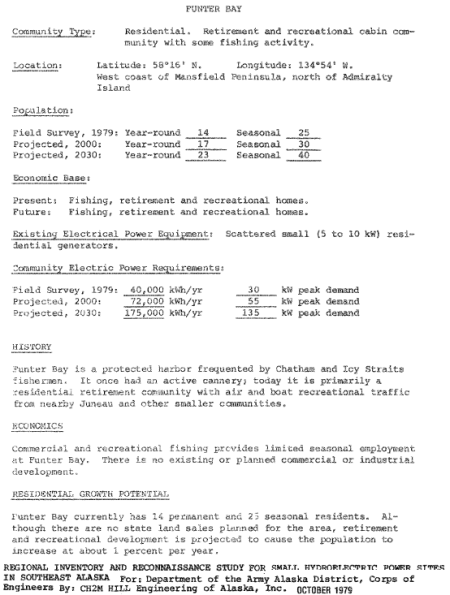
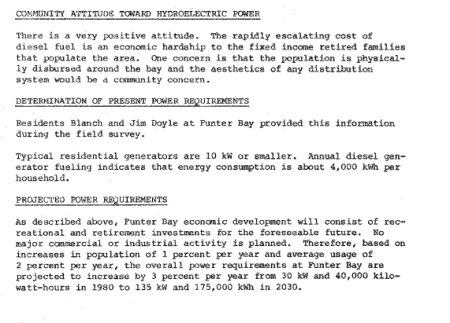
The engineers proposed a 5′ tall cement dam at the site of the former Dano Mine adit, a 150kW turbine, and 4.5 miles of transmission line circling the bay.

A map of the proposed setup can be found here.

This project also failed to go anywhere. Like many proposed infrastructure projects in Alaska, the only result was a contract to an engineering firm and some paperwork to be forgotten by the government. I am not sure which, if any, of the hydroelectric sites proposed in this study were ever developed.


Monorail Museum Updates

May 10, 2018

I’ve added some “artifacts” to my miniature monorail museum, located in the head car of the former MN Zoo Monorail that I bought a couple years ago.

While I’m trying to keep the monorail mostly original, that big hulking power box in the back of the driver’s cab was just begging to be turned into a display case. A little dremel work and a plexiglass window and it’s much nicer than before! Plus the mice don’t chew on my toy trains now! (Keeping mice out of this thing might be impossible, it even came with some free zoo mice when I first got it πŸ˜› )

The Baron, as a former monorail driver, has moved up to my upper shelf of MN Zoo-related memorabilia. The lower shelf is more general monorail “stuff”, since people keep giving me monorail toys and whatnot that they come across. In addition to the obvious Disney monorail, I managed to find an HO scale Von Roll MkIII model that’s pretty darn close to this one! The MkIII was in the same family as the zoo’s UMI Tourister, just a little more developed and streamlined.

The wall displays document monorail tech, MN zoo history, and other monorail-related tidbits.

And outside the monorail I’ve stuck a “historic marker” for random visitors. Although the train is on private property and not open to the public, we do get some friends and acquaintances stopping by who are curious about it!