Time for a new bank!

January 7, 2011

Just sent this to Wells Fargo, both by mail and through email. I imagine it’ll just get pitched in the trash down in the mail room or never make it through customer service, but it felt good to write it!


Dear Wells Fargo,

Congratulations on losing a customer to hidden fees and overcomplicated account restrictions. I’ve been a customer for several years, and recently noticed a new “Monthly Service Fee” on both my checking and savings accounts, in the amount of $10/month for savings, and $15/month for checking. The fee seems to have started about 6 months ago. I was a bit mystified by this, since I was told when I signed up that these were free accounts.

I called your customer service line, and the representative explained that I could avoid these fees by setting up an automatic monthly transfer of at least $75 from checking to savings. I already make manual transfers through online banking about once a month, but apparently these “don’t count”, even if they’re over the suggested minimum. She explained that I could circumvent this restriction by setting up the automatic transfer for the $75 minimum, then manually transferring the money back. So you’re basically telling me there’s no point to this requirement, and that I can get around it if I’m willing to play some games and jump through a few hoops?

I called again the next day to clarify some things, and heard that the fee structure and waiver is even more arcane than the first rep described it. I can avoid certain fees if I set up automatic transfers, or have a total minimum balance, or have a mortgage, or have X number of “qualifying” accounts. I dimly remember that I had a different account structure when I started with Wells Fargo, for a short time I had a CD, and did have a higher balance. I can only assume this is what the banker meant by “free” when I signed up, I must have just qualified for the fee waiver. Apparently my accounts no longer qualify to be free, although I can’t figure out exactly how or when that happened.

The second customer service rep was able to refund part of my most recent fees, but their explanation of exactly how to avoid future fees still doesn’t make any sense.  As you may have guessed, since it took me 6 months to notice these fees, I’m not the best at tracking my money. I have a rough idea of what goes in, what comes out, and I keep an eye on the balance to verify this. I do pretty well, but I have to remind myself of existing automatic bill payments like insurance, and I really don’t need another pointless automatic transaction or balance requirement or constant babysitting of the account. You have numerous competitors offering genuinely free accounts with none of these confusing and pointless hoops to jump through.

From what I can tell, the only possible reasons for your system are:

-1. You hope people forget that it takes a series of complicated steps to avoid fees (like I did) and you’ll make a $25/month fee for our inattention. Those $10 and $15 charges are easy to miss if you’re just scanning through a statement.

-2. You hope we’ll set up a transfer to avoid the fees, but will forget about it, and overdraw our checking accounts for even bigger fees.

What it comes down to is; I’m paying $300 a year for the privilege of having a hassle free bank account. Maybe $300 is small potatoes to your execs, but that’s more than three days of work for me! I could buy groceries for a month with $300, or a new Netbook every year, or a cheap flight across the country. I don’t need you nickel and diming me out of any of those things.

So, I’m paying you $300 a year to have an account that already makes YOU money by investing mine, and benefits me in no way. Sure, I get some infinitesimal amount of interest, so I could make back my monthly $25 in about 100 years. And sure, I have the convenience of deposits and ATMs, but for $25 a month I could cash my paychecks at the liquor store and keep my savings in a shoebox under the bed. If I want a bank account with you, I have to play a lot of games, the rules of which might change at your whim, or I have to pay you 1% of my annual income to keep my money in YOUR shoebox.

What’s that you say? The savvy customer should always scrutinize every statement, always read every bit of fine print, and have a firm grasp of banking principles? Well, this customer already has an account with another bank which doesn’t pull such tricks, has no hidden fees, and better customer service (My office got a gift basket from them for the holidays!). Ironically, this is exactly why I moved my accounts from Wells Fargo a few years ago; I was getting hidden fees at my old bank and heard that Wells Fargo was better. I guess I heard wrong. I’ll be closing my account shortly, and telling my friends to consider doing the same.


Former Wells Fargo Customer


-Gabe Emerson


Pressurized Potato Shenanigans

August 30, 2010

My first foray into the world of pneumatic potato cannons. I’ve got lots of experience with combustion cannons, and in fact I think the best combustion design is a propane-fueled, spark-plug ignited beast, but I have almost no experience with compressed air designs. My only prior design was a weak, sickly thing built in 11th grade physics class for launching whiteboard markers across the room.

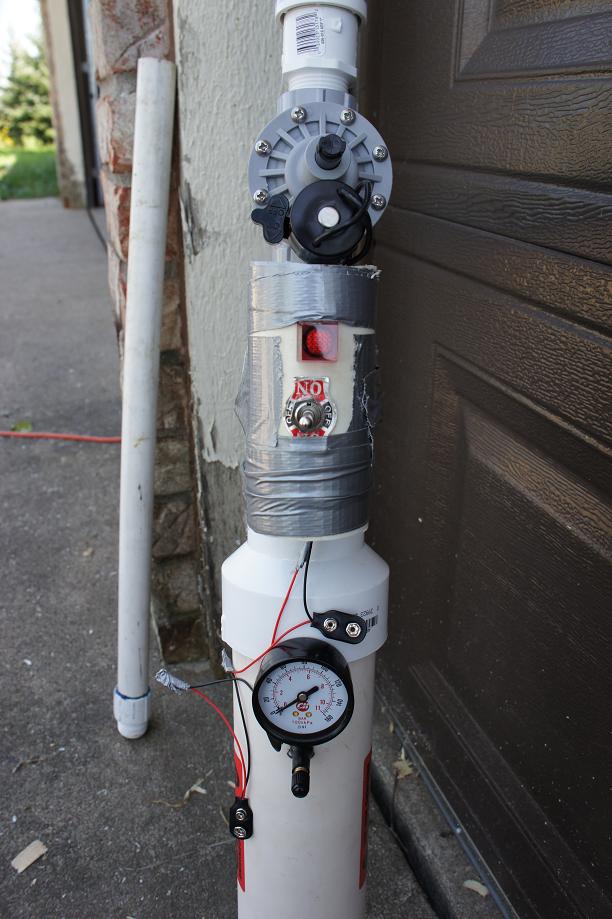
Features: Interchangeable barrels, safety/arming switch, Weather-resistant battery compartment, pressure gauge, safety screws to prevent blowouts. Most non-PVC parts came from Ax-Man, the best store ever! http://www.ax-man.com/

Close-up of the controls and fill valve.

A half-arsed electrical diagram I drew to help remember what went where in the battery tube.

Development has not been completely bug free. So far I have installed the solenoid backwards once, overpressured the chamber and destroyed a PVC weld once, and screwed up the wiring several times. However, everything seems to be working now! Next up, some distance tests vs the latest combustion cannon.


Redneck Sailboat Redux

August 2, 2010

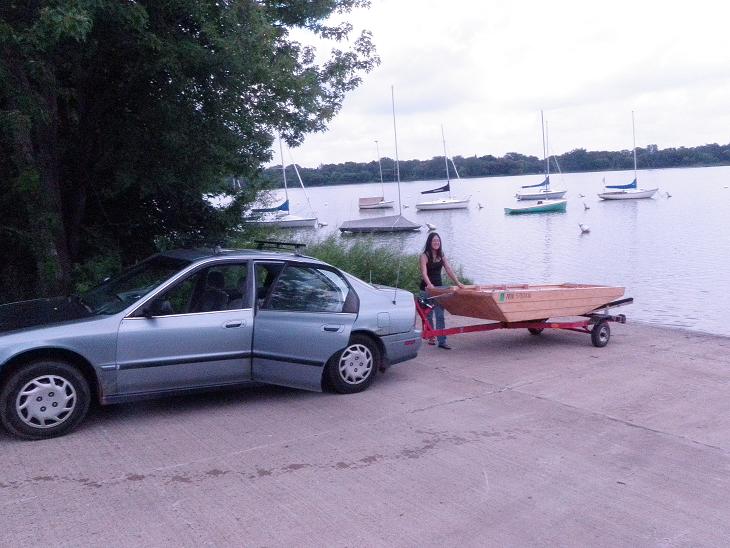
Finally got the Shoebox out on the water! Also got a lot of water in the boat, as the fiberglass turned out to not be very waterproof! Fortunately we had some swim goggles and half a water bottle to bail with. We also had Alex from Milwaukee to take photos and run rings around us in his inflatable raft.

There was little to no wind on Lake Nokomis, but we got occasional puffs that let us try out the homemade sails (blue tarps). Everything seems to work, although we’d need more wind to get a better idea of the handling and performance. I’m not so sure that our homemade sails are the best shape (they’re based on a design from a 1920s Popular Mechanics boat book!)

I think I should have made the mast a bit taller, the sail plan seems stubby now. The guy who started the hull intended it to use a Sea Snark sail, which is probably similar in overall area.

It’s like Swallows and Amazons of the urban jungle 😛


What fate for the S/V Pagoo?

July 28, 2010

Last year I regretfully had to sell my sailboat, the Pagoo. Originally a moldy derelict in Elfin Cove, I’d spent several years refurbishing, rebuilding, and sailing the 24′ Bayliner Buccaneer around northern Southeast Alaska. Since my life had taken me to Minnesota more or less long-term, and transport cross-country being cost and time-prohibitive, I decided to pass the boat on to someone else who could make use of it locally.

After posting an ad on Craigslist and some flyers around town I found a buyer. I carefully explained all the faults I could think of (and there were a few, it was a work in progress), and turned over the Pagoo along with a literal boatload of spare parts, equipment, books, and other extras.

Fast forward a year, and I get an email from someone else who had looked at buying Pagoo in 2009. They had noticed the boat tied up in Auke Bay, accumulating tickets (supposedly the new owner had secured a slip in Douglas harbor).

A quick call to the Auke Bay harbormaster confirmed it. Pagoo is apparently abandoned, the new owner unable to be reached. The dinghy is sinking at the dock, there is apparently some kind of mechanical problem (did he manage to kill BOTH outboards? Finicky as they were, they could always be persuaded to run eventually). The harbor staff indicated they were close to impounding the Pagoo, at which point it would be auctioned or, if they thought it was in bad condition, “sent to the crusher”!

I’m sure the boat is in good enough shape to have value to SOMEONE, although whether the harbor staff recognizes that, I don’t know. Even if the new owner has stripped and neglected it, it’s definitely in better shape now than it was when I got it! The rigging and hardware alone ran me almost a grand in parts. I’m hoping that someone manages to save it if it comes to harbor impoundment!

In addition, I came across this photo from March showing Pagoo parked behind the classy yacht. It looks like someone didn’t even furl the main sail properly!

Strider

I tried to contact the new owner by phone and email, with no response. What happened? Where is the owner? Why isn’t he at least trying to sell it to pay off the harbor fees and tickets?! What is going to happen to my boat? Even though it’s not “mine” anymore, I still feel bad for its sad abandoned state! If I were still in the area I’d be trying to do more, but I’m at a loss for what more I can do from the Midwest. I don’t even have much left from the sale, due to some recent medical bills.

I am kinda bummed out 😦


Some concerns with St. Paul’s Vacant Building Registration System

June 30, 2010

I sent the following to a number of St. Paul officials earlier this year. It pretty much sums up my experience with trying to find an affordable house here.

To whom it may concern,

I’m a former St. Paul resident who is interested in buying property in
the city. As a younger first time homebuyer with some construction
experience, I’d like to find something affordable in the “fixer upper”
range. However, while searching for property in St. Paul, I’ve been
frustrated time and again by the Vacant Building Registration and
Category system. I’ve had the same experience reported by friends
interested in St. Paul property. To me, the VBR system seems to run
counter to St. Paul’s goal of maintaining affordable owner-occupied
housing and a stable tax base. This system appears detrimental to the
future of St. Paul, especially in our current housing market.

For those not familiar with the Vacant Building system, here’s how it
looks to the average homebuyer. A house in St. Paul is either
“occupied” (which can mean it’s maintained by owners living
elsewhere), or it is “registered vacant” (foreclosed with occupants
evicted). If a house is “occupied”, you can buy it as-is with
disclosure of a Truth in Housing Report. If it is vacant, it falls
into one of three categories.

“Category One” is a house that city officials are relatively happy
with. It has few if any problems, but buyers may have to do some
repairs before being allowed to move in.

“Category Two” usually means the house is boarded up or has multiple
problems. To the buyer, these properties are a huge turn off. Category
Two requires a buyer to bring the property up to code (modern code,
not the code of the construction date), before being allowed to occupy
it. In practical terms, this means owner-occupants are unlikely to buy
a Category Two home, since they have to make major renovations and
live somewhere else until the city is satisfied with repairs. If the
city’s requirements are too expensive for any buyers, the house
eventually degrades into a Category Three.

“Category Three”, to the buyer, is usually a write-off. The city
considers them dangerous, and the threat of demolition hangs
constantly over the property until all work is completed. In the worst
case, these may be obviously-collapsing rotten wrecks, but sometimes
they’re simply foreclosed properties that have sat for a while and
deteriorated past Category Two, perhaps by having the copper stolen or
the windows broken. Even if repairable, these houses are avoided by
everyone, and typically torn down at the city’s expense.

To the outsider (the typical homebuyer), the formula for categorizing
vacant houses is a mysterious and arcane process. Information on
specific properties is available in a city database, but can be
confusing or meaningless out of context. Common things like “partial
basements” or “poor handrails” can apparently decide a house’s fate.
Interior items like rusty furnaces and cracked plumbing fixtures,
though not structurally part of the house, might tip the scales
between categories, suddenly requiring an otherwise sound building to
be completely modernized to today’s standards. Code Compliance can
mean everything from larger windows, higher ceilings, and new wiring,
to a complete rebuild of major structural elements. Due to the
difference in building and housing codes over time, Code Compliance
can be impractical and cost prohibitive for historic homes. It can be
a death sentence for any house over a certain age.

What does this mean to the St. Paul home buyer? Essentially, a large
percentage of vacant properties are not worth considering. The VBR
system is a frightening and incomprehensible thing.  Non-savvy buyers
could purchase a home and then find themselves facing unaffordable
repairs or imminent demolition. Even informed buyers can find a
property has slipped from one category to another between purchase and
closing, as seen in recent news articles. Properties in the same
condition can be found in more handyman-friendly municipalities as
“Fixer Uppers”, where the buyer can purchase, live in, and repair the
house at their convenience, not on the city’s schedule. For the first
time homebuyer like me, looking for a deal or a “handyman special”,
these factors make St. Paul quite unattractive. Anything affordable in
the city is treated with suspicion, or ignored completely.

What does this mean for St. Paul? Intentional or not, the city is
preventing many vacant properties from being re-occupied. With a
number of nearby cities to choose from, some with less stringent
requirements, there’s no reason for anyone to buy a Category Two or
Three house. These houses will eventually be torn down at city
expense. The land will either sit vacant, be taken by the city for
delinquent taxes, or be bought for a few thousand to expand a
neighbor’s yard. In any case, there is little to no income for the
city. Not just the property tax, but also the sales tax and economic
activity from potential residents are gone. The city can hope that
someone will eventually build a modern home on that lot, but this is
unlikely even in the best of economic times. Builders and buyers of
new homes do not like city-size lots. They don’t like “problem areas”
with high numbers of vacant or demolished buildings. During economic
boom times, new construction happens in the suburbs. During economic
downturns, buyers choose cheaper existing properties rather than
expensive new construction. The city can finance or subsidize projects
on the land, but these come with their own financial burden. This
results in a lose-lose situation, a house demolished or categorized
out of affordability today might never profit the city again.

I can see three supposed benefits of the Vacant Building registration
system, but I feel that they are empty benefits, already provided by
other programs. For one, homebuyers may be saved by the VBR from
buying an unsafe or dangerous house. However, they are already
protected by the Truth in Housing program, which requires informed
consent through independent assessment and disclosure of property
condition. Secondly, the VBR and Code Compliance requirements may
prevent the spread of substandard rental property. However, there are
already separate rental licensing and fire safety programs to prevent
this, each with its own inspections. Thirdly, required repairs may
keep people from neglecting dilapidated or ugly houses. Again, there
is already a program for this, the city can and does levy assessments
against properties for anything from trashy yards to decaying
exteriors, so a buyer cannot simply ignore repairs. In all three
cases, major repairs also require licensed contractors, and there are
state and federal codes covering safety and quality standards. As
such, there is really no reason for the VBR and Category system to
exist. It is redundant, it does nothing to protect buyers, and it does
nothing to mitigate the spread of vacant housing. If anything, the VBR
and Category system encourages the neglect and eventual destruction of
vacant homes.

I realize that city politics move slowly, and change may be unpopular.
However, as a frustrated homebuyer trying to become a contributing St.
Paul resident, I feel that some reform is needed. Eliminate the VBR
and Category system. Eliminate the threats of Code Compliance and
demolition for all but the very worst properties. Allow buyers to live
in and repair properties as their time and finances allows. Reconsider
the Code Compliance requirements so that older properties don’t need
to be fully modernized, OR, offer and publicize incentives for the
average person to afford Code Compliance. Relax the restrictions and
eliminate some of the hoops that homebuyers have to jump through. Work
to attract people who are dedicated to improving old homes, and thus
improving neighborhoods and the city as a whole. We can keep St. Paul
beautiful, livable, and free of neglected properties, but it doesn’t
have to be done by tearing down half the city and driving away
residents. Give the handymen and fixer-upper buyers a break, and give
the tax base of St. Paul a break.

Thank you for your consideration,

-Gabe Emerson
Minneapolis, MN


Boat work

June 25, 2010

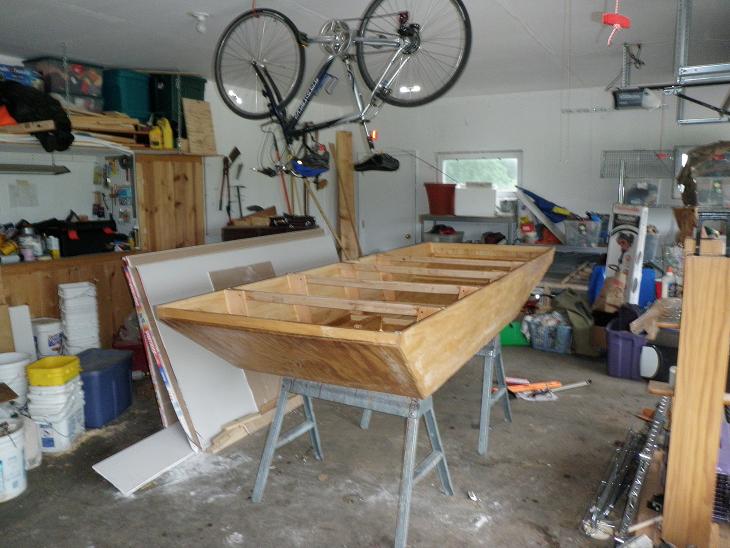
I’ve been working off and on to finish this little sailboat hull I picked up on Craigslist. So far I’ve waterproofed it and built seats and a mast step. Have also bought parts for a mast and various other additions. I’m tempted to name this the SS Shoebox. So far it’s doing a good job of taking up half my friend’s garage…


Stunningly realistic!

June 15, 2010

I think the sculptor has captured their essence quite well, you can almost see them looking back at you… longing to run free in the wild with their styrofoam brethren.


Recent activity

April 28, 2010

What have I been up to lately?

I bought and modified a storage trailer (on the projects page).

I bought ANOTHER boat (small kayak, shown below):

And we’ve been playing Settlers of Catan every week:


Oh god, another boat…

April 2, 2010

Thanks to Craigslist and some guy not having enough space in his garage, I now have yet another project boat! This one is a homemade sailing design, somewhat boxy but pretty stable and roomy. It’s partly done but still needs interior waterproofing, seats, gunwales, and rigging! I actually got this about a month ago, but haven’t had time to do any work on it. I’m also trying to get rid of some other boat stuff like a project outboard, so have been busy with that as well.

Speaking of boats, I have moved all (or most) of the content on my sailboat over to its new home on this server.


A few photos from ’09 and ’10.

March 10, 2010

Megan the pirate!

I dug a few pictures off my cell phone recently. I’m too lazy to sort these into actual pages or anything, or even to put them on Facebook (now that’s lazy!)

OhYes!

The Monarchmobile!

The Monarchmobile!

Rachael's cat Wobbler after we caught him as a stray kitten in her garage.

Even Catan gets boring sometimes.

Don't do drugs?

More plywood kayak construction

I miss my sailboat 😦