Funter Bay History: The misadventures of Fred Patrick

April 30, 2013

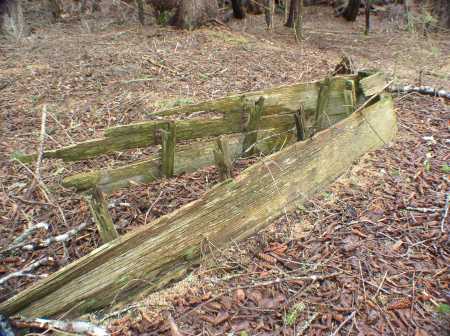
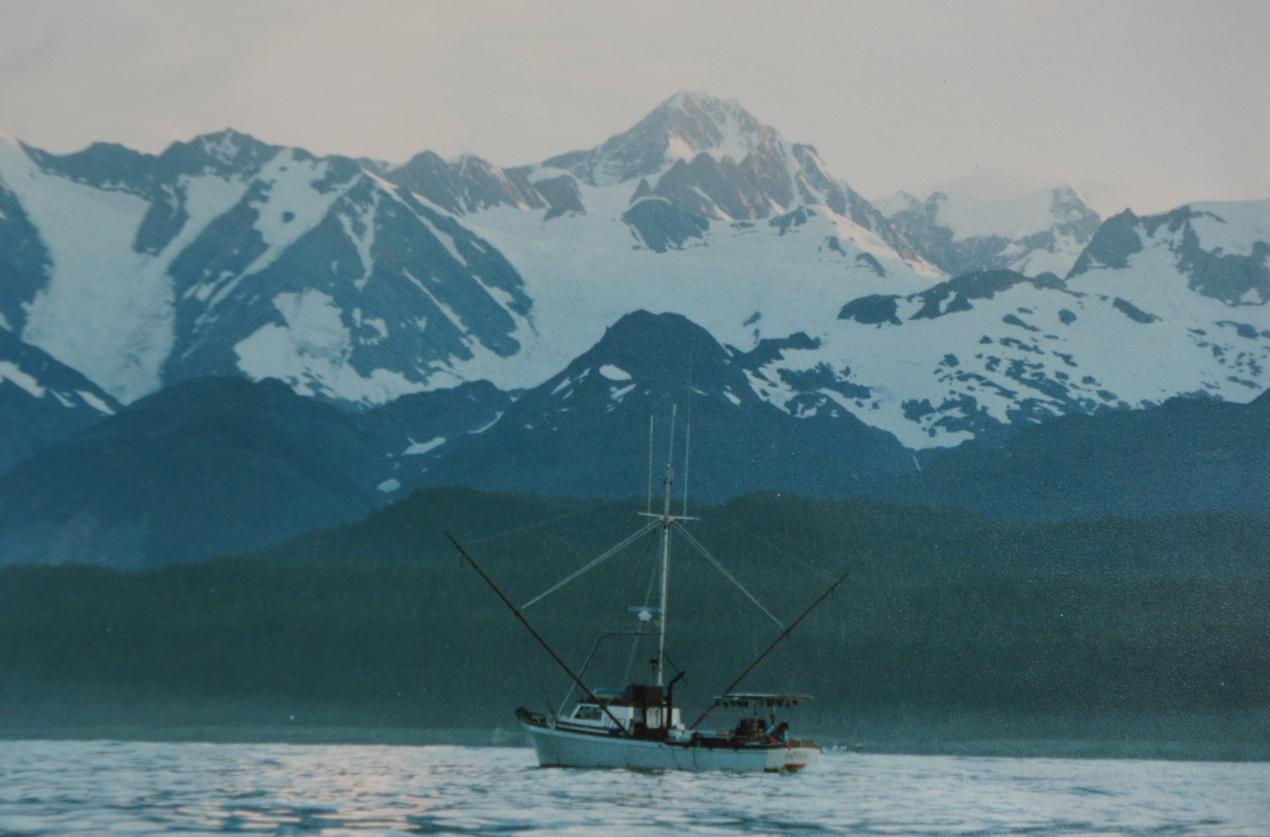
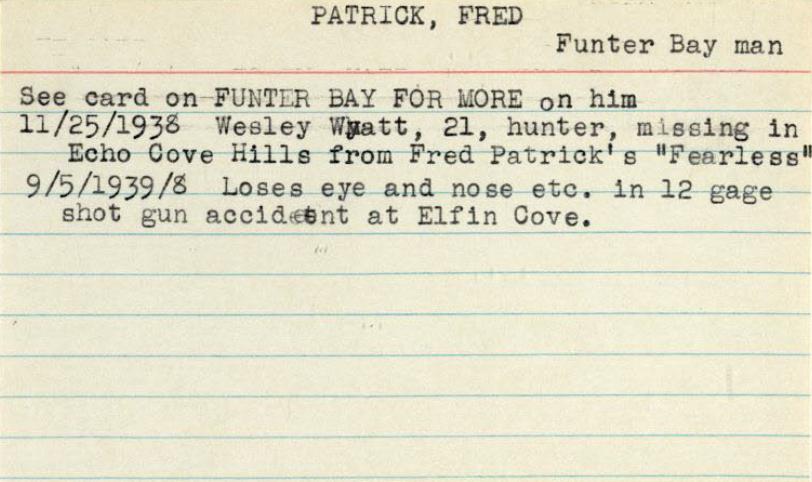
This guy seems to have lived an “interesting” life… I came across his name several times in old newspaper archives and notes on local history. The Kinky Bayers note cards mention him several times. Fred Patrick owned the fishing vessel Fearless and resided in or fished out of Funter Bay in the 1930s.

As previously mentioned, in October of 1938: Geo. Ford’s troller was found sunk in Funter Bay, he and Fred Patrick were missing for three days but turned up at Funter.

fred2

He seems to have had bad luck with guns: In October of 1931, Fred Patrick shot Harold Tipton in the foot during a drinking bout at Funter. In September 1939, Fred Patrick lost an eye and his nose when a shotgun went off in his face at Elfin Cove (also from Kinky Bayers notes).

fred3

fred1

Iin 1934, Fred Patrick was part of a march of unemployed men on the federal building in Juneau, demanding food benefits.

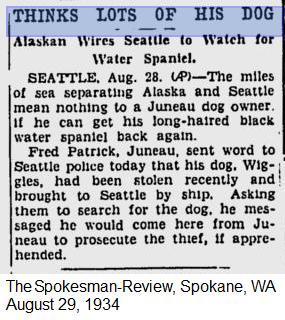
Fred’s dog Wiggles was stolen in 1934.

dog

Fred’s boat was disabled in Echo Cove in 1938, and a hunter who was on board went ashore, never to be seen again.

The Fearless was a 33ft fishing boat built in 1916 at Berkely, CA. It had a 60hp gas engine and a crew of one. Reg. # 237891. Owner in 1942 was Fred R. Patrick of Juneau. In 1945 the boat is listed as abandoned.

That’s all I’ve been able to find so far on the (mis)adventures of Fred, if anything more turns up I will update this!


Funter Bay History – Barron Family

April 26, 2013

Here are a few more details on the Barron Family, who started the cannery at Funter Bay.

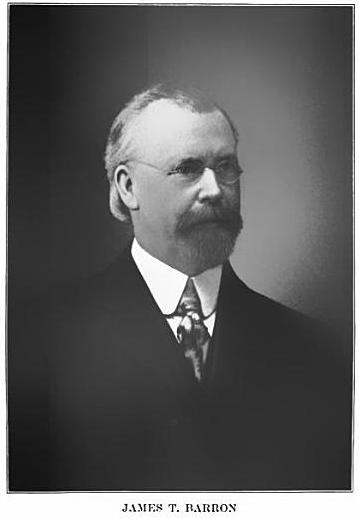
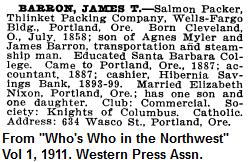
Thlinket Packing co founder James T Barron of Portland was born in Cleaveland OH July 8, 1858. Parents were James Barron of Clonmel, Ireland (1828-1890) and Agnes Myler of Ireland (ca 1831-1910). Agnes’ father was Andrew Myler. Both James’ and Agnes’ families immigrated to the US when they were young children. James Sr. owned and operated barges on the Erie canal and moved to the Pacific coast in the 1860s, where he owned steamships, warehouses, and other transportation properties. (source 1) (source 2)

JT Barron

James T Barron attended St. Mary’s and Santa Clara colleges, then worked as an accountant (with sidelines in beekeeping) until becoming secretary of the Hibernia Savings Bank in 1893. In 1899 he started the Thlinket Packing Co. He quickly sold his first two canneries to finance the new cannery at Funter Bay in 1902, but then bought back some of the interest in the earlier canneries when they went bankrupt (mentioned previously). He remained involved in the Hibernia Savings bank. He was described as a member of various professional and social clubs and organizations around Portland.

Whos who

J.T. Barron married Elizabeth Nixon in 1890. Her parents were Robert Nixon and Anna (Hogan) Nixon, both natives of Ireland. Robert Nixon was killed during the Civil War while serving in New Hampshire’s volunteer regiment.

James and Elizabeth seem to have had a comfortable household in Portland, living at 634 Wasco St (near downtown). They were occasionally mentioned in the local paper for such notable things as parties and car ownership, and they could apparently afford two maids in 1916.

help wanted

James and Elizabeth’s children were Robert J. Barron (1896-1917), Anna Maria Barron (b 1894), and Agnes Elizabeth Barron (1897-1898). Both Robert and Anna had cannery boats named after them.

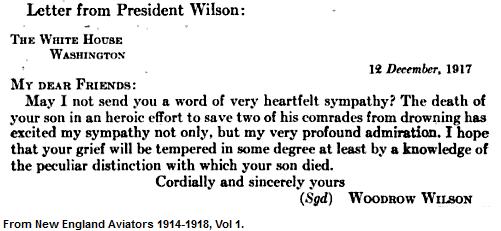
As previously mentioned, Robert Barron entered the Army Aviation Training Corps on June 3rd,  1917. At Age 22 he had already become Vice President of the Thlinket Packing Co under his father. Shortly after his enlistment, on August 21 or 22 (records conflict) of that year, Robert was killed while attempting to save fellow cadets from an aircraft accident. During landing practice near Chandler Field, two cadets had been thrown from a Hydroplane (an early type of floatplane) into the rough water of the Delaware River (ref). Robert attempted to swim to their aid, but was overcome by the current and drowned. He was applauded as a hero and given a full military funeral of a ranking officer. Everman Field at Fort Worth Texas was renamed “Barron Field”, and the mountain above Funter Bay in Alaska was named Mount Robert Barron in his honor. Woodrow Wilson sent a letter of condolence to James and Elizabeth.

Wilson

Robert Barron’s Grave

Robert’s Funeral notice.

Anna Barron married Thomas Martin Fitzpatrick (1882-1948) in 1914, and had 5 children including James Barron Fitzpatrick (1916-1992), Adrian Thomas Fitzpatrick(1926-1977), and Robert Barron Fitzpatrick (1921-1979).

James Barron Fitzpatrick seems to have been the chairman of the Portland City club in 1952. He was married to Elizabeth Rae Lansworth (1924-1988) and had 9 children.

Here is J.T. Barron’s gravestone. and Elizabeth Barron’s.

I ran out of steam on tracking the Barron family farther, this became one of those recursive research topics where one thing leads to another, and suddenly I have half the family history of someone who was previously just a name. If I happen across more information I’ll see about updating this.


Funter Bay History IV – More Boat Details

April 25, 2013

Here are a few more details of the marine and boating history of Funter Bay. With the number of steamships, fishing boats, tugs, barges, etc that have used Funter Bay, posts on this topic could likely continue for a while!

To follow up on the cannery tenders, I’ve tracked down the Thlinket Packing’ Co’s Barron F (seen in a previous post).In the 1940s and 50s it was owned by the Nakat Packing Corp. out of Ketchikan. In was renamed the Frank F (same registry number) sometime between 1950 and 1965, and became a fishing vessel based out of Oregon. Currently it is listed in the USCG database as based in San Diego. Here’s a photo of the boat from 2007 compared to the 1919 photo:

ShipSpotting.com
Barron F 2
© John Kohnen Barron F in 1919

Another photo from 2007.

And this appears to be the same boat in 2010, described as a squid boat from San Pedro CA. It’s looking somewhat modified with trolling poles and a new paint job:

Frank's Fishing Boat

Another photo from 2010.

The Frank F seems to be a popular boat with local artists as well!

Frank F Painting #1, by Tony Podue.

Frank F Painting #2, by Gina McLagan.

And to be extra stalkerish (can one stalk a boat?) Here is the Frank F viewed on Google and Bing maps (as of spring 2013… imagery may change over time).

The former Barron F looks a lot like the Morzhovoi, which I believe is the wreck at Coot Cove. Both were built in Seattle in 1917, probably by the same company (date on photo below is wrong):

Morzhovoi

Another cannery tender, the Robert Barron, was listed as belonging to Albert Kookesk (Kookesh) of Killisnoo (Angoon) in 1925, and by Matthew Kookesh of Juneau in 1950. As of April 10, 1950 it is listed as abandoned in Angoon.

In addition to boats named after the Barron family, other cannery tenders previously alluded to include some named after the Thlinket Packing Co’s product lines, the Tepee, Peasant, and Sea Rose, and the previously mentioned Buster. I could not find a record of a boat named after the Arctic Belle brand. None of these seem large enough to be the wreck on Highwater Island.

Peasant, a 46ft 60hp gas boat built in 1926, crew of 6, registry 225554. Owned by Alaska Pacific Salmon Corp in 1930. Owned by PE Harris Co in 1945. Listed as callsign WD5837, owned by Van Baker of Blaine WA in 1965.

Tepee, a 29′, 12hp gas boat, registry 210208. Owned by Alaska Pacific Salmon Corp in 1930. Owned by PE Harris in 1945. In 1965 it was listed as owned by the US govt. in trust for the village of Kake, and used for freight.

Sea Rose, registry 213376, 7 tons, 29′ gas fishing boat, built 1915 in Seattle. listed as abandoned in 1925.

And coming back to the Nimrod, the wreck at Nimrod Creek, here is some information on that vessel. According to the Merchant Vessel registry, the Nimrod was a 53ft wood-hulled tugboat, built in 1903 in Chuckanut Washington. It is listed at various times as having either a diesel or gas engine, of around 135hp.

OLYMPUS DIGITAL CAMERA OLYMPUS DIGITAL CAMERA OLYMPUS DIGITAL CAMERA
Remains of the Nimrod at Funter Bay.

The H.W. McCurdy Marine History of the Pacific Northwest mentions the Nimrod: “At Seattle, Capt. C.W. Waterman…. later adding the 53-foot gas tug Nimrod of 1903, and forming the Waterman towing Co, which also remained active on Puget Sound for some years”

Here’s a classified ad run in the June 2, 1918 Sunday Oregonian by Capt. Waterman:

“WANTED Gas tow boat about 50 to 65 ft.. with 40 to 75 H. P.; would consider pleasure boat if power enough and boat could be converted to suit; price must be right. Address C. W. Waterman, 2210 47th av s. S. W.. Seattle, Wash.”

The Nimrod is listed in the 1963 registry as being “dismantled”.  Owner Elmer P. Loose Jr. was listed as a Funter Bay resident in 1965, and also owned the Sally Ann. An Elmer Palm Loose is recorded as having passed away March 1962 at Funter Bay (some of these dates would appear to be inaccurate).

When I show people the Nimrod, they ask, “who would name their boat that?” Lots of people, it turns out! The British navy had six ships with that name, and Ernest Shackelton had a ship named the Nimrod. The USCG documentation database lists 9 boats currently with that name. Several others are listed in the historic Merchant Vessel registry.

Here is another local wreck:

-Feb 15, 1959, a 42 foot, 14 ton, 91hp gas boat, the Teddy, was abandoned at Funter. Registry 207218, built 1910 in Astoria OR and listed as a passenger boat in 1911. Listed as a fishing boat owned by Teddy Preston Childers of Funter Bay in 1958, callsign WB7995. (per Merchant Vessels of the United States: Vessels Lost). According to this document, The Teddy was being used as a ferry, and had engine trouble near Pt. Retreat in 1953. The boat was abandoned at the AAGMC mine at Funter (across the bay from the cannery).

I’m still working on tracking down the Highwater Island wreck, and I also have some commercial steamship history to investigate, so stay tuned for more boat-related posts!


Funter Bay History – Mansfield Mine & Other Small Mines

April 17, 2013

OLYMPUS DIGITAL CAMERA

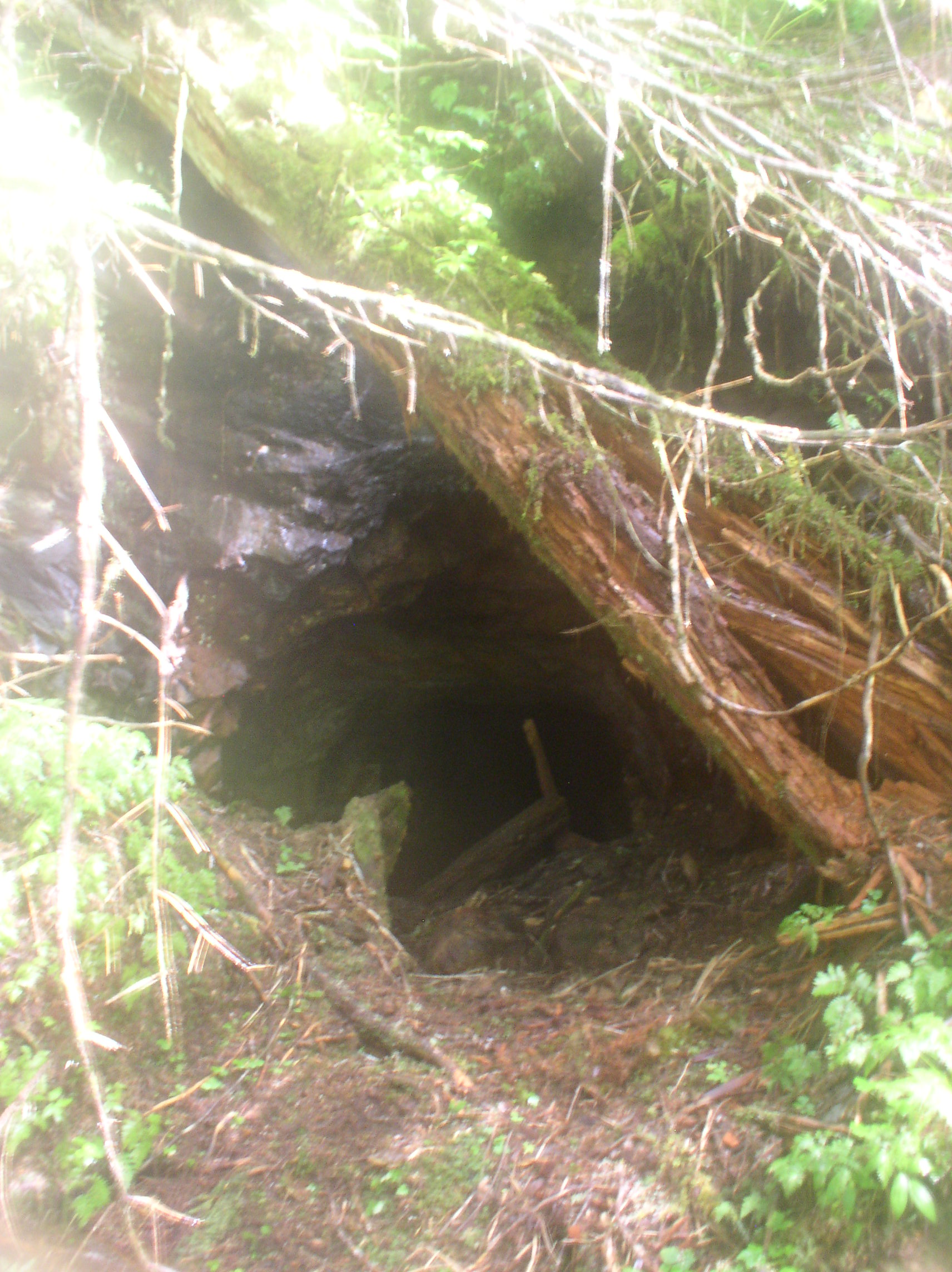
The Mansfield mine (also listed as the Seattle mine) is located at 500ft elevation about 3/4 of a mile from the head of Funter Bay. Discovered in 1908, the claim showed promise of gold, copper, zinc, and lead. A beach camp at the head of the bay still has some barely-visible cabin foundations, locally known as a blacksmith and/or mule-skinner’s cabin. A blazed trail leads up through the woods to the mine site and the ruins of another log cabin.

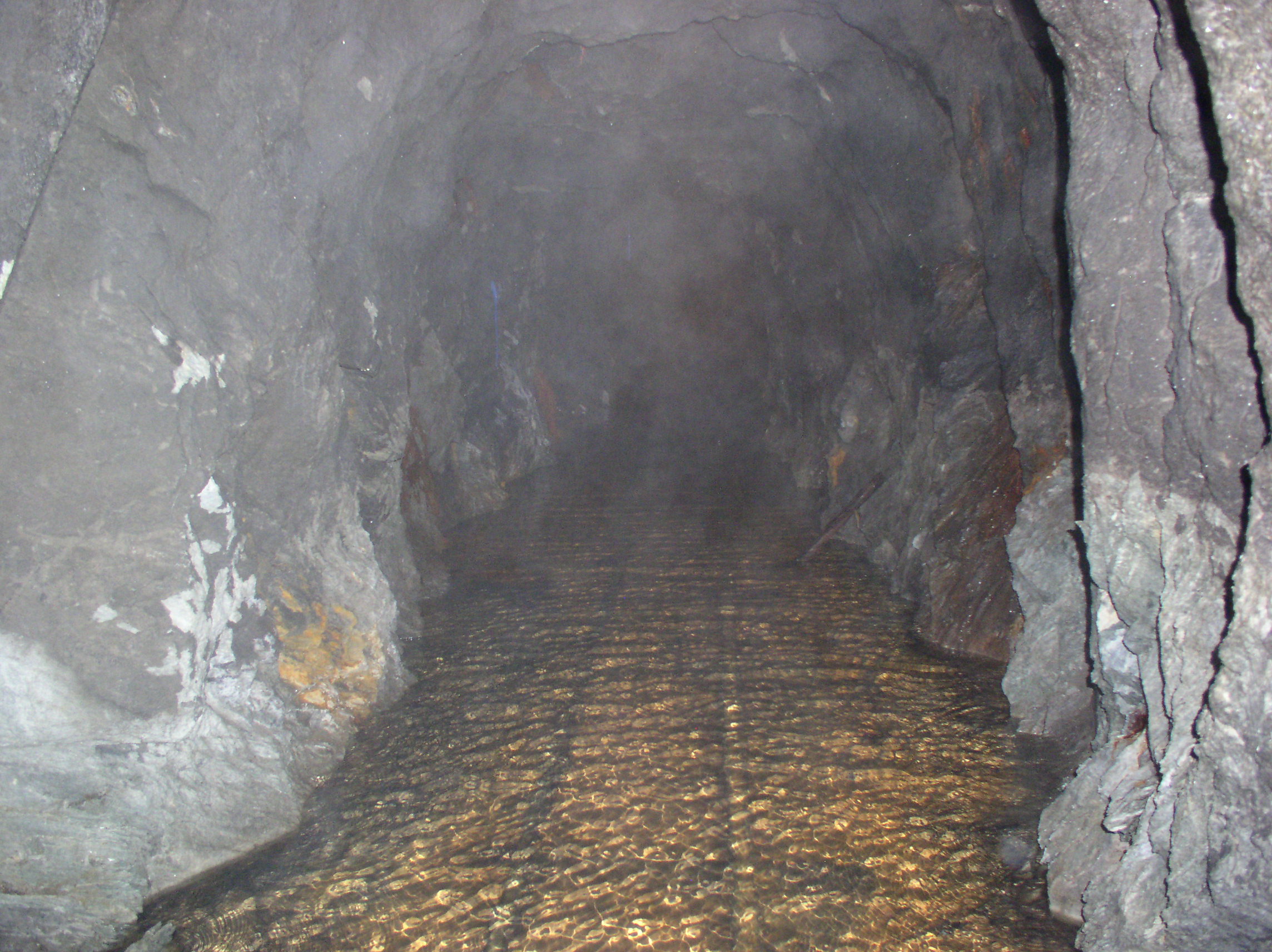
The prospect has two short tunnels (less than 100′ long), a small amount of railroad track, and one ore car. Transporting the ore car up to the site probably involved disassembling it and using mules to pack the parts to the mine. Inside the cart you can still find an intact pick and drill steels, it’s almost like a history exhibit! More rusty tools were found inside the mine adits. Several open cuts were also in the same area, a narrow ridge of granite with quartz veins cutting through it.

Apparently the claim was promising enough to pack in equipment, but not profitable enough to mechanize or exploit it beyond the small workings.

John at the upper cabin site, one of the cut logs is barely identifiable.:

OLYMPUS DIGITAL CAMERA

The ore cart outside the first adit:OLYMPUS DIGITAL CAMERA

Inside the ore cart, a collection of mining tools:OLYMPUS DIGITAL CAMERA

The first, and longest, adit. The tunnel featured rails along most of its length, and was flooded with about a foot of water:

OLYMPUS DIGITAL CAMERA

OLYMPUS DIGITAL CAMERA

Chris poses at the end of the tunnel. We suspected it might be flooded and didn’t feel like packing waders along, so we used the latest in Alaska fashion accessories: Trash bags and duct tape:

OLYMPUS DIGITAL CAMERA

Iron and calcium deposits on the floor, and the exposed quartz vein in the granite tunnel:

OLYMPUS DIGITAL CAMERA

OLYMPUS DIGITAL CAMERA

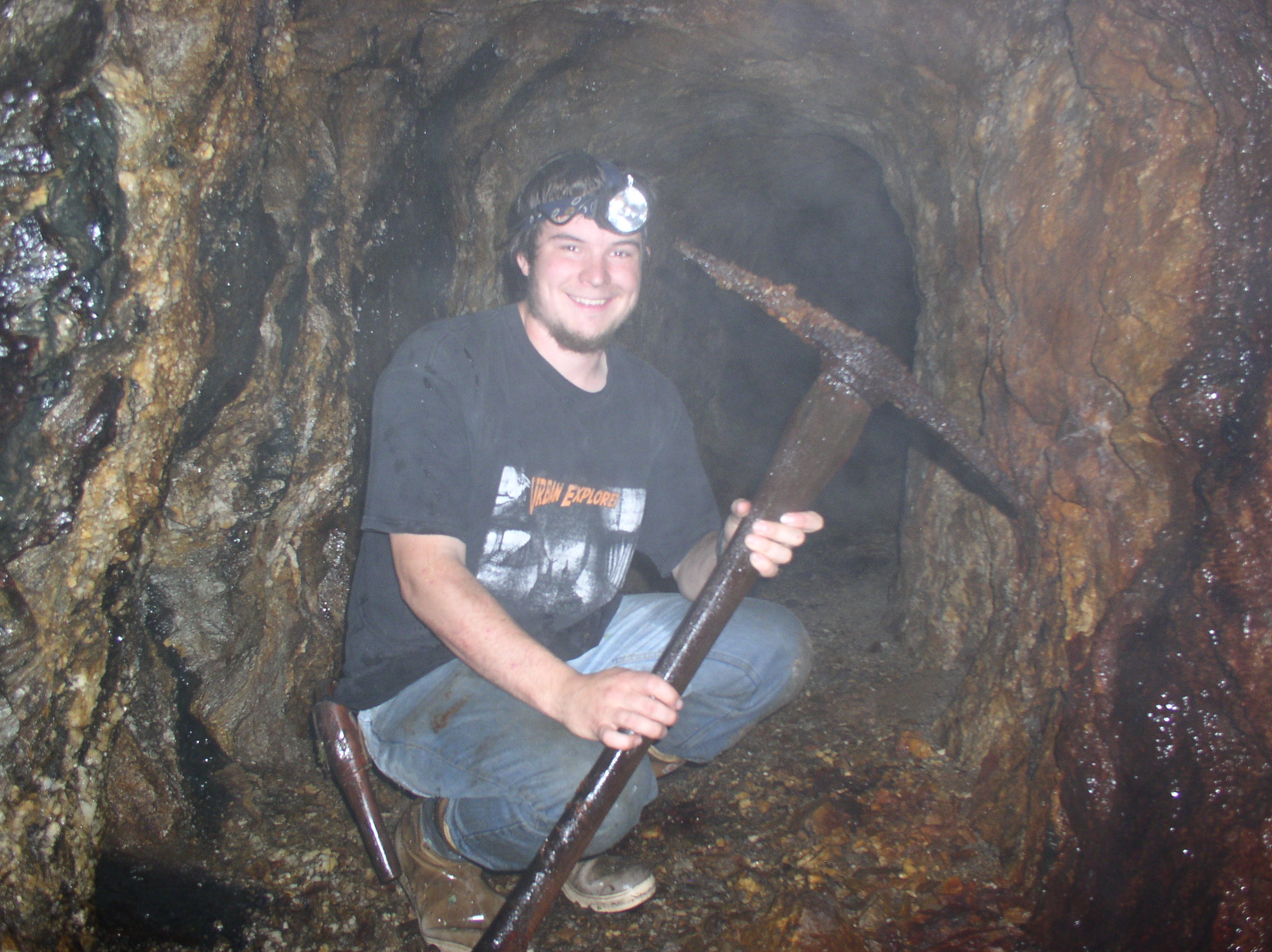
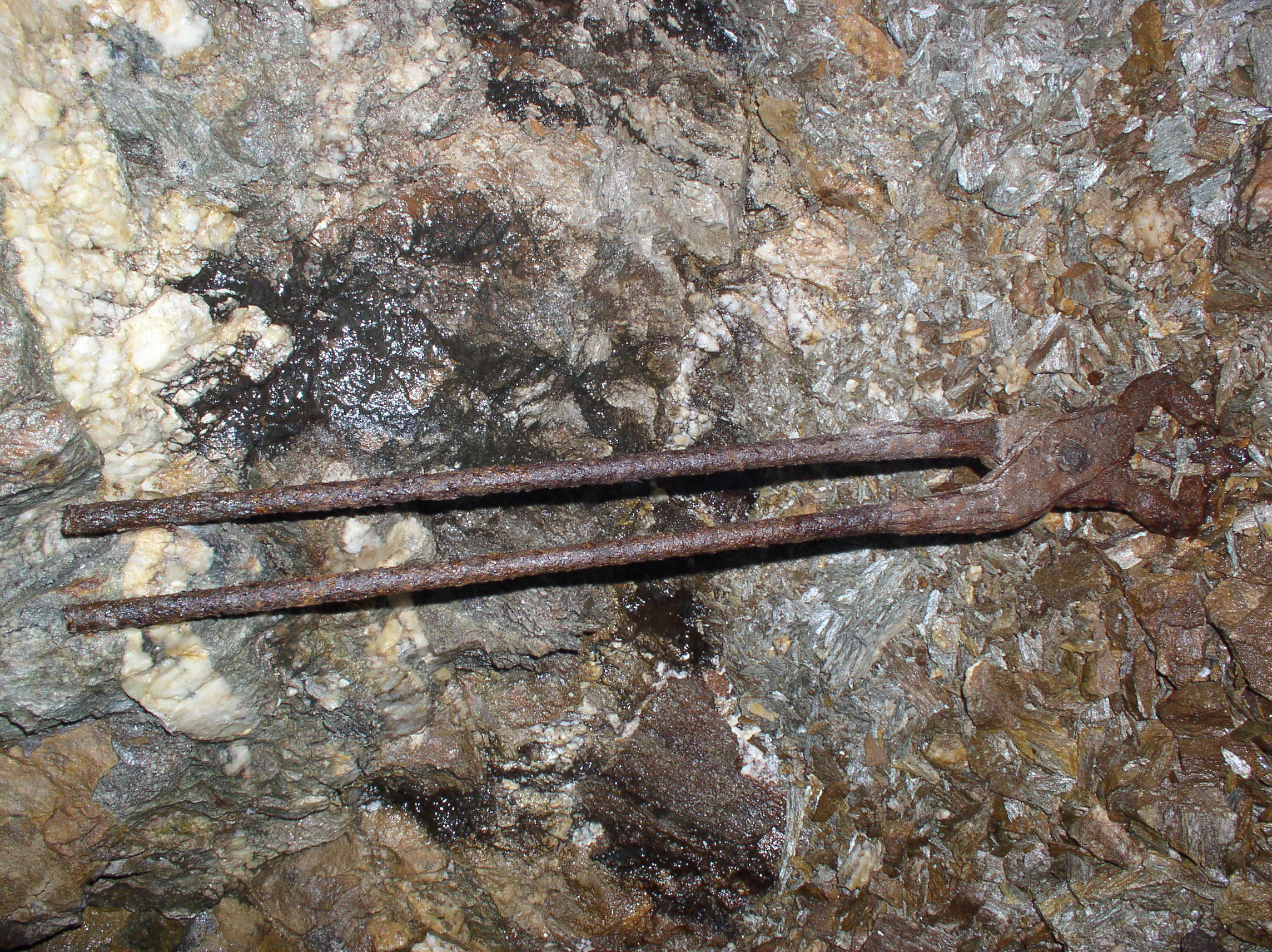
The second adit was partly collapsed and much shorter (about 20ft, probably dug around 1916 according to USGS data). This one featured an intact pickaxe (shown in the top photo), and some kind of clamping or plier tool, seen below:  OLYMPUS DIGITAL CAMERA

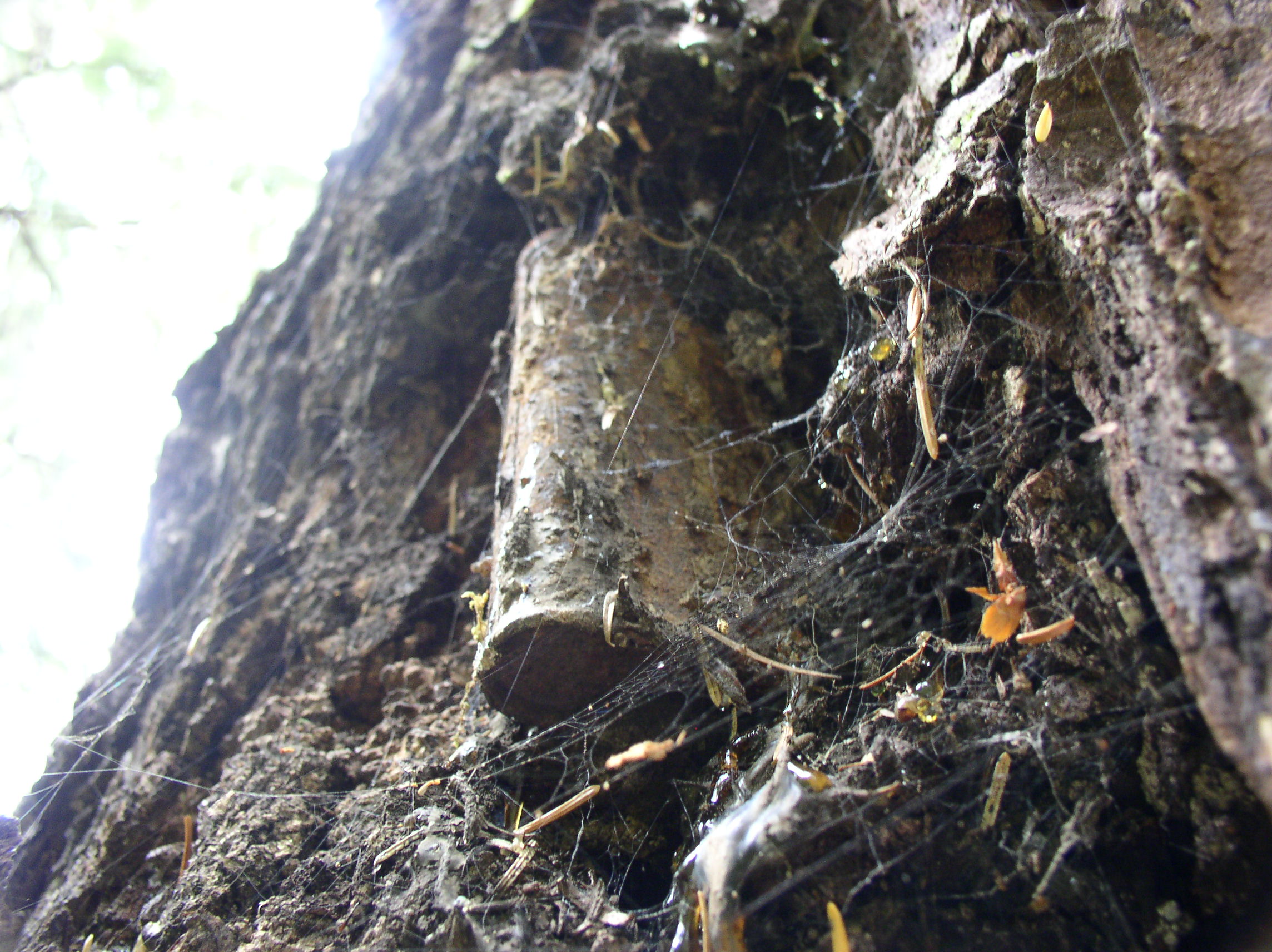
The mine claim was marked with corners like this: A metal can containing paper with claim information, jammed into a blaze in a tree. The can was pretty well stuck in there, the tree had grown around it a little since it was placed.

OLYMPUS DIGITAL CAMERA

Finding this mine was pretty interesting. Despite having hiked and hunted around the area extensively, I’d never stumbled across it. The trails are overgrown and the tunnels and mine cart are covered with thick brush, so there’s not much to see until you get right on top of it. I first heard of this mine while perusing some old survey documents relating to claims. I was able to locate the original USGS survey monument and derive GPS coordinats for the claim site based on the surveys. We then set out with a PDA running digital topo maps to try to locate the mine. Even with coordinates, it took us some time to find the two tunnels, and we still missed finding some of the open cuts. The GPS also required an external antenna to get a signal through the thick tree coverage.

OLYMPUS DIGITAL CAMERA

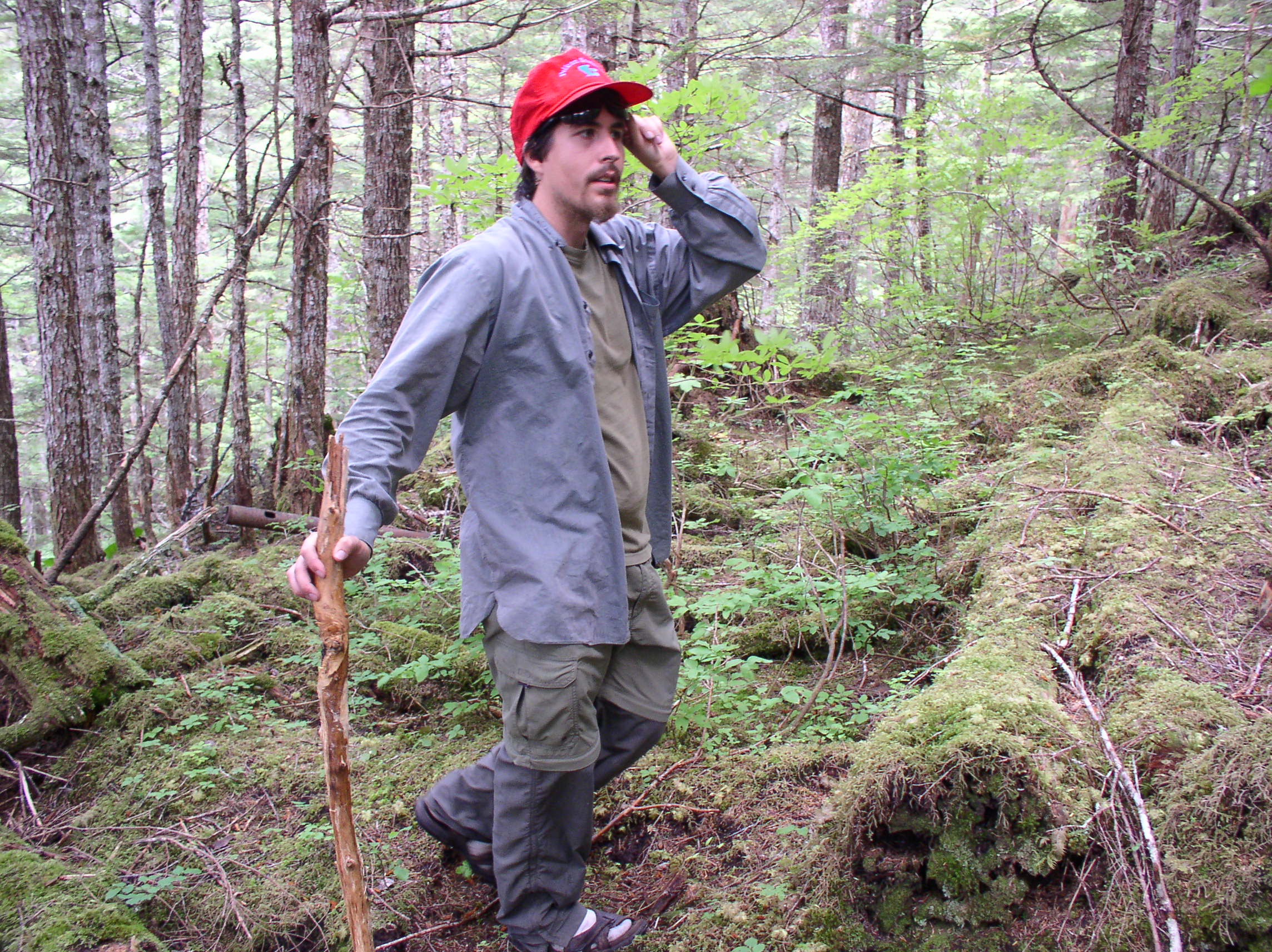
Some scenery on the way to the mine:

OLYMPUS DIGITAL CAMERA

View out over Funter Bay from the mine site:

OLYMPUS DIGITAL CAMERA

There were several other small mines near the head of the bay. The Portage prospect, across Bear Breek, was started in 1900 and had a small shaft, tunnel, and trenches, but did not reach profitable ore. I have heard there is some machinery still visible at this site. The “Bear Creek” placer claim of 1967 was just downstream of this, and was probably a local resident’s gold-panning spot.

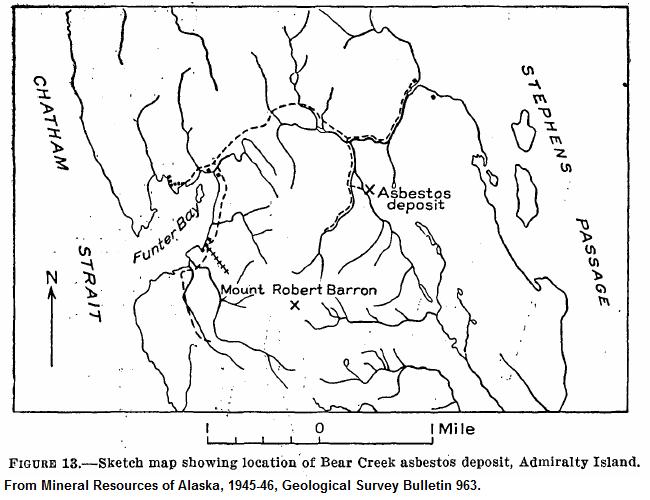
On the back side of the pass, facing Juneau, was another “Bear Creek” claim, this one for Tremolite asbestos. Around 1928, a Juneau resident named Augustus DeRoux discovered asbestos while searching for gold and copper. The Alaska Asbestos Co built a road from the beach around 1930 and apparently started a “rail tram”, but abandoned it when the USGS found the deposit not worthwhile.

asbestos asbestos2


Funter Bay History II – Ships and Shipwrecks

April 11, 2013

As mentioned in my prior post, the Thlinket Packing Co had a cannery tender named the Anna Barron based at Funter Bay, named after James and Elizabeth Barron’s daughter Anna. The cannery also owned a number of other vessels, many named after people in the Barron family, but the Anna is best known (for such an obscure topic as Southeast AK cannery tender vessels), since it appears in numerous publicity photos and postcards of the cannery.

AnnaBarron

The October 1920 issue of Pacific Motorboat mentions that the Anna Barron had three engines which were overhauled that year. The HW McCurdy Marine History of the Pacific Northwest describes her as being 77ft long, built in Astoria in 1902 for the Thlinket Packing Co, fitted with a compound (9 1/2, 20×20) engine developing 130hp. Her merchant vessel registry number was 107759.

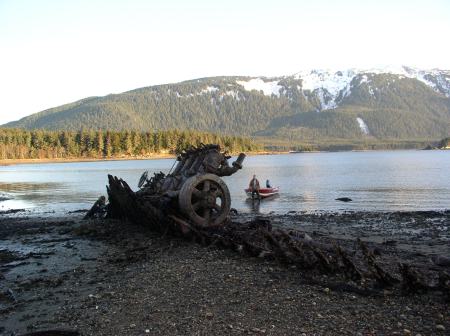
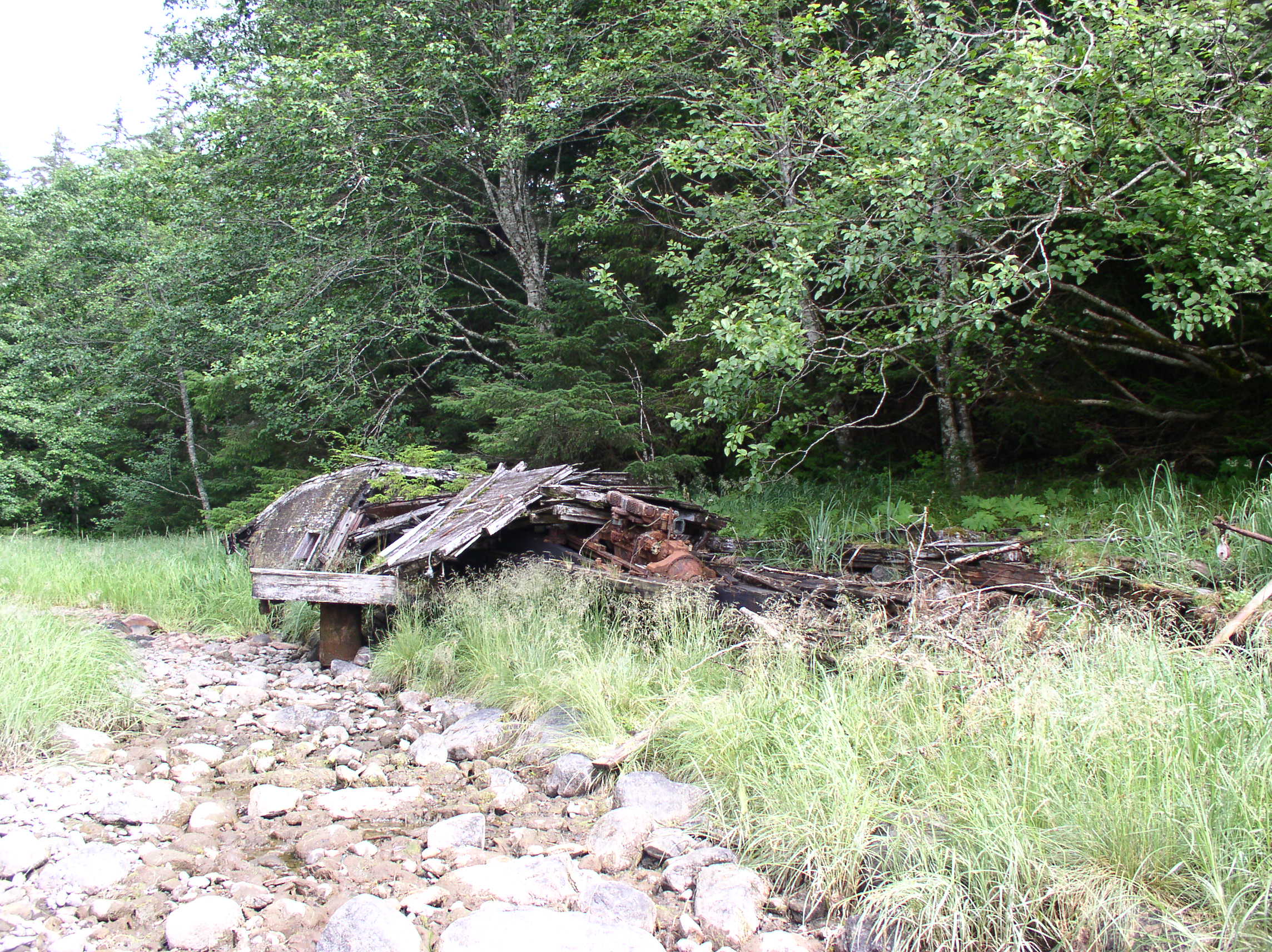
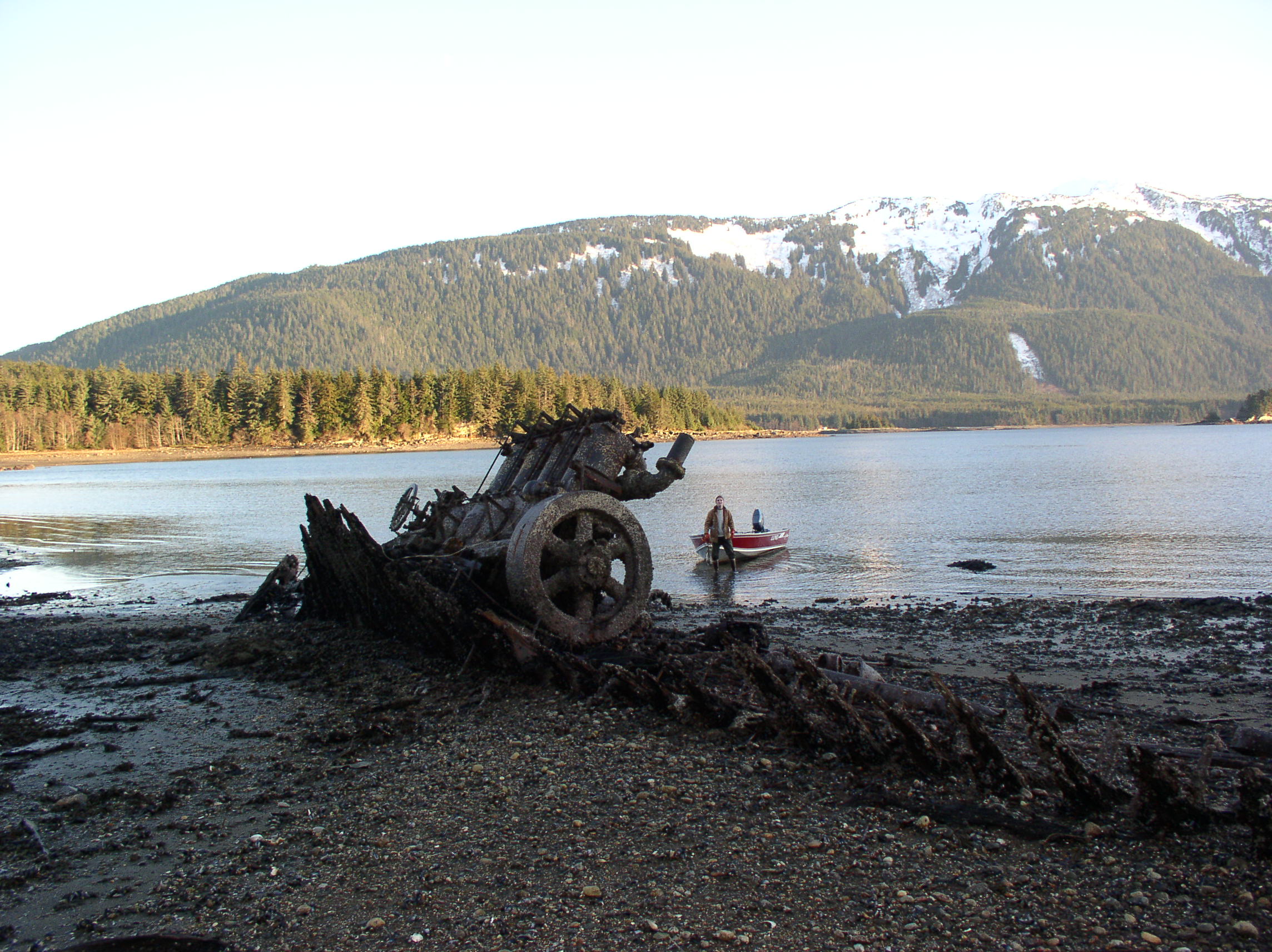
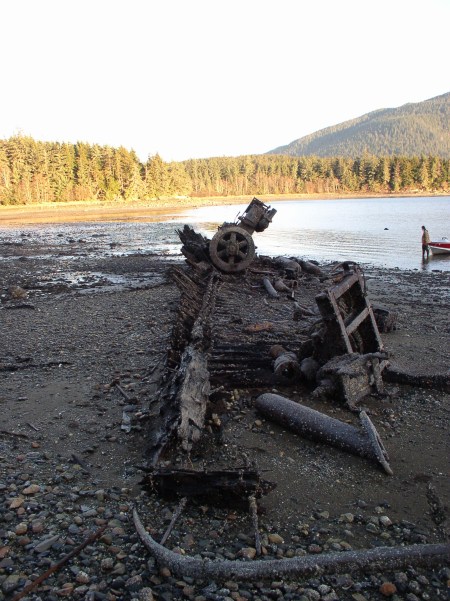
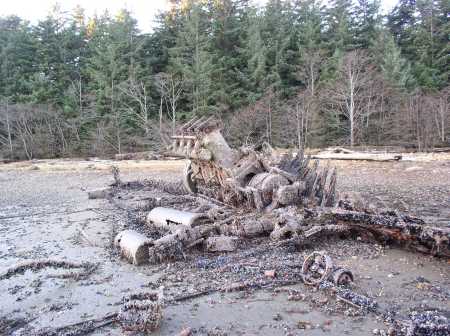
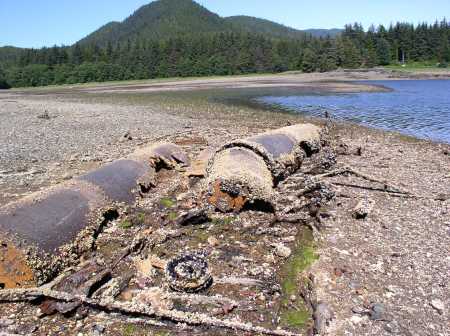
Today in Funter Bay, there are two wrecks of midsize boats (or parts of them) visible on the beaches. Both of these are locally referred to as “tugboats”, and I had always heard they were cannery boats. One is located in Scow Bay (AKA Coot Cove), and one is on Highwater Island (also called Crab Island on some state survey maps, although I’ve never heard it called that).
OLYMPUS DIGITAL CAMERA OLYMPUS DIGITAL CAMERA OLYMPUS DIGITAL CAMERA
The three photos above show the Coot Cove wreck. There’s not much left aside from the keel, some ribs, and the large Atlas-Imperial diesel engine. As this page notes, the vessel seems to have fire damage. It seems to be about 70-80ft in length, but estimation is difficult due to the condition of the wreck. Here is a photo of a similar (but larger) engine in another cannery tender.
OLYMPUS DIGITAL CAMERA OLYMPUS DIGITAL CAMERA
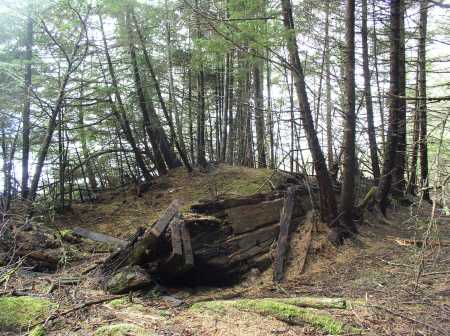
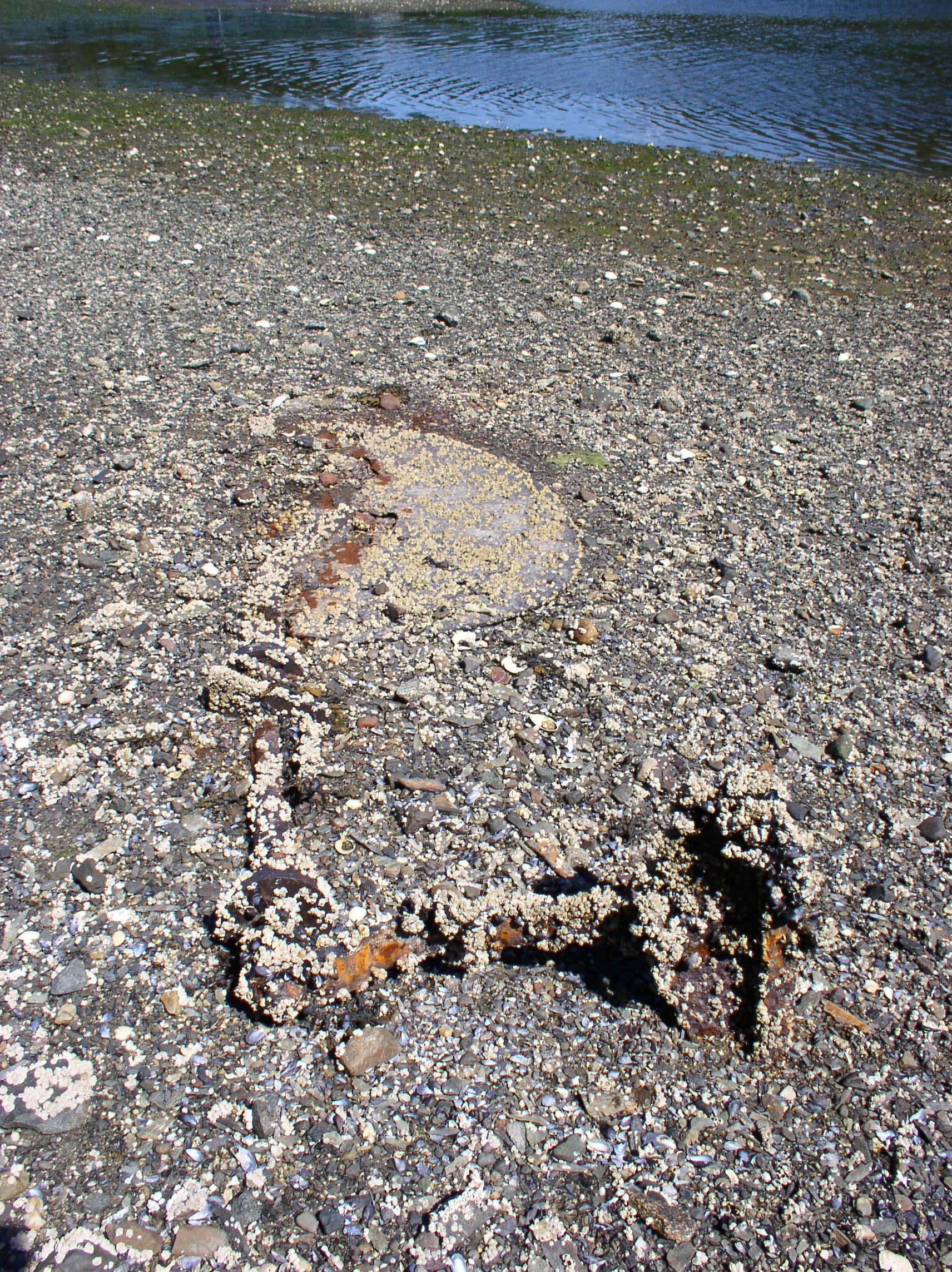
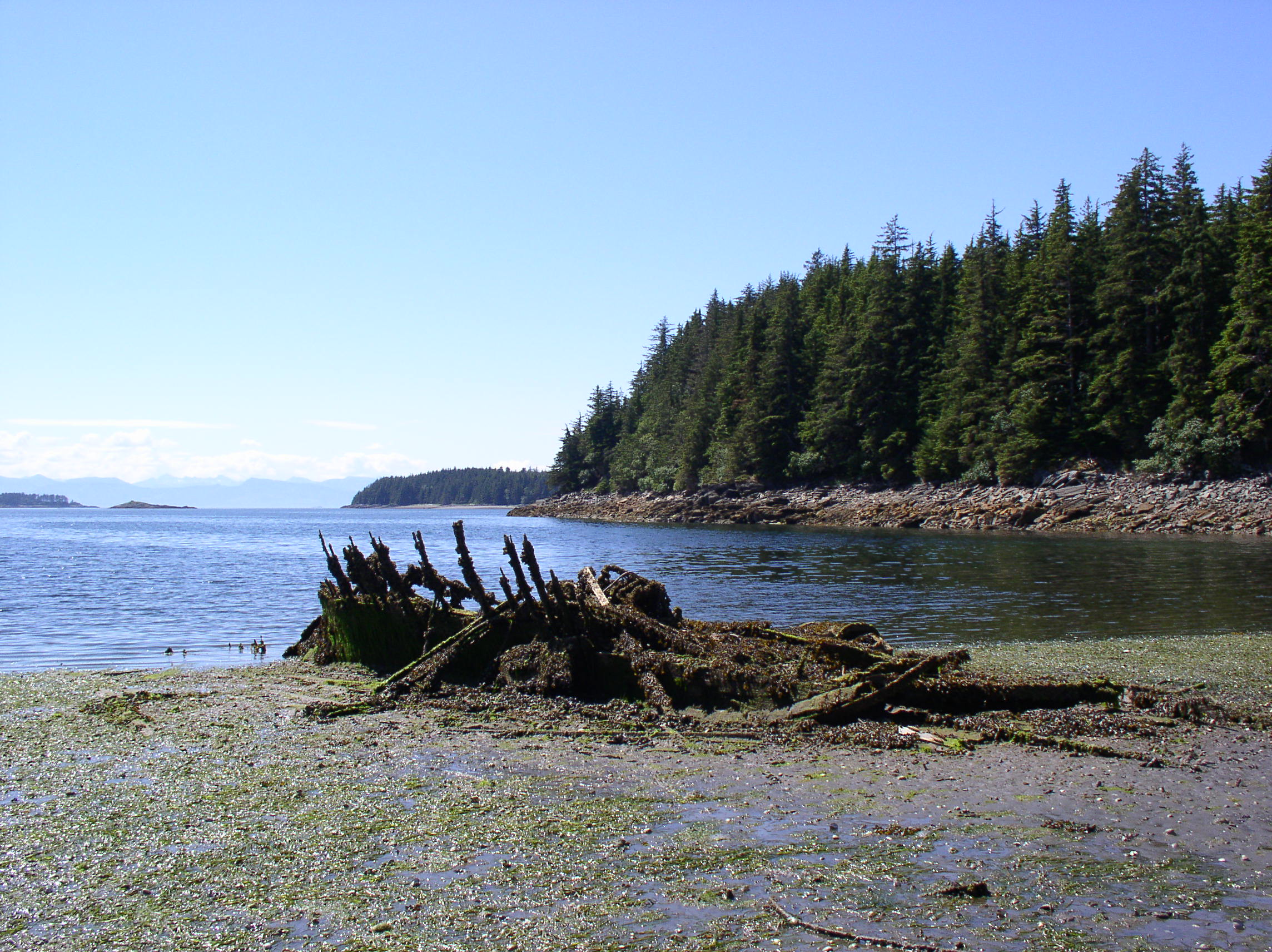
The two photos above show the Highwater Island wreck. There is even less remaining than at the other site. You can still find some cylindrical tanks and the rudder, a few wood and metal bits showing the rough outline of the hull, and a few interior items like plates and glassware. This one seems shorter than the other wreck, maybe 50-60ft, but again, estimation is difficult.

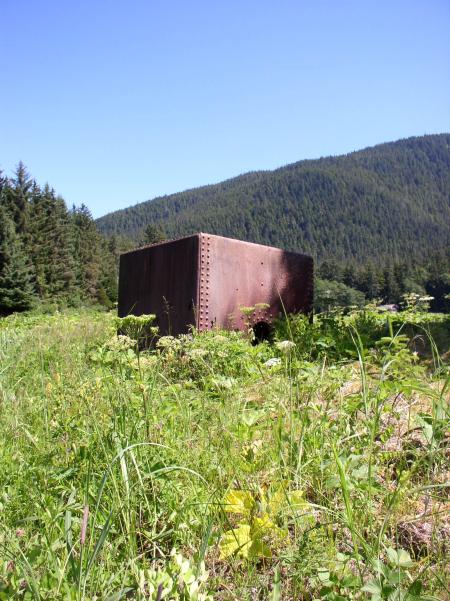
The hollow steel boiler from the Highwater Island wreck appears to have floated across to a small peninsula known locally as “The Point”, where it rests at extreme-tide level slowly rusting away.
funterhistoryboiler

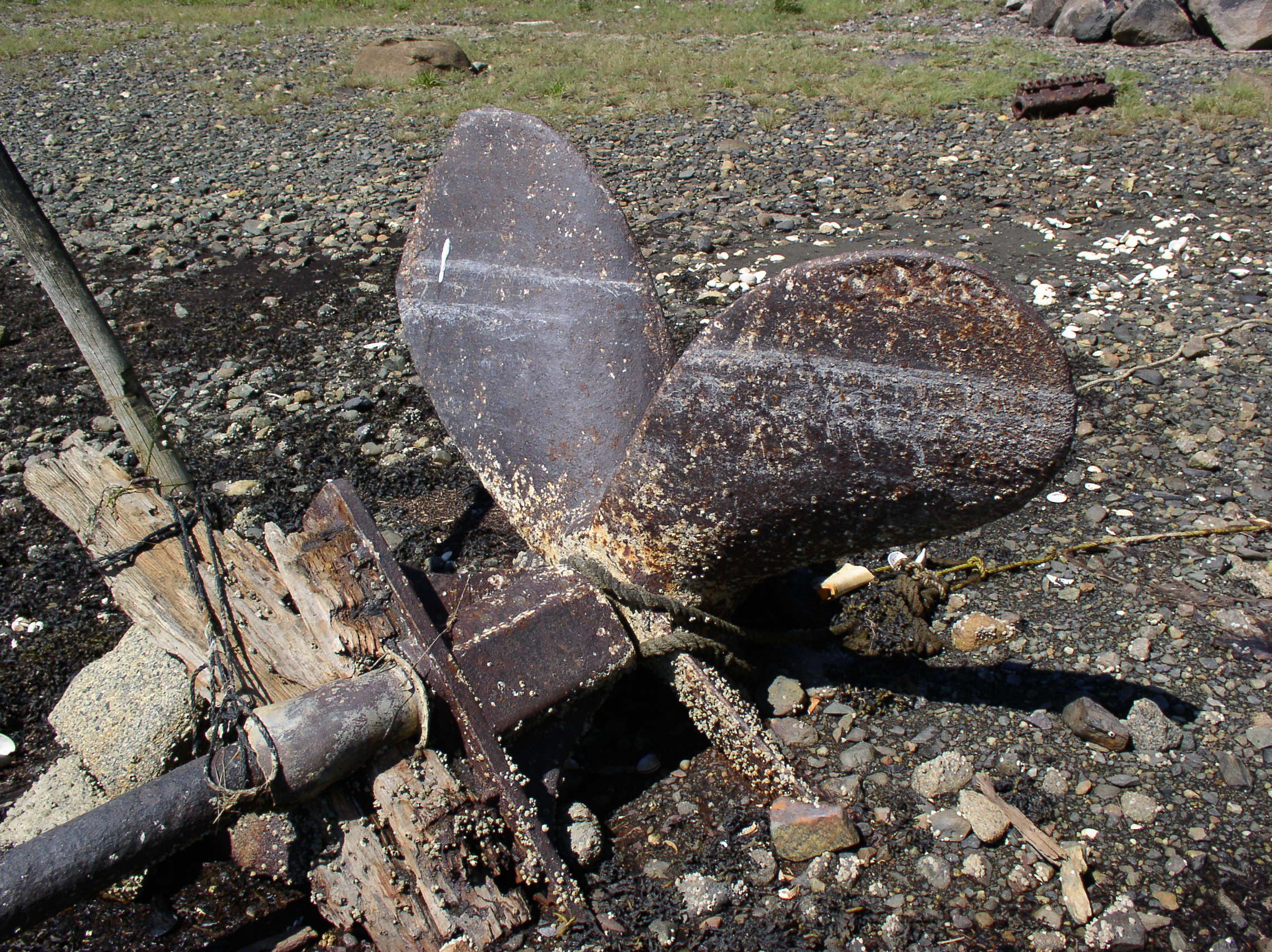
The propeller from this wreck was also removed by a prior resident of my family’s property, and dropped in the front yard. The story goes that the person believed it was brass, and planned to sell it for scrap, but when they began cutting into it, they realized it was cast iron. You can still see a cut section on one of the flukes.

OLYMPUS DIGITAL CAMERA

Is one of these wrecks the Anna Barron? I found a small snippet from a 1931 Google document claiming the Anna Barron sank at Point Couverden across Icy Strait, still with its original steam engines. Unfortunately the full text is not available.

“The “Anna Barron”, owned by the Alaska Pacific Salmon Corporation, believed to be the last remaining steam tender in the fleet, struck a rock and sank in Icy Strait July 22. Built many years ago by the former Thlinket Packing company, she was still valued at about $20,000

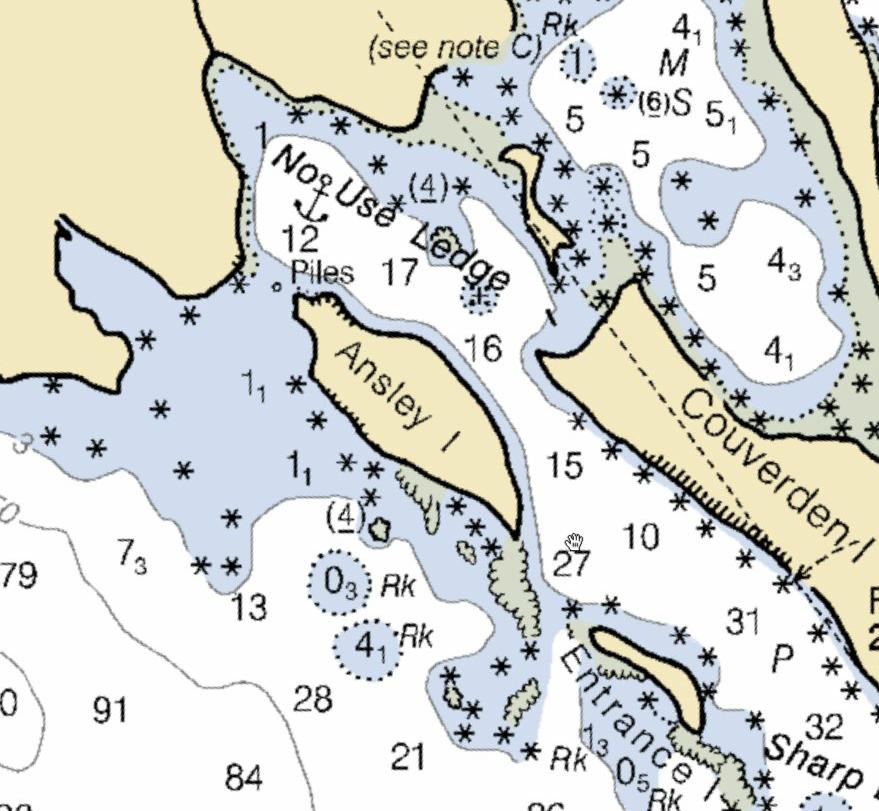
This page contains some additional information, sourced from US Customs wreck reports. According to the report, The wood steam tender Anna Barron hit the rocks at Ansley Point (Near Point Couverden) after departing Funter Bay the night of Tuesday, July 22 1930. Captain George D. Black was carrying a half scow load of fish and was attempting to offload to scows tied to a dolphin (piling structure) between two reefs off Port Ansley (now known as Swanson Harbor). The wind and tide in the narrow passage proved too much for the vessel, and it was forced onto the rocks in the darkness while maneuvering to reach the dolphin. The captain was quoted as saying the Anna Barron might be raised in the future.

Swanson

Some of the dolphins and other pilings are still visible in Swanson Harbor, and appear on nautical charts of the area.

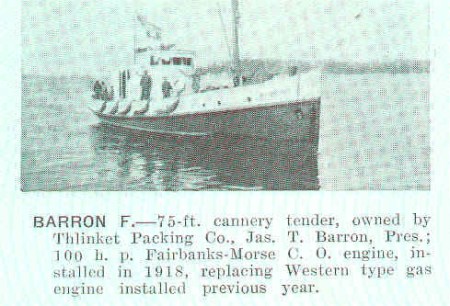
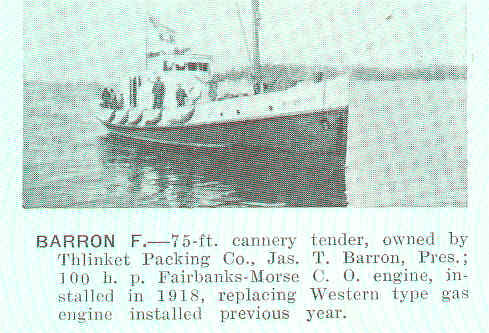
In addition to the Anna Barron,  the cannery also owned a 75′ boat named the Barron F.  (From UW Freshwater and Marine Image Bank)
Barron F

According to McCurdy there was an 85′ cannery tender named the Barron F built in 1917 for the Nooksack Packing Co. The US Merchant Vessel Registry lists a 65′ Barron F built in 1917, registry number 214967. I am not sure if these are all the same boat with errors in the published length, or different boats. It seems unlikely there would be so many vessels named after the Barron family in exactly the same way at the same time.

The cannery also seems to have owned a 53′ gas boat named the Buster, registry number 14481, built in 1889 in San Francisco. This boat caught fire and sank in Funter Bay in July of 1926, as mentioned here. The boat had left the cannery dock and suffered engine trouble, then a fire broke out in the gas engine during repairs. The vessel was assisted by the Anna Barron and the Driva (a 56ft gas towboat belonging to Juneau Lumber Mills), and towed to a dolphin. The  mooring line burned and the boat drifted around the bay, burning all night, before sinking “in deep water”. I do not know where this wreck is located precisely. The cannery had just been purchased by the Sunny Point Packing Company in this year.

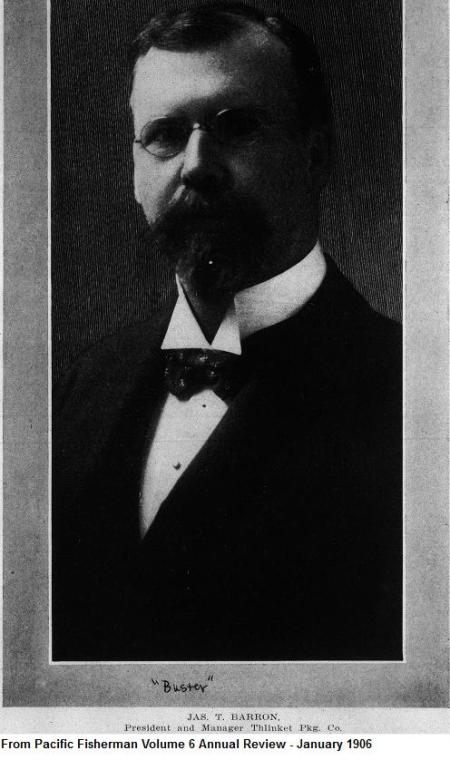
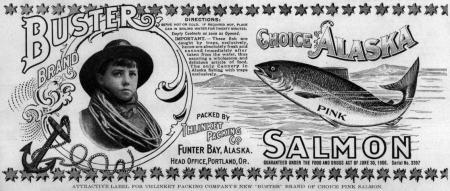
The Buster was probably either named after J.T. Barron himself (who sports the Nickname “Buster” scrawled on a portrait printed in the 1906 Pacific Fishermen Annual Review), or his son Robert, who was the model for the company’s “Buster Brand” logo. Robert was also featured on the cover of the May 1907 issue of Pacific Fisherman.
Buster

busterbrand

Robert Barron 2

As mentioned previously, Robert died in 1917 while trying to save fellow airmen from an accident in Philadelphia. Mount Robert Barron in Funter Bay was named for him.

Robert also appears to have had a cannery boat named after him, the Robert Barron, a 44ft gas vessel built in 1901 (perhaps for J.T. Barron’s earlier cannery near Wrangell), registry 111335.

So, back to the wrecks on the beaches. Which boats are they? Digging through alaskashipwreck.com I find the following listed for Funter Bay:

Vernia, 6 ton 28ft sloop, blown onto a rock at or near the Kitten islands and sank in Lynn Canal Jan 4 1904. Cargo of fish and gear worth $200, boat worth $150. No casualties, but the boat was a total loss. Master was William Beckler of Juneau.

This one is interesting because it was listed as built at Funter Bay in 1919. The 38ft gas screw Sandy, owned by LF Morris of Juneau, caught fire and sank in Auke Bay in 1928, while carrying an illicit cargo of liquor in kegs. All but 6 kegs were destroyed, the rest were confiscated by prohibition officers.

Tiny Boy, 46ft wooden oil (diesel) freighter owned by WH Bowman sank near Funter Bay Oct 11, 1940. All 6 crewmen escaped.

Reliance No 3, a 32ft wooden fishing vessel owned by WJ Smith, burned and sank off Naked Island near Funter Bay in 1953.

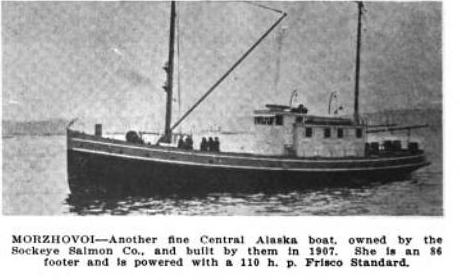
Morzhovoi, an 80ft wooden oil screw (diesel) boat, burned in Funter Bay on June 10, 1955. Reported as having a 165hp engine, being built in Seattle in 1917, and being used for freight service. Owned by the PE Harris Company, registry 214789.

PE Harris (which later became Peter Pan seafoods) purchased the Funter Bay cannery from the Sunny Point Packing Co around 1941. Morzohovoi Bay was another location where PE Harris co owned a cannery.

The Morzhovoi seems like the best candidate for the Coot Cove wreck. Digging some more, I find a reference in McCurdy to Morzhovoi; 80ft, 110hp, first vessel built at the National Shipbuilding Co yard in Seattle. Built for the Sockeye Salmon Co of Morzohovoi Bay (who later leased their cannery to PE Harris)

The 1918 Merchant Vessels of the United States registry lists the following specs for the Morzhovoi: 81 tons, 80.2ft long, 18.9ft breadth, 7.6ft depth, Fish service, crew of 7, 110hp gas engine, home port Seattle. Its registry number appears on the rolls of merchant vessels until 1956, when it disappears. In the 1955 registry it’s listed as an Oil boat of 165hp, radio call sign WB4935, belonging to PE Harris of Juneau.

Morzhovoi
Here’s a photo of the Morzhovoi from the 1919 issue of Pacific Motorboat. It lists some slightly inconsistent info (original HP and owner are correct, but year and length are off. I would suspect that these are typos).

Obviously the 110hp Frisco gas engine must have been replaced with a 165hp Atlas-Imperial diesel during a later refit.

So there’s one wreck identified to a high probability!

Trolling (pun intended) through the merchant vessel registry, I find a few other boats which may have been associated with the Funter Bay cannery. In the mid 1920s these include the Peasant, a 46ft gas boat built in 1926, registry 225554 and the Tepee, a 29′ gas boat, registry 210208 (The Thlinket Packing Co had canned salmon brands called “Peasant” and “Tepee”).
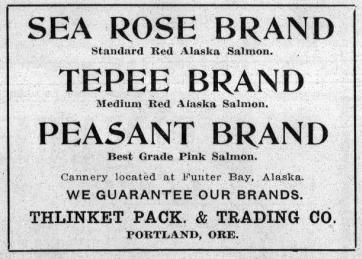
Ad 1905

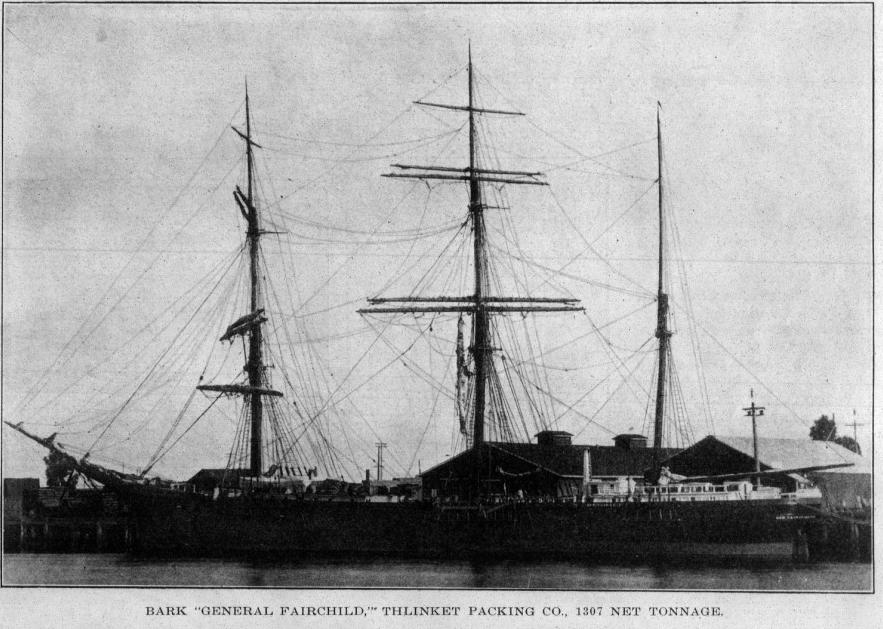
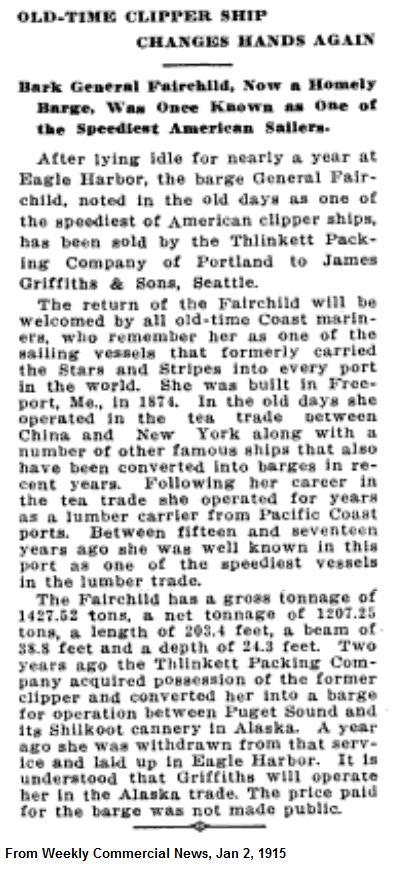
While researching Funter Bay ships, I was surprised to learn that the Thlinket Packing Co owned a large sailing vessel, the General Fairchild. This clipper ship seems to have been converted into a cannery barge, hauling packaged product from the canneries to sales “Down South”. It appears to have been used at the “Shilkat” (Chilkat?) cannery, probably near Haines, but may have also served Funter Bay. The ship was taken out of service after only two years, and then sold to another company.

fairchild

fairchild2

Prior to starting the Funter Bay cannery in 1902, the Thlinket Packing Co seems to have been active in Southern Southeast Alaska, using a leased steamer named the Baranoff and a 6 ton launch (gas boat) named the Perhaps, (per this article). The company (and later owners) also owned a number of other boats, used throughout Alaska, to the point where a complete list would take quite a bit of time to produce and would take this post wandering even further through Southeast maritime history! None of this helps me identify the other wreck at this time, but maybe I’ll find something as I continue digging.

Moving along to other shipwrecks around the bay…

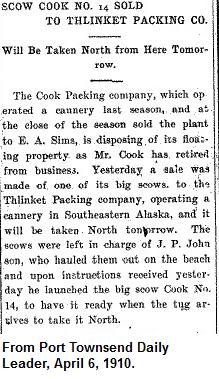
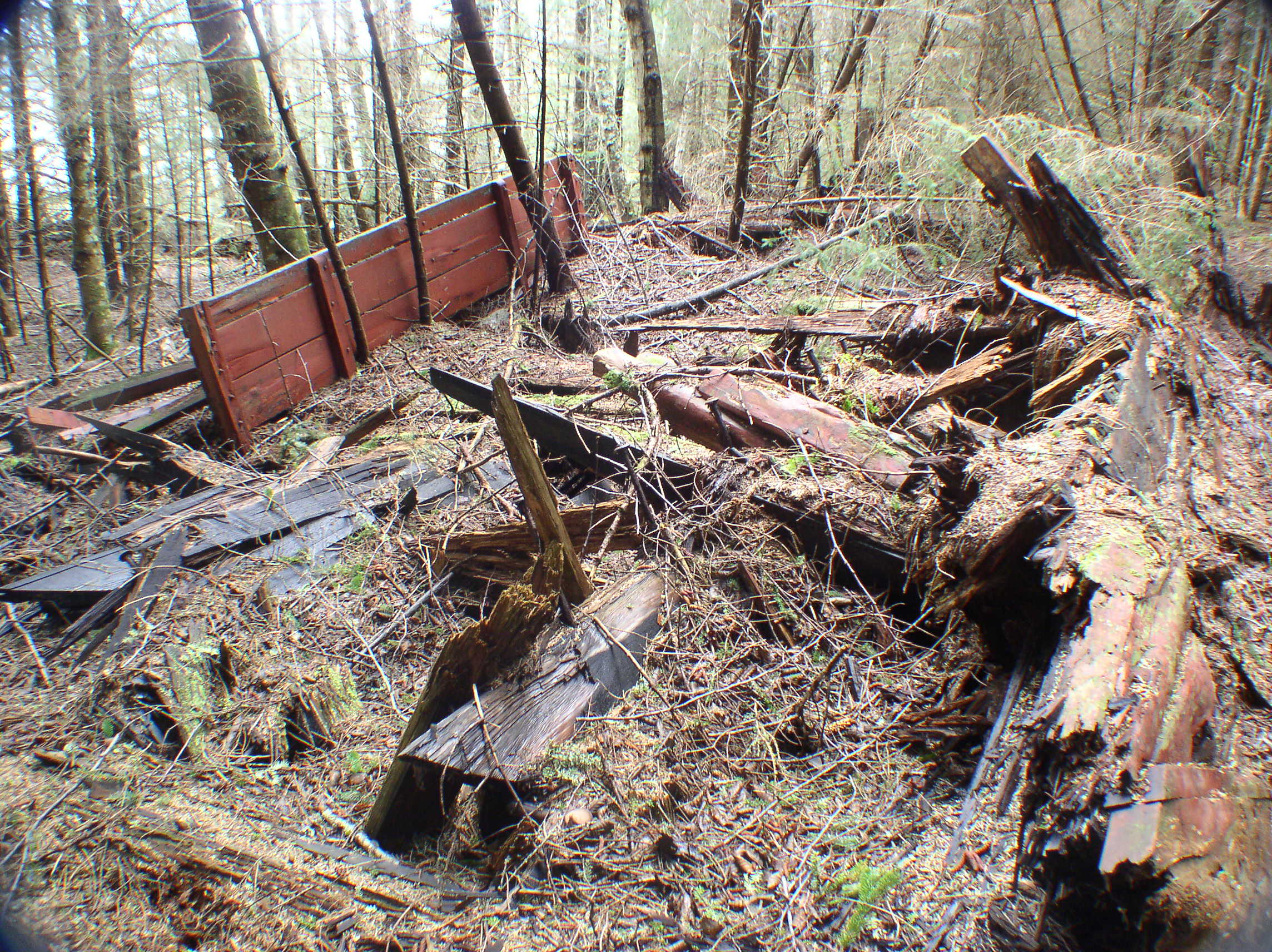
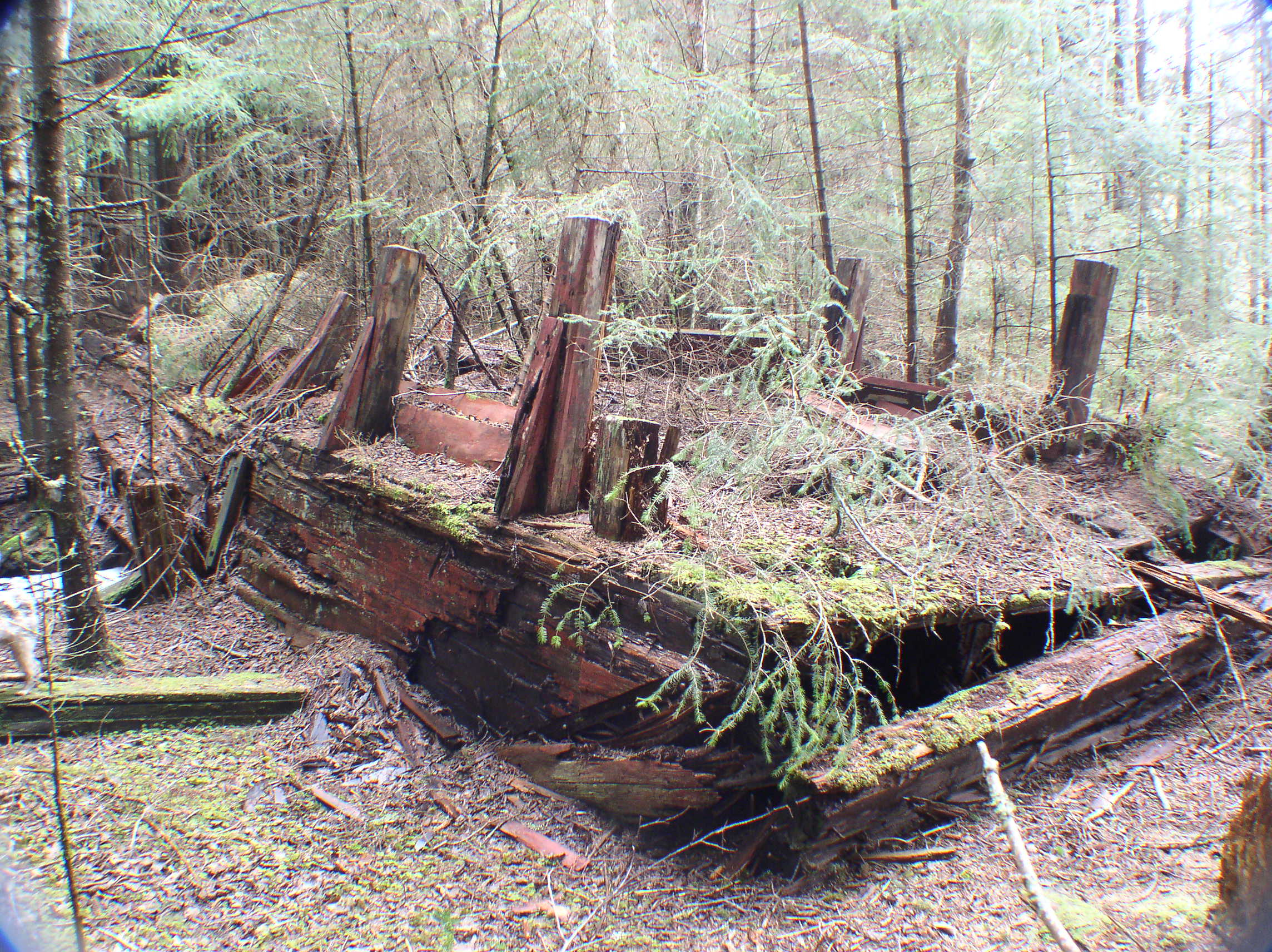
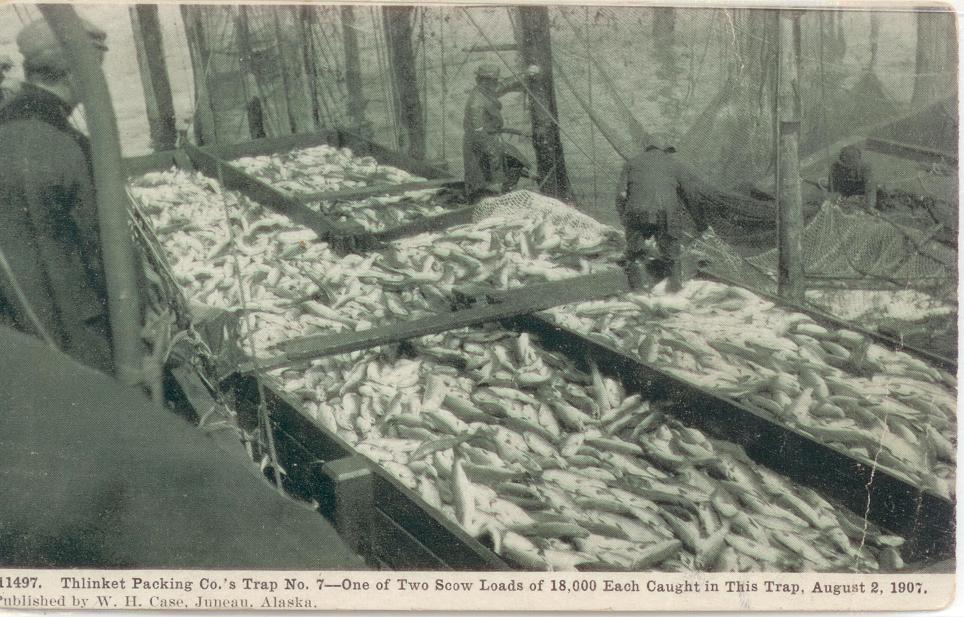
The Funter Bay Cannery also had a number of scows, which were fairly standard among canneries of that era. These were basically open wooden-hulled barges with high sideboards, used to transport fish in bulk from the traps to the cannery. Some of these were also registered with the government, and had such imaginitive names as “Scow #1”, etc.

scow

They were simple, rugged vessels which could be beached for storage over the winter. Scow Bay (AKA Coot Cove), around the corner from the main cannery dock, held the slipways and drydocks for scow storage. There are a number of scows still resting there, decaying into the rainforest.

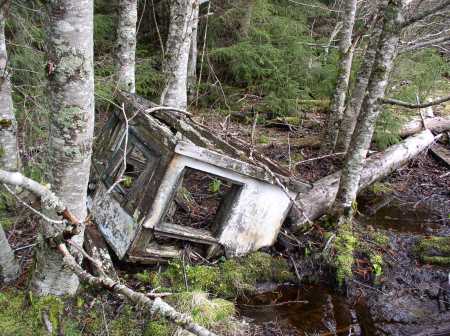
OLYMPUS DIGITAL CAMERA OLYMPUS DIGITAL CAMERA OLYMPUS DIGITAL CAMERA OLYMPUS DIGITAL CAMERA
Scows on the drydocks at Scow Bay.

OLYMPUS DIGITAL CAMERA OLYMPUS DIGITAL CAMERA
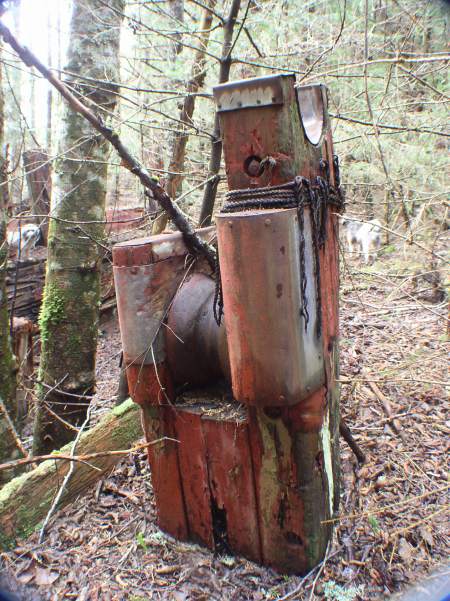
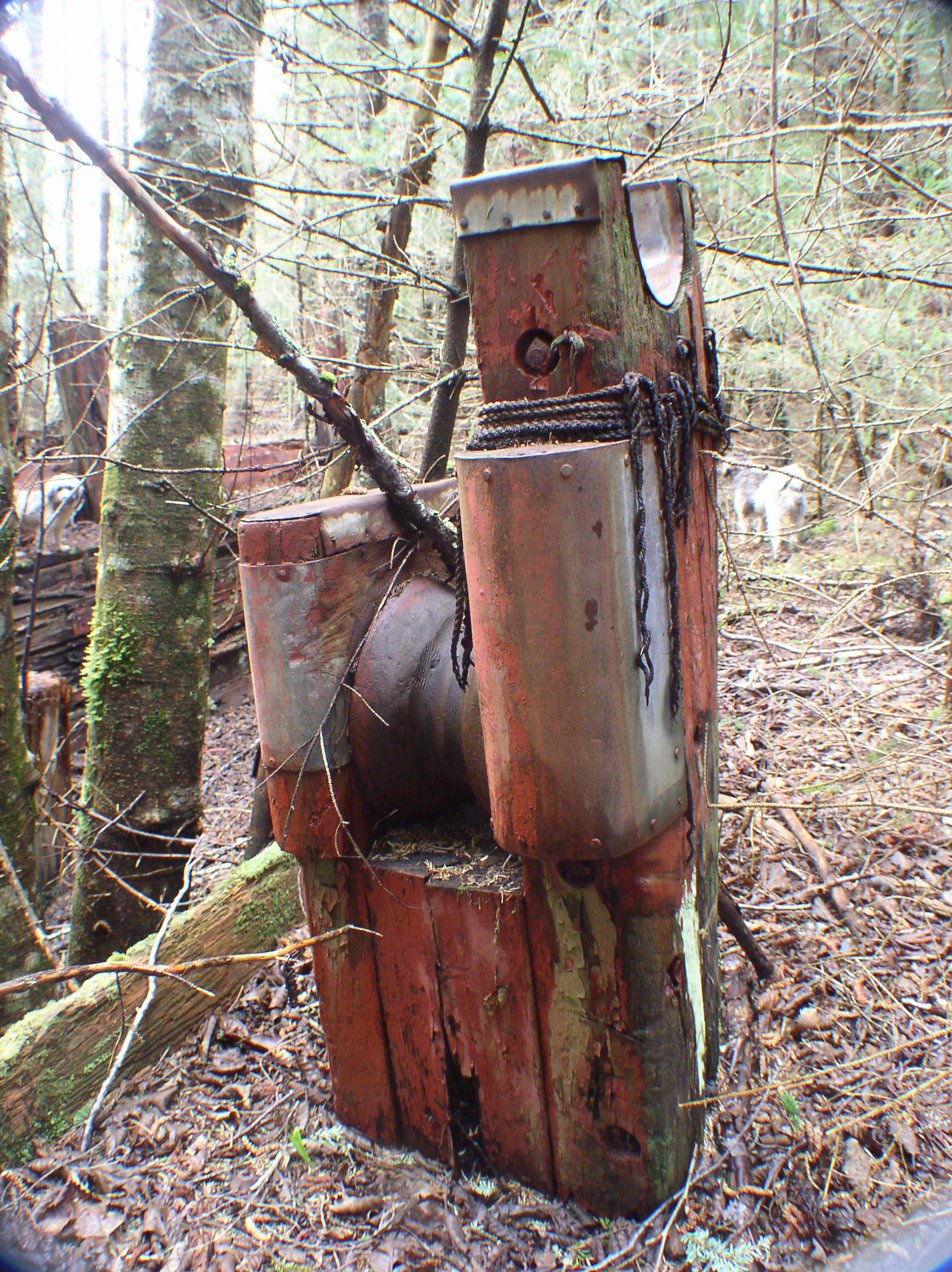
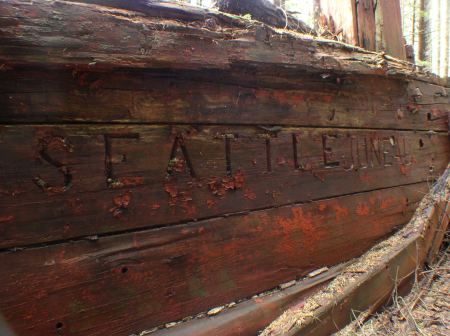
Some of the scows had their own machinery on board, including what looks like a small steam engine. There was another steam engine in the woods that ran a winch for hauling the scows up wooden ramps (slipways) to their storage spot.
OLYMPUS DIGITAL CAMERA
Port names listed on the side of a scow. Visible are “Seattle” and “Juneau”.

OLYMPUS DIGITAL CAMERA


Slipways at Scow Bay.

Scow Bay also has the remains of a ~30ft fishing boat:

OLYMPUS DIGITAL CAMERA OLYMPUS DIGITAL CAMERA

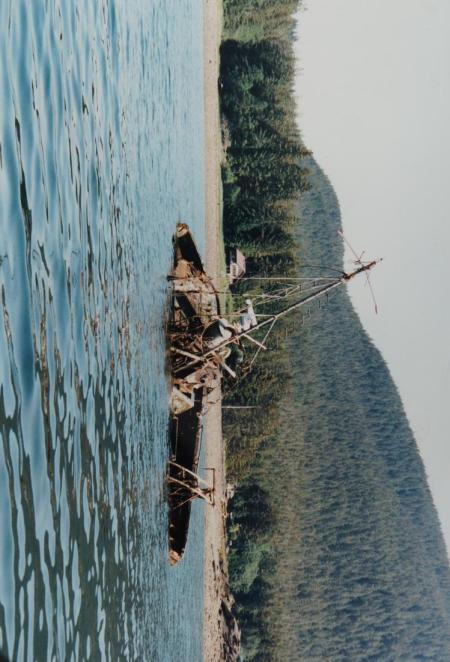
Wrecked fishing boats can be found in a few places around Funter Bay.
Jolene M
The Jolene M, a fishing boat which drug anchor and hit Highwater Island one night when I was young. The owner re-floated it and attempted to beach it for repairs, but never managed to get very much done with it. This is an old picture, there’s little visible of the wreck today aside from some metal bits in the mud at low tide.

OLYMPUS DIGITAL CAMERA
The Jolene M looks more like this now. Wood decays very fast in tidal environments.
Nimrod
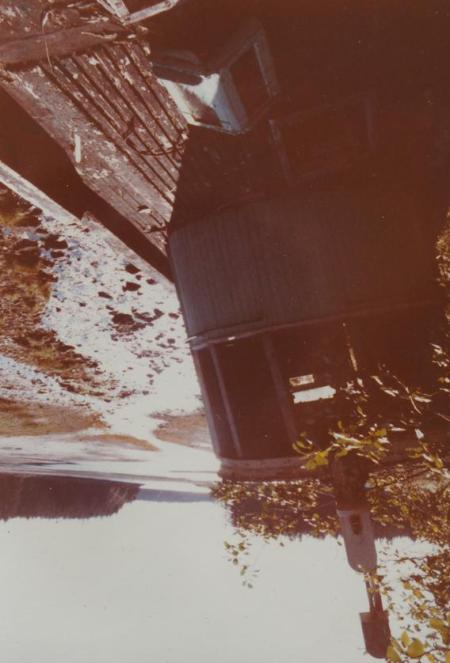
The Nimrod, a wooden boat (probably also a fishing boat) which was beached up “Nimrod Creek” (local name). There is also quite a bit less of this boat remaining intact today. (Update 4/23/13: This was originally a tugboat, I’ll add more details in a future post).
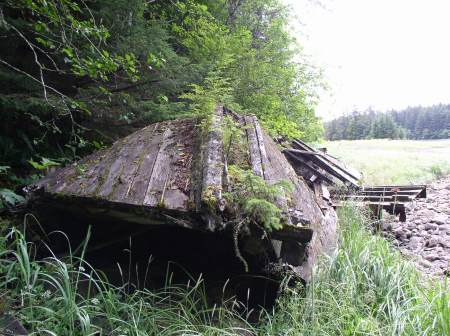
OLYMPUS DIGITAL CAMERA
More recent Nimrod photo.

And just for fun, here are a few even smaller abandoned boats (skiffs). Maybe some of them are the lifeboats seen on the cannery tenders, or the small sailing boats mentioned in articles about the Barron family? Or they could simply be some of the many small skiffs that you find in any Southeast Alaska community, as common as the family cars down south.
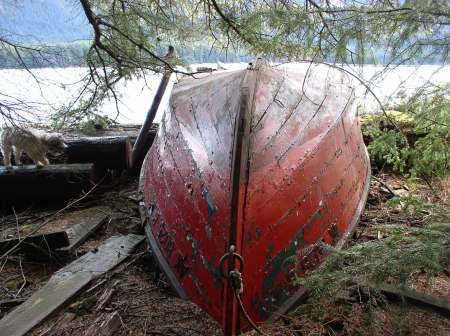
OLYMPUS DIGITAL CAMERA OLYMPUS DIGITAL CAMERA OLYMPUS DIGITAL CAMERA

Once again I have produced a stream of meandering research beyond all reason. And I still have plenty more to expand on things mentioned in this post… what happened to the Barron Family? How did they use legal loopholes to get their land? What was the later cannery history? What other fishing-related activities happened around the bay? Just a few things I hope to cover in the future!


Funter Bay History – Cannery Postcards and Leftovers

April 10, 2013
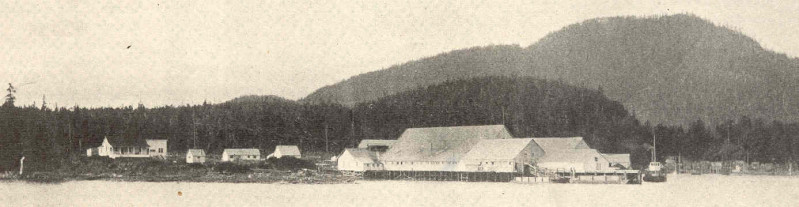
Cannery overview

Thlinket Packing Co Cannery at Funter Bay (from Pacific Fisherman Annual Review 1908 via University of Washington Library Freshwater and Marine Image Bank, used as Public Domain per their policy.)

I came across a few old postcards that I’d purchased at an antique show in the Midwest, showing my hometown of Funter Bay, Alaska during the salmon cannery days. I’ve put together a little more information and back-story to these. I’ll try to add more photos and information on the history of Funter Bay as I have time.

postcard4

The cannery tug Anna Barron, shown tending Fish Trap #6 in or near Funter Bay in 1907. As with most of these postcards, this is a colorized B&W photo by Case and Draper, a Southeast Alaskan photo studio that operated until 1908.

Here is an original B&W of this image with some additional information, courtesy of the Alaska Digital Archives. Here’s another photo of the Anna Barron approaching the cannery dock with two scow-loads of fish.

Here is a close-up of what the crew is up to in the first postcard shown above. The derrick onboard the Anna Barron is lifting a section of fish trap net (Brailing) to dump the salmon into a scow (barge).

postcard2

And here are two versions (from two different postcards) showing the same operation from a different angle. I believe this is the same crew, although they’ve colorized Mr. Floppy Hat guy’s clothing differently:

postcard5postcard3

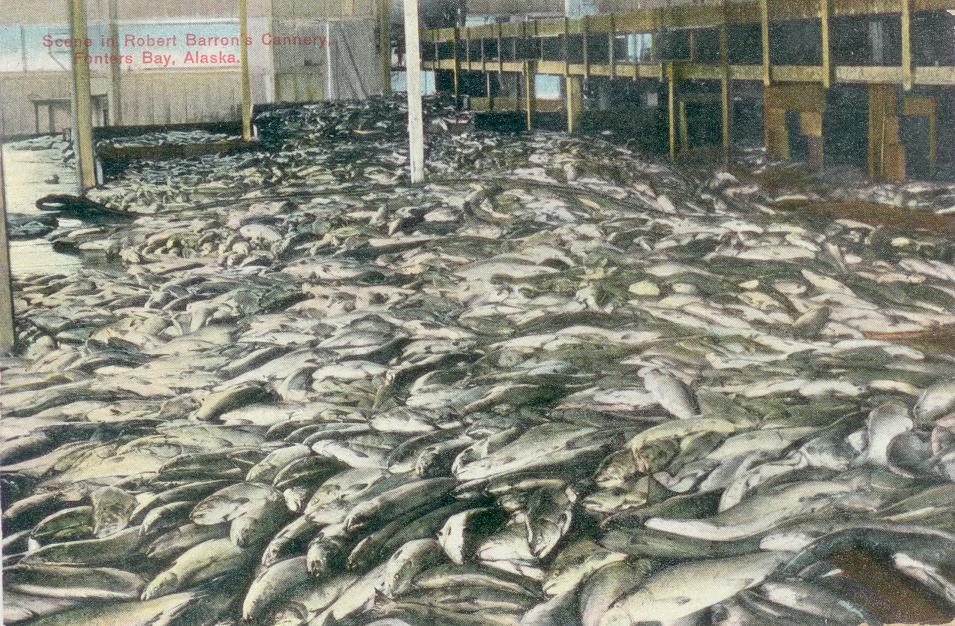
And here are the salmon after being unloaded at the cannery, waiting to be sent through the processing equipment to be cleaned and packaged.

postcard1

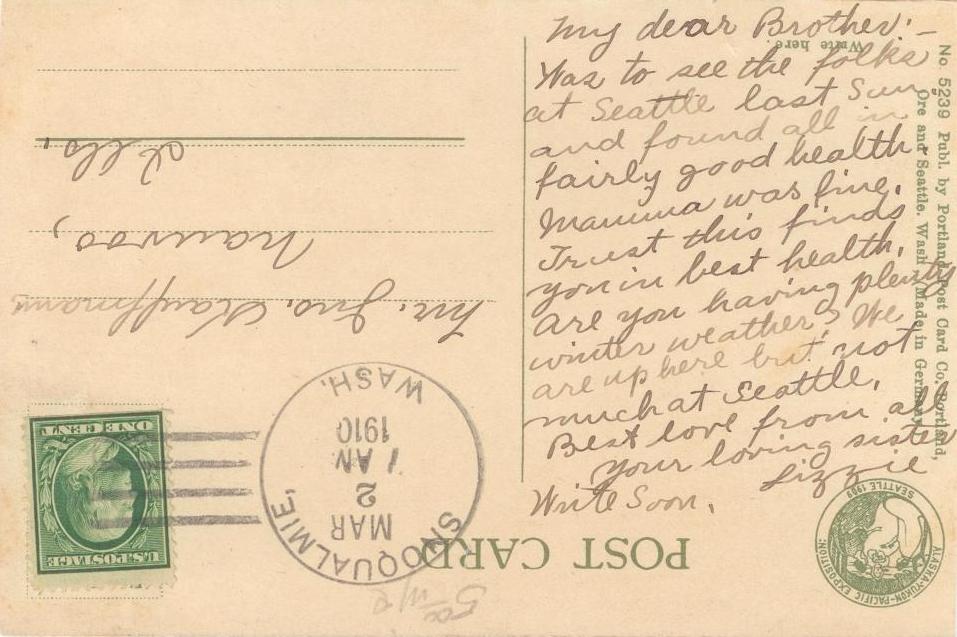
Just for fun, here’s the only postcard which was filled out and mailed, the rest were unused.

postcard1-back1 postcard1-back2

The Alaska Digital Archives have many more from this Case & Draper set, as well as photos of cannery operations from later years. All of them can be found here.

Here is another photo from the University of Washington Archives, showing salmon being brailed onboard the Anna Barron.:

brailing

Fish traps were hugely efficient at catching salmon, as they effectively blocked spawning streams and diverted all returning salmon into the nets, making the salmon do the work of catching themselves. They were often temporary structures maintained during the spawning season, usually being built from untreated driven pilings, floating logs cut locally, and nets. The nets and more expensive hardware were stored over the winter, and the trap structures would often require repair or rebuilding in the spring after winter storms and rot had taken their toll. Today you can still sometimes find “trap logs” on the beaches, identifiable by the rusty bolts and hardware that attached them to other parts of the structure.

weasel 1
A trap log in our yard (with an ermine on it). These are so massive that it’s easier just to leave them where they are and attach stuff to them. This one was the top end anchor of our outhaul.

The design of fish traps resulted in enormous early profits for the canneries, but quickly proved self-defeating, as the salmon runs for those streams were wiped out. In the 19th and early half of the 20th century there were few legal restrictions on fishing, although competition was fierce, the the point of nearing international incidents. In 1904, President Roosevelt dispatched the revenue cutter Perry to Funter Bay, where two Japanese fishing vessels were seized and the crews deported (source). (I hadn’t heard of this before, so I Googled around a bit and happened across this picture of the Perry’s eventual fate in 1910).
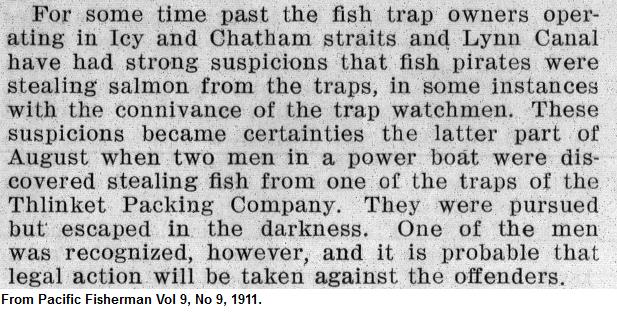
Native Alaskans and independent fishermen often opposed and sometimes sabotaged fish traps. There were even incidents of “Fish Piracy“, in which traps were raided before the company could empty them. This led to watchmen manning each trap, living on board the floating or driven-piling structure in small shacks during the fishing season, although the watchmen could sometimes be bribed.

pirates

Here’s a model of a fish trap, including the small watchman’s shack:

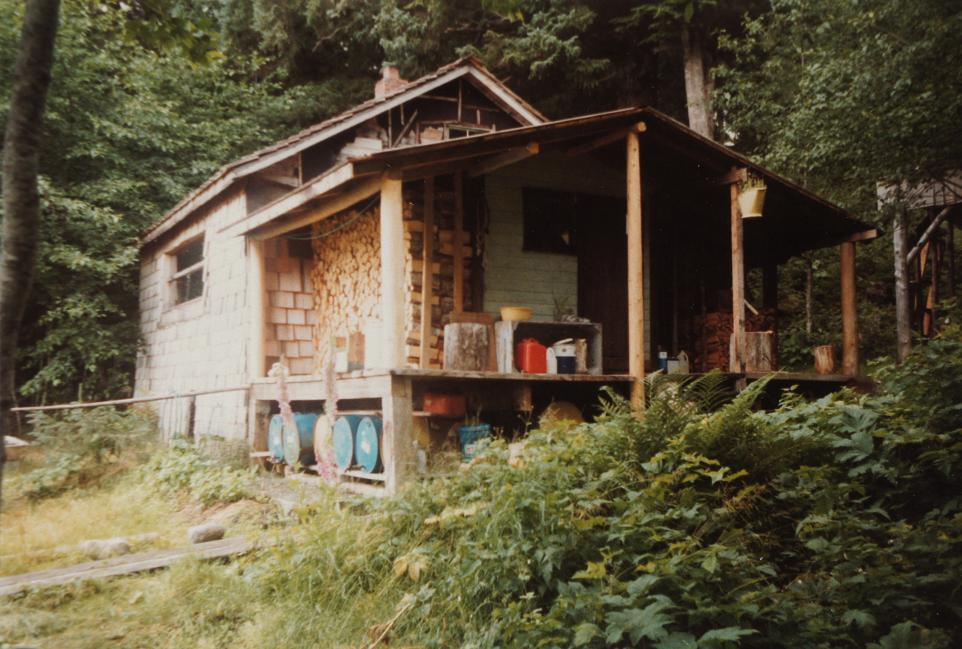
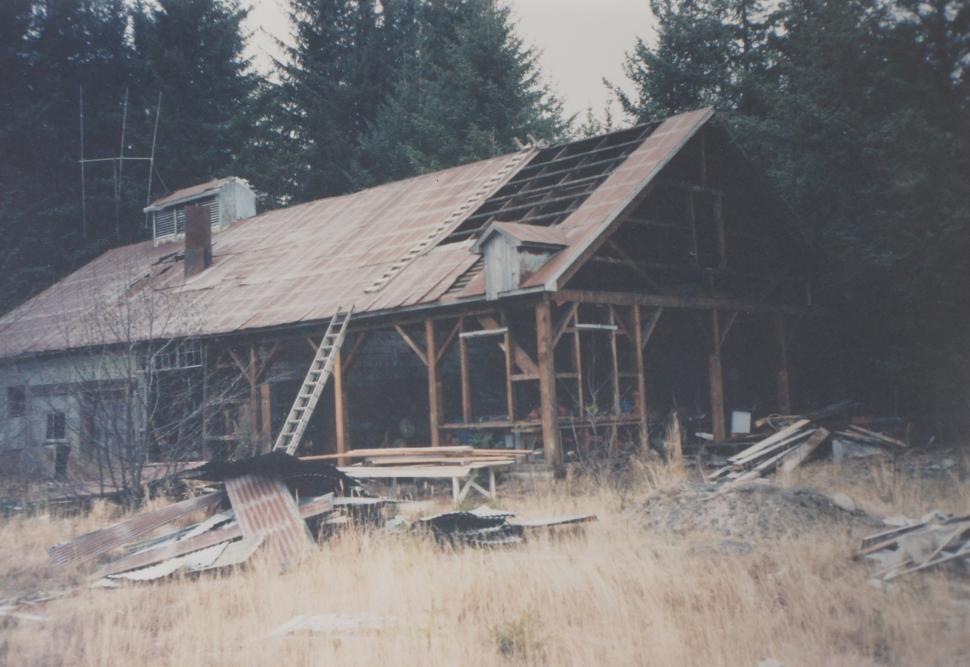
Part of the house I grew up in was a trap watchman’s shack that was moved up the beach. My Dad later added it to the house as an entry/mudroom.

House early
An photo of our house soon after my Dad moved in. The structure to the left is the former trap watchman’s shack, which Dad moved up and to the right to attach to the main house.

House back porch
The same house after Dad began adding to it. The fish trap shack is in the foreground surrounded by a new deck and awning.

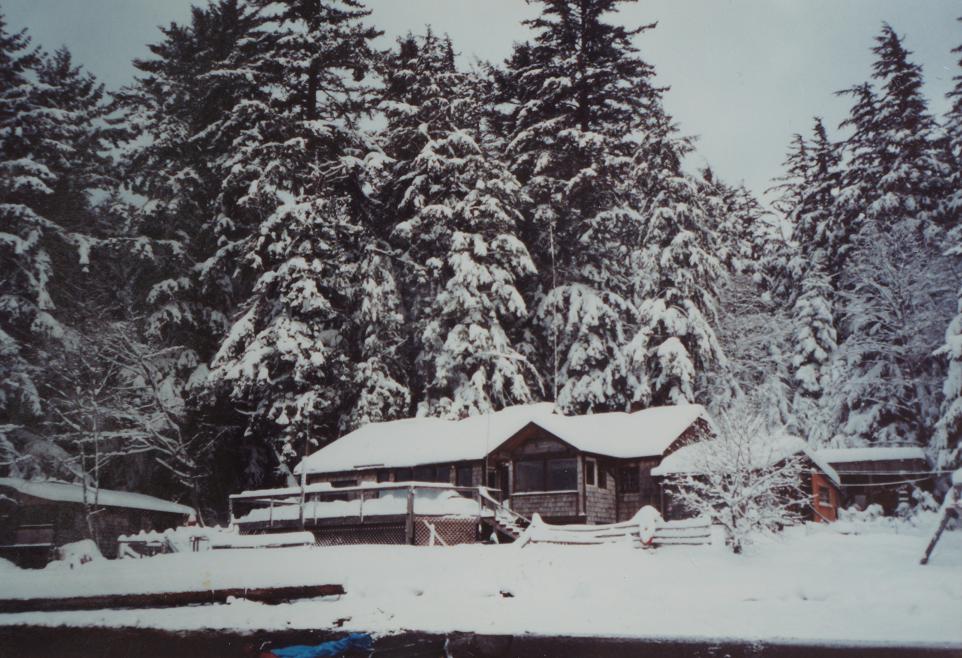
The house at Funter Bay on a snowy day. Normally winter was just wet, and snow didn't tend to last very long.
The final house layout, the entry is on the right behind the small Alder tree.

Fish traps were eventually regulated and later banned entirely. More information on Fish Traps (PDF) can be found in this research paper from the University of Alaska, there’s also an HTML version.

And now, more information on the cannery itself.

The Thlinket Packing Company, owned by James T. Barron of Portland, Oregon, was begun in 1902. It operated until the 1960s when fish traps were effectively outlawed. I suspect that other fish packing operations at Funter predated this company (there was also a saltery less than a mile away on Highwater Island). During the later years, the cannery location became known as “Funter”, and is shown as a town on some maps. It had regular mail service by both boat and seaplane. Well-maintained trails connected the cannery to the gold mines at other locations around the bay, and the Bear Creek Trail ran over the top of Mansfield Peninsula through a pass to the other side of Admiralty Island (facing Juneau). Various pipelines connected the cannery to nearby streams, as operations required a large amount of fresh water. Scows were overwintered on an extensive slipway and drydock system in Coot Cove.

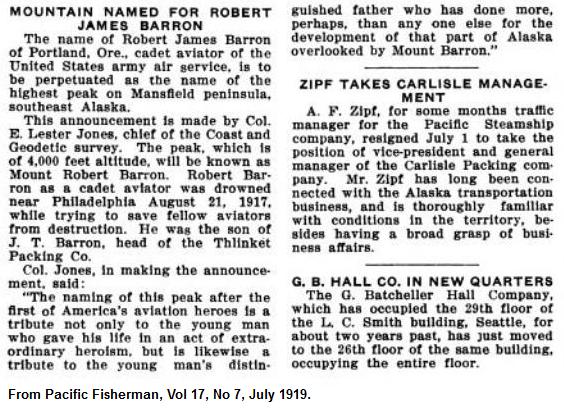
Mount Robert Barron, the highest peak near Funter Bay, was named in 1919 to honor J. T. Barron’s son Robert.

Robert Barron

James Barron apparently also built an office building in Portland in 1921.

And to further wander from the original topic of postcards, here are some photos my Dad took of the Cannery’s appearance when he arrived in the 70s:

Funter Cannery

An overview of the cannery as seen from the water.

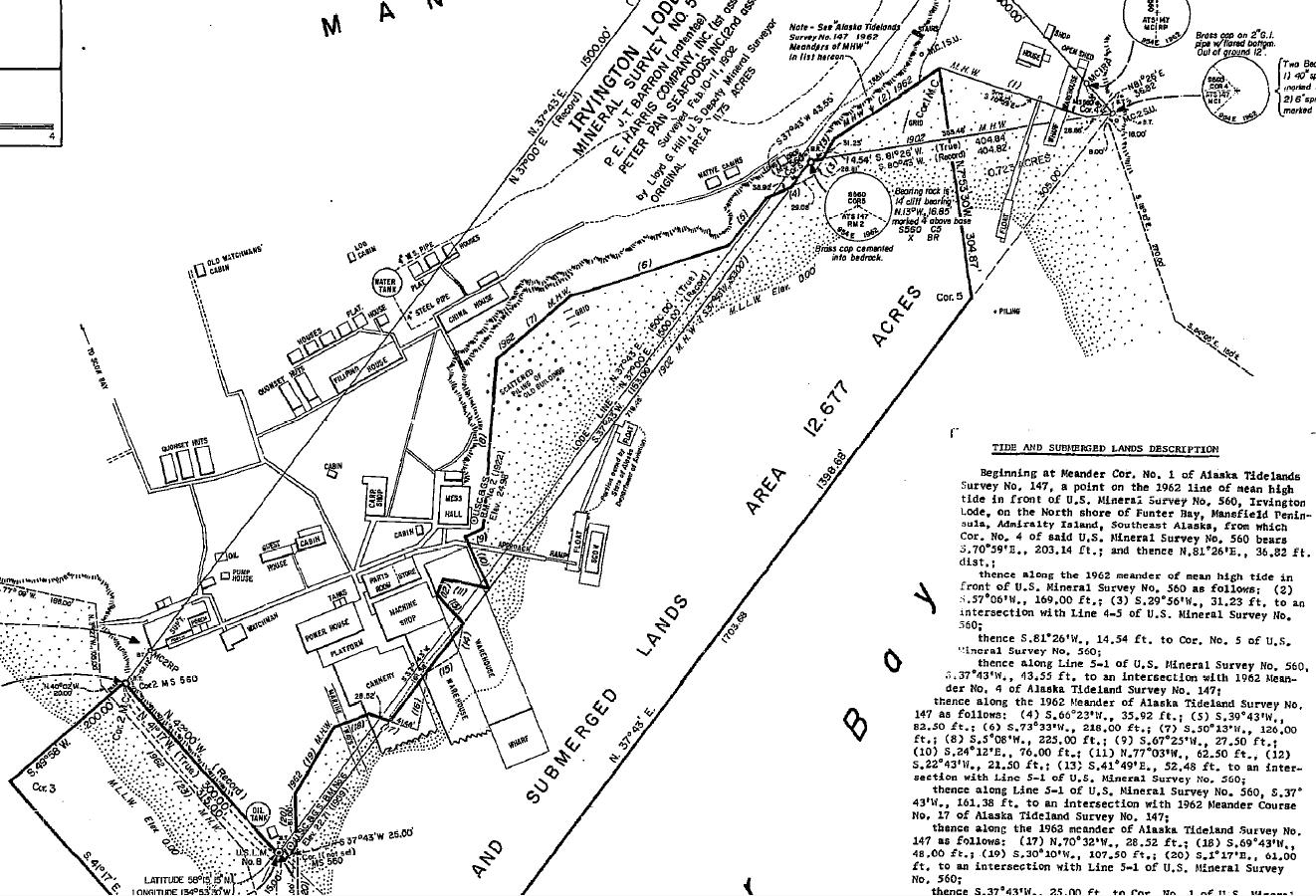
Here is a great survey map showing the layout of some of the buildings in 1964. This includes many additions, such as the Quonset huts brought in by the army during WWII to house “evacuated” Aleuts (more information on that unfortunate incident is available here).

Cannery map

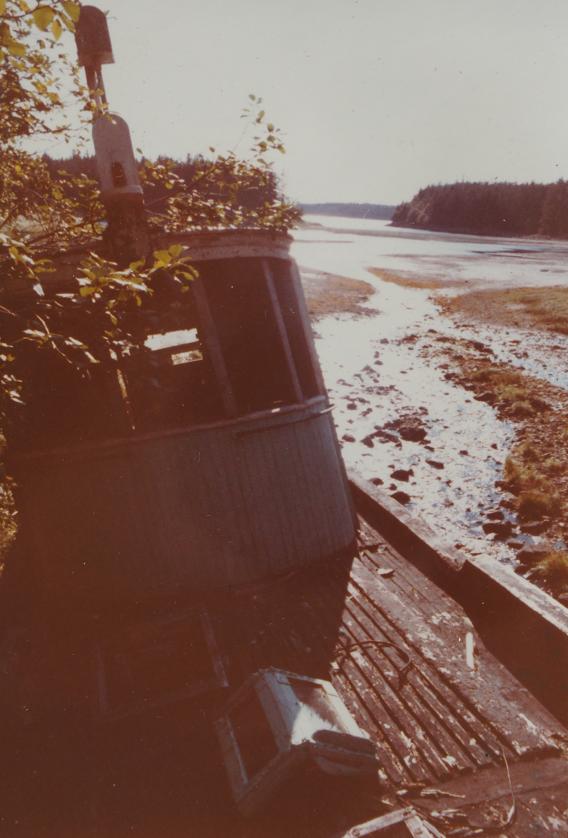
The carpentry shop. That’s not a church, the cross at the top is a telephone pole. This is where Dad built his first wooden fishing boat:

Cannery 1Cannery 2

I believe this was the power house:

Cannery 5

Either the Chinese or Filipino bunkhouse:

Cannery 3

Various cannery ruins on the beach:

Cannery ruins


When I was a kid, we still had a few of these buildings left, and a lot of leftover equipment and rusty “stuff” on the beach. Unfortunately, a lot of the old buildings were burned or bulldozed during various subdivision and redevelopment attempts (including some built from huge California Redwood planks, worth a fortune today)

Steam Engine 1Steam Engine 2

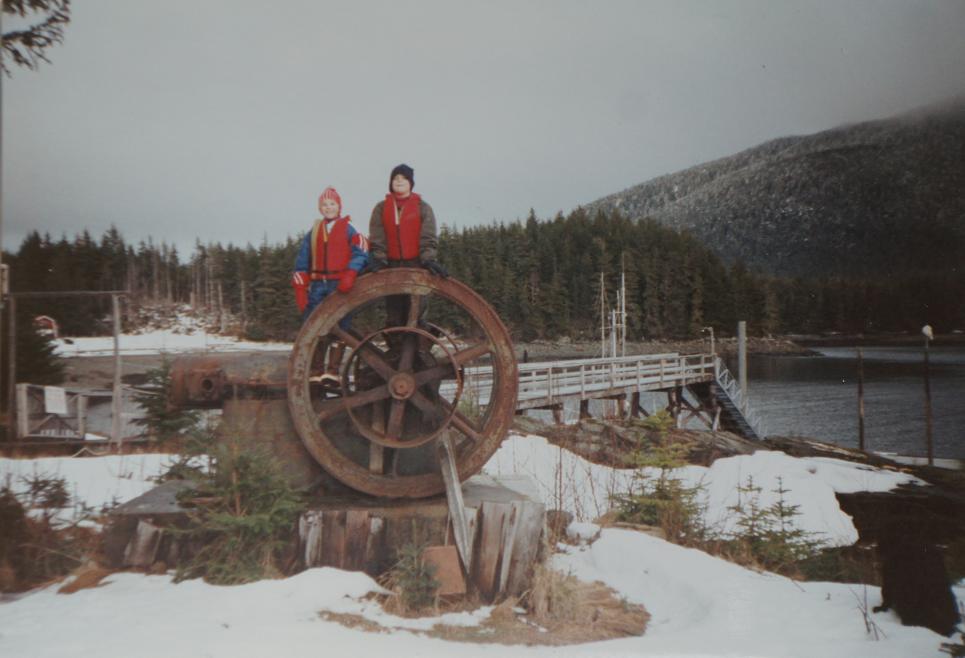
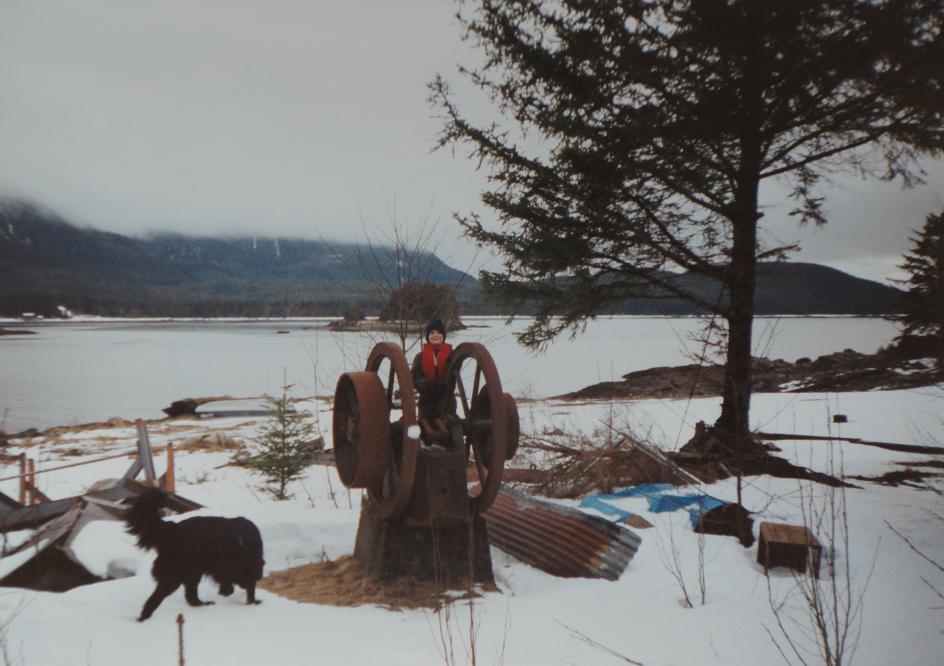
Here are Megan and I on two of the stationary gas engines that drove the canning lines. These made great trains/cannons/spaceships!

steamengine1.jpg

These would have had a belt driving overhead rods, which drove the other equipment throughout the cannery building. Here’s a photo from the archives showing the overhead shafts and belt drives

This post is starting to get ridiculously long and wandering, so I’ll continue thing later. Next up: what happened to the Anna Barron? Stay tuned!

Edit: Gordon Harrison pointed out that the stationary engines were early Fairbanks-Morse gas engines, not steam as I had previously thought.


Boatbuilding

March 22, 2013

I found a few more photos in the old album scans that are relevant to the topic of boat building. Long-time readers of this site will recall some of my boat projects like the S/V Pagoo, plywood kayaks, and the Craigslist sailboat (update: I sold the small sailboat to the St. Paul Saints as a prop/prize for one of their halftime shows)

Anyway, here are some of my Dad’s boats!

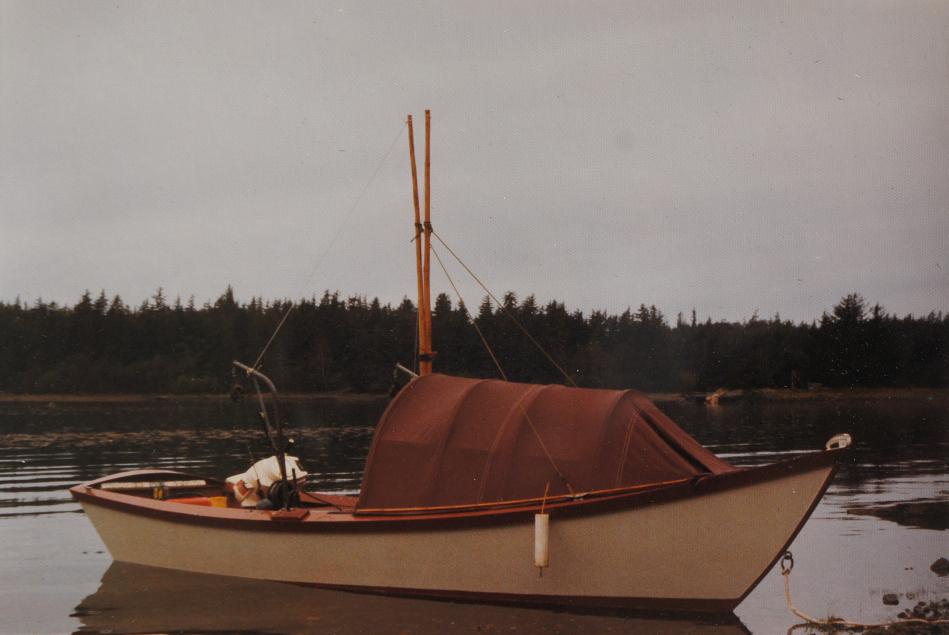
After moving to Alaska in the 1970s, he hand-built a small fishing dory in one of the old cannery sheds. It was powered by an outboard motor and equipped with hand-crank downriggers (gurdies) for hand-trolling. It even had a small “cabin” which was more like a tent.

Dory 1

Here’s the dory under construction:

Dory 2

And launching with the help of some neighbors:

Dory 3

After saving up enough money from dory fishing, he was able to upgrade to a larger power troll vessel, the F/V Venture. This was a converted wood cruiser.

Venture

In the pit

And finally, the 36′ F/V Imperial, which Dad purchased as a fiberglass shell (“Hull, deck, and house”), and finished off in Port Townsend WA before bringing it up to Alaska.

Imperial  Imperial and Fairweathers

The Imperial was named after Imperial Whiskey, and featured the font on the stern. Someone sent a photo to the company who produced the brand, and they sent Dad a bunch of free stuff. Apparently Imperial Whiskey is now a collector’s item!

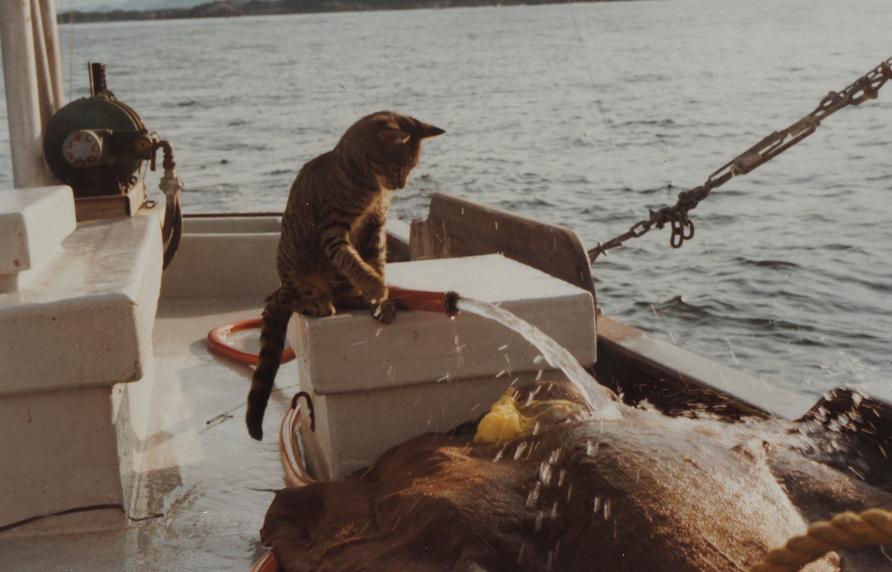
For a while, the crew of the Imperial included our family cat, Mandy. I think the story goes that someone had a box of kittens they were giving away in Elfin Cove, and as they got back on the plane for Juneau, they handed my parents the box with the last kitten.

Mandy washing fish Mandy driving


Another dredge update

January 23, 2013

I received another email from the state of AK regarding the dredges. It seems these were in fact on private land and no oversight or government involvement was required to scrap them. It sounds like Tri-Mountain metals can continue scrapping historic sites if they’re all privately owned. If they want to work with the BLM in the future, as the ADN article stated, then hopefully there will be more attention paid to historic status of their targets.

Dear Mr. Emerson,

Your email was forwarded to our office following its receipt and review by the BLM Fairbanks District Office.  Upon our preliminary review, it appears that both of the dredges that you reference in your email below (F.E. Company Dredge No. 5 [AHRS #LIV-00111] and F.E. Company Dredge No. 6 [AHRS #FAI-00222]) were located on private land and privately owned.  As you point out, in 2004, the F.E. Company Dredge No. 5 was listed on the National Register, which is our Nation’s official list of historic places worthy of preservation.  We agree that the loss of these important historic properties is unfortunate.

At present, our office reviews and provides recommendations to avoid, minimize, or mitigate impacts to the State’s significant historic properties when there is a specific State or Federal action that has the potential to affect them.  If a private owner/operator takes an action, the action is located on private land, and it does not involve any Federal or State oversight, permitting, authorizations, etc., a review by our office is not required.  While we often work with private operators/landowners in an effort to protect significant sites, some may choose not to do so.

We would be happy to answer any additional questions that you may have about the State and Federal review processes that our office participates in.

Best regards,
Shina

Shina duVall, RPA
Archaeologist, Review and Compliance Coordinator
Alaska State Historic Preservation Office / Office of History and Archaeology


Dredge scrapping updates

January 11, 2013

Here’s a quick update to yesterday’s post. After reading the Anchorage Daily News article, it seemed that the Bureau of Land Management was working with Tri Metal International to procure dredges and other mining equipment for scrap metal, as the article states “The company is also pursuing abandoned mining equipment and machinery via the Bureau of Land Management.” A poster on the AKmining forum also had the impression that the BLM owned the dredges.

I tried contacting the Fairbanks office of the BLM, but their online form was broken. Eventually I found a few email addresses and sent essentially the same thing that I posted here, CCing the main contact from the National Register of Historic Places (NRHP) website. Here’s what I got back, apparently the BLM was not involved in the dredge removal:

BLM_AK_FDO_GeneralDelivery to Gabe:

Mr. Emerson — Thanks for your message about the gold dredges. I talked with the archeologists in our office and learned that the two dredges in question were not on BLM-managed public lands at the time of their removal. The BLM was not involved in dismantling or removing the dredges, and we have no information on who undertook the project or why they did  so. At the archeologists’ recommendation, I am forwarding your message to Mark Rollins at the Alaska DNR Office of History and Archaeology. He may be able to shed more light on what happened.

I’m sorry you had problems using the BLM-Alaska contact page. I’ll look into that problem and get it fixed.

Please let me know if I can be of further assistance. — Craig McCaa

Craig McCaa
Public Affairs Specialist
BLM Fairbanks District Office

——————————————————————————————————————-

Paul Lusignan (NPS NRHP) to Gabe

Gabe,

You may want to direct your concerns to both the Alaska State Historic Preservation Officer and the Federal Preservation Officer for BLM.  Under Section 106 of the National Historic Preservation Act (NHPA), federal agencies have to evaluate the impact of their actions on properties listed in or determined eligible for listing in the National Register of Historic Places prior to proceeding with their projects.  Federal agencies consult with the State Historic Preservation Officers (SHPO) and interested members of the public regarding the identification of historic sites and ways to mitigate or lessen the potential negative impacts of their actions.  It is not always possible to stop federal projects, but at least there is a process for considering alternatives.
It may be that BLM and the SHPO did consult on this project under the provisions of Section 106, as one of the articles did note an agreement was reached with the state to document elements of the project.   The Federal and State Preservation offices will be better able to discuss their specific actions.
Paul R. Lusignan

Historian
National Register of Historic Places
National Park Service

(Paul also included contacts for the BLM and SHPO)

So, while Tri Metal may be soliciting scrap metal sources from the BLM in the future, it appears that they sourced the two Fairbanks dredges some other way, perhaps directly from the owners? It’s still disappointing that they’re gone, and I’m still disappointed in the BLM for demolishing the Jack Wade dredge, but it doesn’t sound like they’re on a systematic dredge hunt at the moment!
I’ll be interested to hear if their archeologist has any more information, and I’m still waiting to see what else Tri Metal gets their hands on…

Scrapping History for Fun and (no) Profit

January 9, 2013

I was saddened to learn that <someone> has begun demolishing historic sites in Alaska and selling them for scrap metal. And they’re not even making a profit on it! (Update: I initially thought the Bureau of Land Management was doing this, but after emailing them, they’ve stated that they weren’t involved).

As reported in the Anchorage Daily News on November 15th of 2012, a “Test Shipment” of scrap to South Korea included “Two gold dredges from Fairbanks” (http://www.adn.com/2012/11/15/2694098/new-international-export-at-port.html)

Here’s a video version of the article released by the MatSu Borough: http://www.youtube.com/watch?v=gLl-fPHfCKQ

As some background (click for Wikipedia article), gold dredges are large mining machines, designed to float along streams and scoop up gold-bearing gravel (placer gold). There were once 8 of them in the Fairbanks area, with this recent destruction there are only 4 remaining.

I happen to be familiar with both the dredges that were scrapped, The Fairbanks Exploration Company’s #5 and #6. Dredge Number 5 is (was?) on the National Register of Historic Places: http://pdfhost.focus.nps.gov/docs/NRHP/Text/04000186.pdf
Here are some photos from the National Historic Register.

Here is a historic video of #6 being moved from one mining area to another: http://vilda.alaska.edu/cdm/singleitem/collection/cdmg11/id/6910/rec/15

Some more recent photos on Flickr:
F.E. Co Dredge #5: http://www.flickr.com/photos/45622415@N06/sets/72157622883552541/with/4187941367/
F.E. Co Dredge #6: http://www.flickr.com/photos/45622415@N06/sets/72157622901922769/with/4195297437/

Maybe these dredges weren’t as popular or well-known as the ones you can drive right up to, but they had their share of visitors. I’ve hiked out to both of the dredges in question (I’m not sure who owned the land at the time, the trails to the dredges were not signed or marked when I visited. I did hear that someone later put up a “no trespassing” sign at Dredge #5 after it became popular with geocachers) (Update: the BLM says that they don’t own or manage the land). I enjoyed seeing these somewhat forgotten mining relics in-situ, as they were left at the end of mining work, with trees growing up through them and wildlife inhabiting the interior.  It felt like a much more authentic experience than queing up with a group of Florida tourists to visit some sanitized, OSHA-approved, restored commercial attraction (No offense to the owners of Dredge #8, but I always preferred the rusty abandoned dredges and never got around to visiting their touristy one). I particularly liked the journals of dredge movements, weather, and other comments written on the interior walls with chalk by workers in the 1930s. All of which is gone now. It isn’t even a win for the environment, looking at recent aerial photos, I see that whoever pulled the dredges out bulldozed their way through and generally tore up the areas, leaving landscapes that look more like a gravel pit than the quiet 2nd-growth forest that used to surround these machines.

before-after
Dredge #5 site before and after. Click for full size.

Here’s one of my own photos of #5:

Here is another another article about the BLM’s destruction of a dredge near Chicken in 2007, Apparently it wasn’t safe enough to leave just lying around, someone could need a tetanus shot just from looking at it! Plus, without gift shops, these abandoned dredges clearly aren’t doing anything useful for the economy. The Jack Wade dredge at Chicken was listed in the Historic American Buildings Survey / Historic American Engineering Record: http://www.loc.gov/pictures/collection/hh/item/ak0198/

Here is some local discussion of the destroyed Fairbanks dredges. Unfortunately, some of the photo links don’t work.
http://www.akmining.com/forums/showthread.php/1749-Another-One-Bites-The-Dust?s=312222970e925115bbd86194e425b141

It’s depressing to think that these historic landmarks have no value other than as scrap. In fact, they barely have any scrap value at all, as the ADN mentions that they were destroyed and sold at a loss, just to see if it’s feasible to transport something on a ship from one place to another (hint: I’m pretty sure people have been doing that for a couple centuries now).

“Working on the effort nearly 2.5 years, Syed Hussain is a managing partner of Tri Metal International LLC. Two international buyers of scrap metal for Japan and South Korea traveled to Port MacKenzie Saturday to observe the loading effort, and were very pleased, Hussain said. Breaking into the global competition has had its hurdles, he said. He said he is losing money on this shipment just to prove to the scrap industry that it can be done.” (From Anchorage Daily News)

The ADN article goes on to state that Tri Metal International is working with the BLM to acquire more “abandoned mining equipment and machinery”. I have to wonder what historic properties they’ll set their eyes on next? Maybe they could just go through the National Historic Register and use it as a hit list, I see a few properties on there that are probably rich in scrap metal! Maybe Nome’s iconic ghost train, or the giant Igloo hotel in Igloo City, or all those rusty mini-submarines and artillery cannons the Japanese left in the Aleutians. Sure, people like to take pictures of those things, but none of them are on OSHA-approved museum-curated tour routes with gift shops and quick bus access to cruise ships, so they’d probably be more valuable as scrap exports, right? (I think the Igloo is mostly cement, but maybe someone could crush it up and use it to fill potholes or something).

(Original post updated based on info received from the BLM and National Park Service)