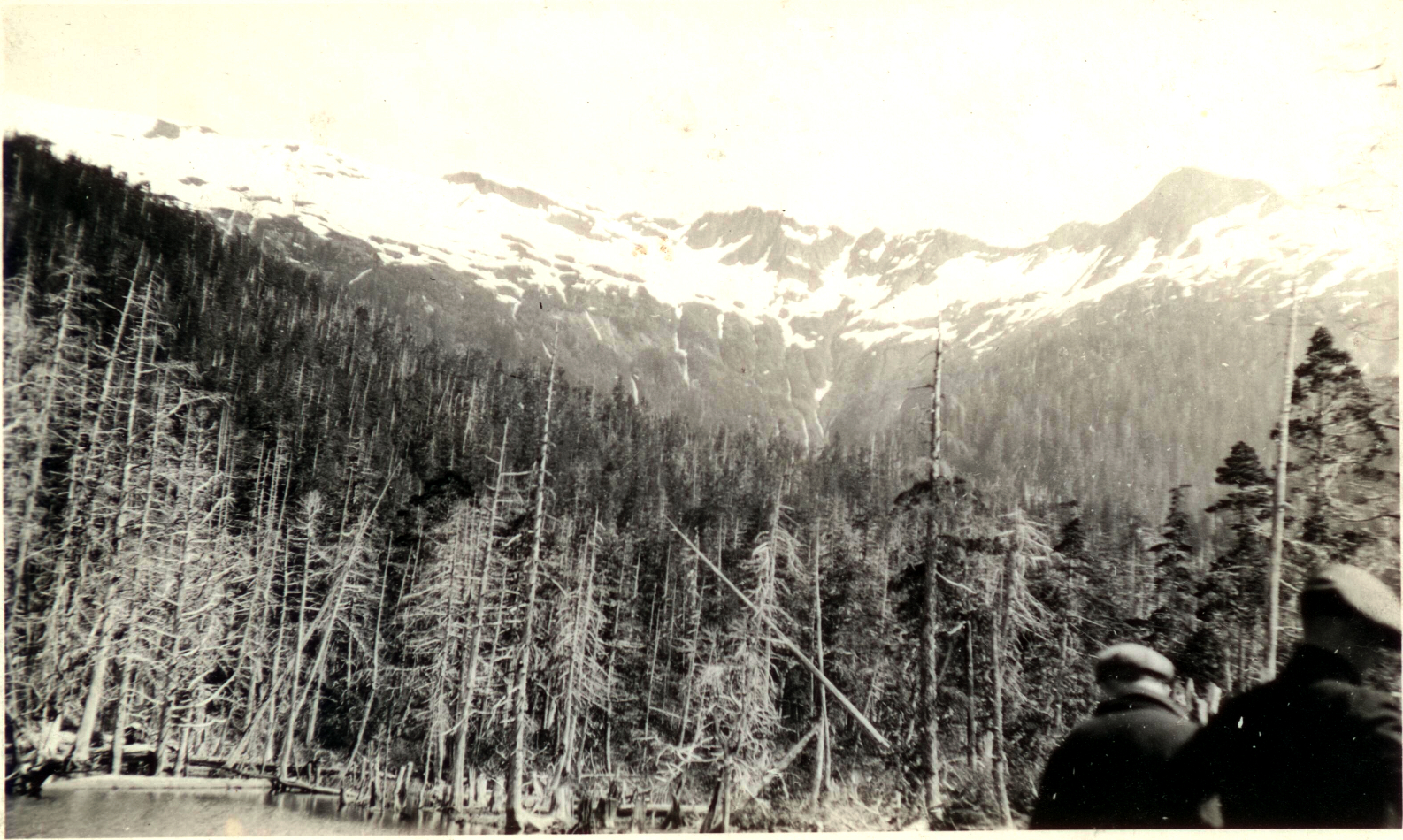
Funter Bay History: Helen Antonova, Mining Engineer

May 28, 2015

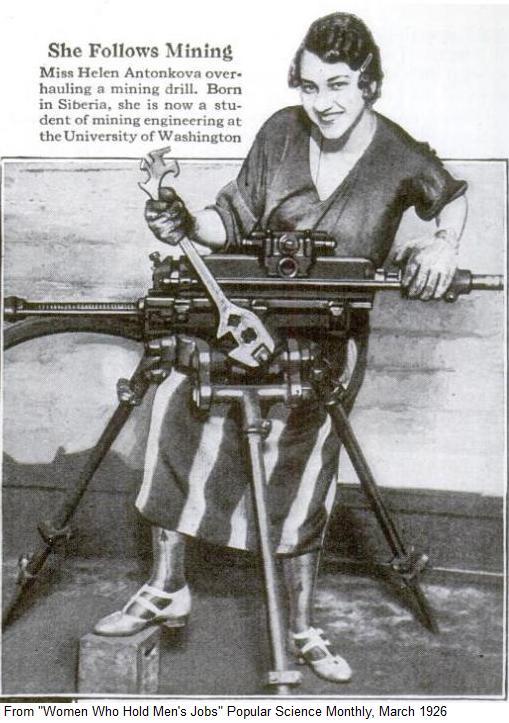
One of the first women to graduate with a degree in Mine Engineering, Helen Anatolievna Antonova arrived at Funter Bay in the fall of 1929. Born in Russia in 1904, Antonova traveled through China and Japan with her mother before moving to the United States. Her early life was spent in Siberian mining towns, and despite early work in theater, she always dreamed of becoming a mining engineer. She enrolled in the University of Washington’s College of Mines, the only woman to do so at the time (though not the first in the US).

Antonova3

University of Washington Libraries, Special Collections, Tyee 1928, pg 57. Courtesy UW Digital Archives.

As a female student in a traditionally male field, Antonova encountered much skepticism from officials and unfriendliness from classmates. She would later experience mistrust from coworkers (and their wives). Despite being told by the dean that no one would hire a woman for mine work, she led a successful career as a mine engineer, working throughout the US. On several occasions she was offered roles in theater and in Hollywood, but preferred surveying and assay work over acting.
After finishing her thesis and graduating in 1928, Antonova found a job with a mining company in Funter Bay. She recalled that the owner initially assumed her to be male, writing that he was surprised an engineer would have a woman’s name. Helen described Funter Bay as a small mining town, but noted that nothing could be purchased there. Despite its small size and remote location, Funter was home to a fellow female UW alumni. May Sophia Otteson (Tubbs) was a graduate of the class of 1916 and daughter of Charles and Mary Otteson, who ran another mine close to the one which employed Helen.

Conditions at Funter were spartan, a house was provided for Helen and her mother but was poorly insulated and had almost no supplies. The mine owner’s wife suggested they bring their own wood-burning stove with them. Groceries and goods were brought out on the weekly steamer from Juneau. Some medical care was available from a nurse living at the nearby cannery. Running water and electricity came from a waterfall, and stopped working during the winter. Helen took these conditions in stride, sometimes standing in icy water while surveying. The mine was reportedly very happy with Antonova’s work, and begged her to return after she moved back to Washington state.

Helen eventually married a Russian miner from Juneau (She mentioned that many Russian miners worked in Alaska, some sneaking over from Siberia illegally in rowboats). Her new husband became jealous of Helen’s superior position and income, and demanded they move back to Washington so he could pursue a degree of his own. She divorced him after his attitude and anger grew worse.

After moving back to the Lower 48, Helen held various jobs at mining and refining companies. She later married Nicholas All from New York (Her last name is sometimes listed as Antonovall). Helen Antonova All was interviewd in 1978 by author Joan Dufault, whose book Vintage: The Bold Survivors! contains more details of her life and experiences.


Funter Bay History: A 1906 Visit

April 23, 2015

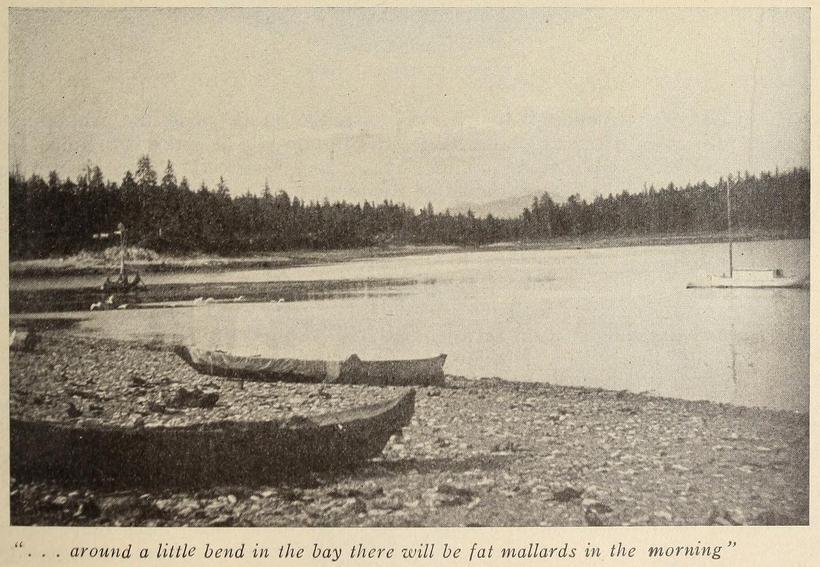
An article in the January, 1906 issue of Recreation magazine describes a visit to Funter Bay. Mining Engineer Waverley Keeling penned the piece, entitled “From the Delaware to Alaska” from a bunkhouse in Funter Bay. He describes it as a business stop at “a quartz mine”, but mentions that his party would also “shoot some of the thousands of ducks and a few deer, dig clams at low tide, and catch halibut at any tide”.

mallards

From Keeling, Waverley; “From the Delaware to Alaska”; Recreation, vol 24, No 1, January 1906.

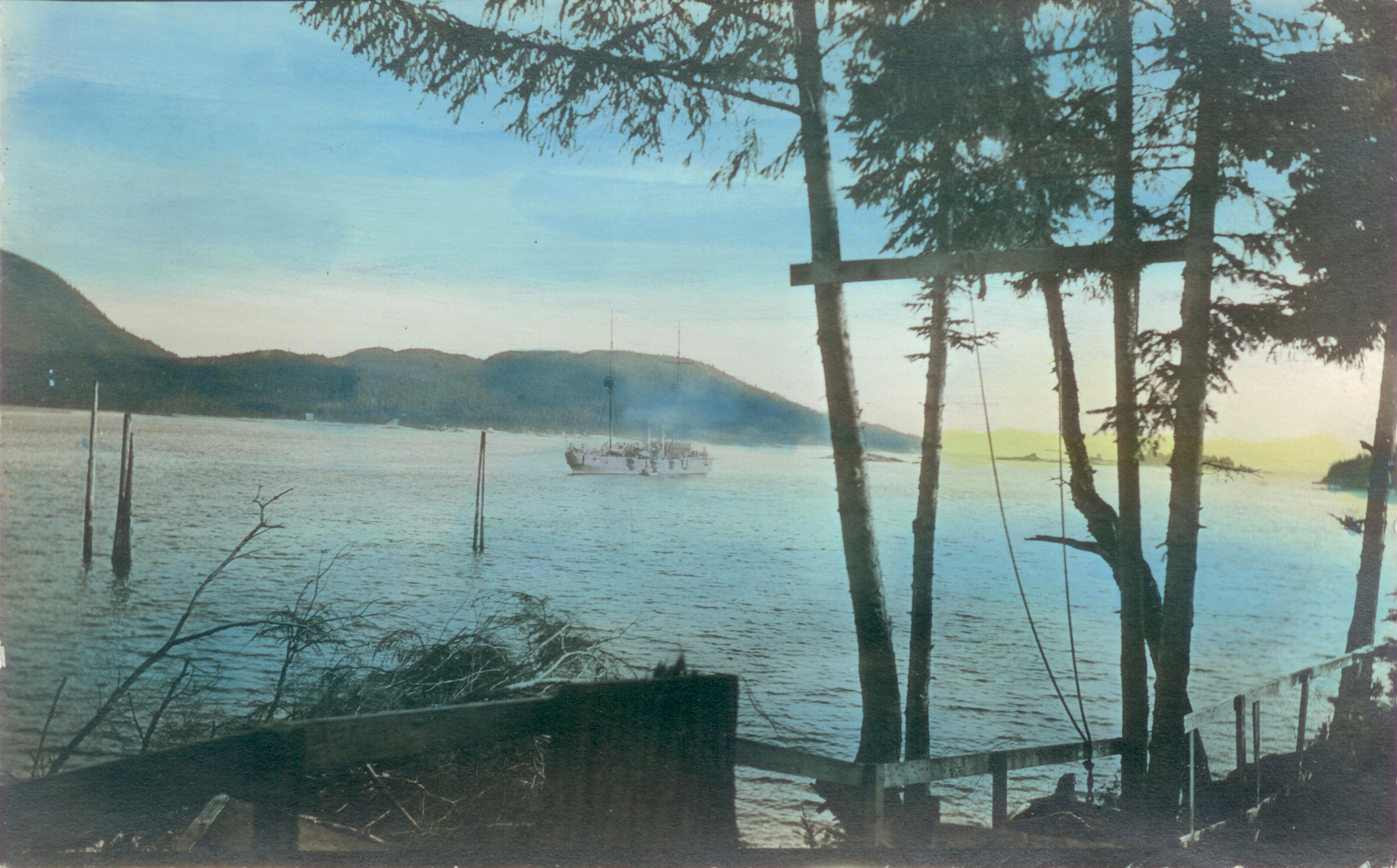
The photo from Funter Bay accompanying the text appears to show Coot Cove. The photographer was on the Western shore looking towards the area which would later be home to the cannery’s scow slipways.

Keeling describes his lodgings as a boarding house “near the shore of a beautiful little harbor called Funter Bay, and just back of us are the peaks of Snow Mountains some 4,000 feet high” (The mountain was not yet named for Robert Barron). He wrote from the combined kitchen and dining table, by the light of a large swinging lamp and tallow candle stuck in a beer bottle, sitting on “the hardest spruce-board stool that man ever constructed”. The group of six had purchased mining properties around Lake Atlin, BC, and had stopped in Funter as a side trip on the way North. They sailed to Funter on the “big Columbia River sailboat of that famous southeast Alaskan, Windy Bill”.

While Keeling notes the beauty and abundant wildlife of Funter Bay, he also comments on the downsides; “there is no particular season of the year when it doesn’t rain. The thermometer at Funter Bay since we came has been up to 40, and the rain which descended that day was as unmistakably an outpouring of ‘settled cloudiness’ as anything I have ever seen or felt in Pennsylvania”.


Funter Bay History: Mystery Photos

April 9, 2015

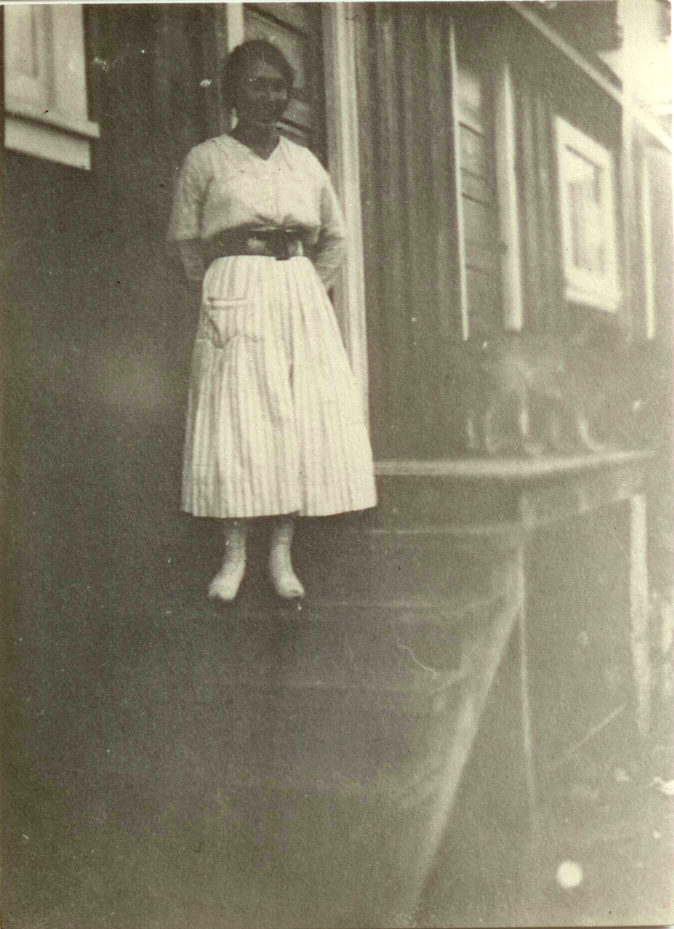
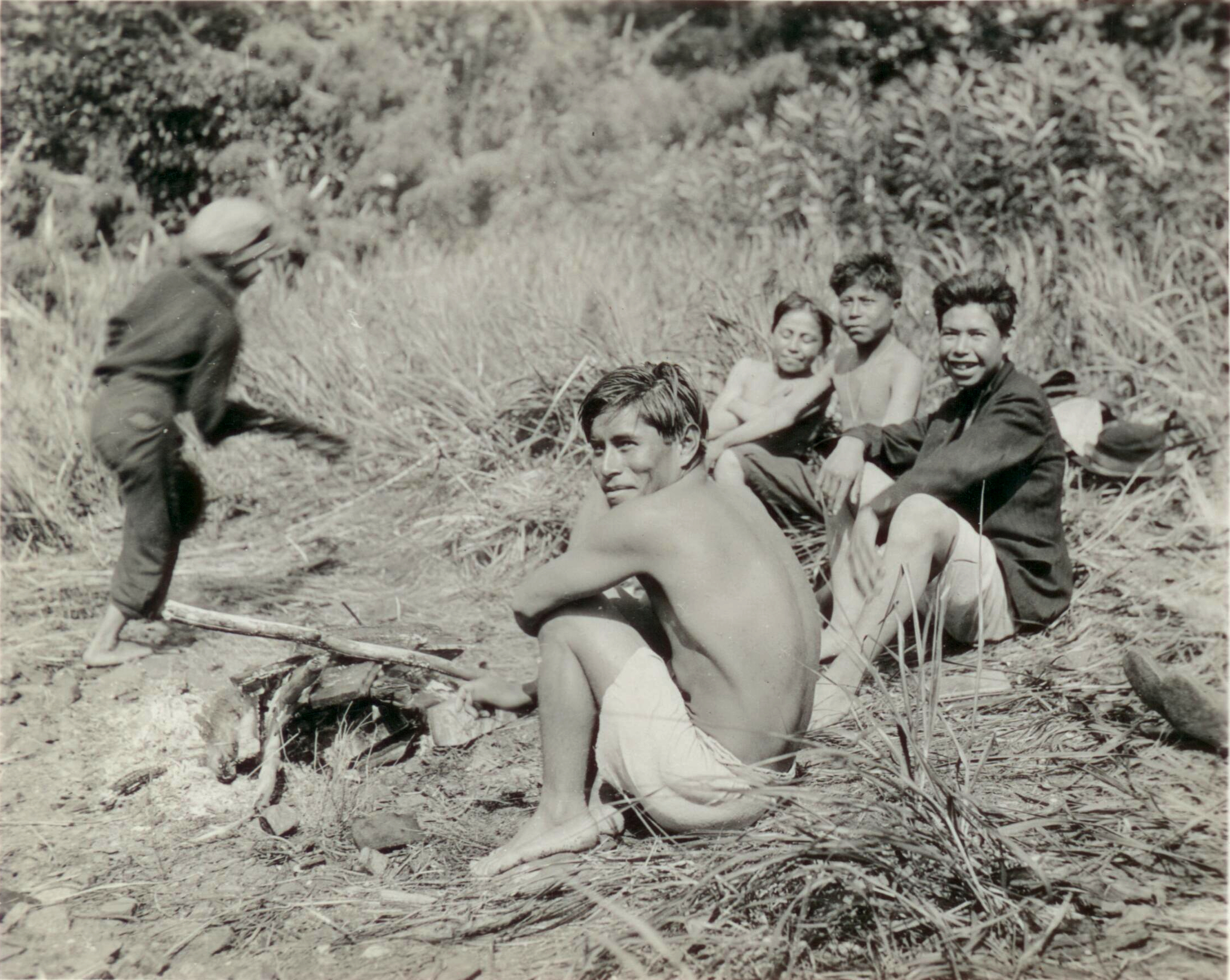
These photos were mixed in with some of the 1920s postcards and photographs that I’ve recently been posting. They are not labeled or otherwise identified, and the exact locations are uncertain. As they were included with a large amount of Funter Bay material, it is possible they are from the Funter area. However, the same collection also had some identifiable pictures of Juneau and Taku Inlet.

This photo shows a woman in a white dress and white shoes, standing on steps in front of a building:

mystery1

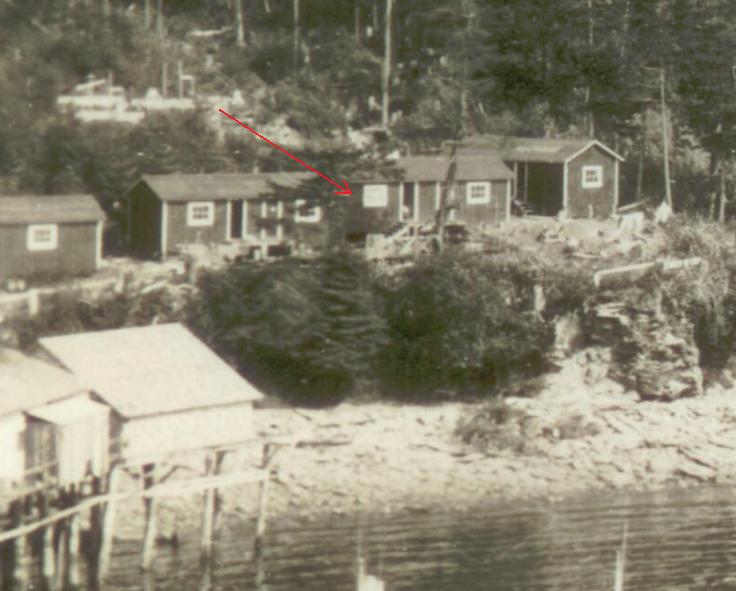
The above photo was possibly taken at one of the Tlingit Native houses on the hill behind the cannery, as seen in the zoomed-in image below (from a photo earlier posted). The windows, doors, and steps seem to match. Some of these houses look like they could be very small duplexes:

house_zoom

The next mystery photo shows a waterfall. I don’t recognize this as immediately near Funter Bay, but it could be higher on the mountain or somewhere else on Admiralty Island. It could also be somewhere closer to Juneau.

mystery2

The last photo shows a group of people, possibly about to light a fire. These may be local Tlingit Natives. The setting suggests the shore just above the high tide line.

people

If any readers have ideas or suggestions, please let me know! As usual, you can email me at gabe@saveitforparts.com.


Funter Bay History: Steam Donkey Part II

March 3, 2015

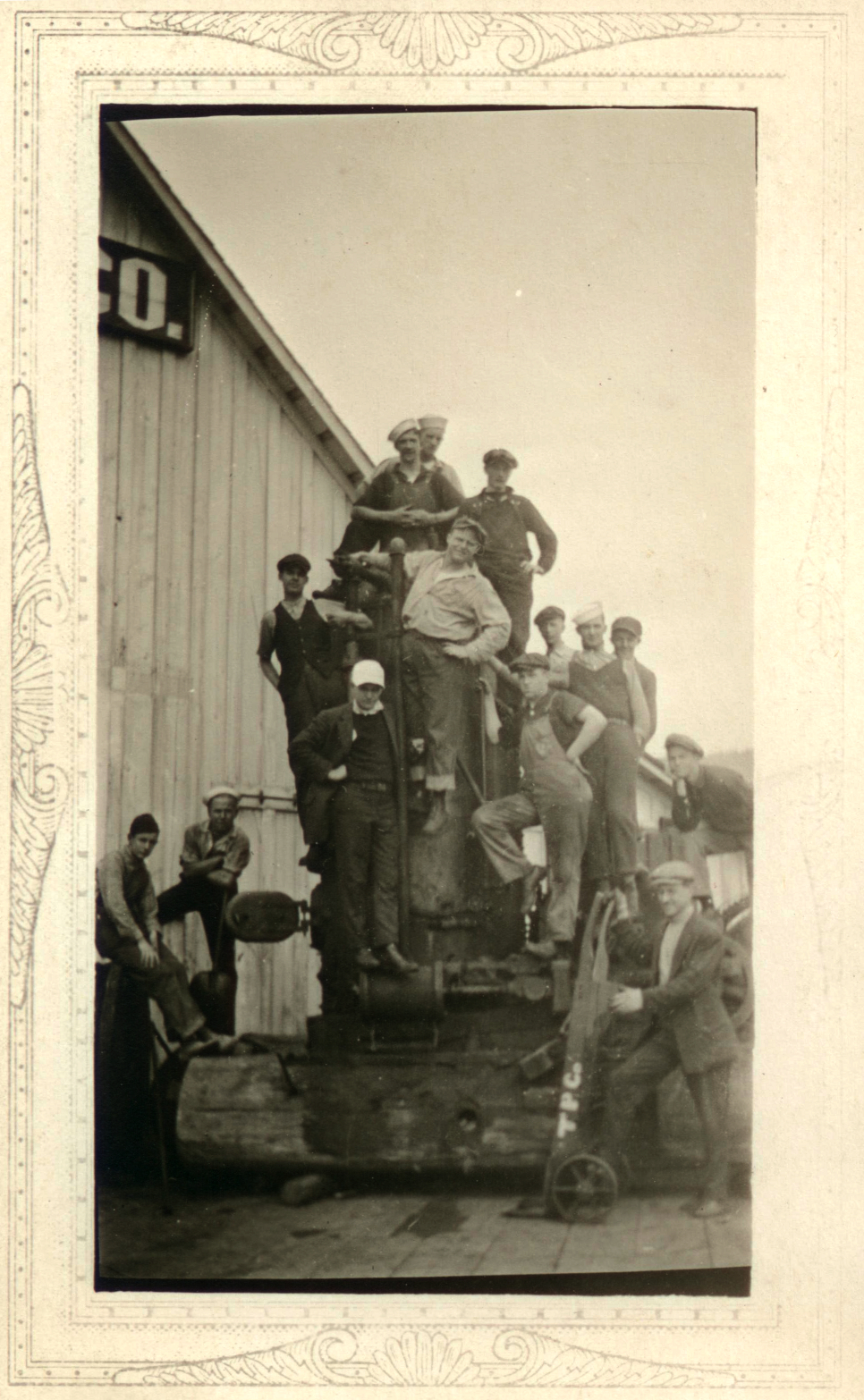
I previously mentioned a Vulcan Iron Works steam donkey at Funter Bay in one of my earlier posts on steam power and internal combustion. Recently I acquired a photo which shows a very similar device at Funter, perhaps the same one. This photo is likely from the summer of 1919.

donkey

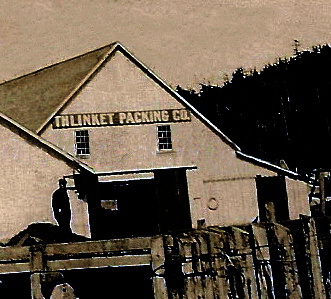
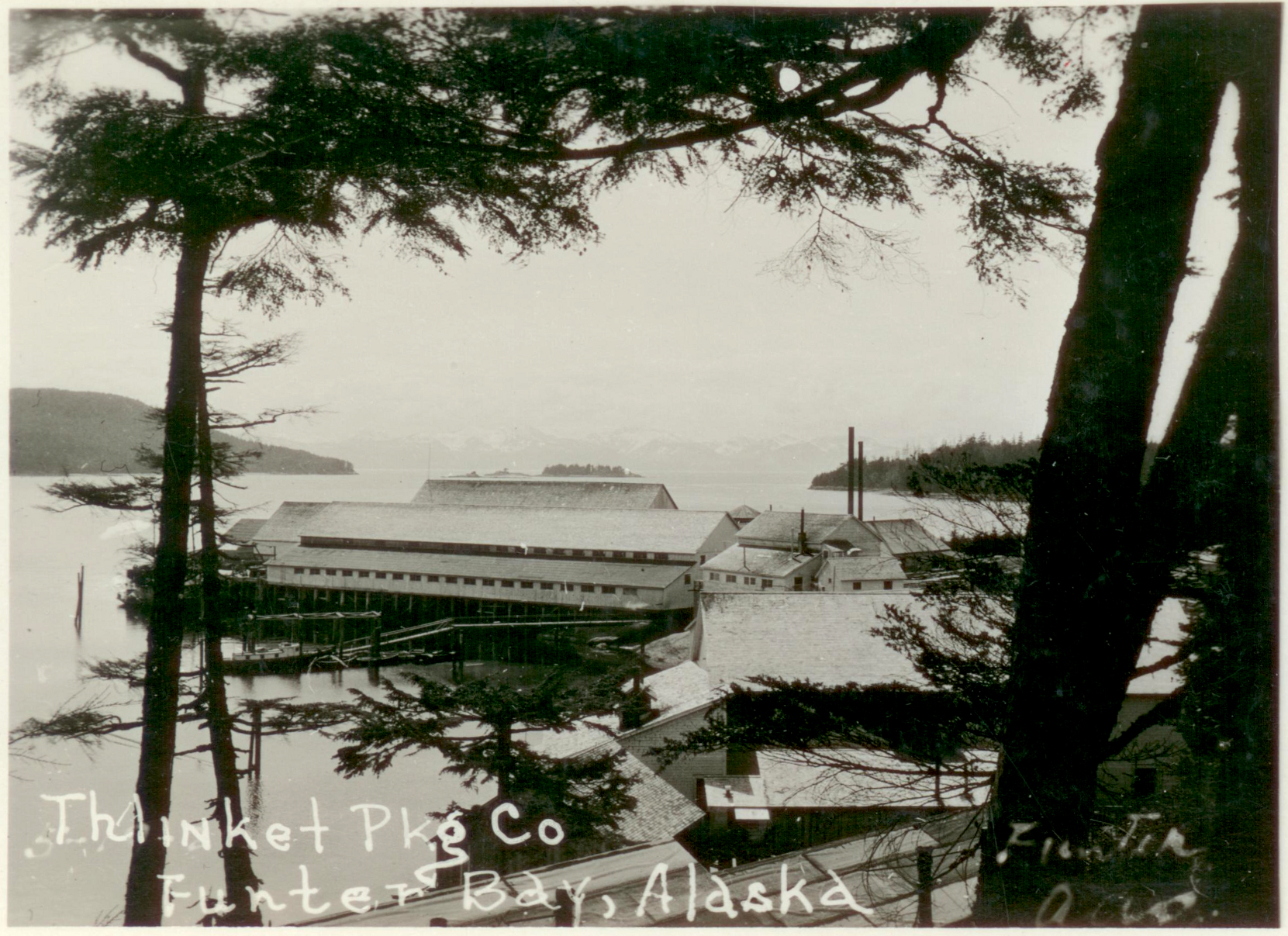
The photo was taken at the corner of the main Thlinket Packing Co warehouse, seen below:

crop

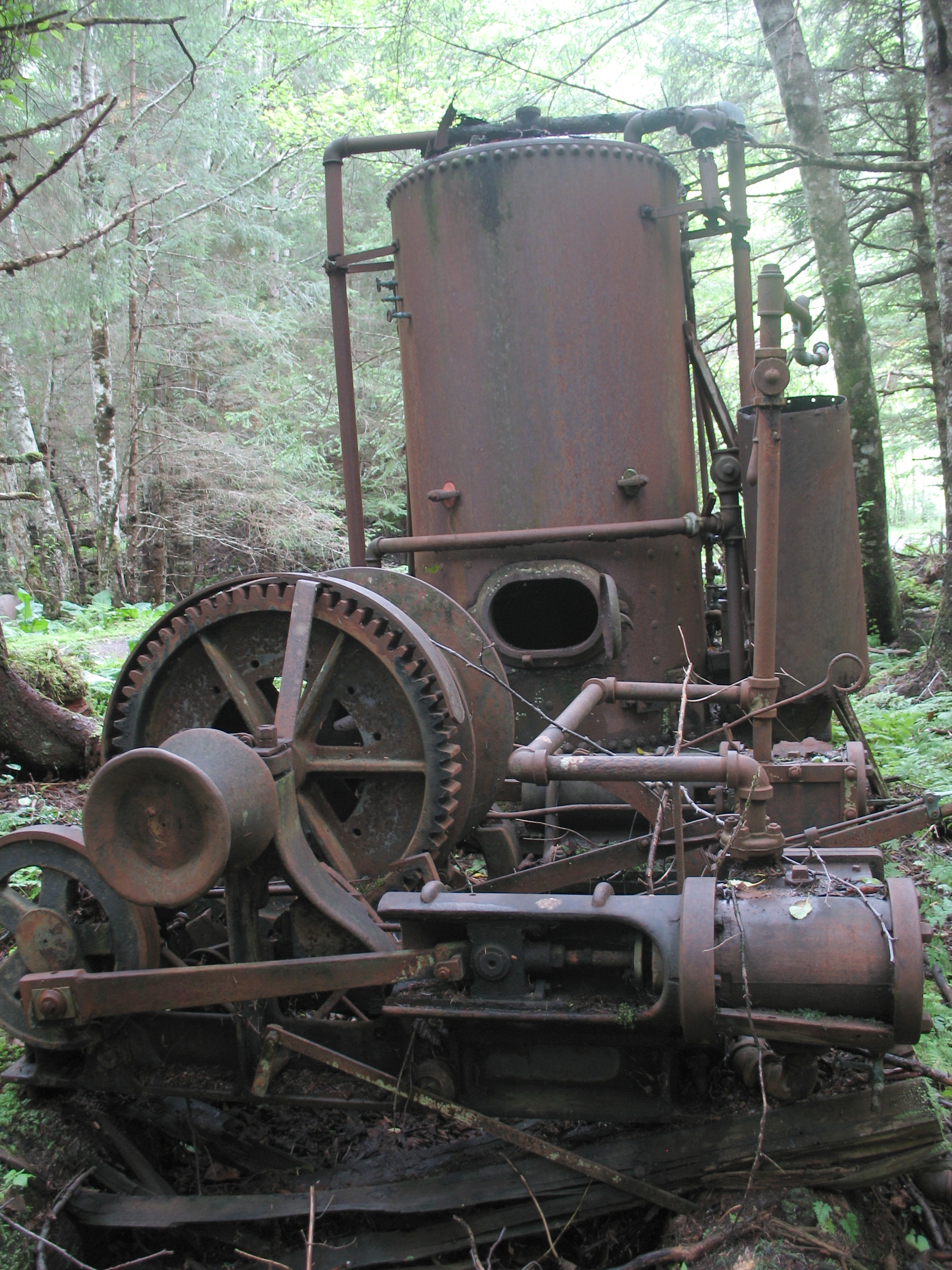
The steam donkey seen in 1919 and the one in my modern photos look nearly identical to me. The layout of pipes, the piston parts, and the boiler door all appear to match. The donkey in 1919 is mounted on large logs. My modern-day photos do not show any logs under the engine, but loose spikes are visible (the logs likely rotted away or were removed). John Taubeneck provided some details on the Vulcan Iron Works in a comment on my earlier post, noting that there are only a few of these donkeys remaining. He believes the unit pictured above is slightly smaller than the one in the woods, but it is hard to tell.

Neither photo shows the conical top or smokestack seen on other Vulcan donkeys, in the 1919 image they may have been removed for shipping, and by the time of my photos the stack seems to have rusted off and fallen to the ground (a few decades ago it was still mostly upright and covered with a washtub).

donkey2

The remaining donkey is across the bay at the base of the mountain where it powered an aerial mine tram. If these are the same unit, it may have originally been owned by the cannery and later sold to the mine. As the cannery used mainly low-horsepower gas engines on-site, a steam engine would likely have been used somewhere off the property. It could have served as a pile driver engine, or been used for logging in Kelp Bay or elsewhere.

The men posing on the donkey in the 1919 photo seem to have been a group of Seattle high school students. They will probably be discussed in an upcoming post.


Funter Bay History: Cannery Tender Operations

February 27, 2015

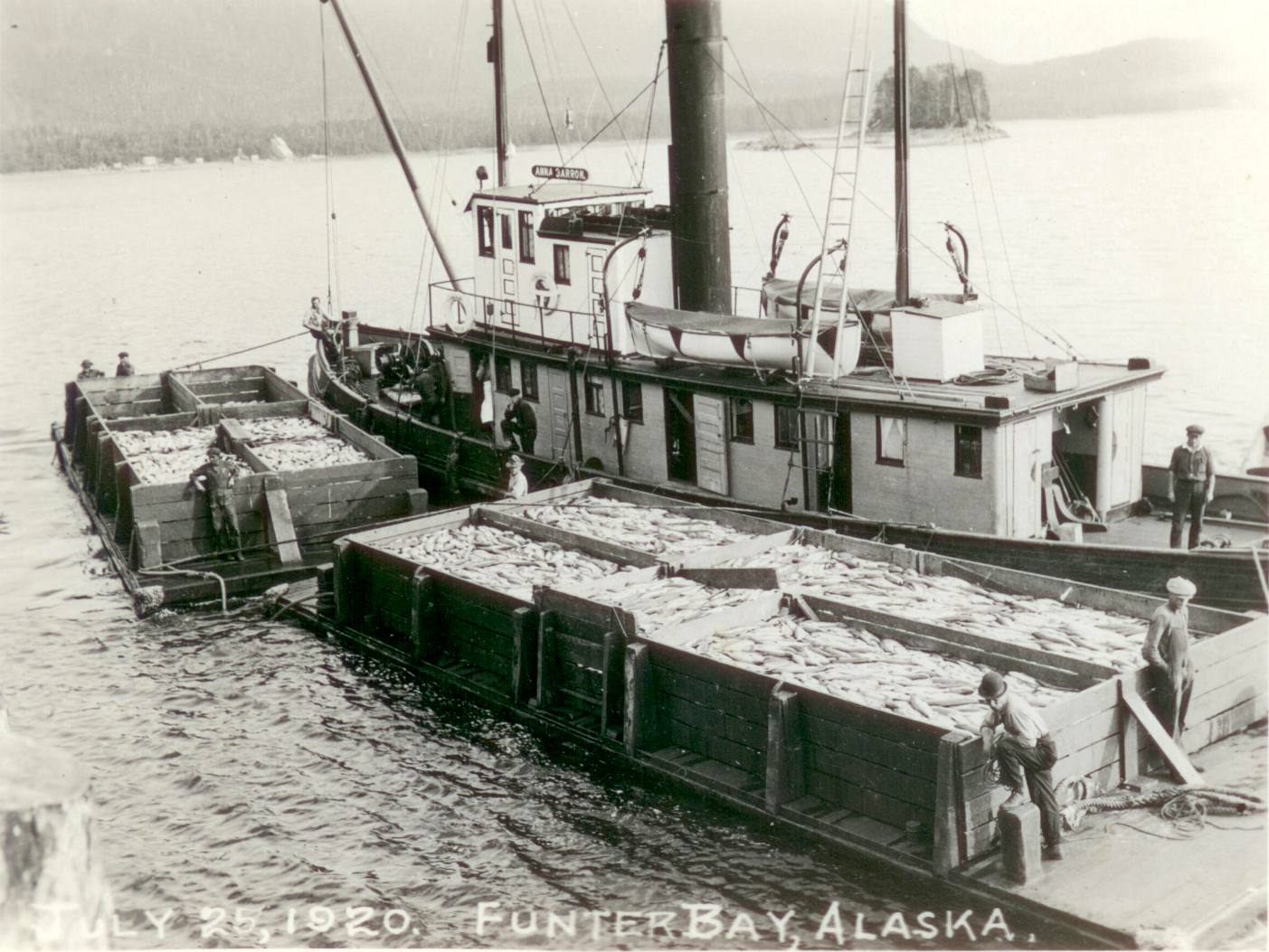
Some photos from July of 1920 show several of the cannery tenders (fish handling boats) and barges at the Thlinket Packing Co.

barron

Above, the Anna Barron maneuvers two loaded fish scows up to the cannery wharf. This vessel is discussed further here.

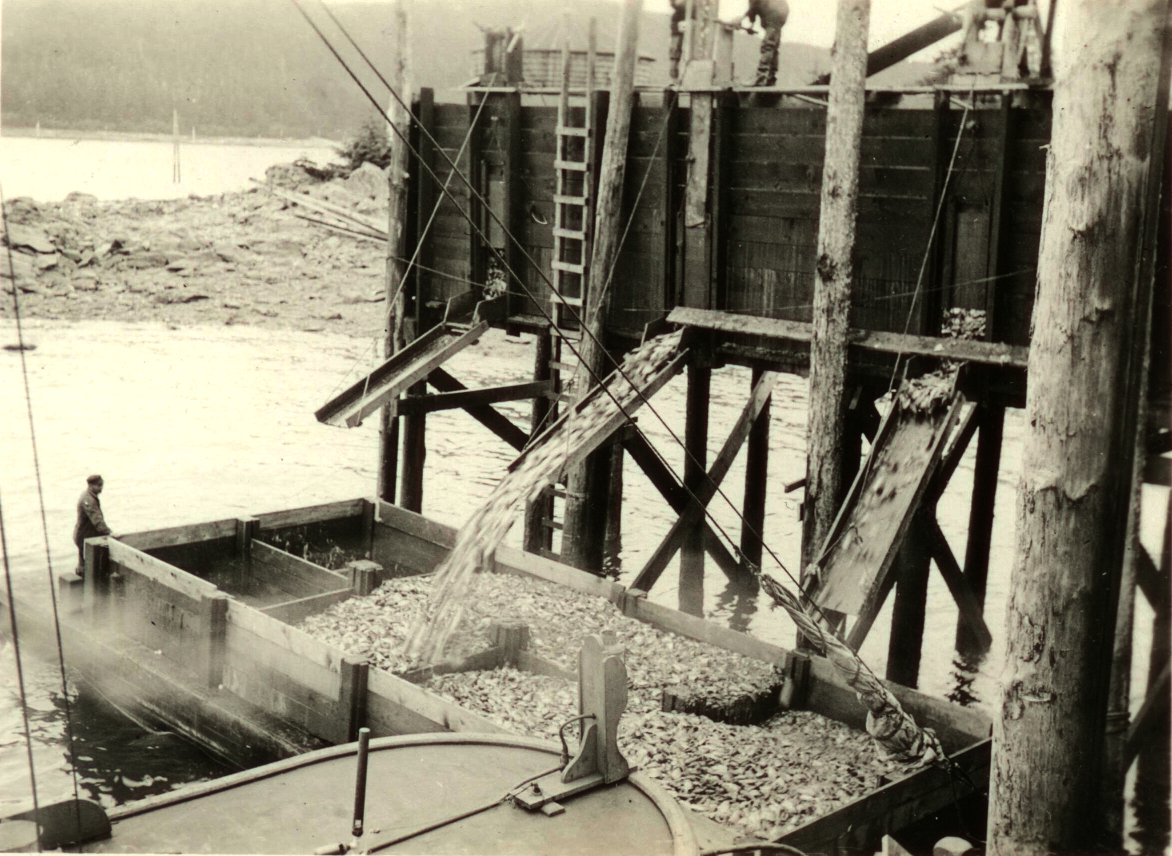
A close-up of one of the scows shows a full load of salmon fresh from the traps:

salmon2

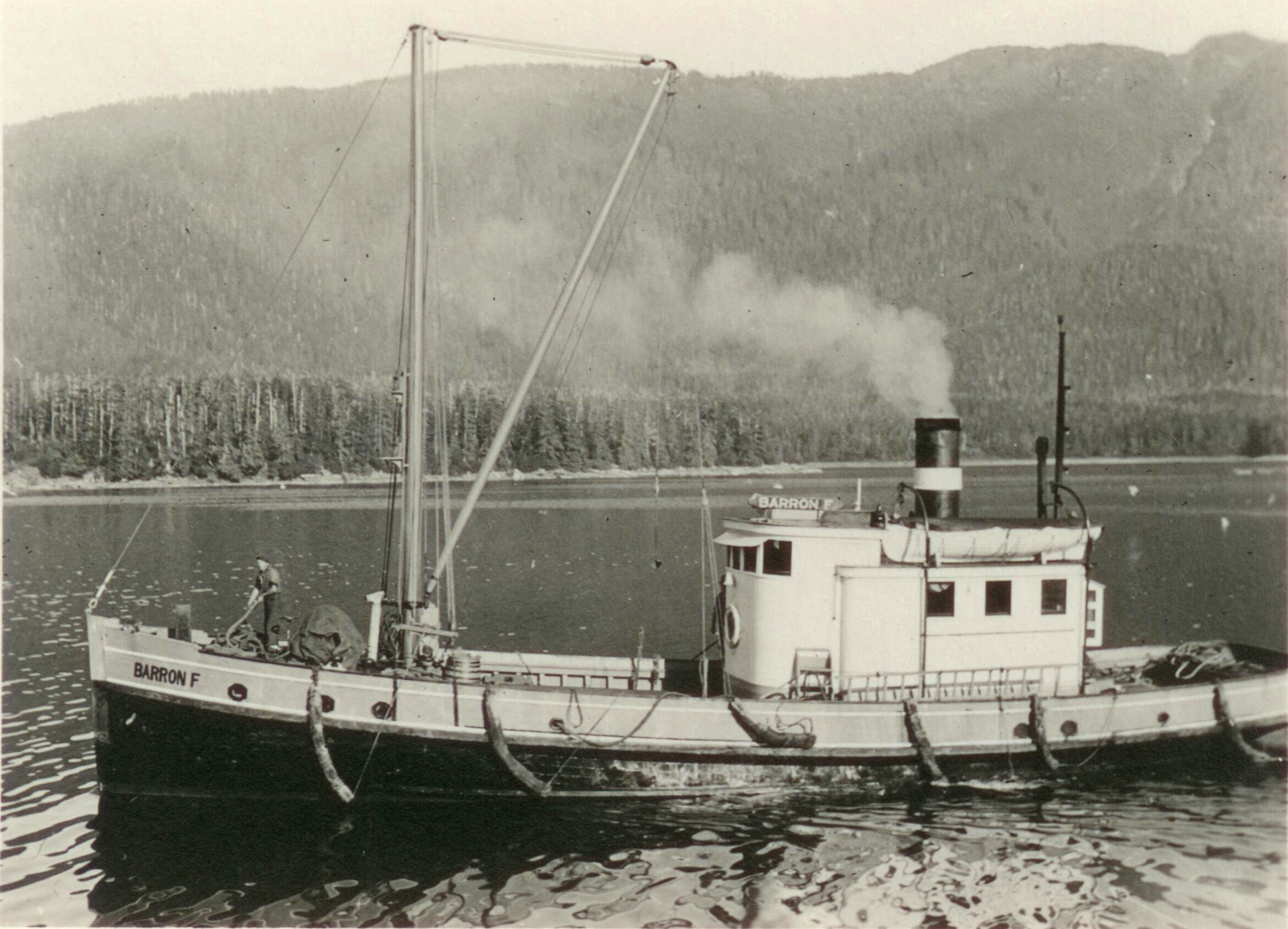
Below is another Thlinket Packing Co boat, the Barron F, seen in front of the cannery wharf with Highwater Island and Mt. Robert Barron behind. This 98-year-old boat is still working the West Coast, I have a number of photos courtesy of the present owner available here.

barron_f

Unlike the Anna Barron, which was configured as a tugboat, the Barron F was a packer or cargo vessel with large midships hold. The Funter Bay cannery had several of each type of vessel, used somewhat interchangeably depending on the task at hand.

The next photo shows a scow, now emptied of salmon, being loaded with waste from the canning line. Elevated wooden bins held heads, guts, and other unwanted bits of fish until they could be dumped into a scow. The scow was then towed to deeper water and dumped. This kept the cannery smelling slightly better, with fewer bears nosing around, than if the waste were simply dumped directly in front. The cannery’s oil tank is visible on the point in the background.

dump

In the last photo, we see one of the cannery tenders towing a piledriver out of the bay. The profile of the vessel suggests it might be the Anna Barron. Smoke is coming from the pile driver’s steam engine, which suggests it will soon be at work on one of the fish traps outside the bay.

piledriver


Funter Bay History: Cannery Workers in the 1920s

February 26, 2015

My last post displayed some 1920s-era postcards (RPPCs) from Funter Bay, showing buildings and boats of the Thlinket Packing Company’s salmon cannery. Other postcards from the same set show some of the workers and people associated with the cannery in the same time period. It is not clear if these are commercial mass-produced postcards or personal images printed on postcard stock.

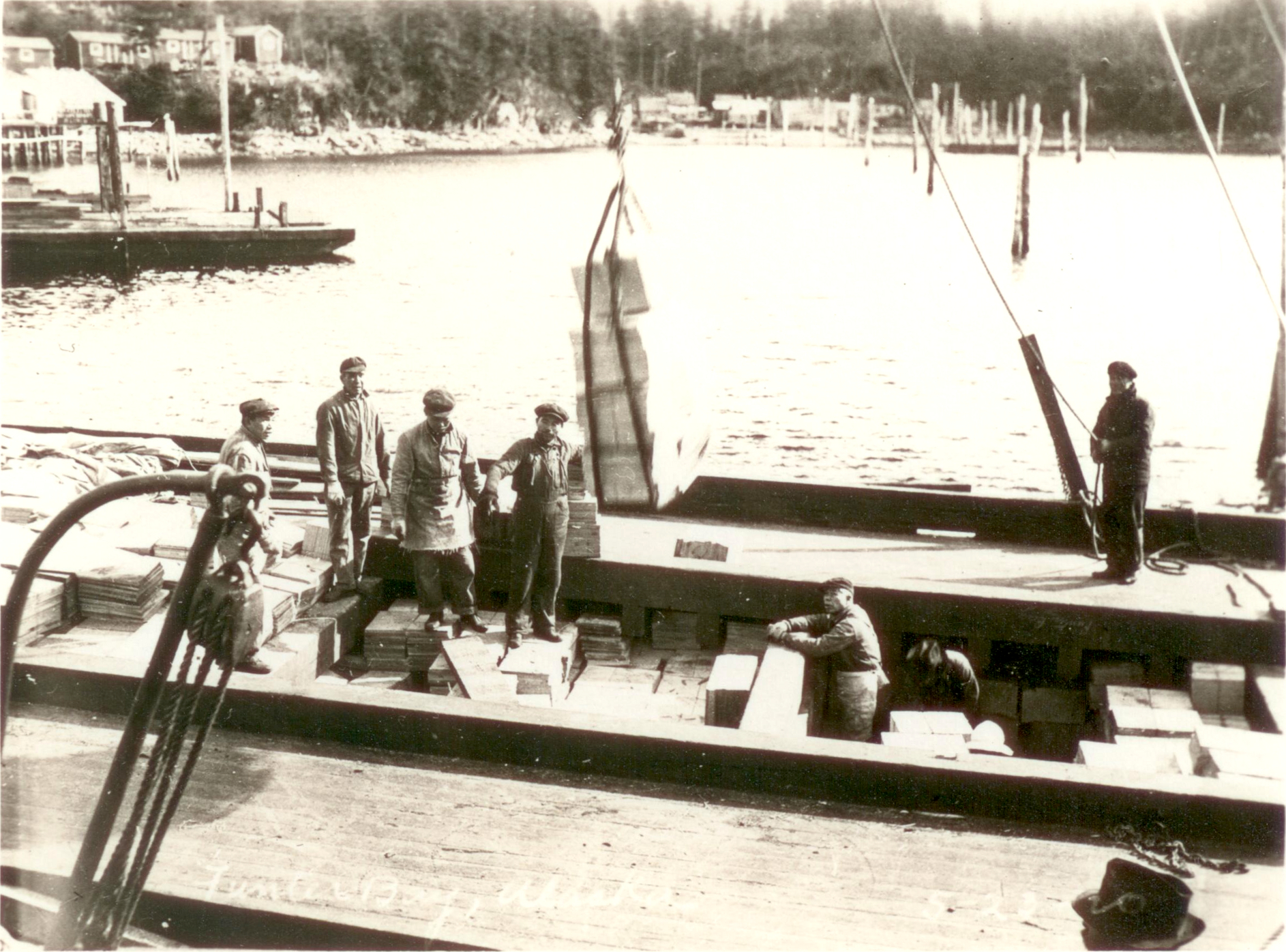
Here we see a group of men unloading items from the hold of a ship. The items are likely knocked-down cases for canned salmon. These would be assembled, filled with cans, and then shipped out again. An example of assembled cases can be seen here. In the background are Tlingit native houses and a scow or barge.

Unloading Ship

The next two photos are not labeled as Funter Bay, but were found alongside Funter Bay photos in the same collection. The firewood behind the seated man looks very similar to the wood stacked next to the boardwalk seen in a previous post. Also visible in the background is a wooden frame for clotheslines with hanging laundry, and some fencing or netting, similar to the garden fencing and clotheslines seen before. I suspect this fellow was one of the Tlingit Natives who worked at the cannery during the summers.

Lumberman

The next photo is labeled (in reverse) “Native Cannery Hands”. The photo seems to be printed in the correct orientation based on the product held by the small boy, reading “Sw… Pr…” (perhaps candy?). In a previous post I linked to a report indicating native children as young as 8 sometimes worked 9-hour days for 10 cents an hour.

Native Cannery Hands

There is a lot going on in the above photo. The man on the right is making some sort of gesture or counting 3. The younger people are all looking at the camera and many are smiling, while the older woman stares away with a stern expression. This phenomenon is noted in “The Tlingit Encounter with Photography” where author Sharon Gmelch points out that Tlingit women photographed at Funter Bay tended to look away from the camera unsmiling. One explanation is that smiling for a picture was considered disrespectful by elders. (As another side note, the 1907 photo of the Tlingit women apparently found its way onto a commemorative porcelain plate made in Germany in 1910, which is now at the Juneau-Douglas City Museum).

Another notable feature of these 1920s photos is the popularity of hats or headgear. The children display a variety of hats, including what looks like a naval hat on the smallest boy (marked with a steering wheel at the front). The men unloading the ship mostly have caps, while someone in the hold and someone in the foreground seem to have fedoras (perhaps the bosses?). Earlier photos of Funter Bay workers also show a wide variety of hats, especially among the men. I am not sure if hats were universally popular among all Alaskans/Americans at the time, or if this were a local cultural habit.

A man rowing a boat near the cannery may have been another cannery employee. He appears to have several cut logs in the boat, perhaps for firewood.

rowboat

Another portrait shows a man of possible Asian heritage, standing on the wharf at the cannery (Mt. Robert Barron is barely visible behind him). He appears to be the only hat-less person in this post!

man

Several people are shown on the cannery wharf with fish in the photos below. These may be some Ballard (Seattle) High School students who visited Funter Bay in 1919, as the images were in the same batch and are colorized similarly to some photos of that group (to be detailed in a later post).

These two have caught salmon, likely with rod and reel:

salmon

And here we see a large halibut (probably in the 150-200lb range). The men are standing on nets, but halibut are usually caught with rod or ground tackle (longlines).

halibut

If any readers happen to recognize any of the people shown here, I would love to hear about it!


Funter Bay History: 1920s Cannery Postcards

February 25, 2015

I recently came across a batch of postcards showing Funter Bay in the 1920s. These appear to have come from the estate of someone associated with the cannery. I was able to purchase several of these, and was generously given permission to use copies of the others here.

view1

It is not clear which of these were commercially-sold postcards and which were private photos printed on postcard stock. “Real Photo Post Cards“, or “RPPCs” enabled people to make a postcard from any photo. Kodak began offering pre-printed postcard stock early in the 1900s, and Federal law allowed postcards with written messages on the back in 1907. Some RPPCs were mass produced and some were unique prints by private individuals. Some of the cards in this set are labeled, dated, and/or have a photographers name, but most are unlabeled. Based on what I can identify of the people and vessels depicted, the dates range from around 1918 to the early 1920s.

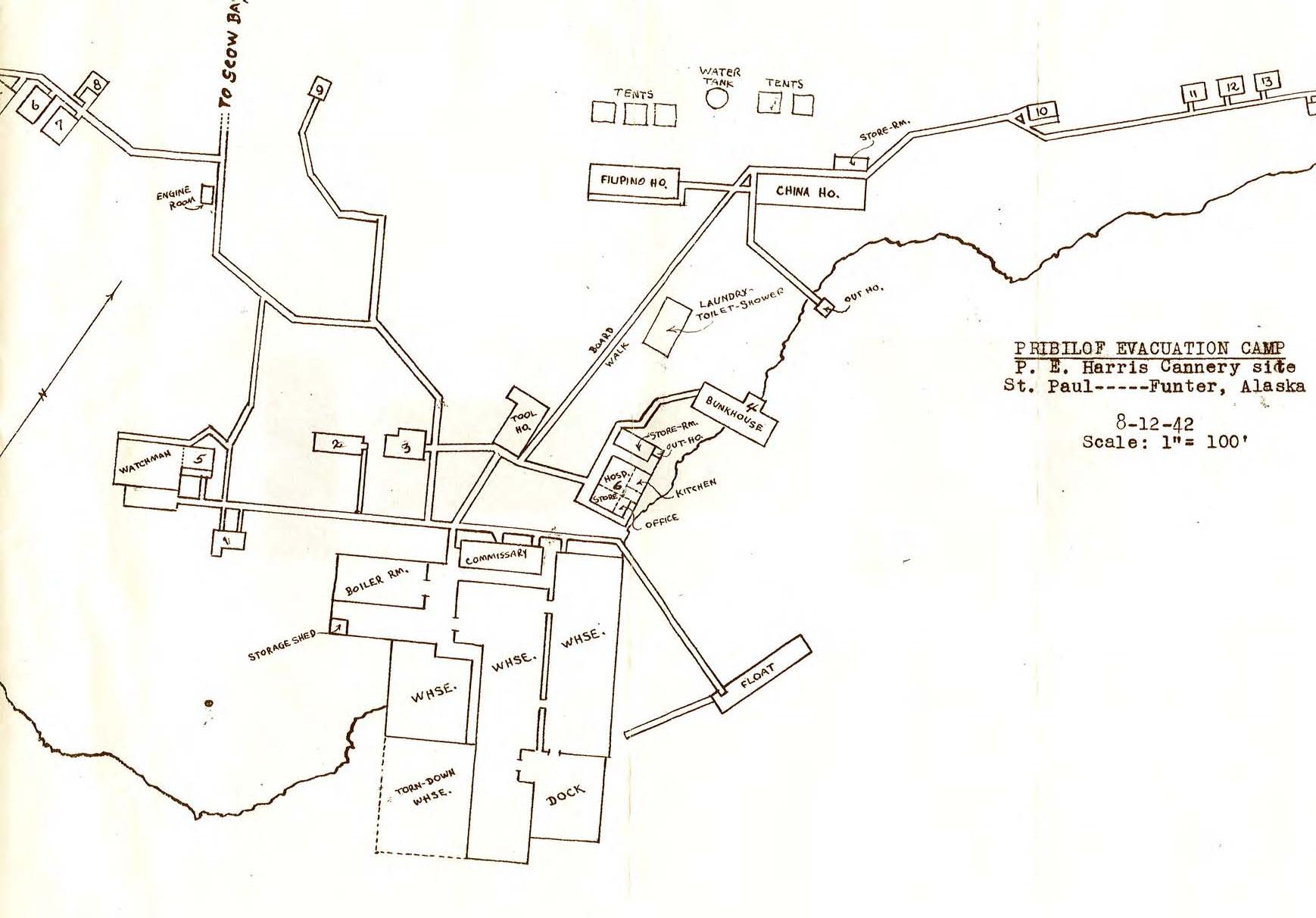
The following map helps place some of these photos. This is part of the US Fish and Wildlife Service records from the National Archives, showing the cannery in 1942. The general layout is much the same as it was in the 1920s, with only minor changes. The 1929 Aerial photo that I previously posted is also helpful.

1942 Cannery map

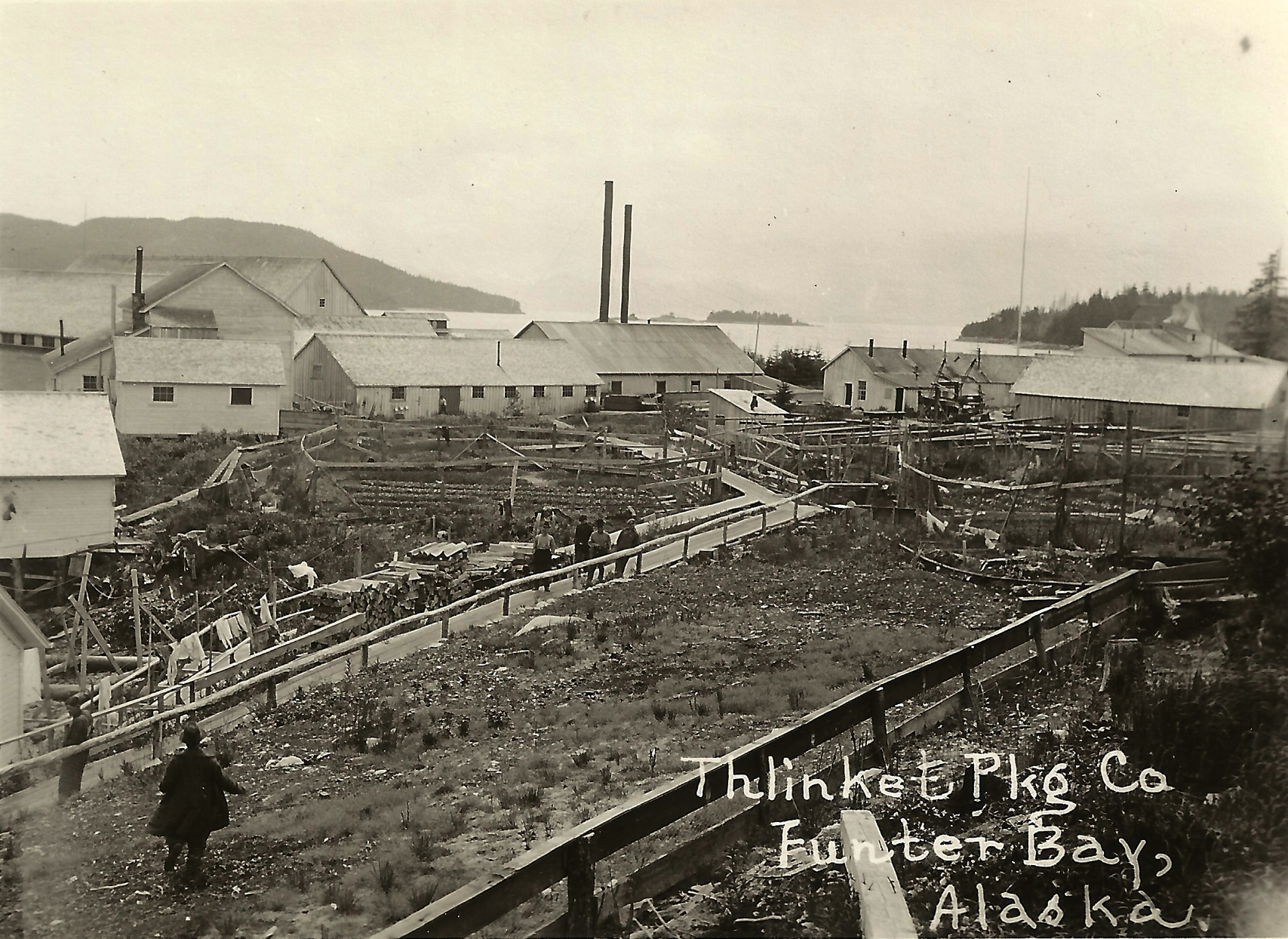
Below is a colorized version of the first photo above. This view looks out over the cannery buildings from near the Native employees’ houses. The main wharf with long packing and warehouse buildings are seen, along with the twin chimneys of the boiler house. Bunkhouses and residences are in the foreground, with the mess hall and company store near the middle.

view4

The next photo shows an open area behind the mess hall and bunkhouses. Boardwalks lead between buildings, with what appear to be vegetable gardens on either side. Stacks of firewood are seen along the boardwalk, with long logs split into quarters. Clothes are hung to dry on the left of the nearest boardwalk, the laundry and bath house was located just off-camera to the left. The building on the far right is probably the repair shop which still stands today, behind it is the Superintendent’s house and just to the left of it are homes for managers and guests (one of these has also been referred to as a schoolhouse).

gardens

Below is a photo of the summer housing for Tlingit cannery workers. This is sometimes referred to as a village, although other accounts state that it was not occupied year-round. These structures were later demolished to make way for saltery buildings. Several canoes and a motor launch are visible.

village

A more distant view of the “village” shows its relationship to the cannery buildings (at left):

village2

A smaller photo or print shows a boat at the cannery’s floating dock, with Mt. Robert Barron in the background. This seems to have been taken from near the bunkhouse which sat partly over the high tide line:

boat

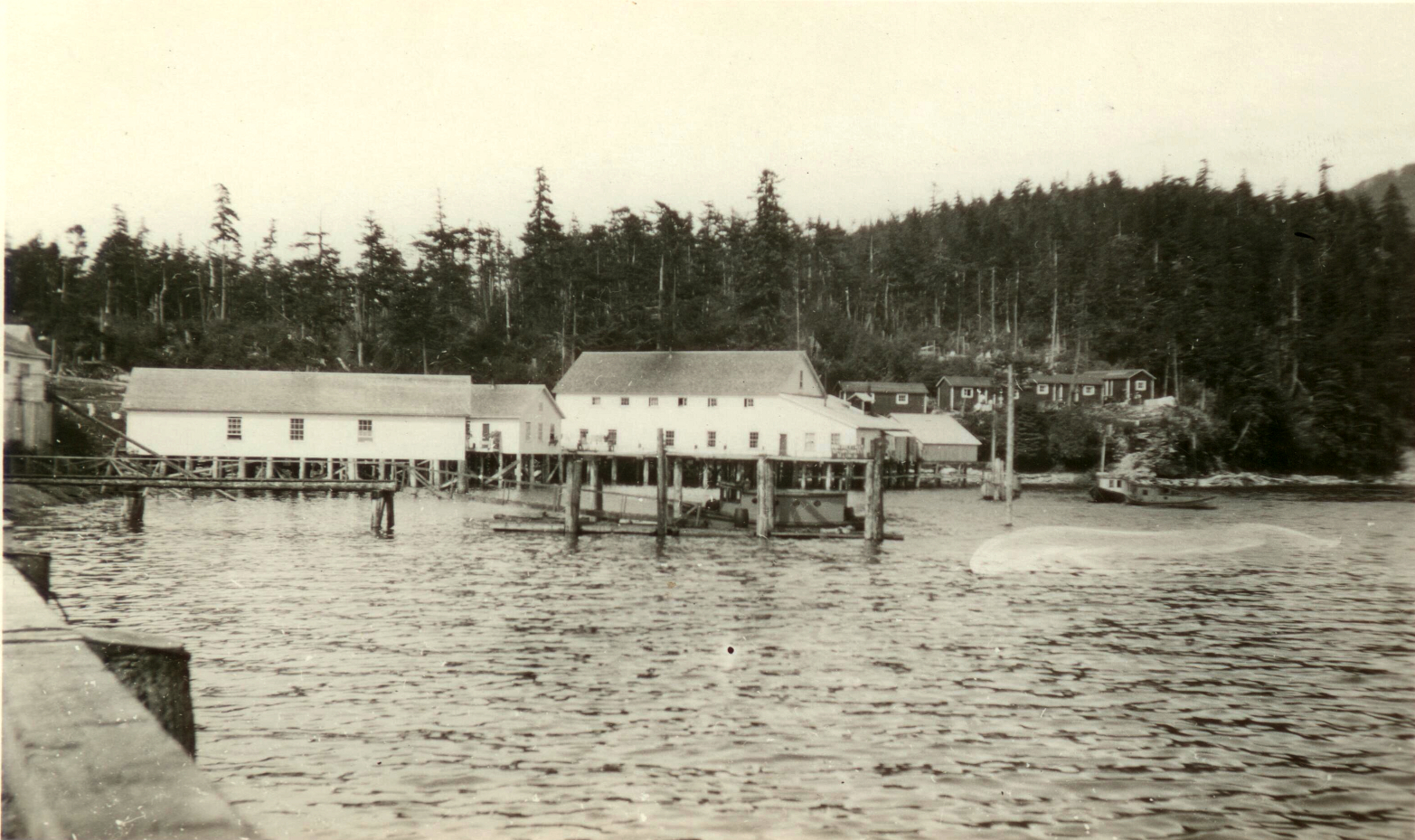
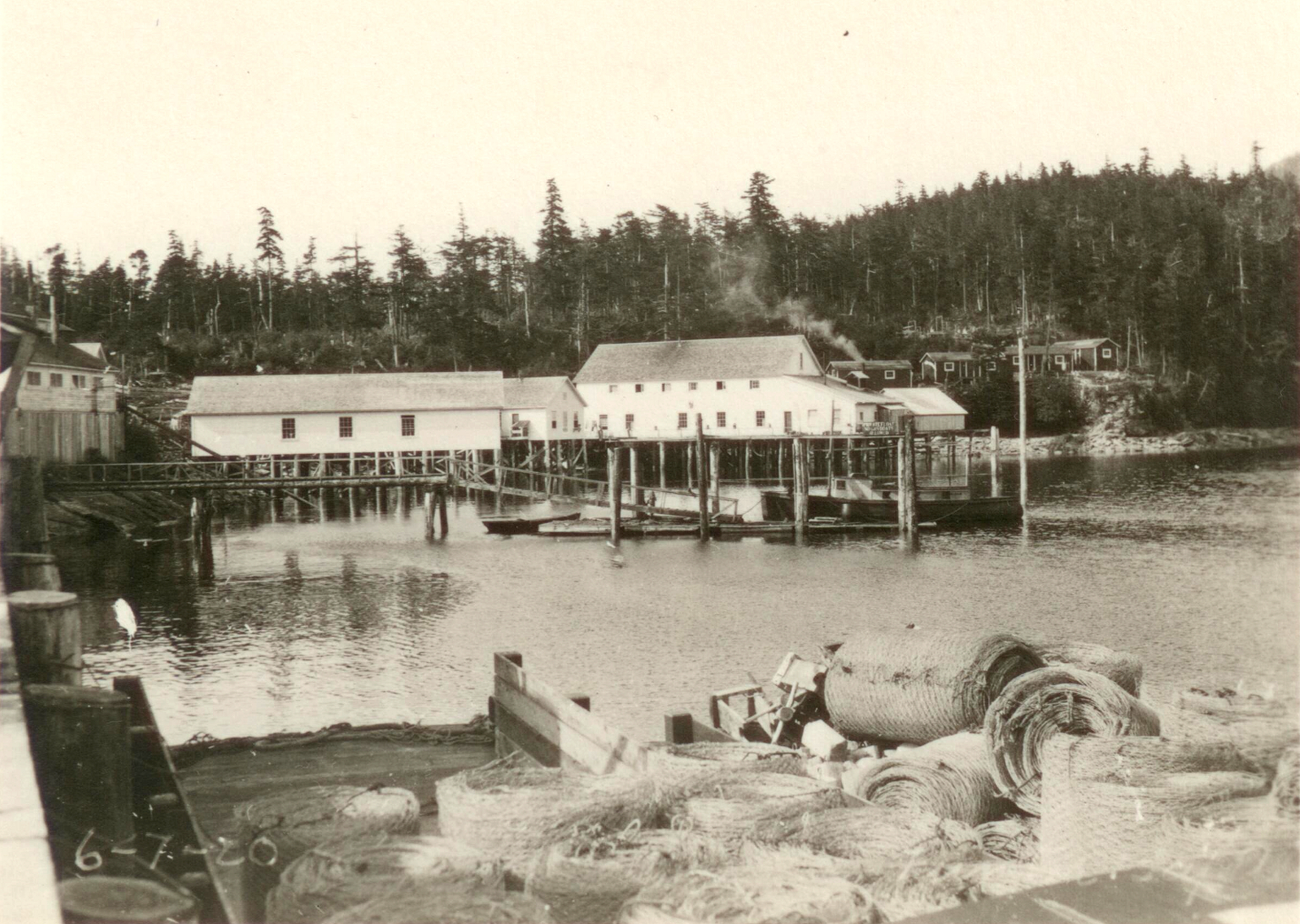
Two more photos show the floating dock from the other direction, taken at different stages of the tide with different small boats at the dock. A sign on the approach ramp appears to read “Private Float, no gas boats allowed”. The bottom photo shows scows with rolls of netting or fencing in the front, likely fish trap materials. Some of the boats seen in prior photos are moored to pilings in the background:

float float2

The next photo shows a higher angle view of the float approach and bunkhouse, maybe from the mast of a ship. The cannery’s wooden water tank is visible in the background. The cleared area between the tank and buildings would later hold the Chinese and Filipino bunkhouses. The company store is on the left. An interesting feature is the narrow ramp extending from the rear of the store into the water. This was the cannery’s trash chute where garbage was dumped into the bay. The base of this chute was very popular for bottle hunting at low tide in later years!

store

The next photo shows the rear of one of the waterfront buildings. A scow is moored to a piling in the middle ground, with the mountain shrouded in clouds behind. This may be from 1919:

view2

The next image also looks out over the cannery buildings, Mt. Robert Barron is in the background:

overview

And finally, a view out over Funter Bay to the South, showing Station Island (two sections, one forested), Rat Island, and Bare Island (low rock at left). Clear Point is on the right, and Chichagof Island’s mountains are visible in the distance:

water1


Funter Bay History: Navy Ships

February 24, 2015

As I’ve previously mentioned, the USS Marblehead visited Funter Bay in 1919 on anti-piracy duties. Cannery owners including James Barron had complained to the government about the depredations of fish pirates, leading the navy to dispatch several patrol vessels.

Below is a photo of what appears to be the Marblehead anchored in Coot Cove near the Thlinket Packing Co at Funter. The photographer was near the scow slipways.

marblehead

The next photo shows the USS Marblehead from a similar angle, helping to identify the ship seen at Funter.

marblehead

USS Marblehead stern view, courtesy Library of Congress

This Marblehead was the 2nd ship to bear the name, a Montgomery-class cruiser 269ft long powered by two steam engines and armed with various 5-inch guns and torpedoes (Wikipedia page). Launched in 1892, the visit to Funter Bay seems to have been one of the ship’s last missions. It was retired in August of 1919. Additional information is available here.

marblehead2

USS Marblehead, courtesy Library of Congress

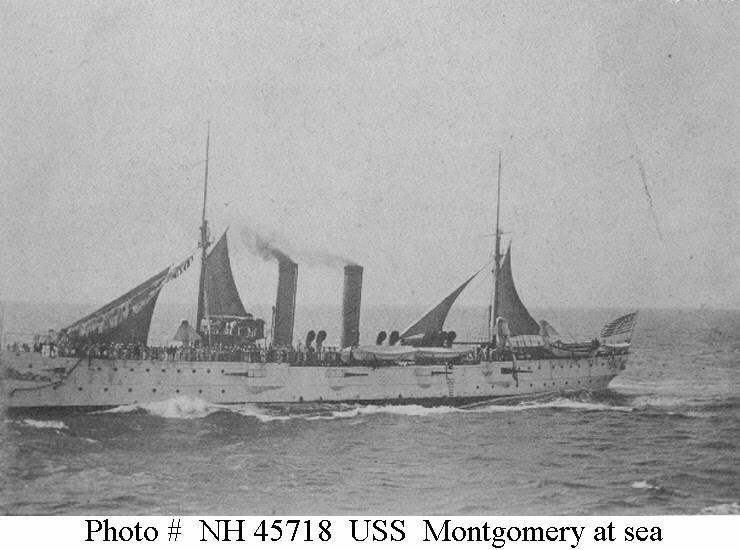
The masts and rigging indicate a ship capable of sail as well as steam propulsion. A photo of the USS Montgomery under steam and partial sail can be seen here.

Another vessel of similar appearance visited Funter Bay on April 28, 1923; the Coast Guard cutter Unalga (Navy History page). This vessel had only one stack, so does not match the one seen in the photo from Coot Cove. The ship’s logs (p1 and p2) from that day mention the motor boat Ceasar which had broken its crankshaft off Funter Bay on the way to Tenakee. The Unalga towed the Ceasar from Funter to Tenakee Inlet. (The source for these logs, oldweather.org, is a project to transcribe ship logs for historic weather data. These logs also contain other interesting information such as records of towns and vessels, wildlife, and general ship operations).

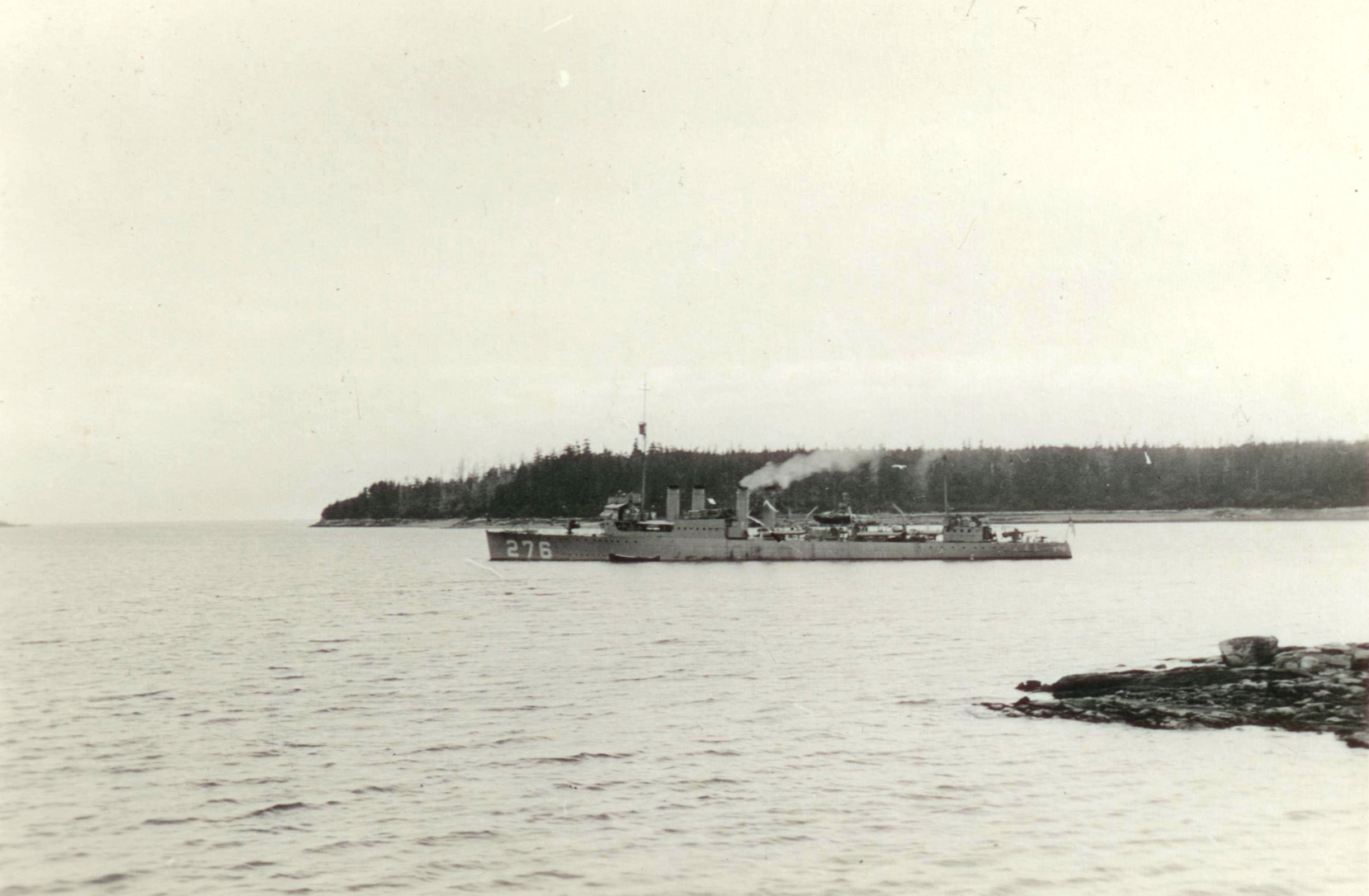
A slightly more modern ship can be seen in Coot Cove in the following photo, circa 1920. Clear Point is visible in the distance, the foreground rocks were near the cannery wharf where the photographer was probably standing.

276

This is the USS McCawley, DD-276, a 314ft Clemson-class destroyer (Wikipedia page). When photographed in Coot Cove it may have been taking part in the 1920 inspection tour of Alaska conducted by Secretary of the Navy Josephus Daniels, Interior Secretary John B. Payne, and Pacific Fleet Commander Admiral Hugh Rodman. A note in the Kinky Bayers files reports the McCawley arriving in Juneau along with the destroyers Sinclair and Meyer on July 13, 1920, carrying Secretary Daniels and party. A photo of the McCawley in Juneau can be seen here. A photo of the VIP group visiting a glacier can be seen here. The Thlinket Packing Co was upheld as a model Alaskan industry by promoters, cruise lines, and publishers, so it easily could have been part of the inspection tour.
An article in the Seattle Times of July 10, 1918, reported that salmon packer “J. E. Barron” asked Navy Captain J. J. O’Donnell to take custody of L. Clarito, Joe Budous, and Martin F. Bolina, “Filipinos who are charged with sabotage”. The trio were brought from Funter Bay to the Juneau city jail aboard a “US Warship” and federal charges were expected to be filed. The actual “sabotage” seems to have been the un-patriotic act of inciting native workers to request higher pay.

I was not able to find a Captain J. J. O’Donnell in 1918, but as the article got J. T. Barron’s middle name wrong, it may not have been 100% accurate with the navy captain’s name either.


Funter Bay History: Dano Mine Part II

February 23, 2015

I recently acquired some photos that I believe are related to the Alaska-Dano Mine at Funter Bay, circa 1920. These needed a bit of detective work to place.

The first photo, taken at high tide, shows several buildings, a boat moored to a piling, and another boat full of people being rowed nearby.

camp

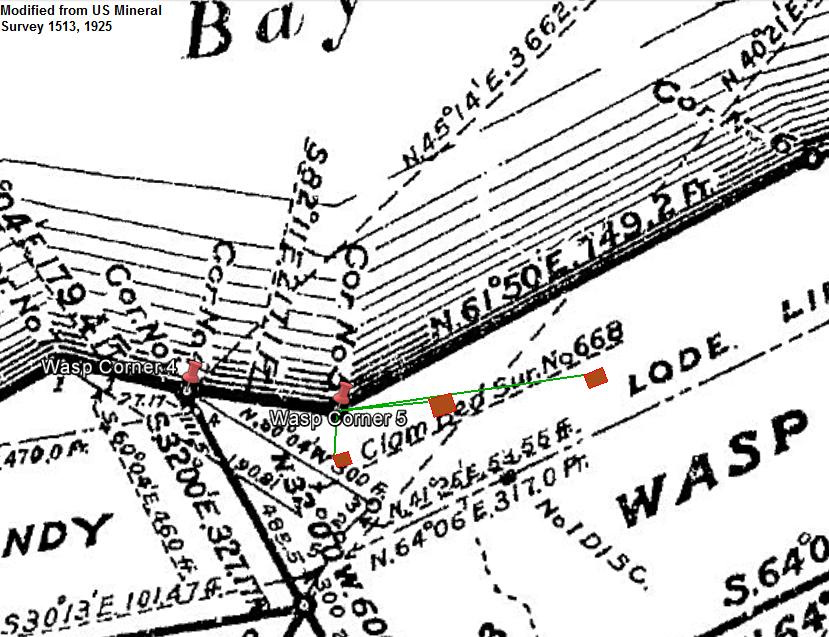
Identifying this photo required some additional research into the Alaska-Dano Mining Co’s surveys, specifically US Mineral Survey No 1513. While the near-shore buildings are not shown on the survey plat, they are described in the text of the document as improvements to the property.

Dano Improvements

The directions in the survey are given in the 90-degree compass heading format used by surveyors, which allows the measurements to be plotted on a map. This results in roughly the layout seen below. Orange squares are buildings, with the two-story bunkhouse in the center and the two log cabins at the sides. The 4th log cabin mentioned was farther up the mountain.

Dano survey

Both of the frame structures in the photo seem to be built directly on tree stumps, a cheap and easy (if not long-lasting) foundation. The smaller frame building in front of the bunkhouse does not appear on the survey, so it may not have existed at the time (built later, or burned down prior). I would guess this to be a tool storage or workshop building. The smaller structure farther to the right is likely an outhouse, and the white structures behind the bunkhouse could be wall tents.

A two-story bunkhouse such as this indicates more than a few workers, structures of similar size at other mines housed a dozen or more men. (A photo from Katalla shows what the inside of an Alaskan bunkhouse might look like). A kitchen was sometimes located in the bunkhouse, although separate mess tents were also common to reduce fire hazards. Mine camps also usually had a blacksmith shop, an assay office where drill cores and samples were evaluated, and sometimes separate cabins for the owners or management. Stables for any horses or mules might also be found nearby.

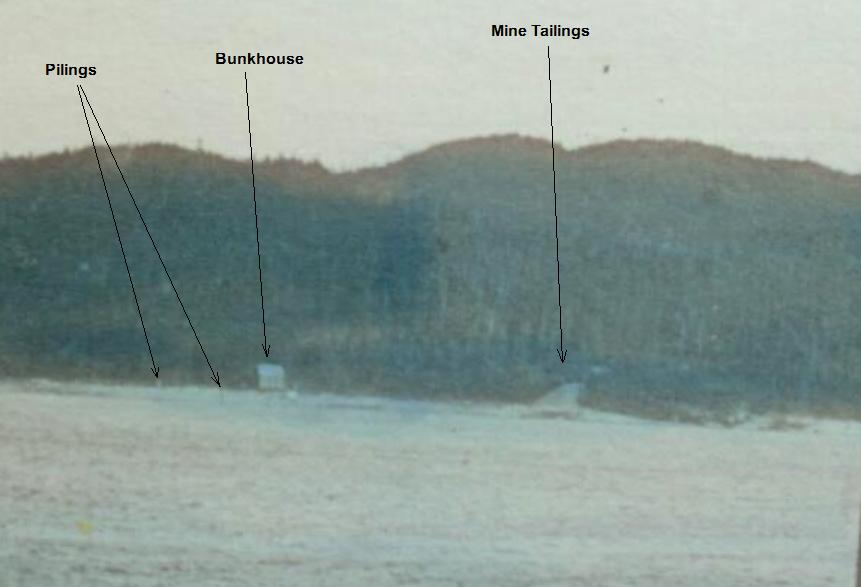
Despite the different number of structures shown on the survey, I believe the photo matches the Dano Mine’s camp pretty closely. In addition to the two-story bunkhouse, the rise of land (tree tops) in the background matches the rise behind and to the right of the surveyed location.  Towards the top of this rise are found shafts and artifacts from the Dano Mine, and farther back is the first tunnel (seen collapsed in my earlier post), likely the “Little Pete” tunnel. The shoreline is fairly generic, but would match this location at high tide. Additionally, a slightly earlier and more distant view of the Dano Mine’s shore camp seems to show a large structure in approximately the right place to be the bunkhouse. The other frame structure did not seem to exist yet when this photo was taken (1919). A smear of light-colored material to the right is likely mine tailings from the tunnel and shafts.

dano_zoom

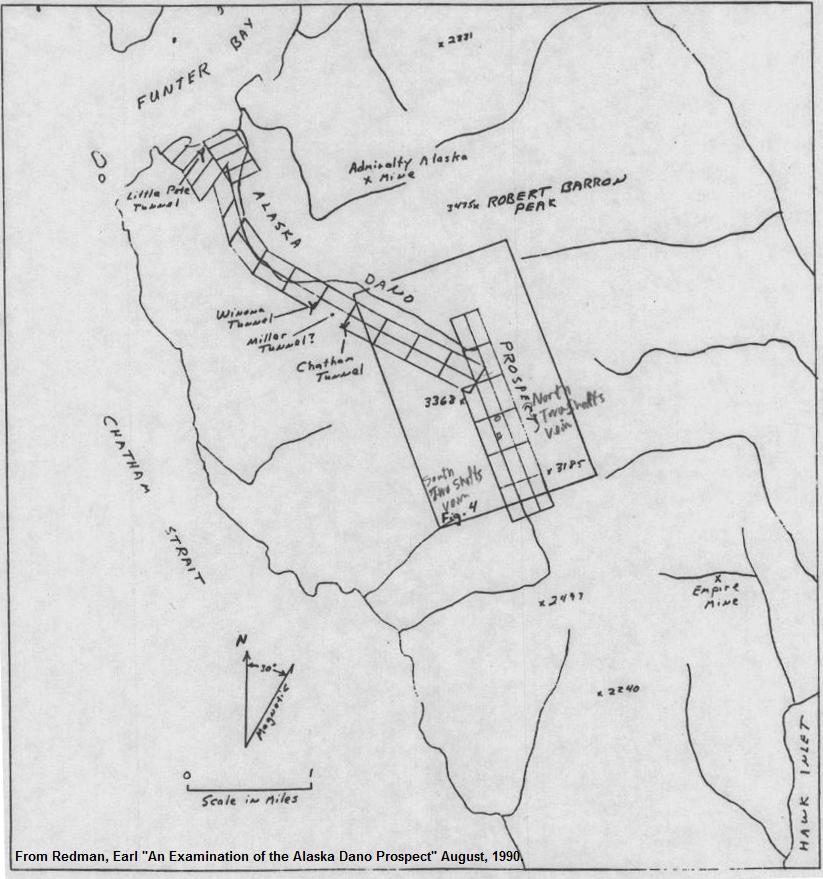
Below is another map of the Dano claims (rectangles) with some of the tunnels labeled. The curving lines are streams.

Dano map

The next historic photo appears to be farther back from the beach, towards the Alaska Dano’s other tunnels near the base of the mountain.

mountain

This photo is not at any of the mine workings, so the people could be on a trail to the mine or on a hunting trip. They seem to be standing in a muskeg meadow with some swampy water in front of them, looking towards a nearby ridge with a mountain stream in the background and a round hill between. Identifying the exact location required a little more photo analysis. Below are some crops from a 1982 infrared aerial photo of Funter Bay, which helps to identify some of the terrain features in the older photo. This is a best guess based on my knowledge of the area and interpretation of the photo.

dano_sat_1

1982 CIR aerial courtesy of US Geological Survey.

dano_sat_2

Lastly, this photo seems to be looking North from near the Dano beach camp. The hills in the background seem to match the terrain behind the cannery, which is just barely visible along the far shoreline to the right.

ice

Several men in a rowboat are roping an iceberg, maybe for use in local cold storage rooms or iceboxes. Summer icebergs used to be common sights along the Inside Passage and even in Downtown Juneau, but as the climate warms and glaciers retreat, they are much rarer today.

Unfortunately I don’t have any more information on these photos, such as the name of the photographer(s) or any of the people shown. Its possible some of these are related to a group of Seattle high school students who visited Funter Bay in 1919. If any readers happen to know more, I would love to hear about it!


Funter Bay History: 1929 Ordway Aerial

February 16, 2015

The Juneau-Douglas City Museum recently posted a 1929 aerial image of Funter Bay, and gave me permission to use a high-resolution scan. This photo was taken by Frederick Ordway, “Alaska’s Flying Photographer”. Ordway opened a photo shop in Juneau in 1927 and was known for photographing many Alaskan subjects. He died in 1938 in in a crash in Oregon.

The photo was taken the same year as the US Navy’s aerial photo survey of Southeast Alaska (previously shown here and here), but offers a different angle on the bay. Click the image below to view it full size:

88_45_001_f_HiRes600

Funter Bay, Alaska Postcard, 1929, photograph by Fred Ordway. Image courtesy of the Juneau-Douglas City Museum, JDCM 88.45.001.

Mount Robert Barron dominates the skyline in this image, showing nearly its full 3,475′ elevation (the very top seems to be cut off by the edge of the photo). The cannery is seen in the middle left, with Coot Cove (“Scow Bay”) in front of it. Across the bay is the AAGMC mine camp. Floating fish traps are visible in the foreground, just above the title text. These would be moored in a shallow area for winter storage, to prevent storm damage.

The view looks a little different today, as a section of the mountain experienced a landslide in the 1990s after heavy rains.

slide

Another interesting feature from the 1929 postcard is visible in Crab Cove beyond Highwater Island. This white blob is in the right location to be the camp of the Mansfield Mine. I have not previously seen this mine photographed, so despite the lack of detail it’s still an interesting white blob!

blob

Close up of Funter Bay, Alaska Postcard, 1929, photograph by Fred Ordway. Image courtesy of the Juneau-Douglas City Museum, JDCM 88.45.001.

A survey from 1915 shows the Mansfield Company’s “Hidden Treasure Millsite”. The land claim seems to have been cancelled or denied, as it does not appear on master title plats for the area (it overlapped some other mineral claims). Unfortunately the accompanying field notes are largely illegible, so there are no details about the size and construction of buildings. The survey plat for MS 1035B shows a cabin and shed near the location photographed above.

Hidden Treasure Millsite

Today all that remains of the Mansfield camp is a faint rectangle of decaying logs where the cabin and shed used to be. Anecdotal evidence describes a stable for pack mules at this location. The Mansfield Mine hauled some equipment up to their tunnel site, including track and a single ore car, seen in a previous post.