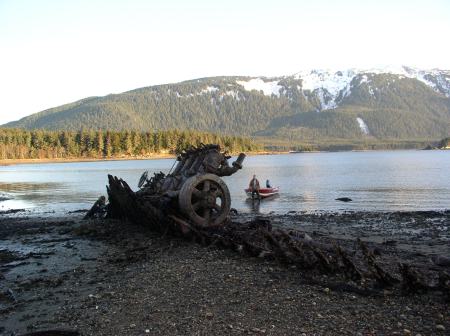
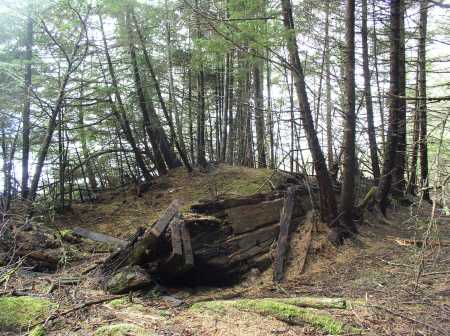
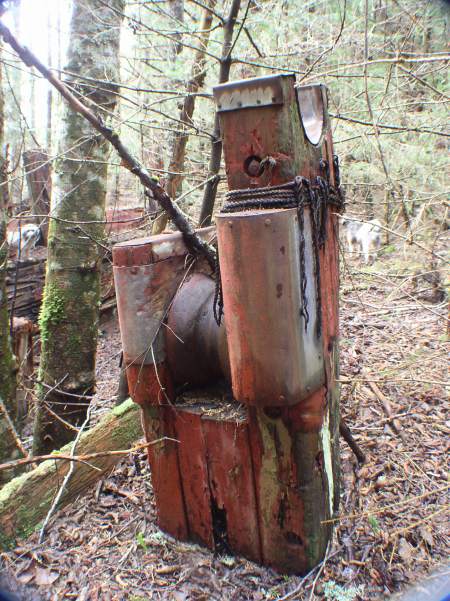
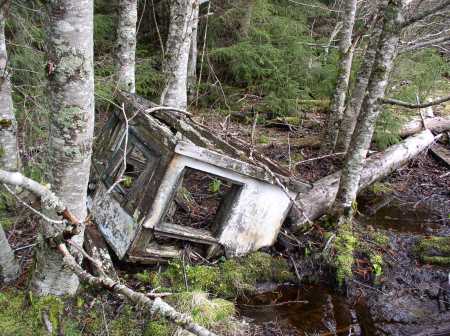
Funter Bay History – Steam Power & Internal Combustion

April 23, 2013

Most of the industry in Funter Bay required power of some kind, steam was the major power source prior to cheap and reliable internal combustion engines, but early gas and diesel engines began arriving around the turn of the century.

You would think that in the middle of a forest, the best fuel for steam engines would be locally-cut wood, but coal seems to have been used instead (you can still find chunks of coal on the beach in a few places). Whether this was due to the design of the boilers, the thermal properties of spruce, or due to lumber harvesting restrictions, I’m not sure. Oil was also an option for fueling boilers (there was a whale oil plant at Tyee, and early petroleum wells in Southcentral Alaska). One document from the 1920s mentions that Killisnoo coal was preferable to oil as a fuel for steam boilers at Funter Bay. Coal was mined at Harkrader on southern Admiralty Island, near the fish processing plant at Killisnoo (now part of the village of Angoon). Discovered by Russian explorers, used by early Russian and American steam vessels, and mined intermittently until 1929 , this deposit was planned to supply Inside Passage steamships, but seems mostly to have been sold in local communities.

Edit: The main engines at the cannery appear to be gasoline, rather than steam, see below.

Large operations like the Funter Bay cannery had a large central boiler which provided steam for cooking and sterilizing, as well as heat and hot water for the sites.

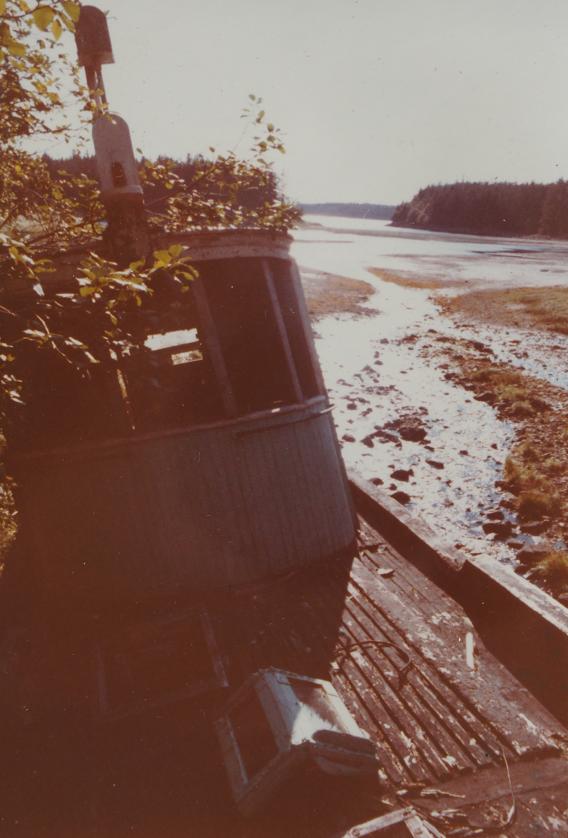
Cannery power house in the 1980s:

Cannery 4

Some close-ups of the two horizontal stationary gas engines at the cannery. The name plates have wandered away, so I don’t know much about these (Update: Local resident Gordon Harrison has informed me these were Fairbanks-Morse gasoline engines, an early type of low-horsepower (5-10hp) internal combustion engine. These seem to resemble the 1898 designs, so it’s likely that they were original equipment for the cannery when it started in 1902. Some diagrams of similar engines can be seen here):

OLYMPUS DIGITAL CAMERA

OLYMPUS DIGITAL CAMERA

OLYMPUS DIGITAL CAMERA

The two engines would have been located in the machine shop, with the boiler located in the power house.

closeup1

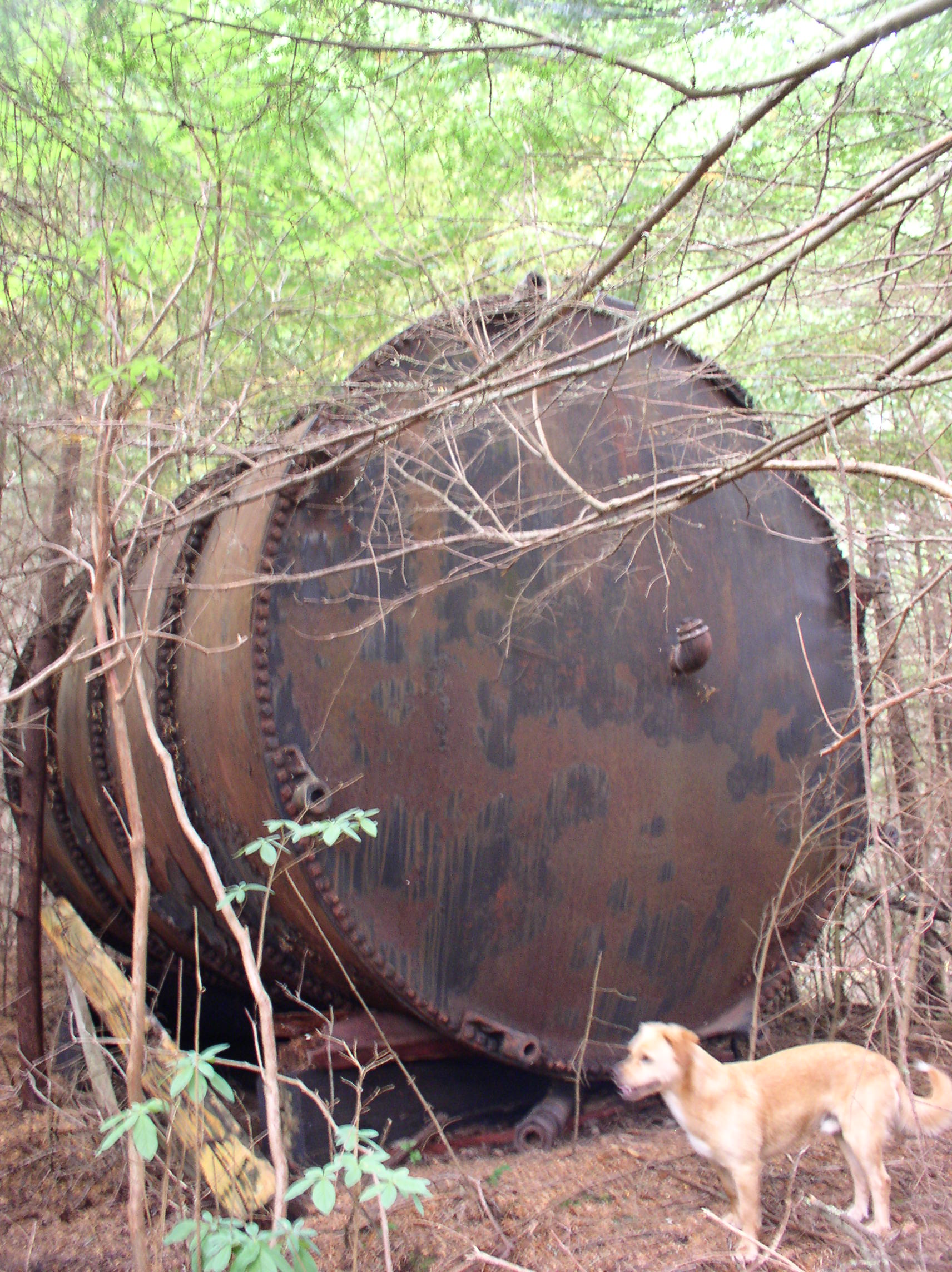
Two large tanks such as this held water for the boiler. On the map above, you can see the tanks located behind the power house. Update: The tank below is in fact the one located behind the pump house on the above map, and was used for oil. The two tanks behind the power house were nearly identical in design.

OLYMPUS DIGITAL CAMERA

Mechanical power from the Fairbanks-Morse engines would be transferred via belts from the engine flywheels to overhead pulleys and shafts (rods), which distributed the power out to various machines (run from other pulleys and belts with a clutch system). Below is a surviving example of some of this overhead equipment in the carpentry shop attic, as viewed from above:

OLYMPUS DIGITAL CAMERA

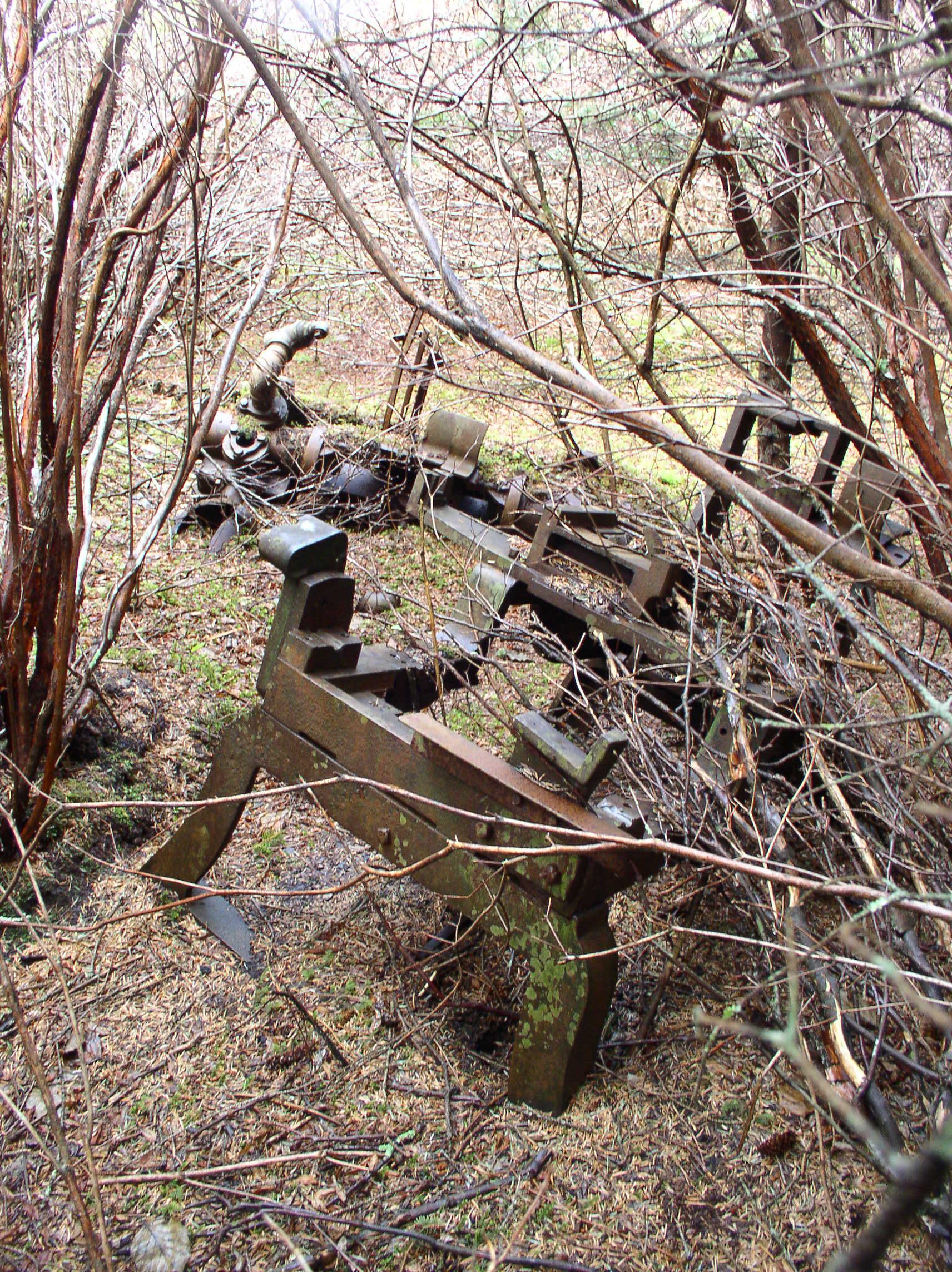
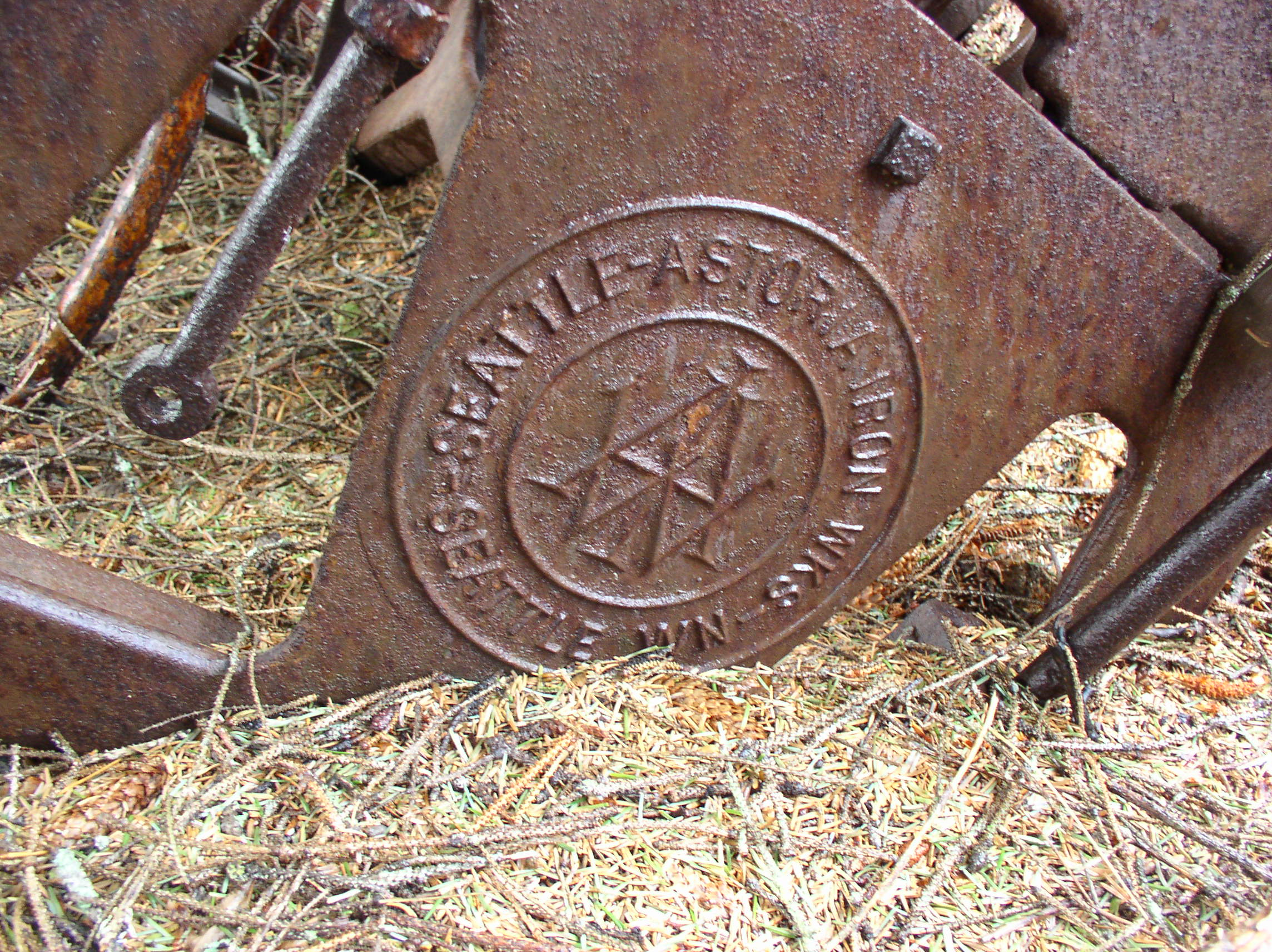
And below is some of the equipment which would have been operated by this arrangement (I’m not sure specifically what the devices below were, they’re rusted pretty badly and missing a lot of parts):

OLYMPUS DIGITAL CAMERA

OLYMPUS DIGITAL CAMERA

OLYMPUS DIGITAL CAMERA

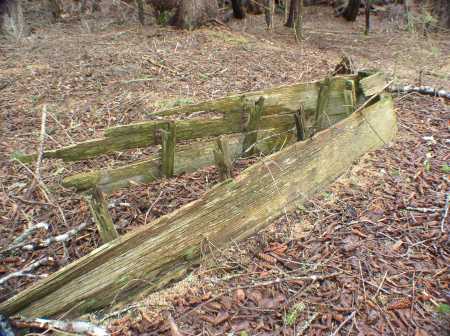
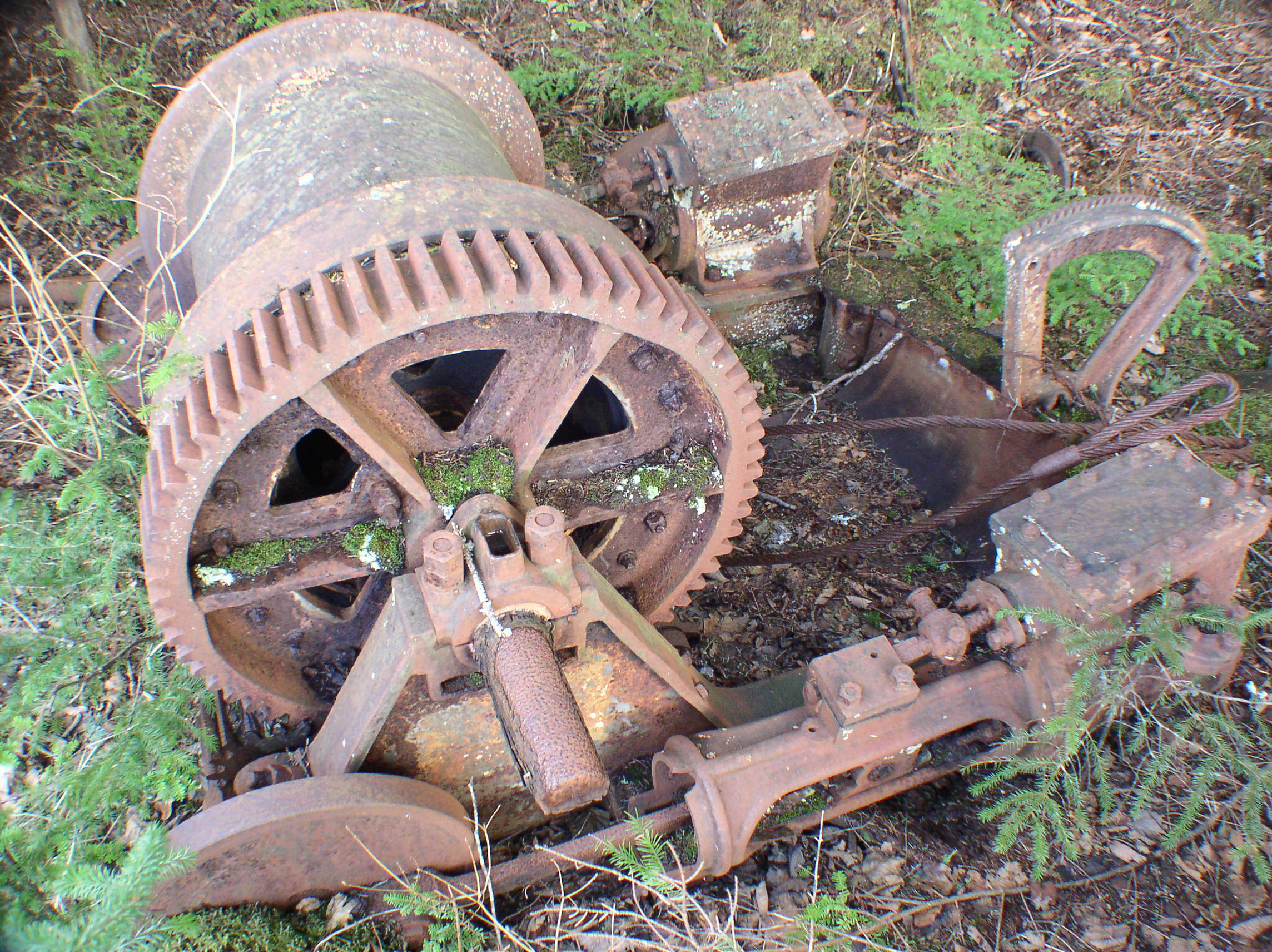
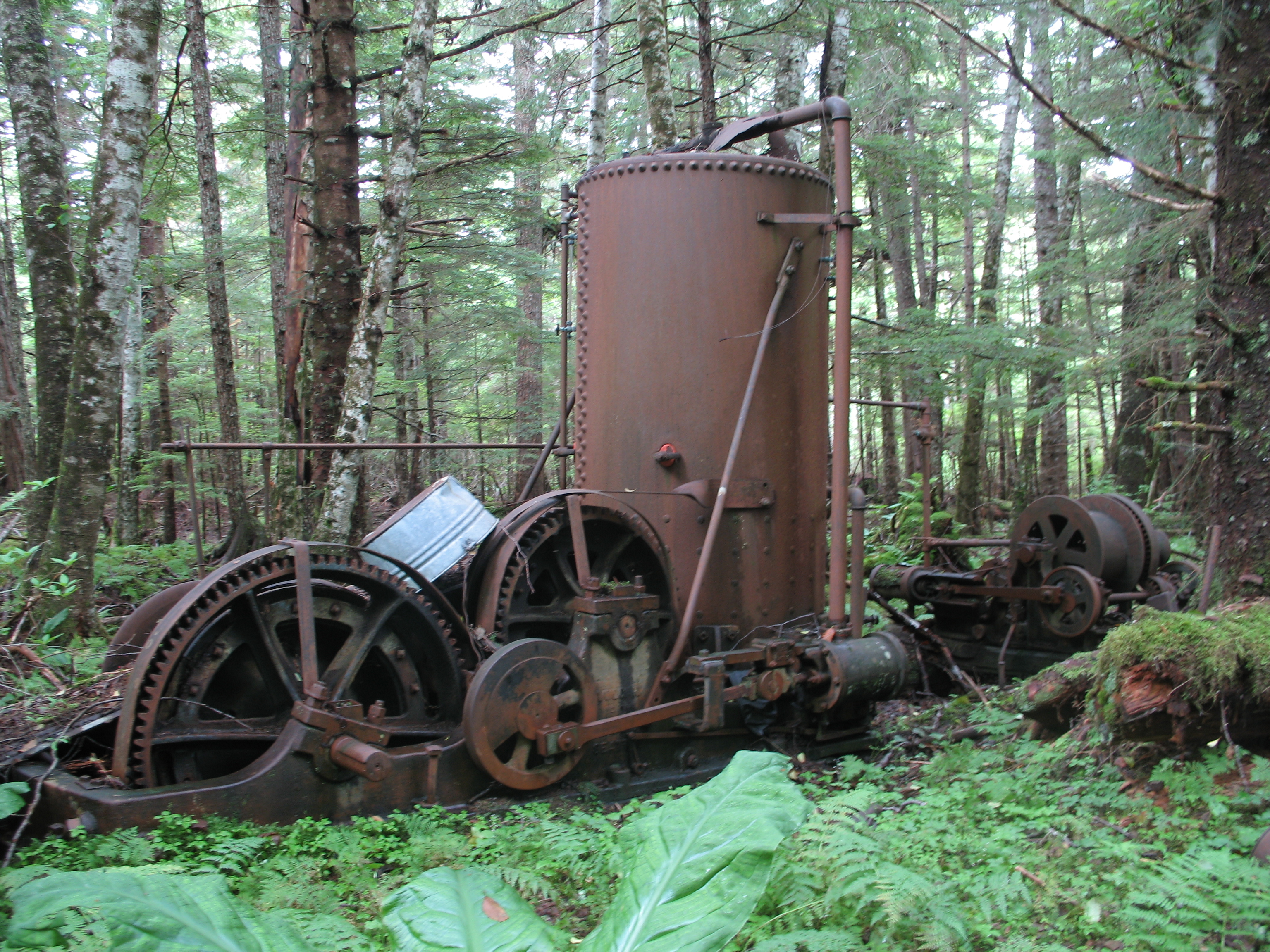
Away from the main site, there would be smaller gas, diesel, or steam engines with “portable” boilers set up to operate things like winches, hoists, and tools. In this case, “Portable” means something like “You can drag it to a new location in about a week with 20 men and a team of mules”. (I’ll try to come back to the mules in a later post). The following shows a boiler for one of these smaller steam plants:

OLYMPUS DIGITAL CAMERA

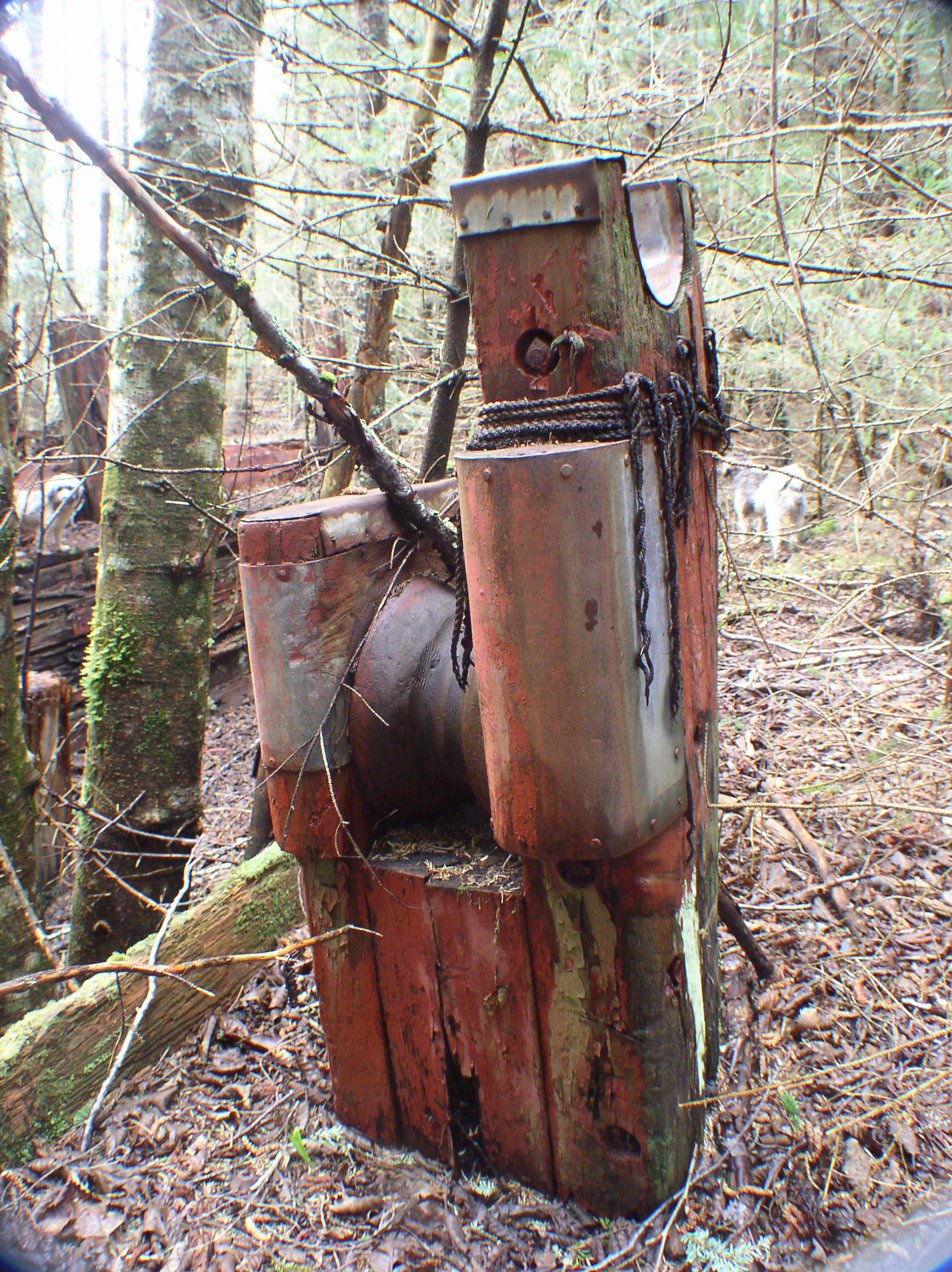
And a winch with small steam piston:

OLYMPUS DIGITAL CAMERA

A more packaged power unit was the “Steam Donkey“, a somewhat standardized portable boiler, steam engine, and winch on skids. These could be moved by clearing a road or trail, hauling a cable to a tree or other anchor, and then letting the unit winch itself towards the anchor. Here is a steam donkey that ran a mine tramway:

IMG_1334

Note that there seem to be two piston units associated with this donkey, the heavily-geared one at front, and another unit with a large cable winding drum at the rear. Below is a closeup of the rear unit, which had a steam piston on each side of the central drum:

IMG_1329-2

Update: after looking closely at my photos, I can make out what appears to be “Vulcan Iron Works” of Seattle. Here are some photos of a very similar Vulcan steam donkey, built in 1901.

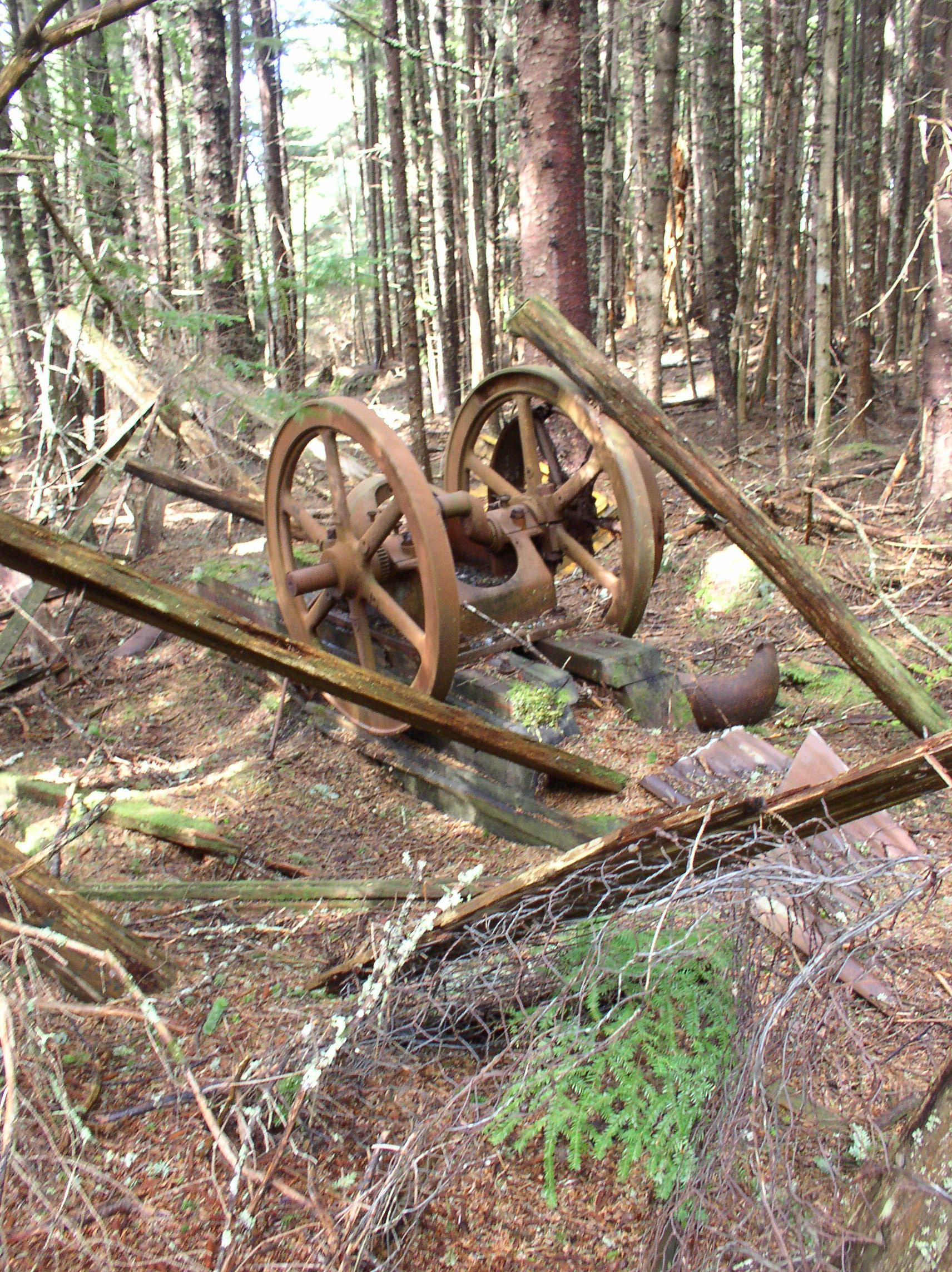
Here is an early low-horsepower gas engine in the woods near the cannery:

OLYMPUS DIGITAL CAMERA

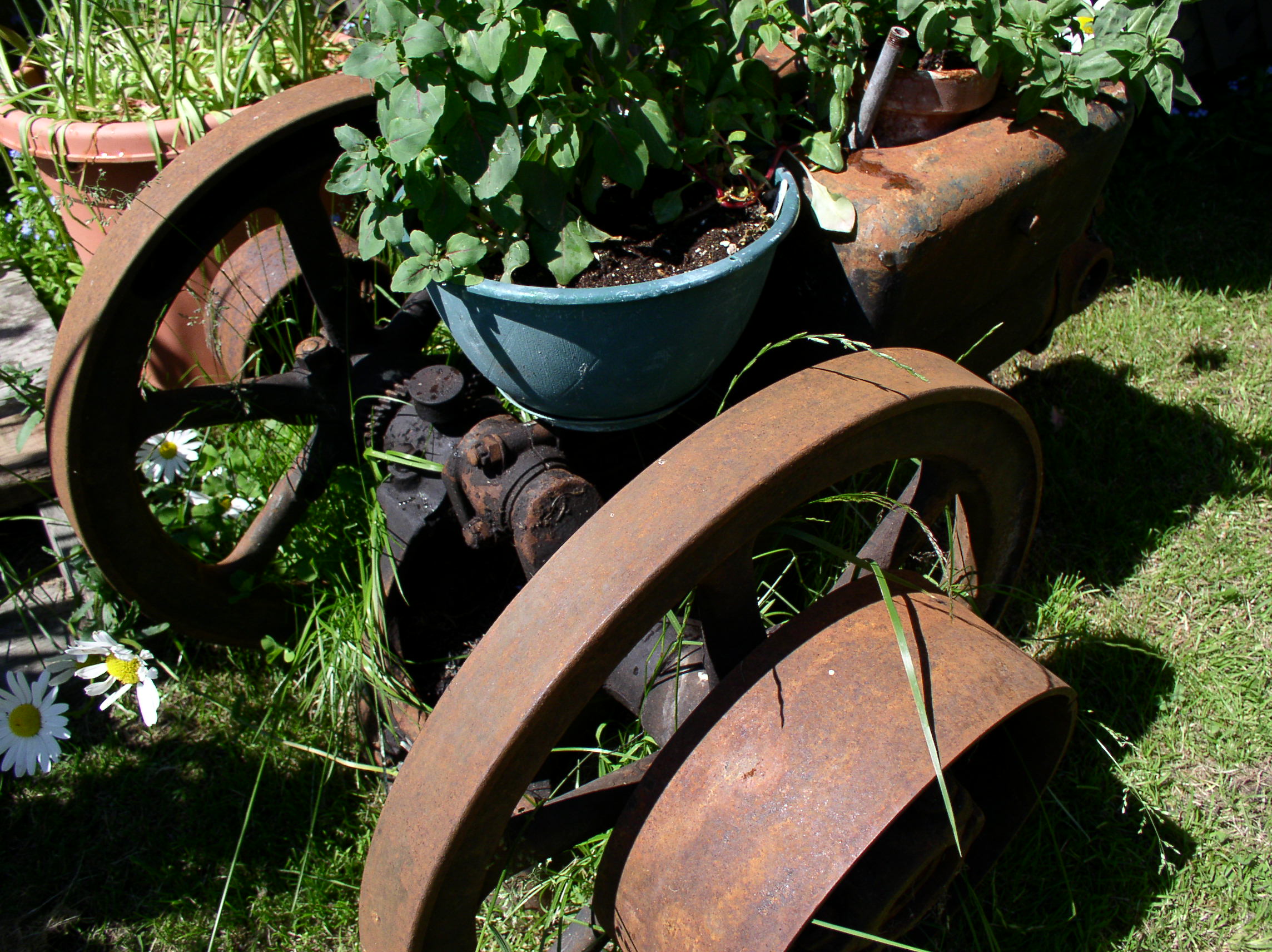
A smaller and slightly newer (3hp?) gas engine, similar to the ones shown here.

OLYMPUS DIGITAL CAMERA

Thanks to Gordon Harrison for providing some additional details!


Funter Bay History III – Cannery Development & Land Hijinks

April 15, 2013

As long as I’m on the history of the Funter Bay cannery, here’s an approximate timeline for the development of the property. Ownership history is a bit tricky, as the history of salmon packing operations in Alaska is a bit of a tangled mess. Many of the companies overlap, consolidate, buy each other out, go bankrupt, and otherwise change names frequently during the early 20th century.  For example, a 1901 article mentions the consolidation of 30 canneries, including the Thlinket Packing co, into a trust under the Pacific Packing and Navigation company, but this holding company went bankrupt in 1903.

1899: James Thomas Barron, a Portland businessman, organizes the Thlinket Packing and Trading Co. They appear to have initially operated in Southern Southeast Alaska, with canneries at Point Gerard and Santa Anna near Wrangell. Early funding was likely via investors and speculators; salmon canneries were becoming popular, with the industry pushing farther and farther north up the Pacific coast.

1901: Barron sells the Wrangell canneries to the Pacific Packing and Navigation Co, using the money to finance construction at Funter Bay. (After the Pacific Packing and Navigation company went under, Barron bought at least one these canneries back at the bankruptcy sale, but abandoned the sites after presumably salvaging the equipment).

1902: J.T. Barron starts the Funter Bay Cannery. According to Barry Roderick’s “A Preliminary History of Admiralty Island“, this was the first cannery on Admiralty Island (Angoon had a herring plant and saltery prior to this), and initially employed 65 white workers, 30 Natives Alaskans, and 38 Chinese workers. The operation  used two steamships (Probably the Anna Barron and the Robert Barron, named after the owner’s children) and 30 small boats. The company initially had two fish traps. In its first year, the company packed 31,888 cases of mostly pink salmon, valued at $87,200.

Volume and profits went up and down over the next two decades, with regular updates and occasional feature articles in industry magazines like Pacific Fisherman. Employment was seasonal and included many migrant and itinerant workers of various nationalities.

Cannery Trademarks

1907: The Thlinket Packing and Trading Co reorganizes as the Thlinket Packing Co. There is an interesting article (pg 21) in the 1907 Pacific Fisherman Journal which includes a cover photo of J.T. Barron’s 11 year old son, Robert.

1913: A news article (actually a letter that was printed in a paper) claims the Funter Bay cannery is the largest in Alaska.

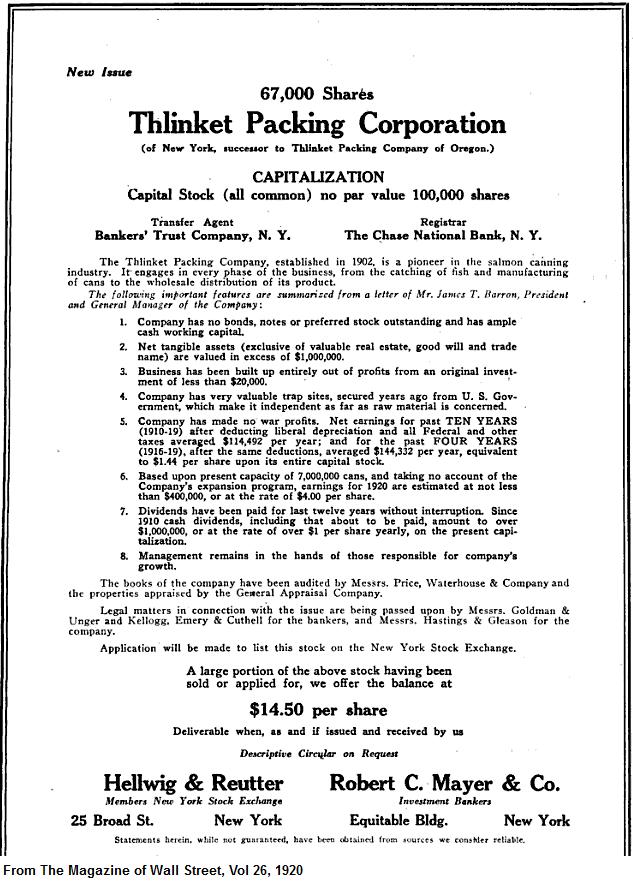
1920: The Thlinket Packing Company changes its name to Thlinket Packing Corporation. This seems to have been a fundraising move, as the company issued public stock that year.

Cannery stock offering 1920

1926: Sunny Point Canning purchases the Thlinket Packing Co, including their property and boats. Barron may have retained some ownership interest in the Funter Bay property until 1941, as there is no transfer to Sunny Point recorded on the survey of the property.

1931: Cannery ends most packing operations, citing a lack of reliable fresh water. Storage, docking, fish trap maintenance, and other associated activities continue. Year-round watchman remains on-site.

1941: PE Harris Co purchases the cannery. J.T. Barron passed away in this year.

The property was used during WWII by the war department to house forcibly relocated residents of the Pribilof Islands (more on this in a future post).

1950: PE Harris becomes Peter Pan Seafoods, Inc.

At some point there was also a fish buying station on Highwater Island, and several handtrolling operations located around the bay (independent fishermen who trolled from small boats with hand-cranked gear).

1959-1960: As the cannery profits declined due to lower fish stocks, and traps became regulated and then illegal, the remaining parts of the operation were eventually shuttered. Buildings were already suffering from deferred maintenance at this point.

1980s: Property sold to Bristol Bay Native Corporation

1990s: Property bought by Juneau resident and subdivided into multiple lots for cabins. Many buildings and debris cleared or demolished.

– – – – – – – – – – – – – – – – – – – – – – – – – – – – – – – – – – – – – – – – – –

As for the early development of the property, It’s well known that early development in the Western US took advantage of loopholes in land regulations. Some of these seem to have been used by J.T. Barron during development of the Thlinket Packing Co cannery at Funter Bay.

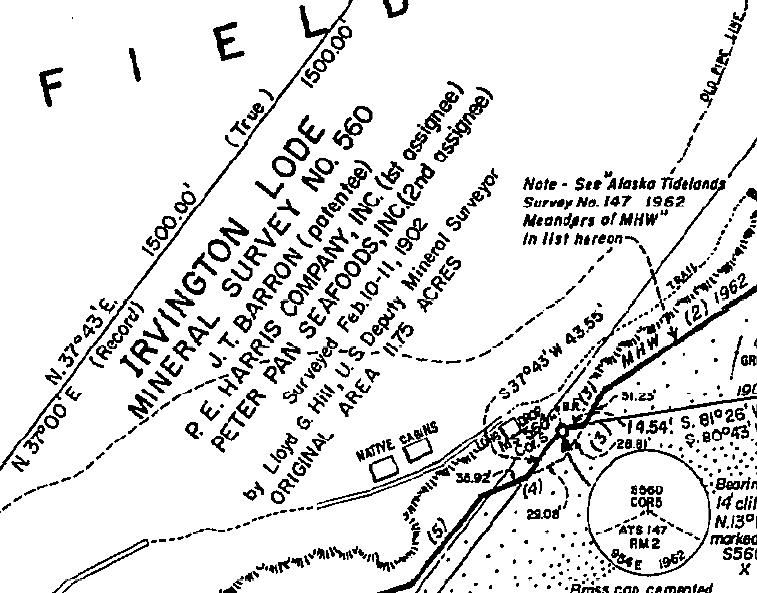
For instance, the cannery site is located on a patented mineral claim for the “Irvington Lode”, a mineral body which was apparently never worked beyond token maintenance. One of the easiest ways to acquire land in Alaska used to be via mining claims: anyone could stake a claim, and effectively do whatever they wanted with it as long as they performed some amount of work each year. There is evidence of some token prospecting at the cannery site (a few pieces of quartz bashed out of an exposed vein), but there does not seem to have ever been serious mining there.

irvington

Similarly, for many years, anyone could claim a homestead site just by staking out land and doing some minimum amount of improvements (such as cutting trees, putting up fences, building structures, etc). After a set number of years or a certain value of improvements, the homestead was “proved up” (improved to some set standard), and owned outright by the homesteader. I have heard that these were often used by cannery operators to acquire fish trap sites. They or their employees would homestead a convenient spot by a stream mouth, do the legal minimum improvements, and use the land as a base from which to build and operate a fish trap.

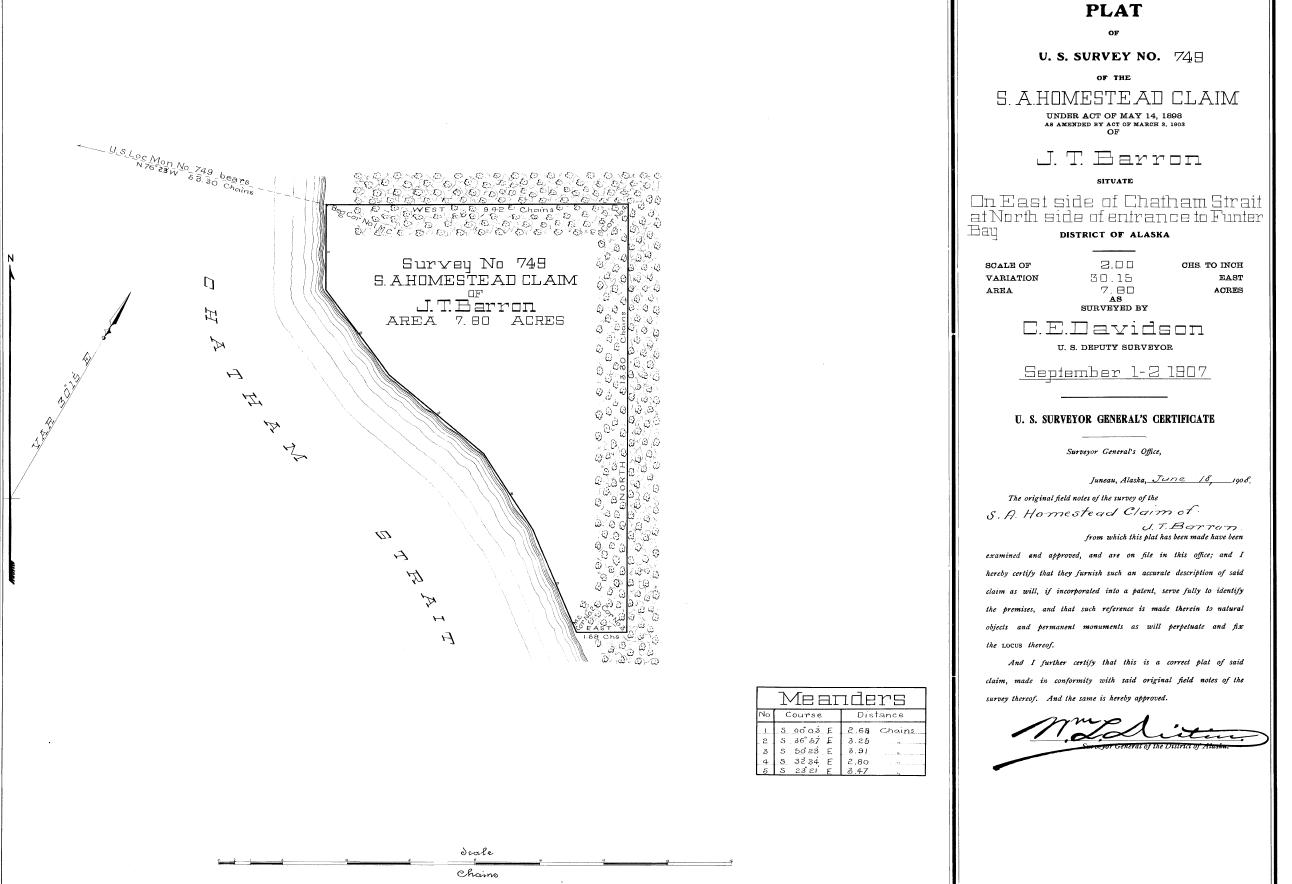
For example, here is a “homestead” staked in 1907 by J.T. Barron. This is on the outside coast of Mansfield Peninsula in Chatham Strait, near the Kitten islands. Locations outside of a protected bay like Funter were less desirable for *actual* homesteads, since they were more exposed to weather, and thus harder to land a boat or maintain a dock. While there are some ruins visible in the woods at this location, and I’ve heard that it was a handtrolling camp at one time, it seems unlikely that this would be the place a cannery owner would choose for his residence.

homestead

As a matter of fact, the image below (also seen in colorized postcard version in a previous post) is looking directly towards Mr Barron’s “homestead”, the land seen beyond the trap and boat, just inside the Kittens (one of the islands where the photographer is standing).

kittens

Interestingly, several of these former trap sites, now “proved up” private land, are highly valued as cabin and home sites in areas that are otherwise exclusively state or federal land!

The DNR’s Alaska Mapper, has some great ownership data and links to old survey maps.

Update 5/17/13: After perusing a few more US Surveys, I’ve found that Barron had a dozen or more “Homesteads” filed, all along the shore of Admiralty Island, and the north side of Icy Strait at Homeshore. The Hawk Inlet Fish Co also had some homesteads in the same area. “Homesteading” for industrial development was not limited to canneries, the Alaska Gastineau mine and other mines also had homestead claims in the Juneau area.


Funter Bay History II – Ships and Shipwrecks

April 11, 2013

As mentioned in my prior post, the Thlinket Packing Co had a cannery tender named the Anna Barron based at Funter Bay, named after James and Elizabeth Barron’s daughter Anna. The cannery also owned a number of other vessels, many named after people in the Barron family, but the Anna is best known (for such an obscure topic as Southeast AK cannery tender vessels), since it appears in numerous publicity photos and postcards of the cannery.

AnnaBarron

The October 1920 issue of Pacific Motorboat mentions that the Anna Barron had three engines which were overhauled that year. The HW McCurdy Marine History of the Pacific Northwest describes her as being 77ft long, built in Astoria in 1902 for the Thlinket Packing Co, fitted with a compound (9 1/2, 20×20) engine developing 130hp. Her merchant vessel registry number was 107759.

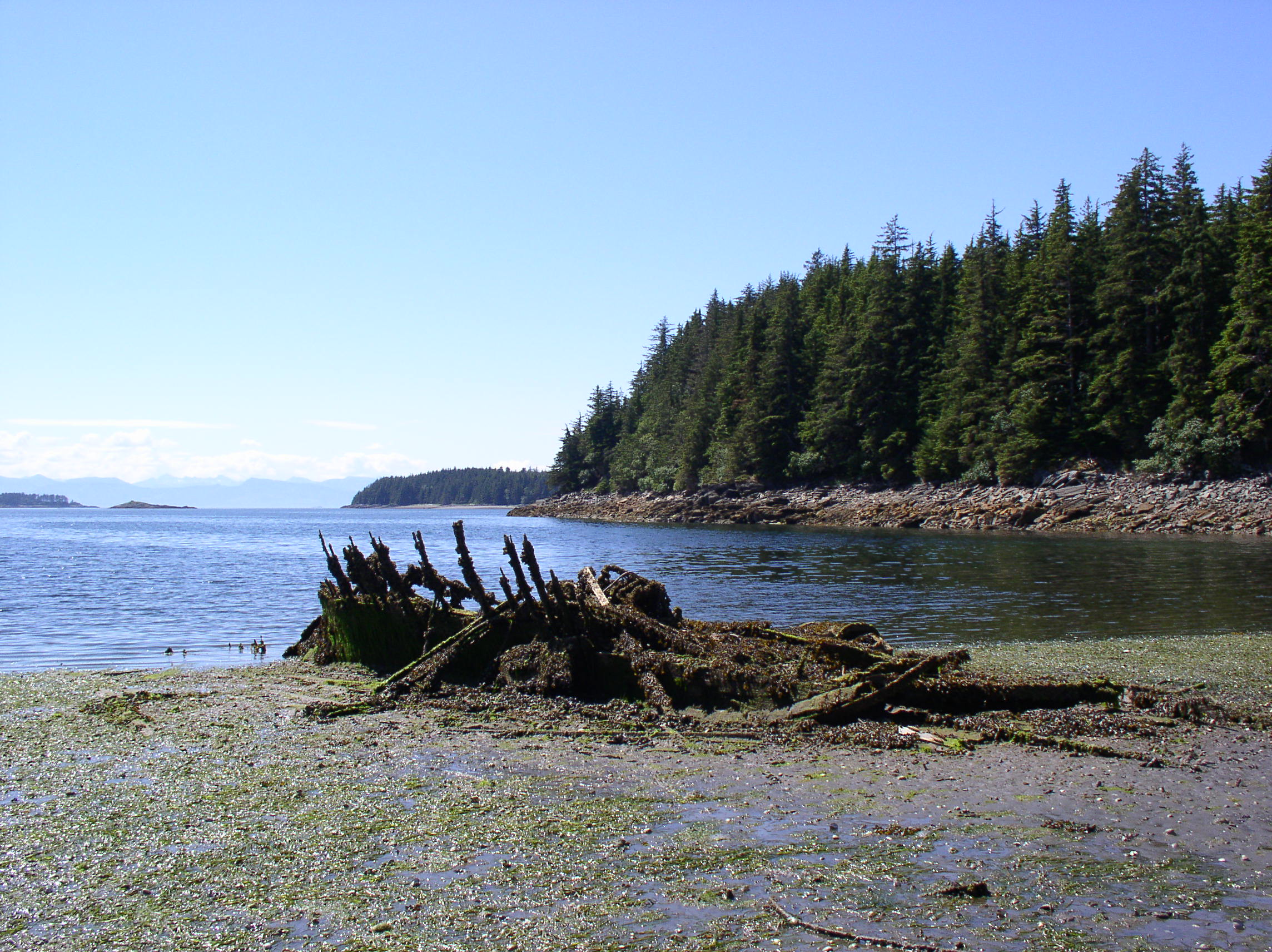
Today in Funter Bay, there are two wrecks of midsize boats (or parts of them) visible on the beaches. Both of these are locally referred to as “tugboats”, and I had always heard they were cannery boats. One is located in Scow Bay (AKA Coot Cove), and one is on Highwater Island (also called Crab Island on some state survey maps, although I’ve never heard it called that).
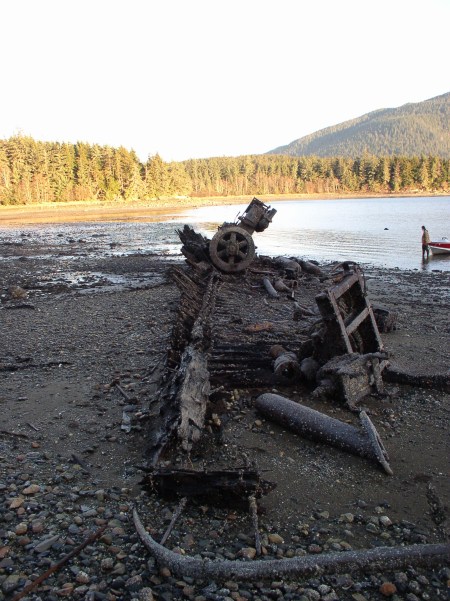
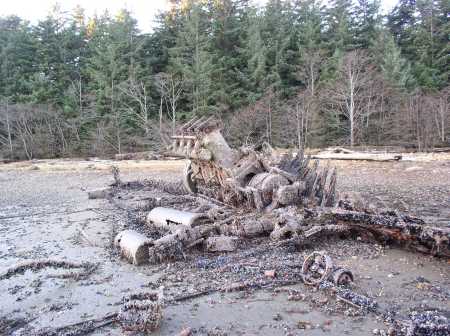
OLYMPUS DIGITAL CAMERA OLYMPUS DIGITAL CAMERA OLYMPUS DIGITAL CAMERA
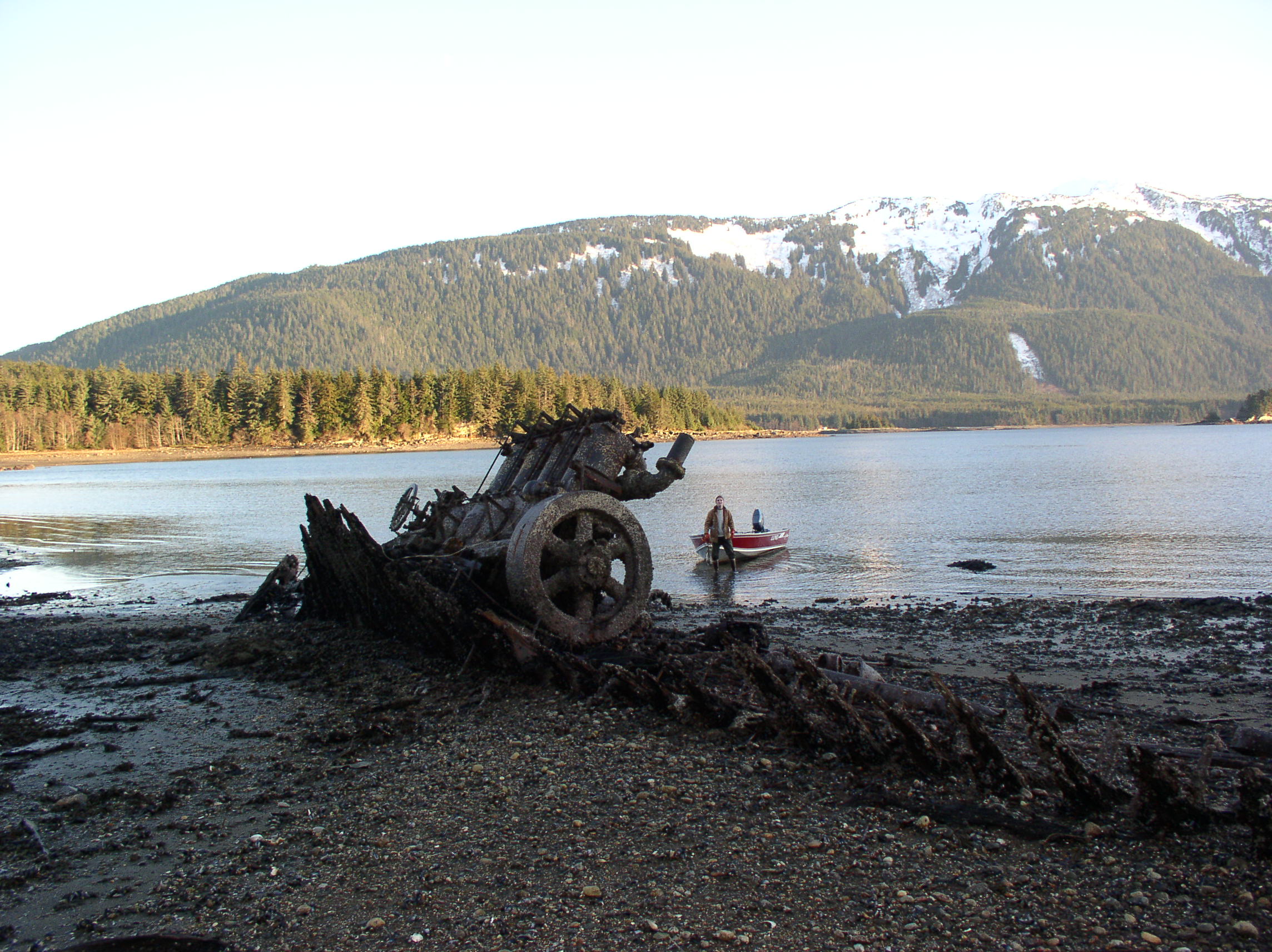
The three photos above show the Coot Cove wreck. There’s not much left aside from the keel, some ribs, and the large Atlas-Imperial diesel engine. As this page notes, the vessel seems to have fire damage. It seems to be about 70-80ft in length, but estimation is difficult due to the condition of the wreck. Here is a photo of a similar (but larger) engine in another cannery tender.
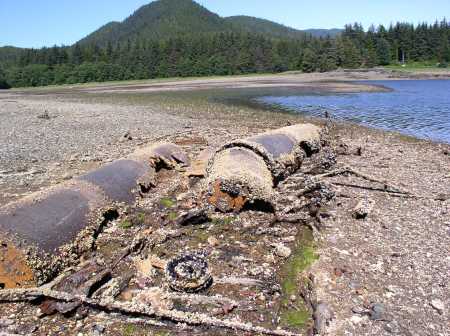
OLYMPUS DIGITAL CAMERA OLYMPUS DIGITAL CAMERA
The two photos above show the Highwater Island wreck. There is even less remaining than at the other site. You can still find some cylindrical tanks and the rudder, a few wood and metal bits showing the rough outline of the hull, and a few interior items like plates and glassware. This one seems shorter than the other wreck, maybe 50-60ft, but again, estimation is difficult.

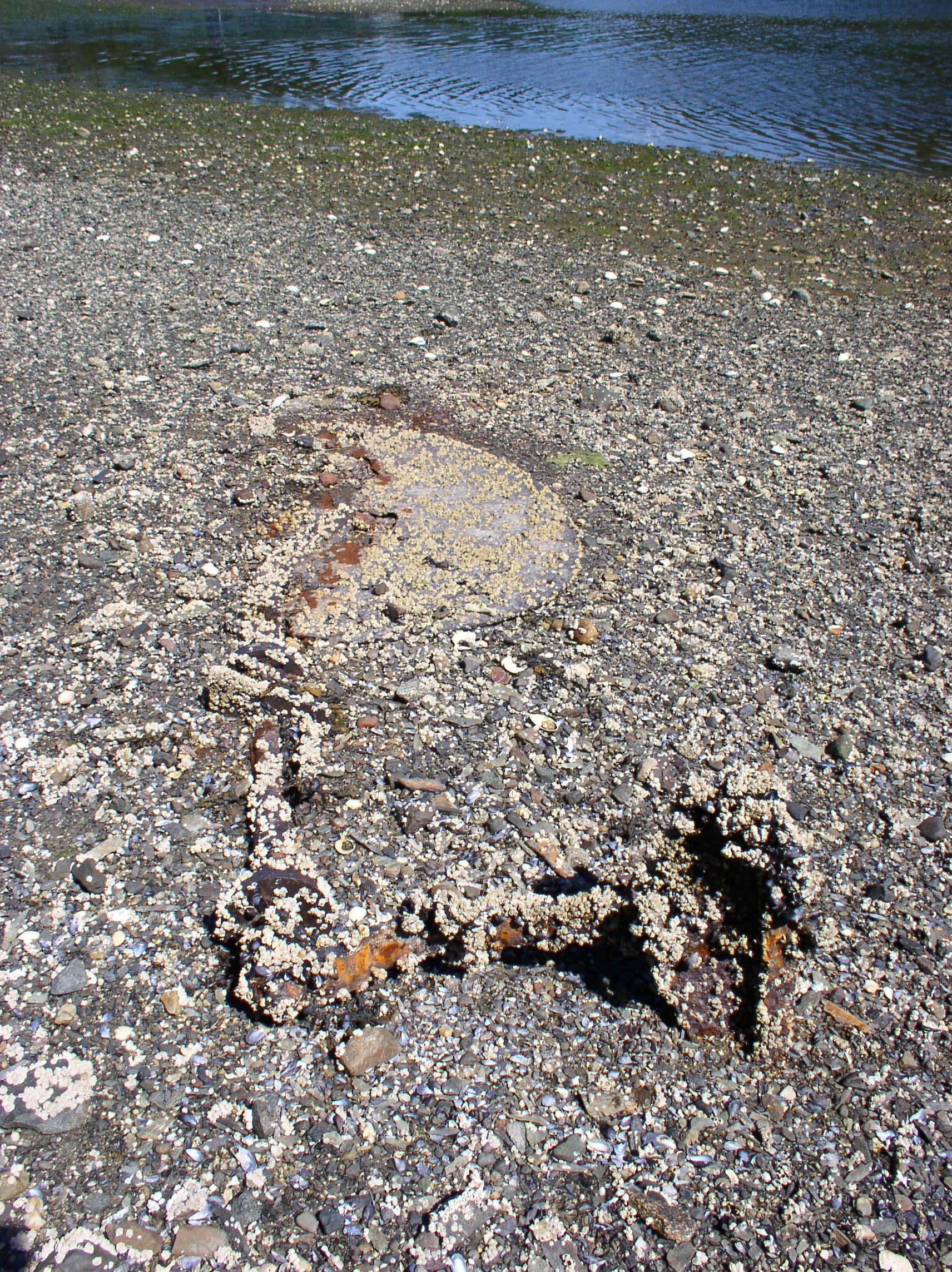
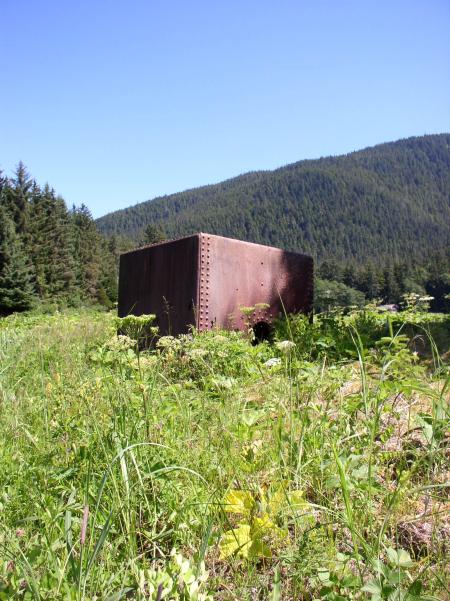
The hollow steel boiler from the Highwater Island wreck appears to have floated across to a small peninsula known locally as “The Point”, where it rests at extreme-tide level slowly rusting away.
funterhistoryboiler

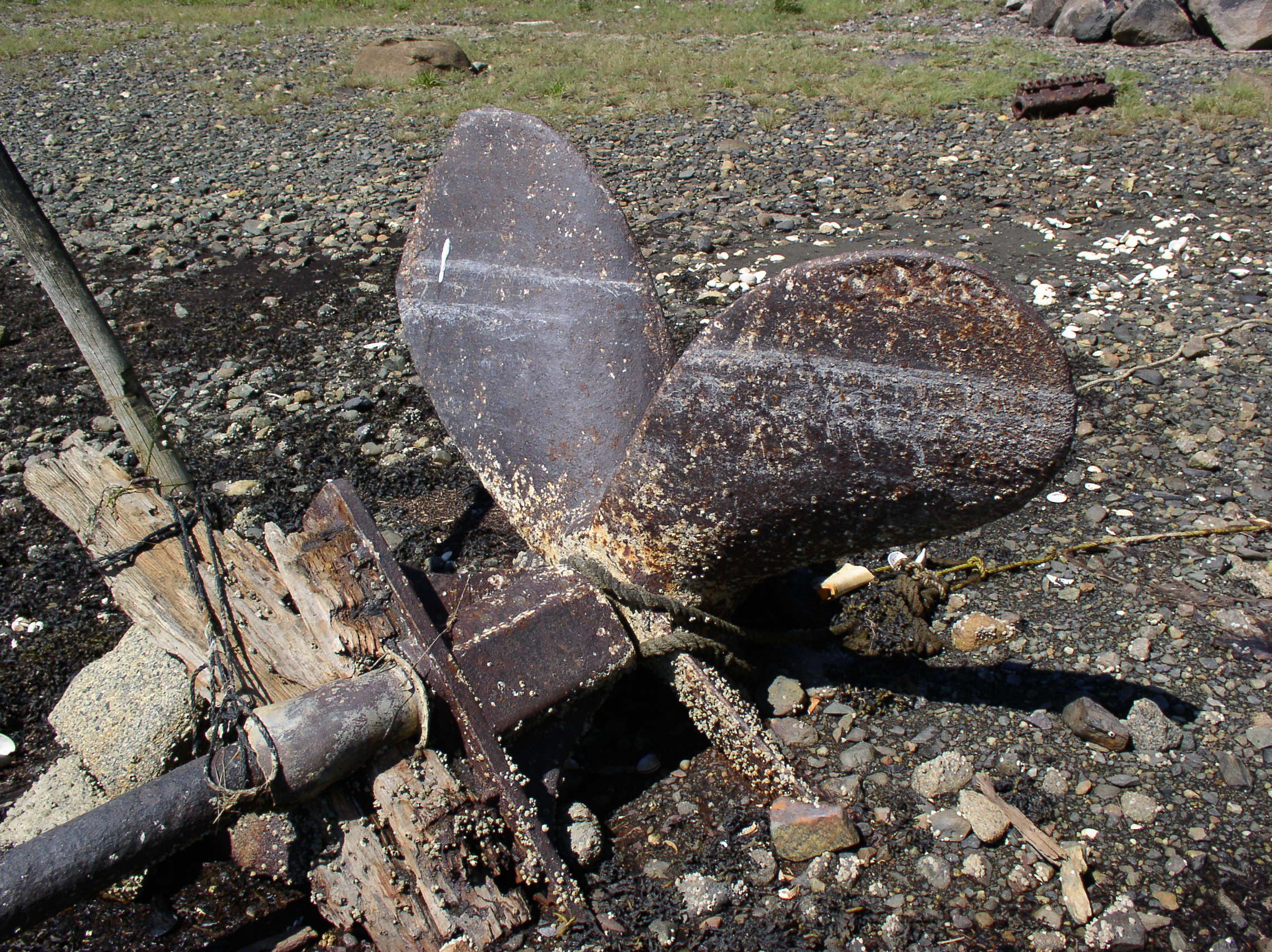
The propeller from this wreck was also removed by a prior resident of my family’s property, and dropped in the front yard. The story goes that the person believed it was brass, and planned to sell it for scrap, but when they began cutting into it, they realized it was cast iron. You can still see a cut section on one of the flukes.

OLYMPUS DIGITAL CAMERA

Is one of these wrecks the Anna Barron? I found a small snippet from a 1931 Google document claiming the Anna Barron sank at Point Couverden across Icy Strait, still with its original steam engines. Unfortunately the full text is not available.

“The “Anna Barron”, owned by the Alaska Pacific Salmon Corporation, believed to be the last remaining steam tender in the fleet, struck a rock and sank in Icy Strait July 22. Built many years ago by the former Thlinket Packing company, she was still valued at about $20,000

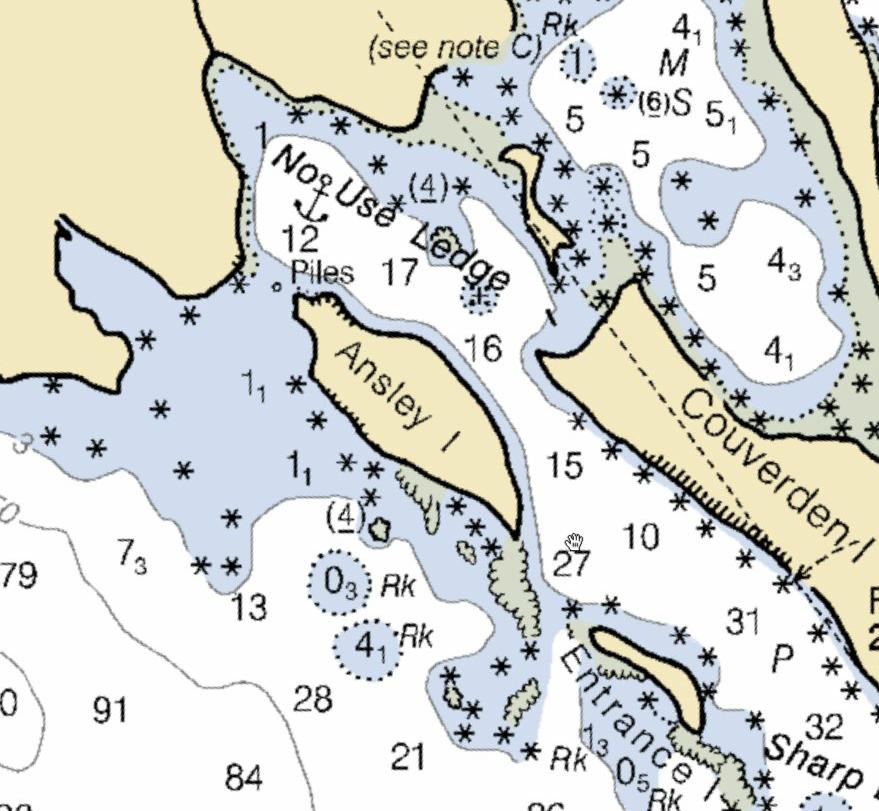
This page contains some additional information, sourced from US Customs wreck reports. According to the report, The wood steam tender Anna Barron hit the rocks at Ansley Point (Near Point Couverden) after departing Funter Bay the night of Tuesday, July 22 1930. Captain George D. Black was carrying a half scow load of fish and was attempting to offload to scows tied to a dolphin (piling structure) between two reefs off Port Ansley (now known as Swanson Harbor). The wind and tide in the narrow passage proved too much for the vessel, and it was forced onto the rocks in the darkness while maneuvering to reach the dolphin. The captain was quoted as saying the Anna Barron might be raised in the future.

Swanson

Some of the dolphins and other pilings are still visible in Swanson Harbor, and appear on nautical charts of the area.

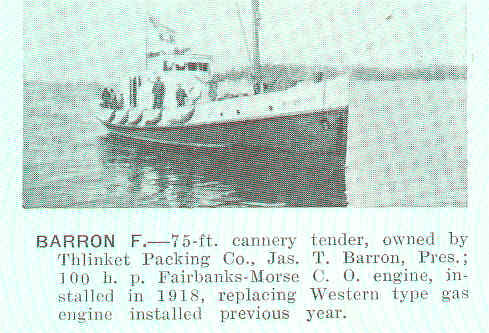
In addition to the Anna Barron,  the cannery also owned a 75′ boat named the Barron F.  (From UW Freshwater and Marine Image Bank)
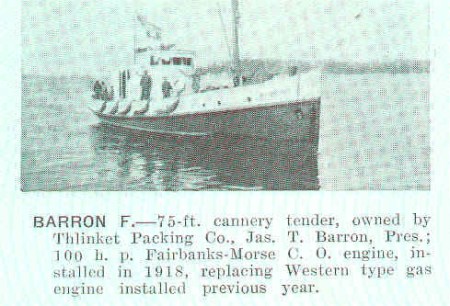
Barron F

According to McCurdy there was an 85′ cannery tender named the Barron F built in 1917 for the Nooksack Packing Co. The US Merchant Vessel Registry lists a 65′ Barron F built in 1917, registry number 214967. I am not sure if these are all the same boat with errors in the published length, or different boats. It seems unlikely there would be so many vessels named after the Barron family in exactly the same way at the same time.

The cannery also seems to have owned a 53′ gas boat named the Buster, registry number 14481, built in 1889 in San Francisco. This boat caught fire and sank in Funter Bay in July of 1926, as mentioned here. The boat had left the cannery dock and suffered engine trouble, then a fire broke out in the gas engine during repairs. The vessel was assisted by the Anna Barron and the Driva (a 56ft gas towboat belonging to Juneau Lumber Mills), and towed to a dolphin. The  mooring line burned and the boat drifted around the bay, burning all night, before sinking “in deep water”. I do not know where this wreck is located precisely. The cannery had just been purchased by the Sunny Point Packing Company in this year.

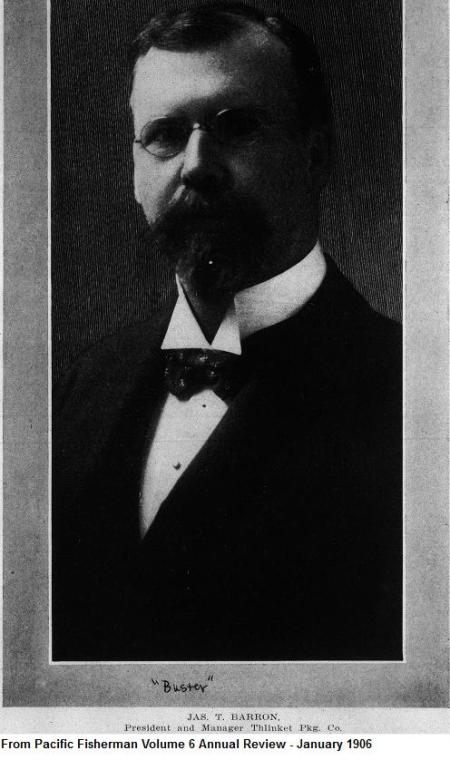
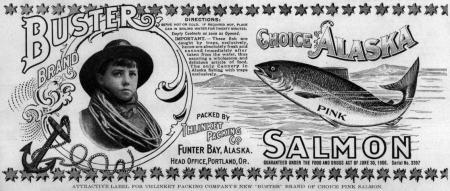
The Buster was probably either named after J.T. Barron himself (who sports the Nickname “Buster” scrawled on a portrait printed in the 1906 Pacific Fishermen Annual Review), or his son Robert, who was the model for the company’s “Buster Brand” logo. Robert was also featured on the cover of the May 1907 issue of Pacific Fisherman.
Buster

busterbrand

Robert Barron 2

As mentioned previously, Robert died in 1917 while trying to save fellow airmen from an accident in Philadelphia. Mount Robert Barron in Funter Bay was named for him.

Robert also appears to have had a cannery boat named after him, the Robert Barron, a 44ft gas vessel built in 1901 (perhaps for J.T. Barron’s earlier cannery near Wrangell), registry 111335.

So, back to the wrecks on the beaches. Which boats are they? Digging through alaskashipwreck.com I find the following listed for Funter Bay:

Vernia, 6 ton 28ft sloop, blown onto a rock at or near the Kitten islands and sank in Lynn Canal Jan 4 1904. Cargo of fish and gear worth $200, boat worth $150. No casualties, but the boat was a total loss. Master was William Beckler of Juneau.

This one is interesting because it was listed as built at Funter Bay in 1919. The 38ft gas screw Sandy, owned by LF Morris of Juneau, caught fire and sank in Auke Bay in 1928, while carrying an illicit cargo of liquor in kegs. All but 6 kegs were destroyed, the rest were confiscated by prohibition officers.

Tiny Boy, 46ft wooden oil (diesel) freighter owned by WH Bowman sank near Funter Bay Oct 11, 1940. All 6 crewmen escaped.

Reliance No 3, a 32ft wooden fishing vessel owned by WJ Smith, burned and sank off Naked Island near Funter Bay in 1953.

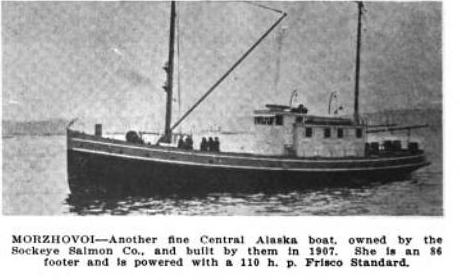
Morzhovoi, an 80ft wooden oil screw (diesel) boat, burned in Funter Bay on June 10, 1955. Reported as having a 165hp engine, being built in Seattle in 1917, and being used for freight service. Owned by the PE Harris Company, registry 214789.

PE Harris (which later became Peter Pan seafoods) purchased the Funter Bay cannery from the Sunny Point Packing Co around 1941. Morzohovoi Bay was another location where PE Harris co owned a cannery.

The Morzhovoi seems like the best candidate for the Coot Cove wreck. Digging some more, I find a reference in McCurdy to Morzhovoi; 80ft, 110hp, first vessel built at the National Shipbuilding Co yard in Seattle. Built for the Sockeye Salmon Co of Morzohovoi Bay (who later leased their cannery to PE Harris)

The 1918 Merchant Vessels of the United States registry lists the following specs for the Morzhovoi: 81 tons, 80.2ft long, 18.9ft breadth, 7.6ft depth, Fish service, crew of 7, 110hp gas engine, home port Seattle. Its registry number appears on the rolls of merchant vessels until 1956, when it disappears. In the 1955 registry it’s listed as an Oil boat of 165hp, radio call sign WB4935, belonging to PE Harris of Juneau.

Morzhovoi
Here’s a photo of the Morzhovoi from the 1919 issue of Pacific Motorboat. It lists some slightly inconsistent info (original HP and owner are correct, but year and length are off. I would suspect that these are typos).

Obviously the 110hp Frisco gas engine must have been replaced with a 165hp Atlas-Imperial diesel during a later refit.

So there’s one wreck identified to a high probability!

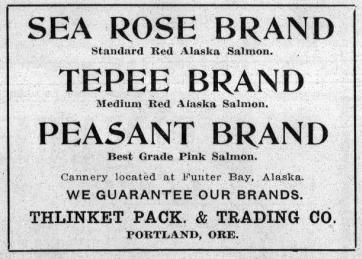
Trolling (pun intended) through the merchant vessel registry, I find a few other boats which may have been associated with the Funter Bay cannery. In the mid 1920s these include the Peasant, a 46ft gas boat built in 1926, registry 225554 and the Tepee, a 29′ gas boat, registry 210208 (The Thlinket Packing Co had canned salmon brands called “Peasant” and “Tepee”).
Ad 1905

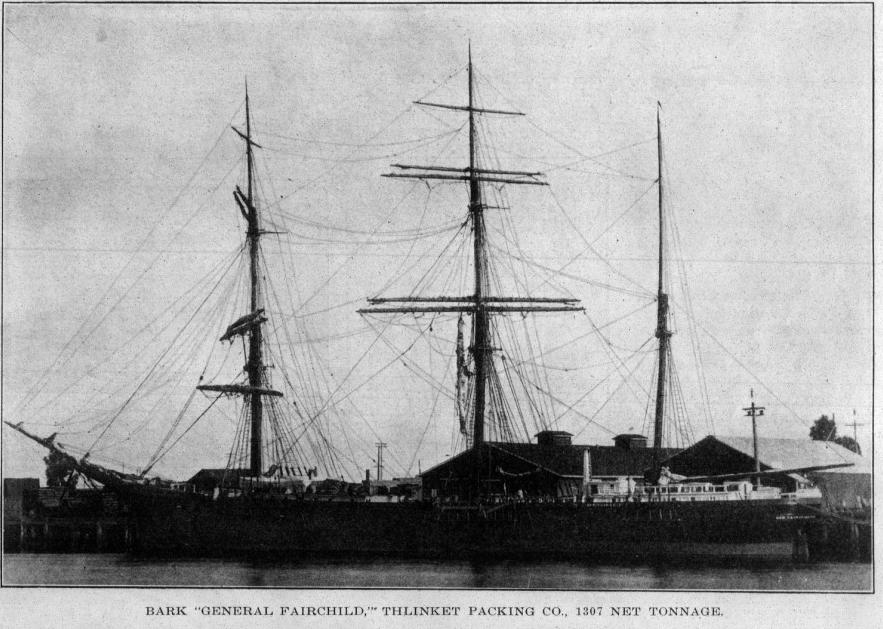
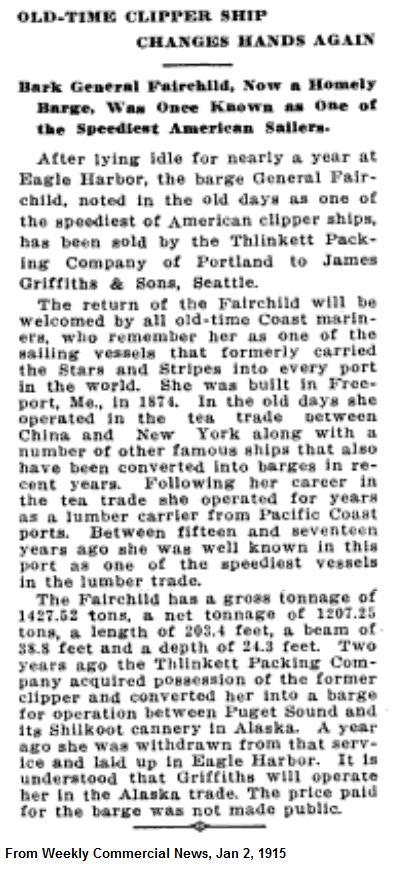
While researching Funter Bay ships, I was surprised to learn that the Thlinket Packing Co owned a large sailing vessel, the General Fairchild. This clipper ship seems to have been converted into a cannery barge, hauling packaged product from the canneries to sales “Down South”. It appears to have been used at the “Shilkat” (Chilkat?) cannery, probably near Haines, but may have also served Funter Bay. The ship was taken out of service after only two years, and then sold to another company.

fairchild

fairchild2

Prior to starting the Funter Bay cannery in 1902, the Thlinket Packing Co seems to have been active in Southern Southeast Alaska, using a leased steamer named the Baranoff and a 6 ton launch (gas boat) named the Perhaps, (per this article). The company (and later owners) also owned a number of other boats, used throughout Alaska, to the point where a complete list would take quite a bit of time to produce and would take this post wandering even further through Southeast maritime history! None of this helps me identify the other wreck at this time, but maybe I’ll find something as I continue digging.

Moving along to other shipwrecks around the bay…

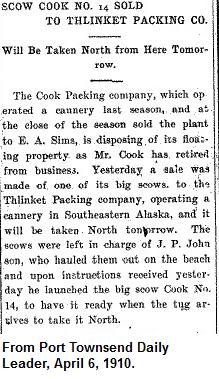
The Funter Bay Cannery also had a number of scows, which were fairly standard among canneries of that era. These were basically open wooden-hulled barges with high sideboards, used to transport fish in bulk from the traps to the cannery. Some of these were also registered with the government, and had such imaginitive names as “Scow #1”, etc.

scow

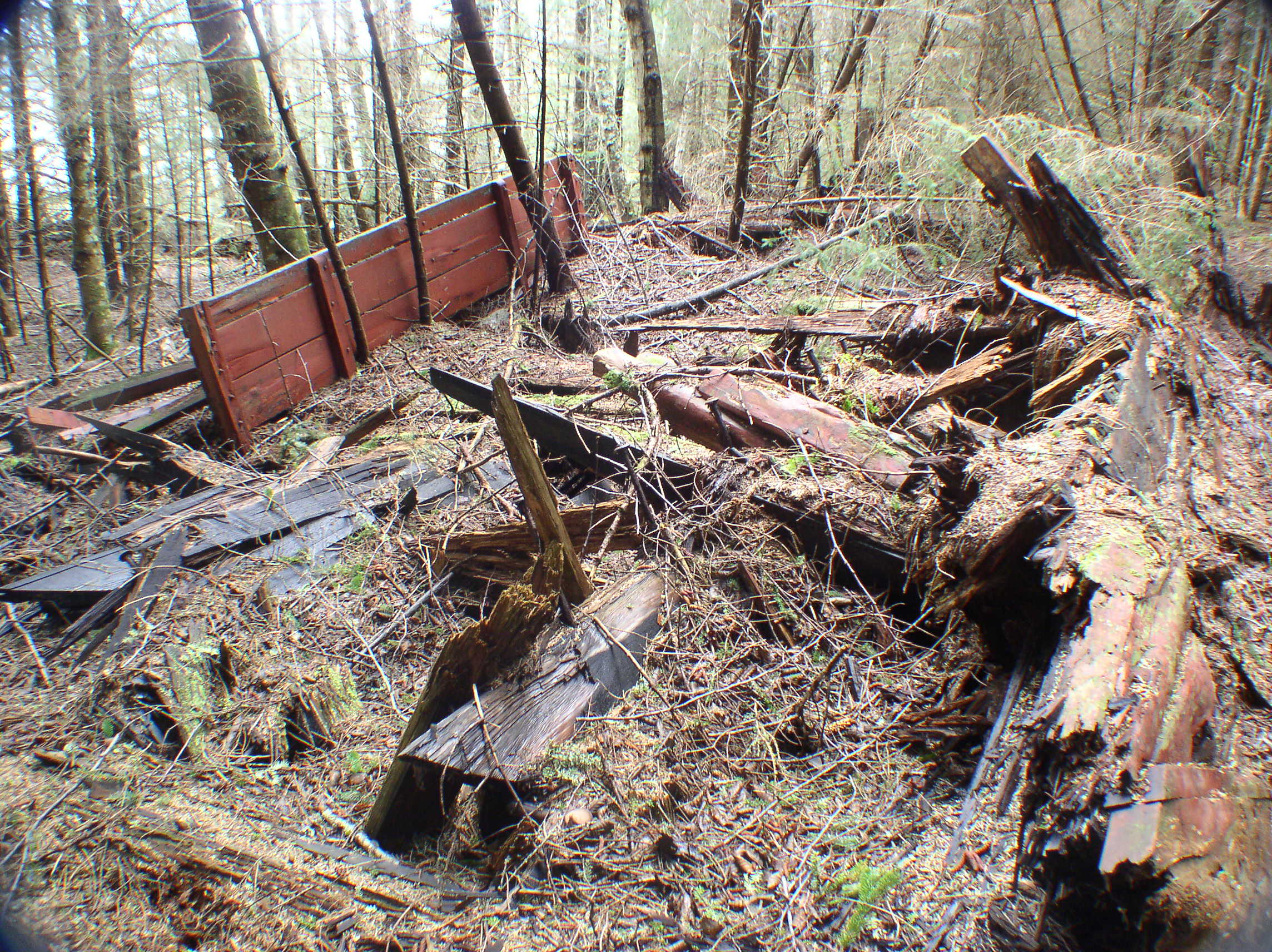
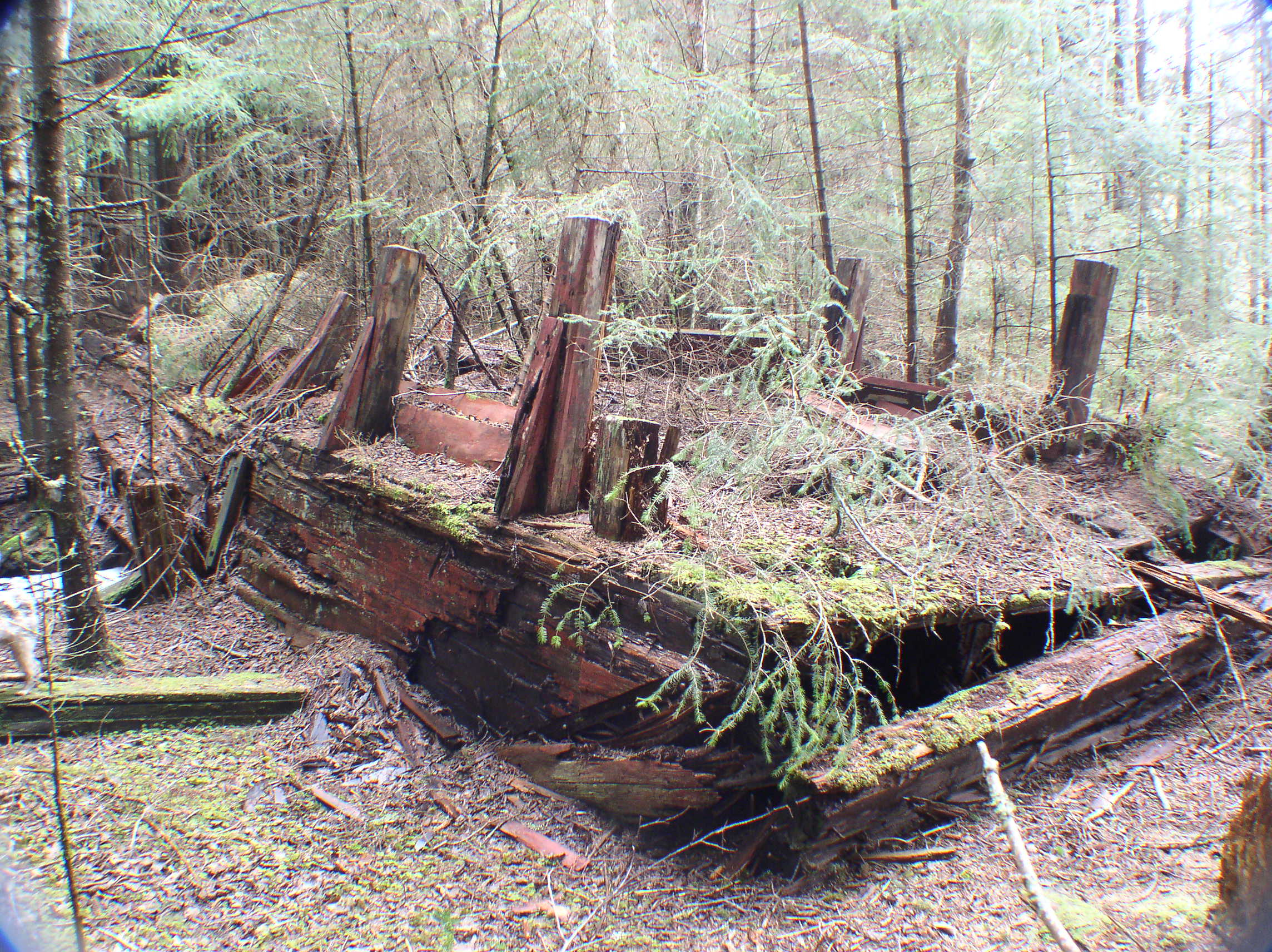
They were simple, rugged vessels which could be beached for storage over the winter. Scow Bay (AKA Coot Cove), around the corner from the main cannery dock, held the slipways and drydocks for scow storage. There are a number of scows still resting there, decaying into the rainforest.

OLYMPUS DIGITAL CAMERA OLYMPUS DIGITAL CAMERA OLYMPUS DIGITAL CAMERA OLYMPUS DIGITAL CAMERA
Scows on the drydocks at Scow Bay.

OLYMPUS DIGITAL CAMERA OLYMPUS DIGITAL CAMERA
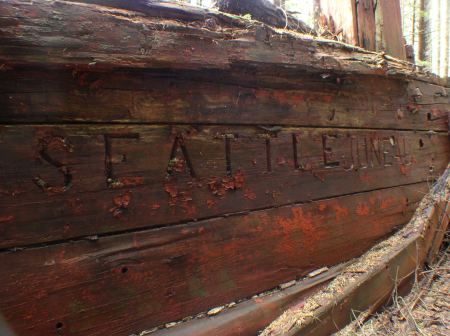
Some of the scows had their own machinery on board, including what looks like a small steam engine. There was another steam engine in the woods that ran a winch for hauling the scows up wooden ramps (slipways) to their storage spot.
OLYMPUS DIGITAL CAMERA
Port names listed on the side of a scow. Visible are “Seattle” and “Juneau”.

OLYMPUS DIGITAL CAMERA


Slipways at Scow Bay.

Scow Bay also has the remains of a ~30ft fishing boat:

OLYMPUS DIGITAL CAMERA OLYMPUS DIGITAL CAMERA

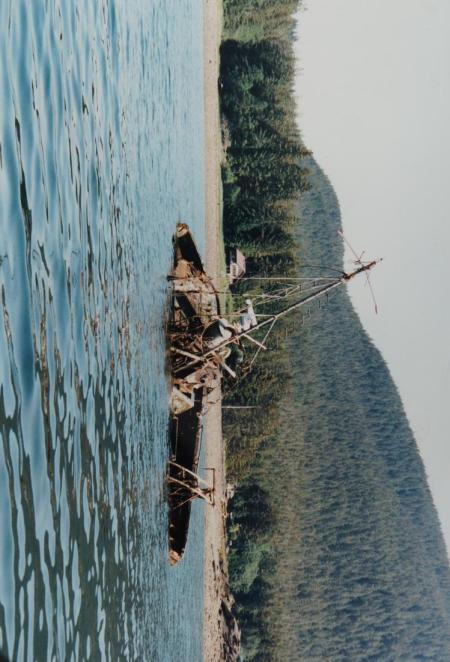
Wrecked fishing boats can be found in a few places around Funter Bay.
Jolene M
The Jolene M, a fishing boat which drug anchor and hit Highwater Island one night when I was young. The owner re-floated it and attempted to beach it for repairs, but never managed to get very much done with it. This is an old picture, there’s little visible of the wreck today aside from some metal bits in the mud at low tide.

OLYMPUS DIGITAL CAMERA
The Jolene M looks more like this now. Wood decays very fast in tidal environments.
Nimrod
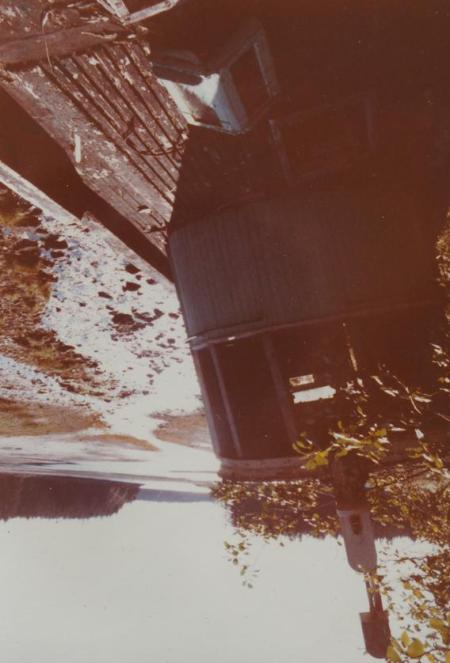
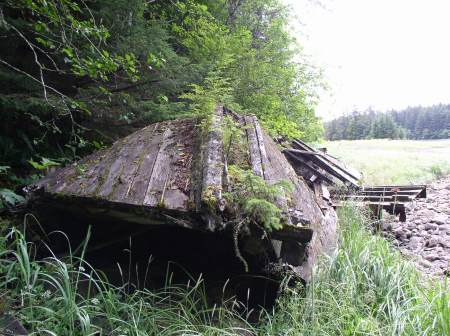
The Nimrod, a wooden boat (probably also a fishing boat) which was beached up “Nimrod Creek” (local name). There is also quite a bit less of this boat remaining intact today. (Update 4/23/13: This was originally a tugboat, I’ll add more details in a future post).
OLYMPUS DIGITAL CAMERA
More recent Nimrod photo.

And just for fun, here are a few even smaller abandoned boats (skiffs). Maybe some of them are the lifeboats seen on the cannery tenders, or the small sailing boats mentioned in articles about the Barron family? Or they could simply be some of the many small skiffs that you find in any Southeast Alaska community, as common as the family cars down south.
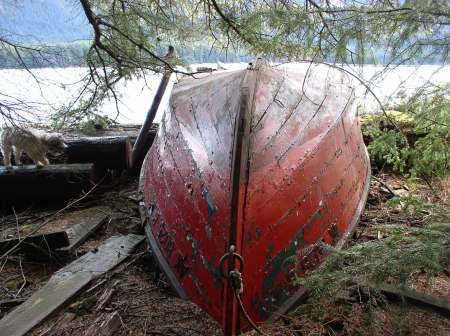
OLYMPUS DIGITAL CAMERA OLYMPUS DIGITAL CAMERA OLYMPUS DIGITAL CAMERA

Once again I have produced a stream of meandering research beyond all reason. And I still have plenty more to expand on things mentioned in this post… what happened to the Barron Family? How did they use legal loopholes to get their land? What was the later cannery history? What other fishing-related activities happened around the bay? Just a few things I hope to cover in the future!

Funter Bay History – Cannery Postcards and Leftovers

April 10, 2013
Cannery overview

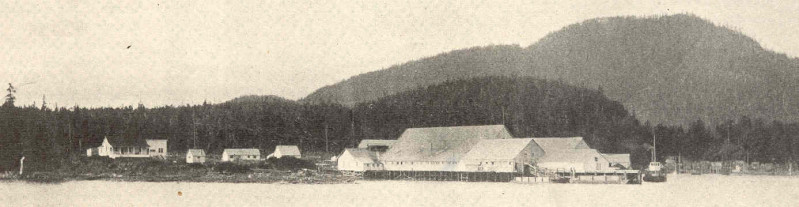
Thlinket Packing Co Cannery at Funter Bay (from Pacific Fisherman Annual Review 1908 via University of Washington Library Freshwater and Marine Image Bank, used as Public Domain per their policy.)

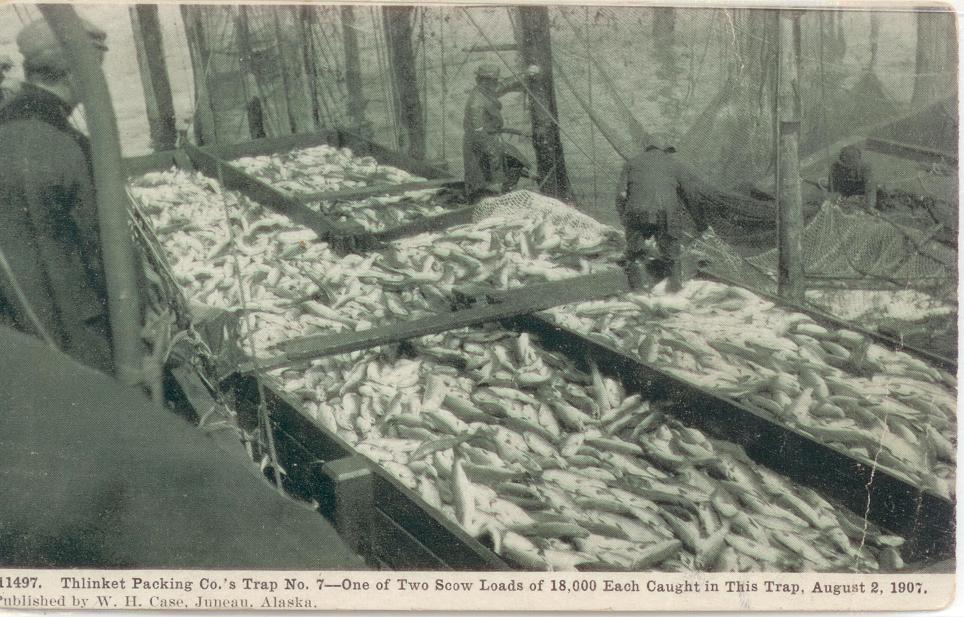
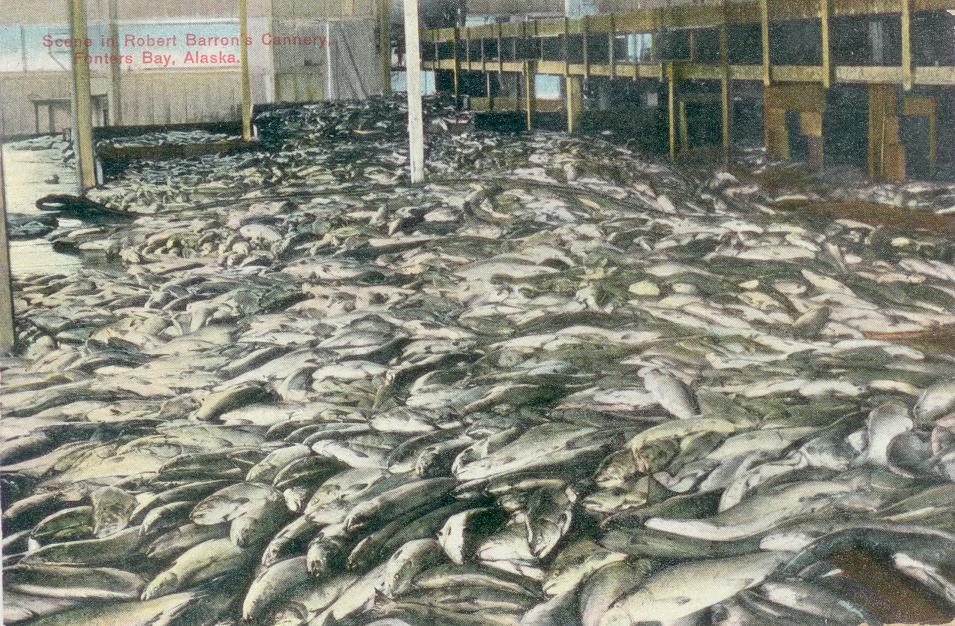
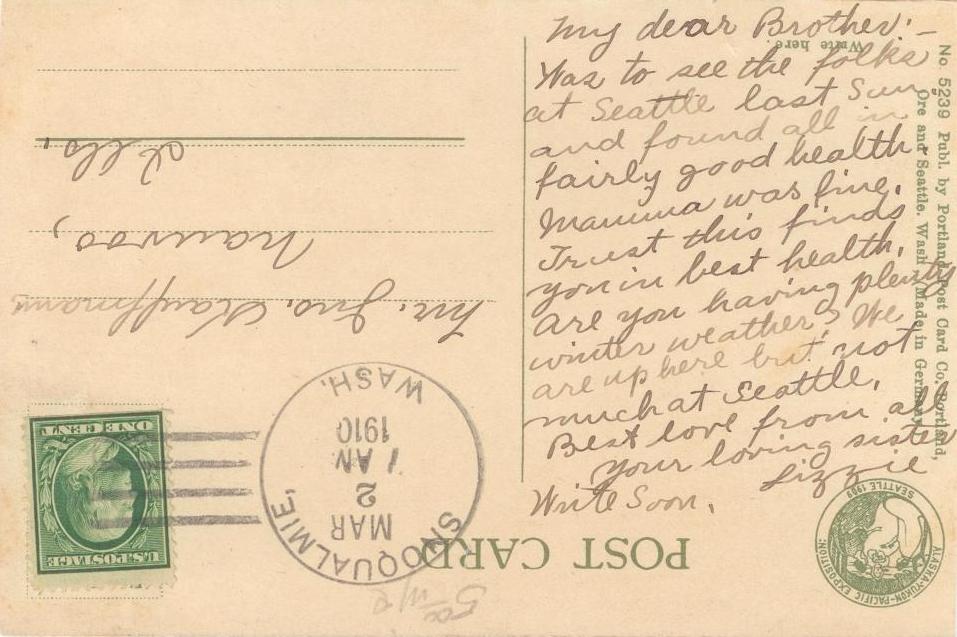
I came across a few old postcards that I’d purchased at an antique show in the Midwest, showing my hometown of Funter Bay, Alaska during the salmon cannery days. I’ve put together a little more information and back-story to these. I’ll try to add more photos and information on the history of Funter Bay as I have time.

postcard4

The cannery tug Anna Barron, shown tending Fish Trap #6 in or near Funter Bay in 1907. As with most of these postcards, this is a colorized B&W photo by Case and Draper, a Southeast Alaskan photo studio that operated until 1908.

Here is an original B&W of this image with some additional information, courtesy of the Alaska Digital Archives. Here’s another photo of the Anna Barron approaching the cannery dock with two scow-loads of fish.

Here is a close-up of what the crew is up to in the first postcard shown above. The derrick onboard the Anna Barron is lifting a section of fish trap net (Brailing) to dump the salmon into a scow (barge).

postcard2

And here are two versions (from two different postcards) showing the same operation from a different angle. I believe this is the same crew, although they’ve colorized Mr. Floppy Hat guy’s clothing differently:

postcard5postcard3

And here are the salmon after being unloaded at the cannery, waiting to be sent through the processing equipment to be cleaned and packaged.

postcard1

Just for fun, here’s the only postcard which was filled out and mailed, the rest were unused.

postcard1-back1 postcard1-back2

The Alaska Digital Archives have many more from this Case & Draper set, as well as photos of cannery operations from later years. All of them can be found here.

Here is another photo from the University of Washington Archives, showing salmon being brailed onboard the Anna Barron.:

brailing

Fish traps were hugely efficient at catching salmon, as they effectively blocked spawning streams and diverted all returning salmon into the nets, making the salmon do the work of catching themselves. They were often temporary structures maintained during the spawning season, usually being built from untreated driven pilings, floating logs cut locally, and nets. The nets and more expensive hardware were stored over the winter, and the trap structures would often require repair or rebuilding in the spring after winter storms and rot had taken their toll. Today you can still sometimes find “trap logs” on the beaches, identifiable by the rusty bolts and hardware that attached them to other parts of the structure.
weasel 1
A trap log in our yard (with an ermine on it). These are so massive that it’s easier just to leave them where they are and attach stuff to them. This one was the top end anchor of our outhaul.

The design of fish traps resulted in enormous early profits for the canneries, but quickly proved self-defeating, as the salmon runs for those streams were wiped out. In the 19th and early half of the 20th century there were few legal restrictions on fishing, although competition was fierce, the the point of nearing international incidents. In 1904, President Roosevelt dispatched the revenue cutter Perry to Funter Bay, where two Japanese fishing vessels were seized and the crews deported (source). (I hadn’t heard of this before, so I Googled around a bit and happened across this picture of the Perry’s eventual fate in 1910).

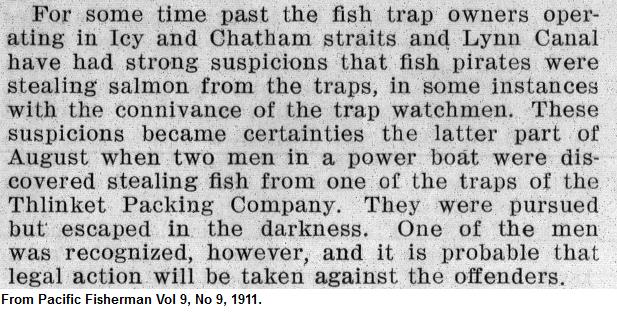
Native Alaskans and independent fishermen often opposed and sometimes sabotaged fish traps. There were even incidents of “Fish Piracy“, in which traps were raided before the company could empty them. This led to watchmen manning each trap, living on board the floating or driven-piling structure in small shacks during the fishing season, although the watchmen could sometimes be bribed.

pirates

Here’s a model of a fish trap, including the small watchman’s shack:

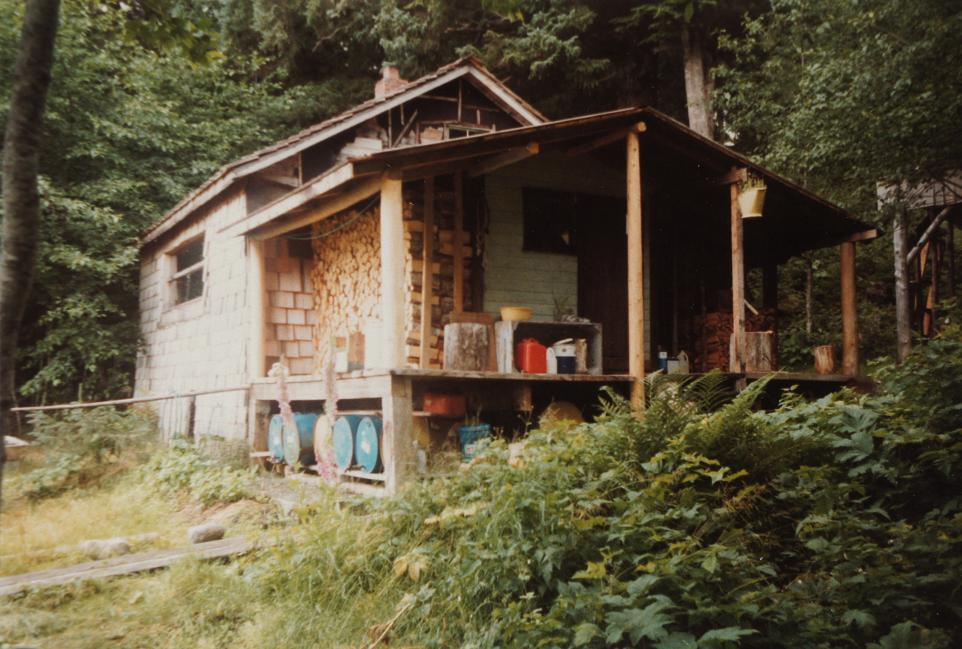
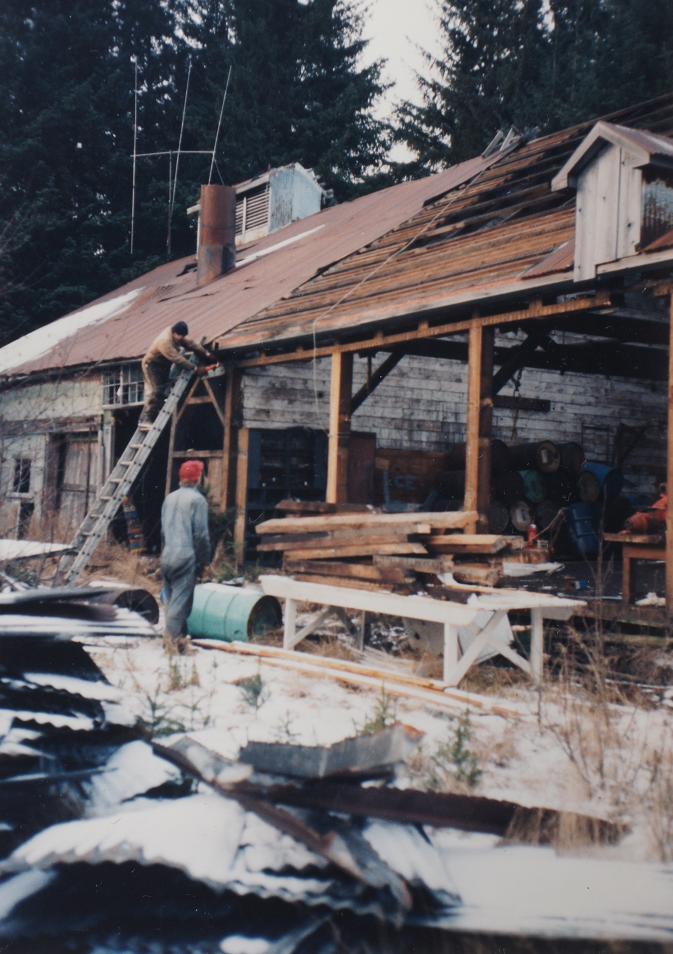
Part of the house I grew up in was a trap watchman’s shack that was moved up the beach. My Dad later added it to the house as an entry/mudroom.

House early
An photo of our house soon after my Dad moved in. The structure to the left is the former trap watchman’s shack, which Dad moved up and to the right to attach to the main house.

House back porch
The same house after Dad began adding to it. The fish trap shack is in the foreground surrounded by a new deck and awning.

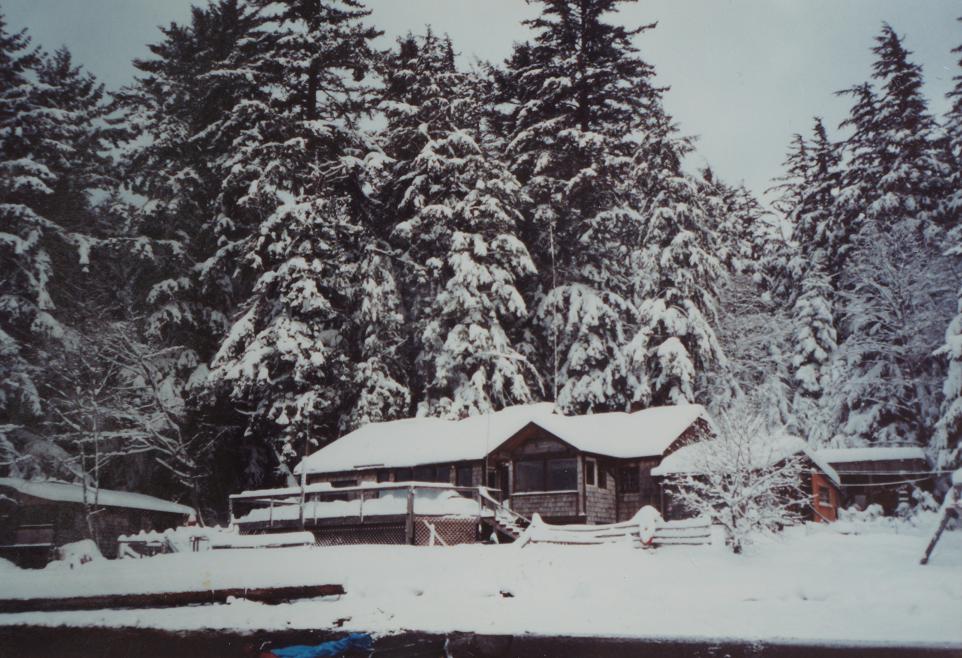
The house at Funter Bay on a snowy day. Normally winter was just wet, and snow didn't tend to last very long.
The final house layout, the entry is on the right behind the small Alder tree.

Fish traps were eventually regulated and later banned entirely. More information on Fish Traps (PDF) can be found in this research paper from the University of Alaska, there’s also an HTML version.

And now, more information on the cannery itself.

The Thlinket Packing Company, owned by James T. Barron of Portland, Oregon, was begun in 1902. It operated until the 1960s when fish traps were effectively outlawed. I suspect that other fish packing operations at Funter predated this company (there was also a saltery less than a mile away on Highwater Island). During the later years, the cannery location became known as “Funter”, and is shown as a town on some maps. It had regular mail service by both boat and seaplane. Well-maintained trails connected the cannery to the gold mines at other locations around the bay, and the Bear Creek Trail ran over the top of Mansfield Peninsula through a pass to the other side of Admiralty Island (facing Juneau). Various pipelines connected the cannery to nearby streams, as operations required a large amount of fresh water. Scows were overwintered on an extensive slipway and drydock system in Coot Cove.

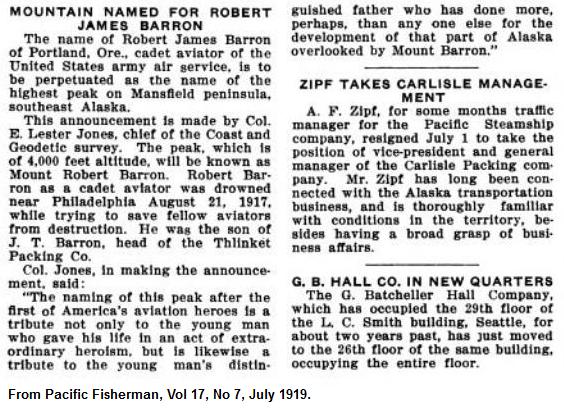
Mount Robert Barron, the highest peak near Funter Bay, was named in 1919 to honor J. T. Barron’s son Robert.

Robert Barron

James Barron apparently also built an office building in Portland in 1921.

And to further wander from the original topic of postcards, here are some photos my Dad took of the Cannery’s appearance when he arrived in the 70s:

Funter Cannery

An overview of the cannery as seen from the water.

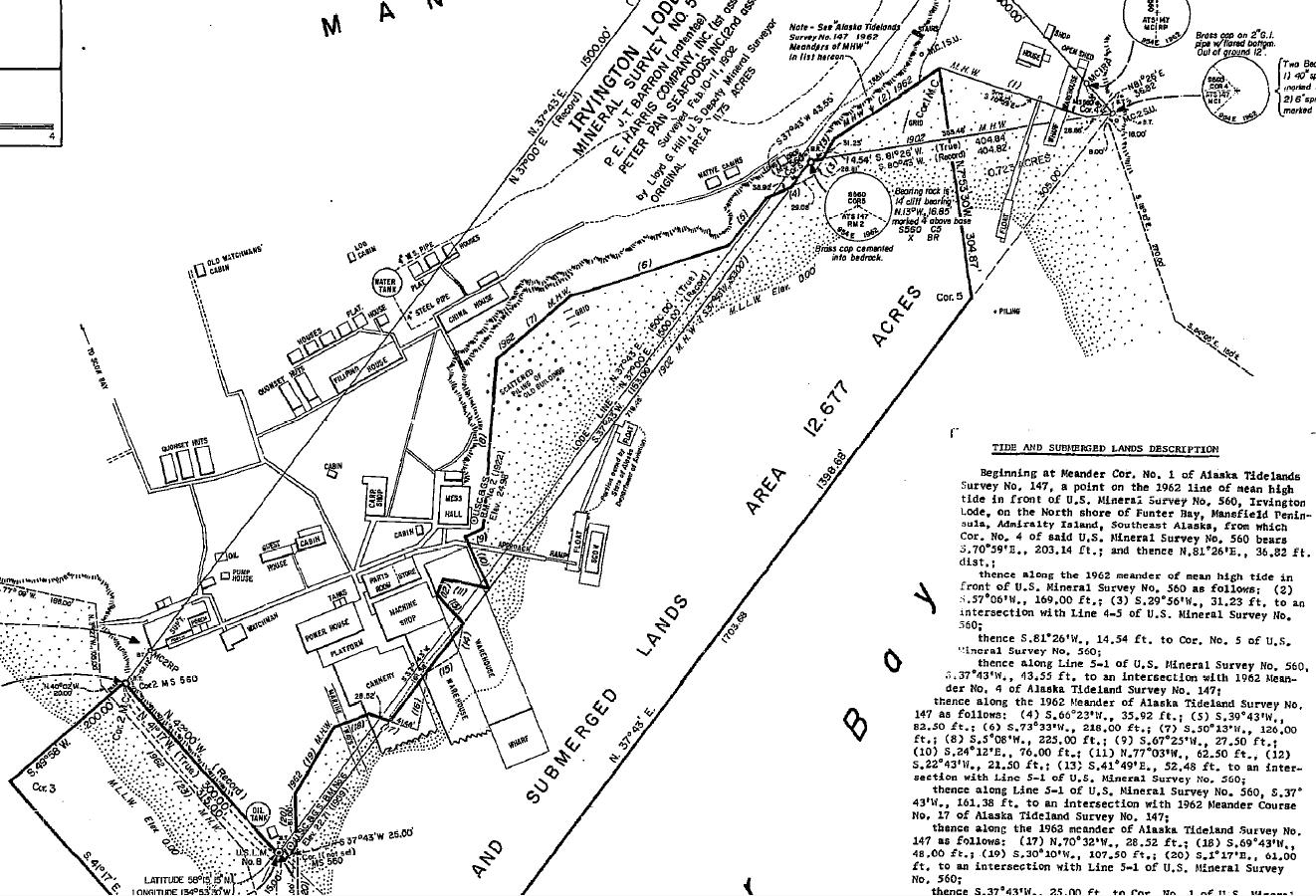
Here is a great survey map showing the layout of some of the buildings in 1964. This includes many additions, such as the Quonset huts brought in by the army during WWII to house “evacuated” Aleuts (more information on that unfortunate incident is available here).

Cannery map

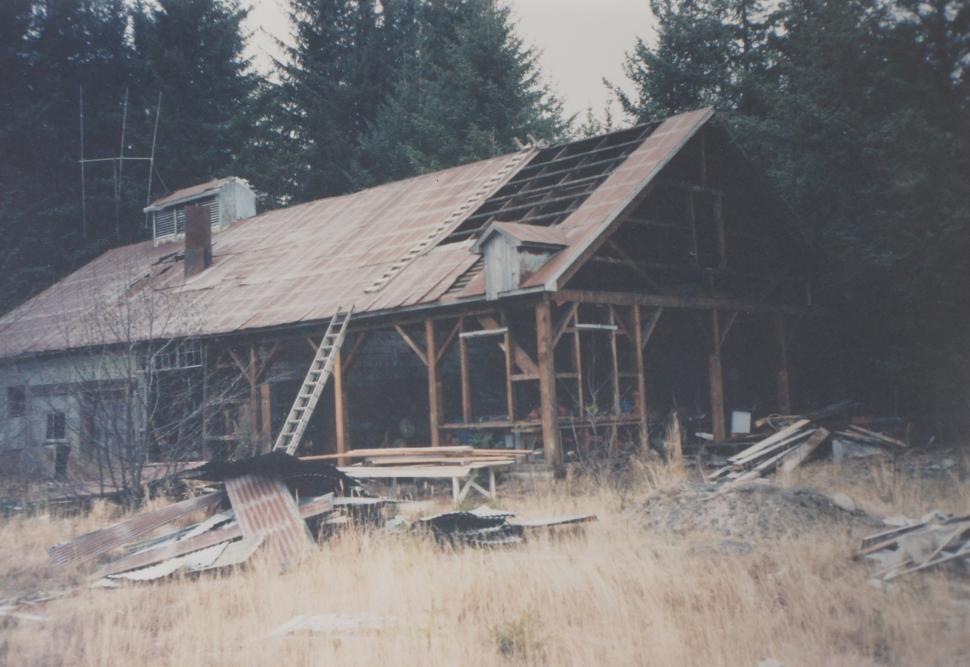
The carpentry shop. That’s not a church, the cross at the top is a telephone pole. This is where Dad built his first wooden fishing boat:

Cannery 1Cannery 2

I believe this was the power house:

Cannery 5

Either the Chinese or Filipino bunkhouse:

Cannery 3

Various cannery ruins on the beach:

Cannery ruins


When I was a kid, we still had a few of these buildings left, and a lot of leftover equipment and rusty “stuff” on the beach. Unfortunately, a lot of the old buildings were burned or bulldozed during various subdivision and redevelopment attempts (including some built from huge California Redwood planks, worth a fortune today)

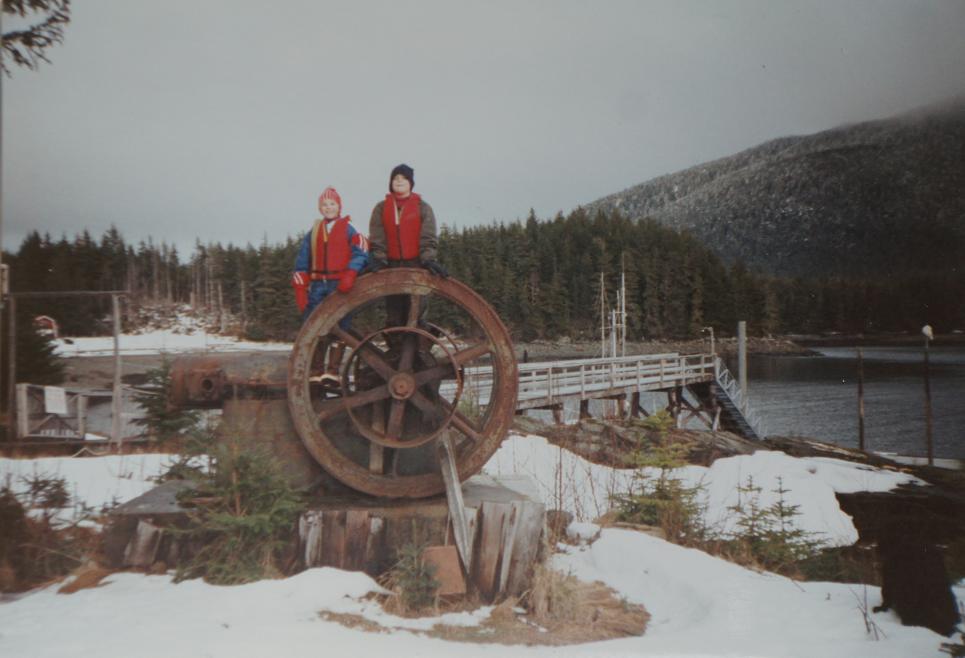
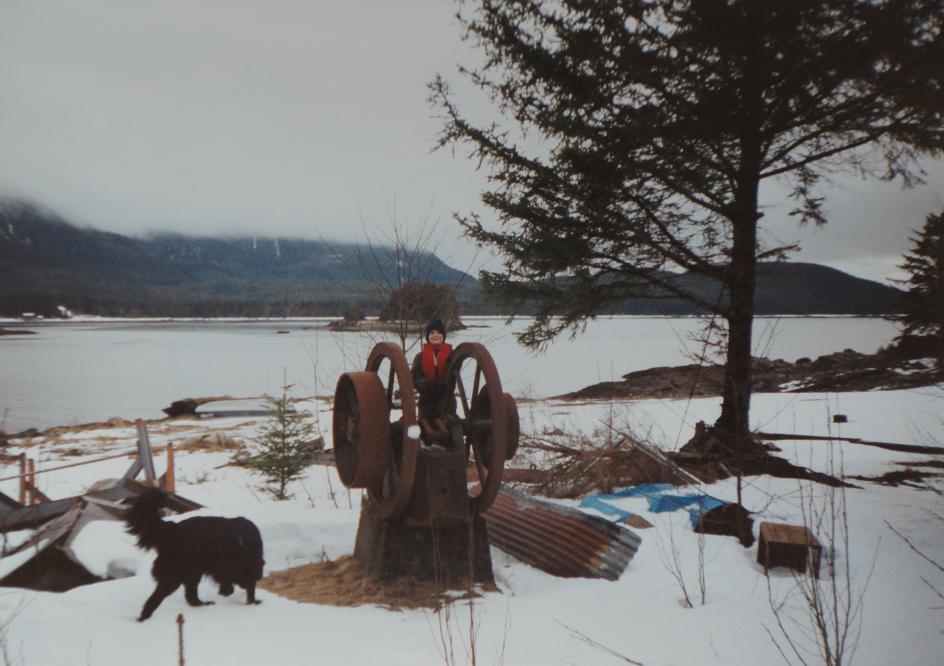
Steam Engine 1Steam Engine 2

Here are Megan and I on two of the stationary gas engines that drove the canning lines. These made great trains/cannons/spaceships!

steamengine1.jpg

These would have had a belt driving overhead rods, which drove the other equipment throughout the cannery building. Here’s a photo from the archives showing the overhead shafts and belt drives

This post is starting to get ridiculously long and wandering, so I’ll continue thing later. Next up: what happened to the Anna Barron? Stay tuned!

Edit: Gordon Harrison pointed out that the stationary engines were early Fairbanks-Morse gas engines, not steam as I had previously thought.