Funter Bay History: Early Tourism

February 6, 2015

The Alaskan tourism industry grew rapidly in the early 20th century. Publicity from high-profile private “expeditions” (such as the Harriman Expedition) sparked an interest in Alaska among America’s middle class. Shipping lines quickly recognized the value of Alaska as a vacation destination, bringing the curious to see strange landscapes, animals, and cultures.

Early tourist cruises to Alaska often shared space on cargo ships or combined cargo/passenger vessels (which I’ve mentioned several times before). Even purpose-built “excursion” vessels usually had a large cargo capacity, and often made stops at industrial ports like Funter Bay during their tour circuits. Shipping lines capitalized on this by calling such stops “Surprise Ports”.

“Decidedly popular… extra calls located off the regular lanes of travel in secluded coves or fjords, and not shown in printed schedules. Here, while the ship loads or unloads, the angler may try his luck in nearby streams or lakes, and the hiker may explore wooded mountain trails, to vistas of incredible beauty.”
(Excerpt from “Looking Ahead to Alaska”, pamphlet of the Alaska Steamship Company, ca 1934).

Of course, the downsides of such “surprise ports” were never mentioned in the advertising… the noise of cargo loaded late at night, the aroma of a fish processing plant, or the unexpected wait if the captain misjudged a tide and went aground at low water.

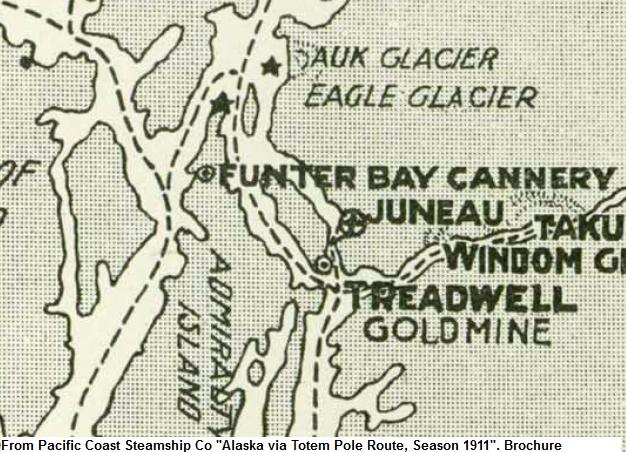
While canneries like the Thlinket Packing Co could be an unexpected stop, at least one steamer line made a point to incorporate it into their regular routes and advertising. A 1911 brochure from the Pacific Coast Steamship Company lists Funter Bay among its regular stops and attractions.

totem

The Salmon Cannery
Funter Bay Cannery is a revelation to those who have not seen the workings of the packing of food fish for market. Millions of salmon annually are taken from these waters, packed in tins after most approved modern methods and take place in the food supply of the world. Passengers have ample opportunity to inspect the cannery or to photograph the beautifully located nearby Indian village.” (From Pacific Coast Steamship Co “Alaska via Totem Pole Route, Season 1911”).

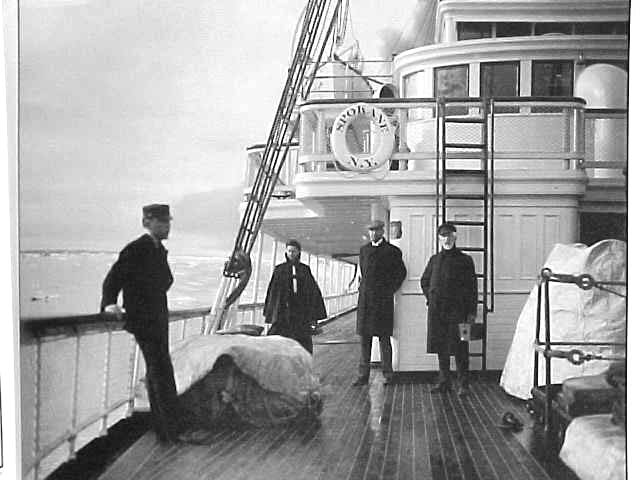
A 1909 advertisement also mentions Funter Bay as a stop for the Pacific Coast’s steamer Spokane.

ad

I’ve previously posted this photo, which was labeled as the SS Spokane at Funter Bay in 1905. I am unsure of the source.
ssspokane_at_funter_1905

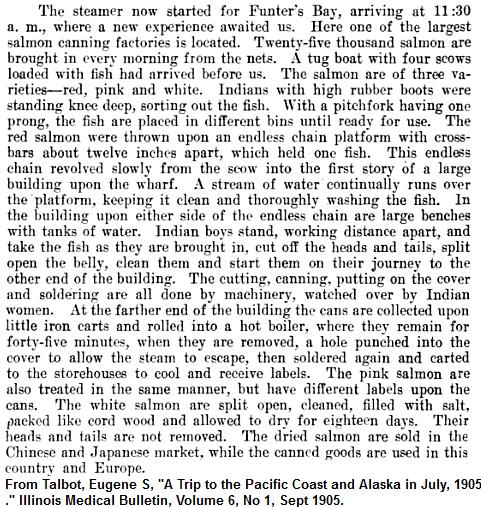
Dr. Eugene Talbot was a passenger on the Spokane in July of 1905 and described the steamer’s stop at Funter:

Advertisement Talbot

The steamship brochures also took every opportunity to push native art and trinkets, asking readers “Have You Collected Indian Carvings?” and “Is Alaska Represented in Your Den?”. Every port seems to have had a dockside market of souvenir merchants, including Funter Bay. An undated photo from the Clarence Leroy Andrews collection is described as “Natives with baskets for sale to tourists. Wharf at Funter’s Bay”.

By 1914, the Pacific Coast Steamship Co seems to have dropped Funter from their tour route and replaced it with a stop at Killisnoo’s herring reduction plant. The SS Spokane continued to visit Funter on cannery business, including a 1920 trip where cannery workers and officials made up the entire passenger complement. Another trip in 1925 saw the former Spokane, now renamed the Admiral Rogers, delivering a load of mining equipment to Funter Bay.


Funter Bay History: Census Takers and Logging Camps

February 4, 2015

Related to an an earlier post about population and census-taking, the following excerpt comes from the account of one Joseph Hewitt, census-taker for part of Northern Southeast Alaska in 1909-1910. Hewitt’s diary “Forty One Days of Census Taking in Southeast Alaska” describes his travels to “all the towns, camps, ranches and settlements located on Chatham Strait, Icy Strait and all their bays and inlets”. He traveled by gasoline launch chartered by the government and operated by its owner, B.F. Dennison, and Dennison’s 11 year old son Dewey. The census enumeration was performed in winter to ensure transient native populations would be in their home villages. Larger communities with schools were expected to provide a census via the local teacher, with people like Hewitt filling in the details for smaller outlying settlements like Funter Bay.

The full document is available here, both in original written form and typed transcription.

“The next day I enumerated twelve at Funter Bay. This is the site of the “Klinket Cannery”. This is a large establishment and it was their logging camp we found in Kelp Bay. We came into Funter Bay on Friday Jan 7th and had the delectable experience of being bottled up by a storm for six days. In shifting the boat one dark night from one part of the bay to another, a thing we frequently had to do to escape destruction during that siege, we lost one of our anchors overboard. The wind and waves seemed bent on driving us out of that bay. The storm outside was so fierce as to tie up the big steamers. Inside it was playing “puss in the corner” with us, and every time it said scat we had to hike. Had it not been for a small island and an unused steamer that was anchored out I don’t see how we could have escaped being driven on the rocks. On Monday morning we made an attempt to escape but were very glad to come back in and fight it out where the trouble started . Finally on Wednesday morning we got away.”

The description of Kelp Bay earlier in the manuscript reports a logging camp abandoned before the first snow, along with a few hundred new cut piles (pilings for dock and fish trap construction). Kelp Bay is on the NE side of Baranof Island, across from the southern end of Admiralty Island about 65 miles from Funter Bay. Although Hewitt reports the logging camp deserted, he did find around 15 people in the Kelp Bay area. A Tlingit family is listed in the 1910 census as associated with the Kelp Bay logging camp, including James Hanson, employed as a woodcutter, and his wife Mary. The court case between Funter canneryman James Barron and rival Claire Alexander (discussed in this post) also mentions Thlinket Packing Co superintendent Fred Barker towing logs from Kelp Bay to Funter for use at the cannery. The cannery tenders Buster and Anna Barron were used to tow rafts of trap piles.

It may seem strange that the T.P. Co would harvest timber so far from the cannery, but a possible explanation lies in the geography of Kelp Bay. Not only is it protected from storms, the bay offers very steep hillsides along the shore, an ideal place for gravity-assisted hand logging. The best trees could be selected and cut so as to slide into the water below. Around Funter Bay, most of the near-shore land is flat, and would require logs to be hauled by equipment or animals. (Limited near-shore logging did happen at Funter, as discussed here). Kelp Bay continued to be logged and clearcut into the 1990s.


Funter Bay History: Aleut Internment Part II

December 12, 2014

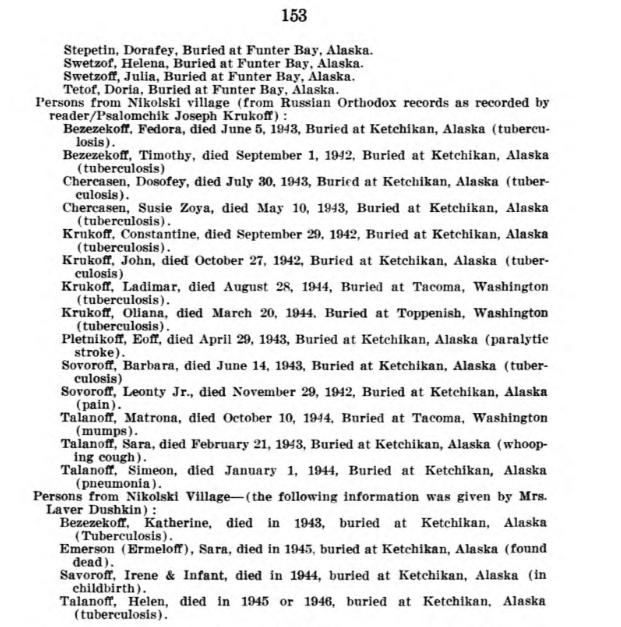
I previously discussed the Aleut Internment of WWII, in which many Native Alaskans were relocated to Funter Bay to “protect” them from the Japanese invasion of the Aleutian islands. Evacuees were shuffled out of the combat theater for the military’s convenience, and left in hastily-organized camps at disused cannery and mine sites. Conditions at the internment camps were poor, with unreliable water, heat, and medical care. Approximately 30-40 people died in the two Funter Bay camps, with more deaths at Juneau hospitals. The Funter Bay cemetery holds approximately 23 recognizable grave sites, although the list below indicates 35 burials there.

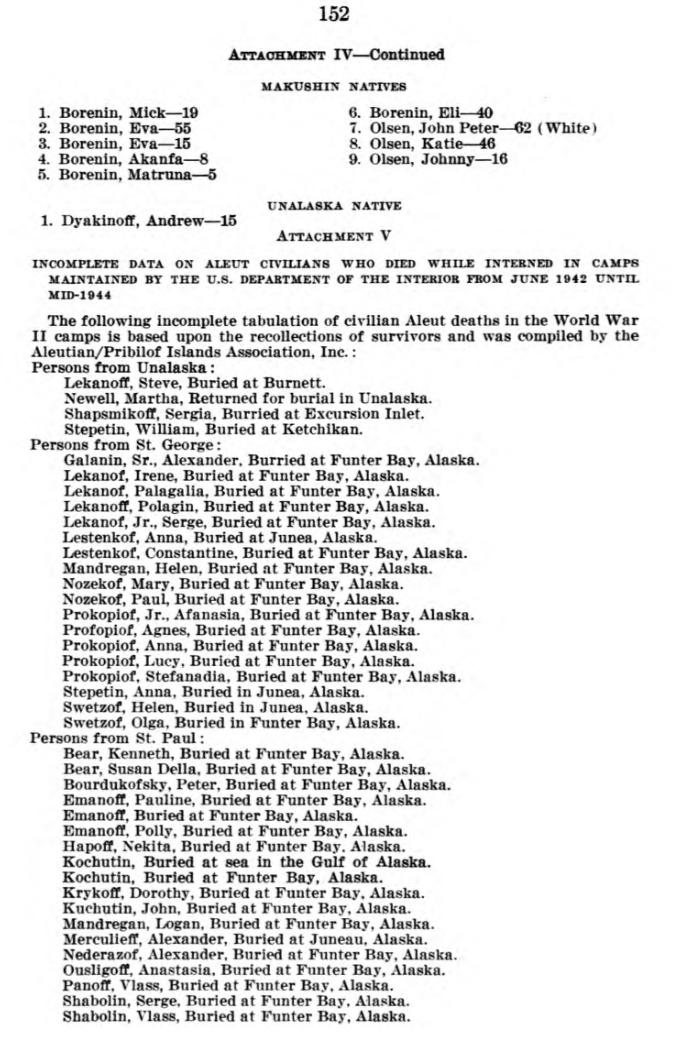
This list is from a 1980 report by the Commission on Wartime Relocation and Internment of Civilians, in hearings before the Subcommittee on Administrative Law Relations, regarding establishment of said commission and payment to victims of forcible relocation by the government.

152 153

The full text is available via the Library of Congress here, in scanned and OCR’d form. I have copied the OCR version below. Obvious scanning and text recognition errors have been cleaned up, but there may be a few errors remaining.  Full lists of evacuees transported on the Delarof to Funter Bay (the St. Paul and St. George Island lists) are at the bottom of this page.

ATTACHMENT V INCOMPLETE DATA ON ALEUT CIVILIANS WHO DIED WHILE INTERNED IN CAMPS MAINTAINED RY THE U.S. DEPARTMENT OF THE INTERIOR FROM JUNE 1942 UNTIL MID-1944
The following incomplete tabulation of civilian Aleut deaths in the World War II camps is based upon the recollections of survivors and was compiled by the Aleutian/Pribilof Islands Association, Inc.:

Persons from St. George:

Galanin, Sr., Alexander. Buried at Funter Bay, Alaska.
Lekanof, Irene, Buried at Funter Bay, Alaska.
Lekanof, Palagalia, Buried at Funter Bay, Alaska.
Lekanoff, Polagin, Buried at Funter Bay, Alaska.
Lekanof, Jr., Serge, Buried at Funter Bay, Alaska.
Lestenkof, Constantine, Buried at Funter Bay, Alaska.
Mandregan, Helen, Buried at Funter Bay, Alaska.
Nozekof, Mary, Buried at Funter Bay, Alaska.
Nozekof, Paul, Buried at Funter Bay, Alaska.
Prokopiof, Jr., Afanasia, Buried at Funter Bay, Alaska.
Profopiof, Agnes, Buried at Funter Bay, Alaska.
Prokopiof, Anna, Buried at Funter Bay, Alaska.
Prokopiof, Lucy, Buried at Funter Bay, Alaska.
Prokopiof, Stefanadia, Buried at Funter Bay, Alaska.
Swetzof, Olga, Buried in Funter Bay, Alaska.

Persons from St. Paul:
Bear, Kenneth, Buried at Funter Bay, Alaska.
Bear, Susan Delia, Buried at Funter Bay, Alaska.
Bourdukofsky, Peter, Buried at Funter Bay, Alaska.
Emanoff, Pauline, Buried at Funter Bay, Alaska.
Emanoff, Buried at Funter Bay, Alaska.
Emanoff, Polly, Buried at Funter Bay, Alaska.
Hapoff, N’ekita, Buried at Funter Bay. Alaska.
Kochutin, Buried at Funter Bay, Alaska.
Krykoff, Dorothy, Buried at Funter Bay, Alaska.
Kuchutin, John, Buried at Funter Bay, Alaska.
Mandregan, Logan, Buried at Funter Bay, Alaska.
Nederazof, Alexander, Buried at Funter Bay, Alaska.
Ousligoff, Anastasia, Buried at Funter Bay, Alaska.
Panoff. Vlass, Buried at Funter Bay, Alaska.
Shabolin, Serge, Buried at Funter Bay, Alaska.
Shabolin, Vlass, Buried at Funter Bay, Alaska.
Stepetin, Dorafey, Burled at Funter Bay, Alaska.
Swetzof, Helena, Burled at Funter Bay, Alaska.
Swetzoff, Julia, Burled at Funter Bay, Alaska.
Tetof, Doria, Buried at Funter Bay, Alaska.

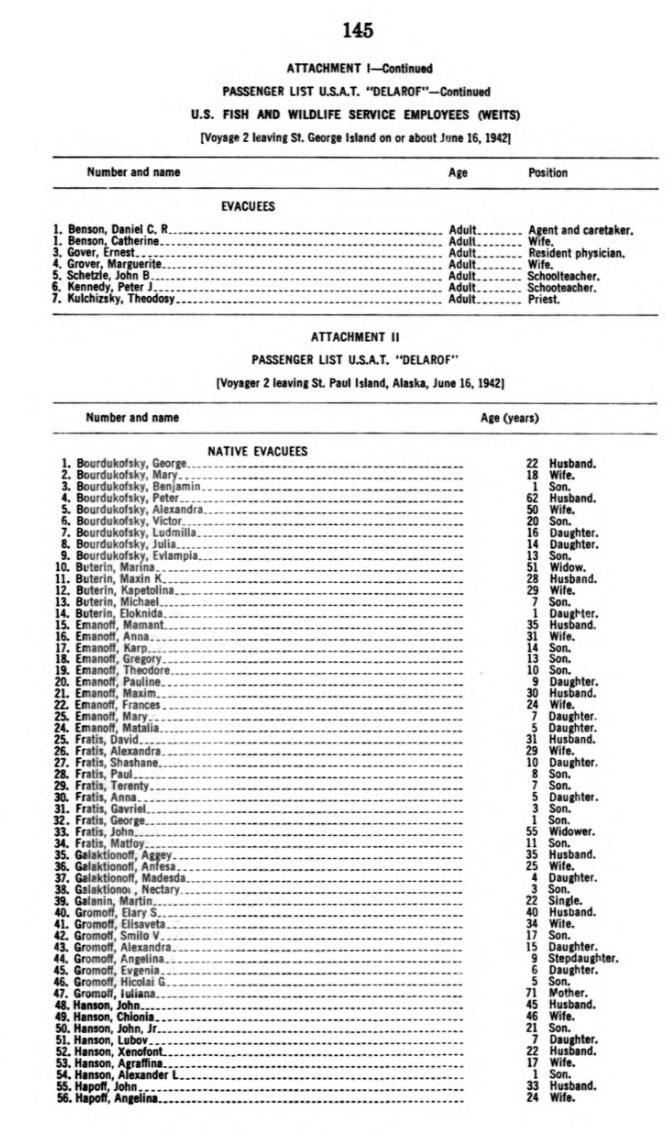
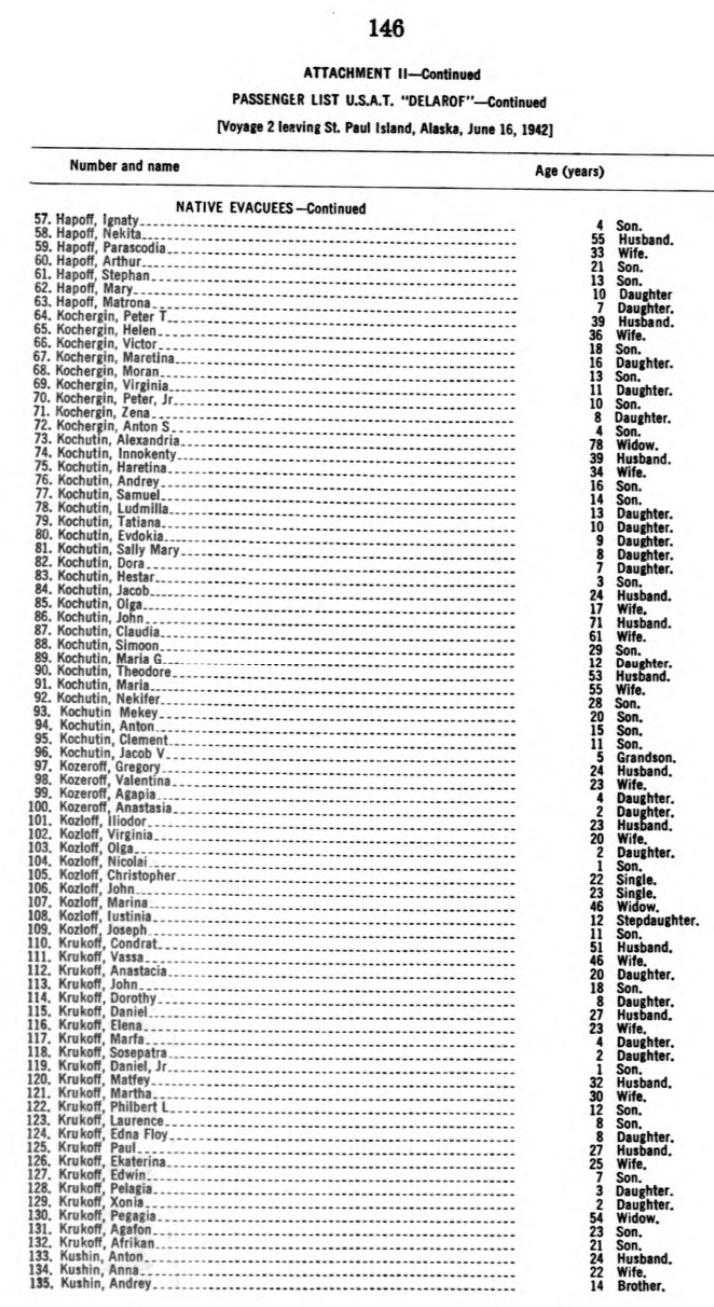
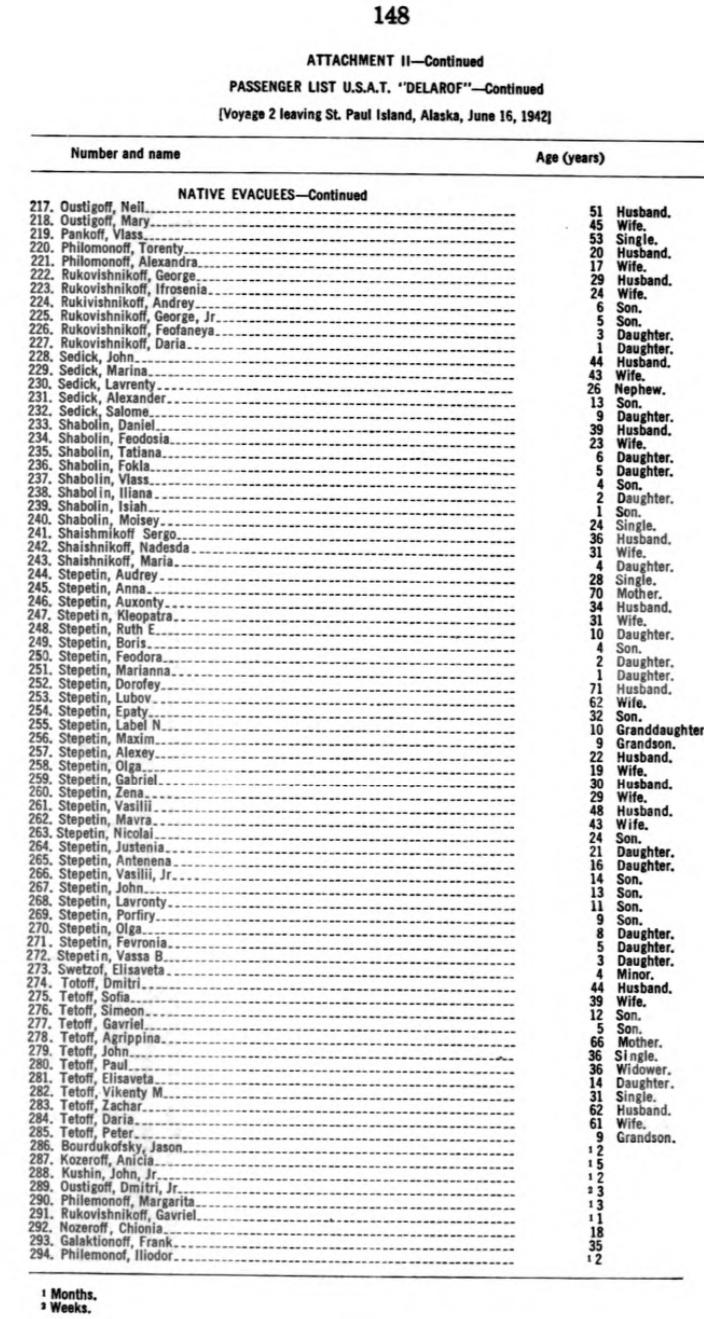
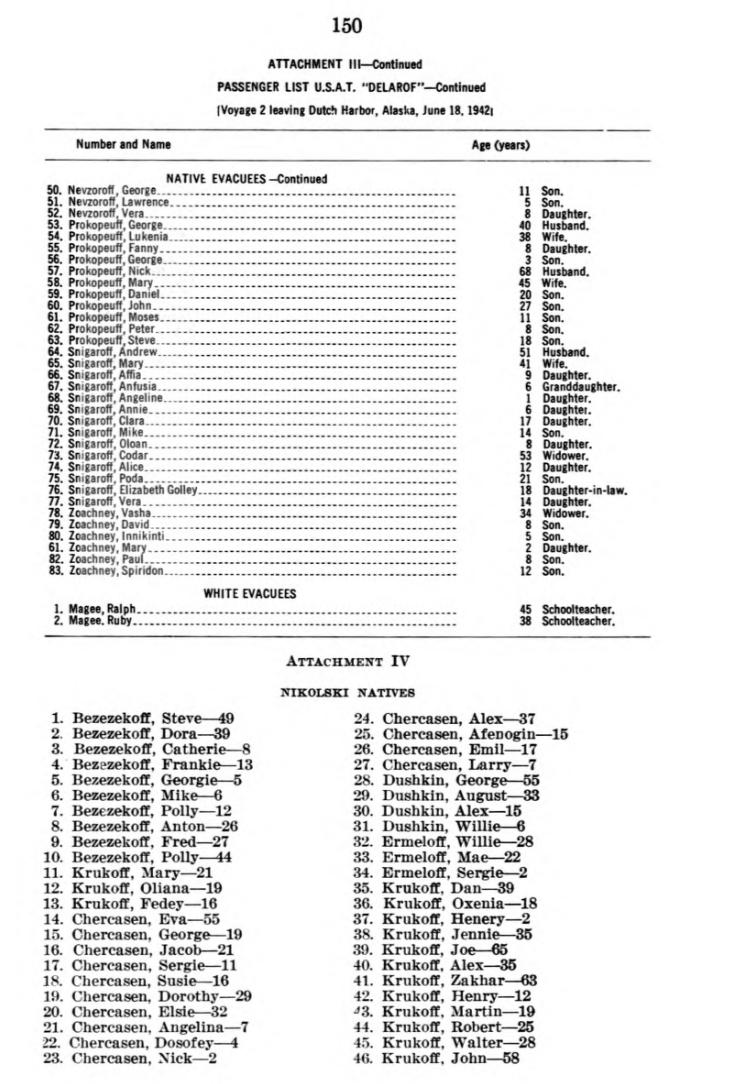
Below are some of the passenger lists from the USAT Delarof. Most “Native Evacuees” from St. Paul and St. George islands (about 477 people) were left at Funter Bay. Other communities were taken to Ward Lake, Burnett Inlet, Wrangell, and Killisnoo. Non-native or white government employees from the islands were given passage out of state, although a few stayed to help organize the internment camps.

142

Passenger List USAT Delarof, Native Evacuees from St George Island to Funter Bay, Alaska. June 16, 1942.


143

Passenger List USAT Delarof, Native Evacuees from St George Island to Funter Bay, Alaska. June 16, 1942.


144

Passenger List USAT Delarof, Native Evacuees from St George Island to Funter Bay, Alaska. June 16, 1942.


145

Passenger List USAT Delarof, Native Evacuees from St Paul Island and Government Employees to Funter Bay, Alaska. June 16, 1942.


146

Passenger List USAT Delarof, Native Evacuees from St Paul Island to Funter Bay, Alaska. June 16, 1942.


147

Passenger List USAT Delarof, Native Evacuees from St Paul Island to Funter Bay, Alaska. June 16, 1942.


148

Passenger List USAT Delarof, Native Evacuees from St Paul Island to Funter Bay, Alaska. June 16, 1942.


149

Passenger List USAT Delarof, Native Evacuees from Dutch Harbor and Government Employees from St Paul Island, Alaska. June 16, 1942.


150

Passenger List USAT Delarof, Native Evacuees from Dutch Harbor and Nikolski, Alaska. June 16, 1942.

Further information is also available at:

Aleut Story. Video DVD with online bibliography of source material.

Evacuation and Internment, 1942-1945. National Park Service page and archeological report by Charles Mobley.

Agony of the Aleutians: The forgotten internment. A recent (November 2014) article.

The Aleut Internments of WWII. Another recent (2014) print book.


Funter Bay History: Some Assorted Machinery

October 22, 2014

I came across some more photos of derelict machinery at Funter Bay. These devices are in the vicinity of the cannery, in most cases their original purpose is unknown.

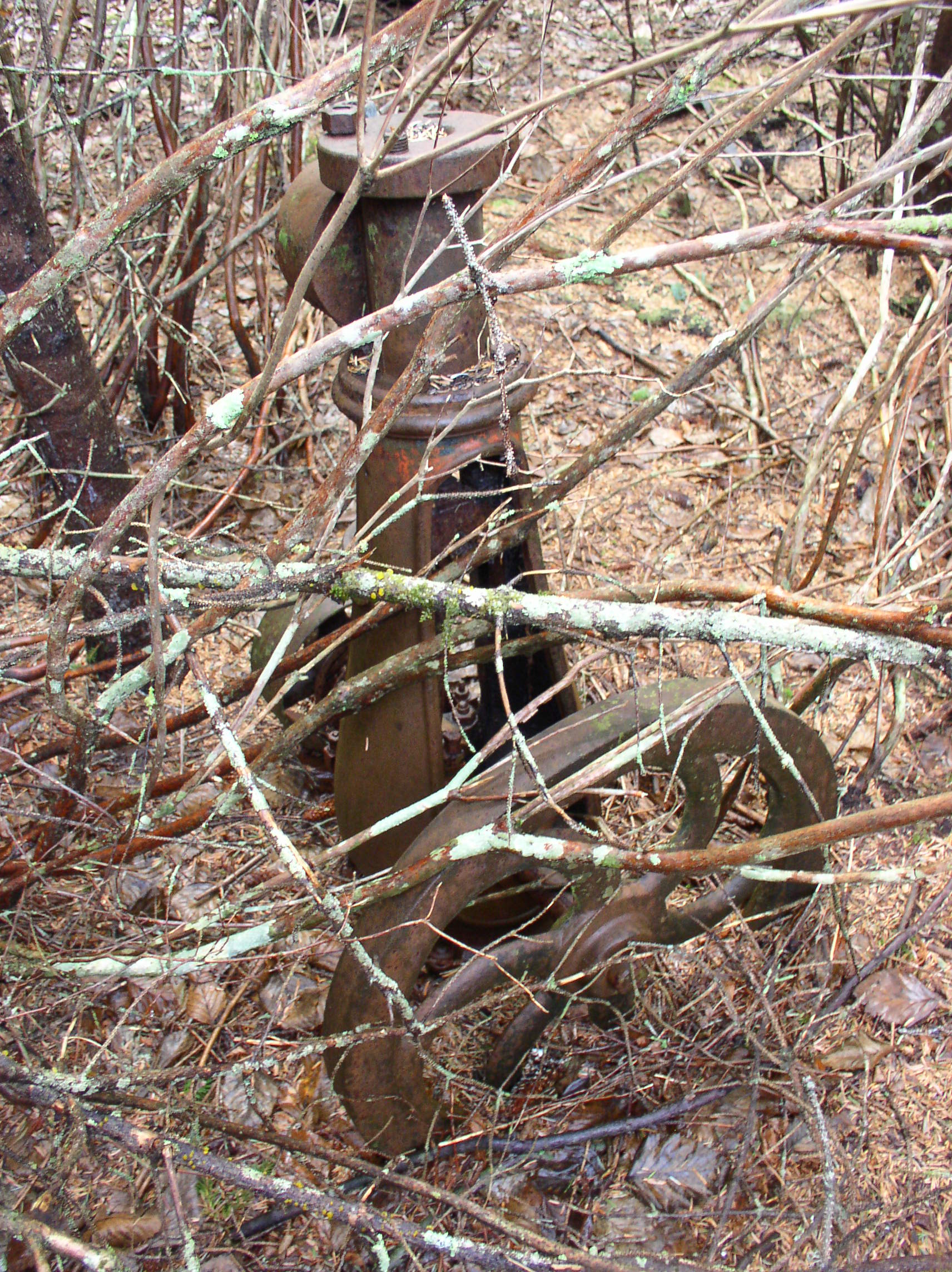
First, what appears to be a small vertical bottle steam engine with one cylinder:

OLYMPUS DIGITAL CAMERA

Unfortunately it is hard to tell the size, but I would estimate it is about 3-4ft tall (with the base buried in the ground). Small steam engines like this had a variety of uses, including small steam launches, and portable power for winches, machine tools, sawmills, etc.

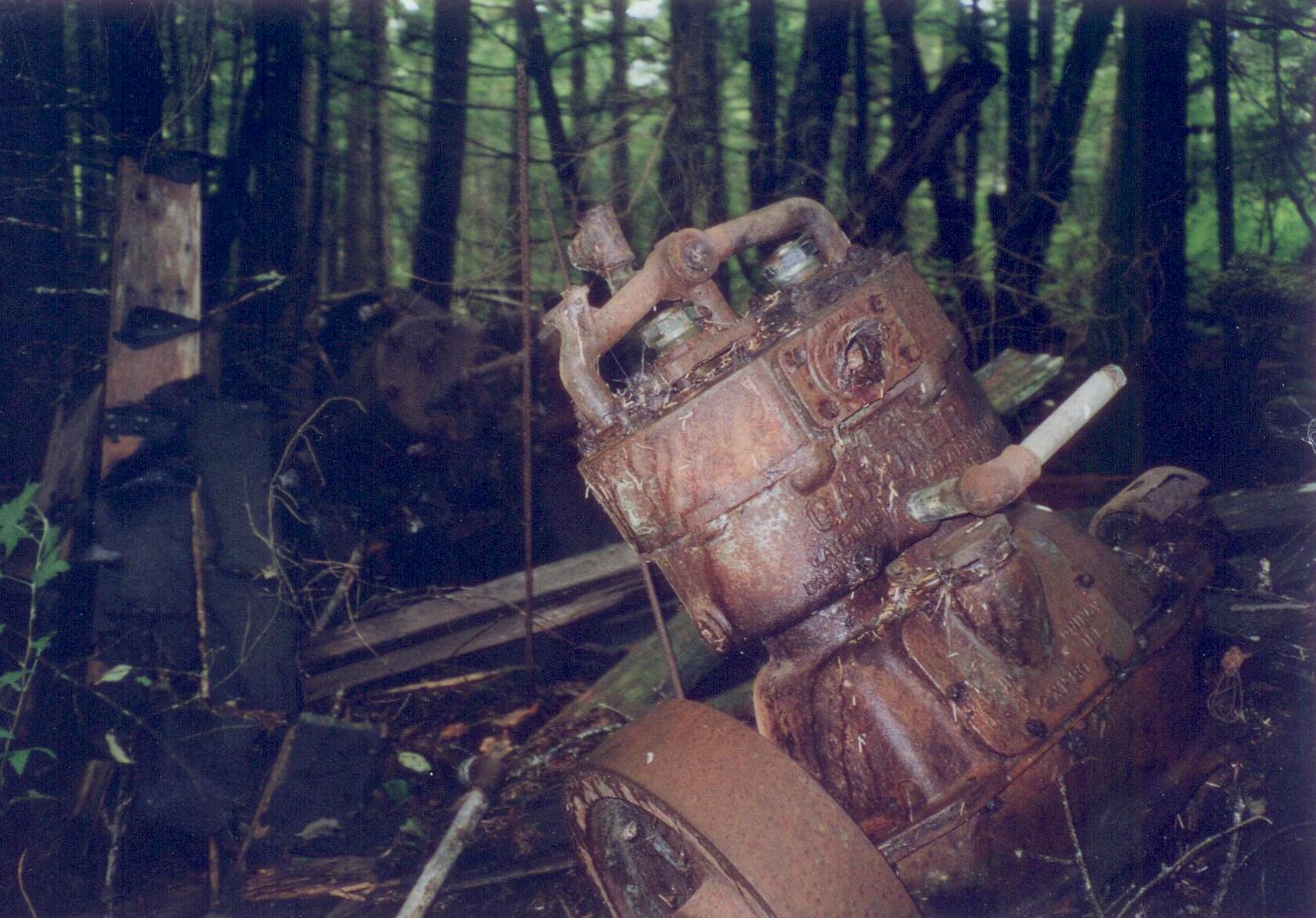
Next is another view of a device found on one of the scows in Scow Bay. It appears to be a small engine or compressor. From what I can tell of the lettering, it was made by Gardner in Quincy, IL and is marked “patent-pending”. The model number at the bottom looks something like 2XF80 or LXB80. This was probably manufactured prior to 1927, when the company became Gardner-Denver. Any machinery buffs reading this are encouraged to enlighten/correct me!

0a-dingus

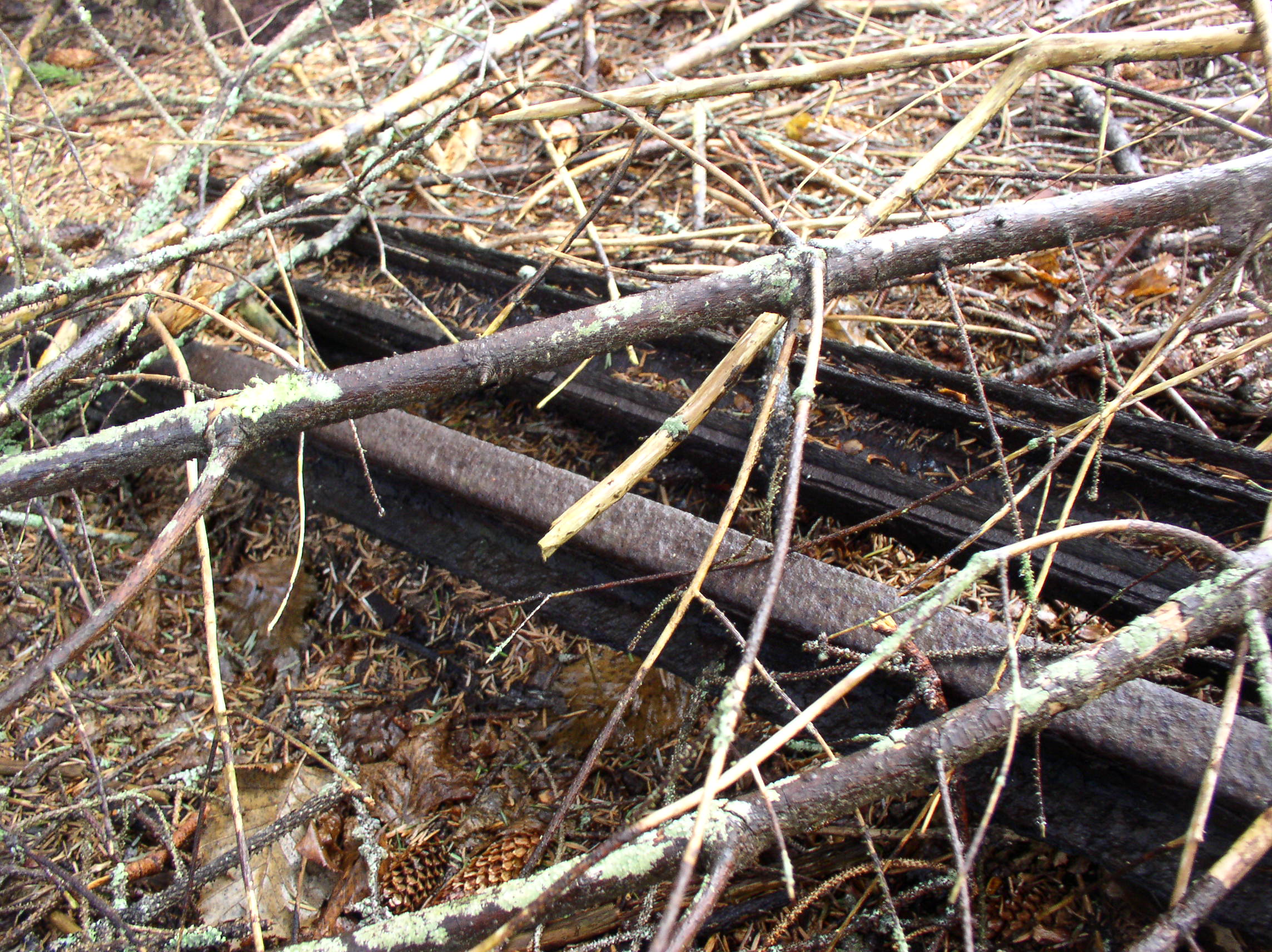
Also found at the cannery is a neatly stacked cache of light railroad track. This may have been for a marine railway, a freight tramway on one of the wharves, or some other use in the cannery.

OLYMPUS DIGITAL CAMERA

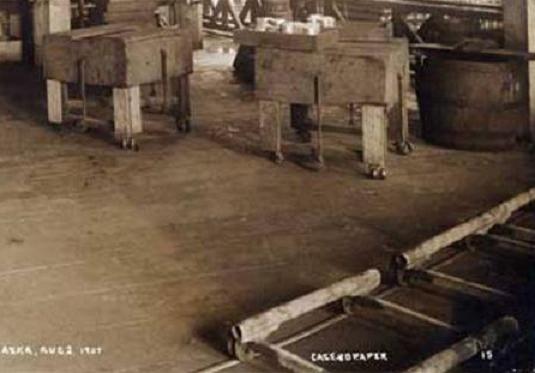
At least one historic photo shows small cart frames riding on tracks at the Funter Bay cannery. However, the tracks look more like pipes or boards than standard rails. The wheels are double-flanged, suggesting this was one track with no switches or branches.

track closeup

This may have been for loading cases of cans into retorts for cooking, as seen in this photo of another cannery. I have not seen any other photos of rails inside or outside the cannery buildings, although some other canneries had tracks around the property for moving freight and fish.

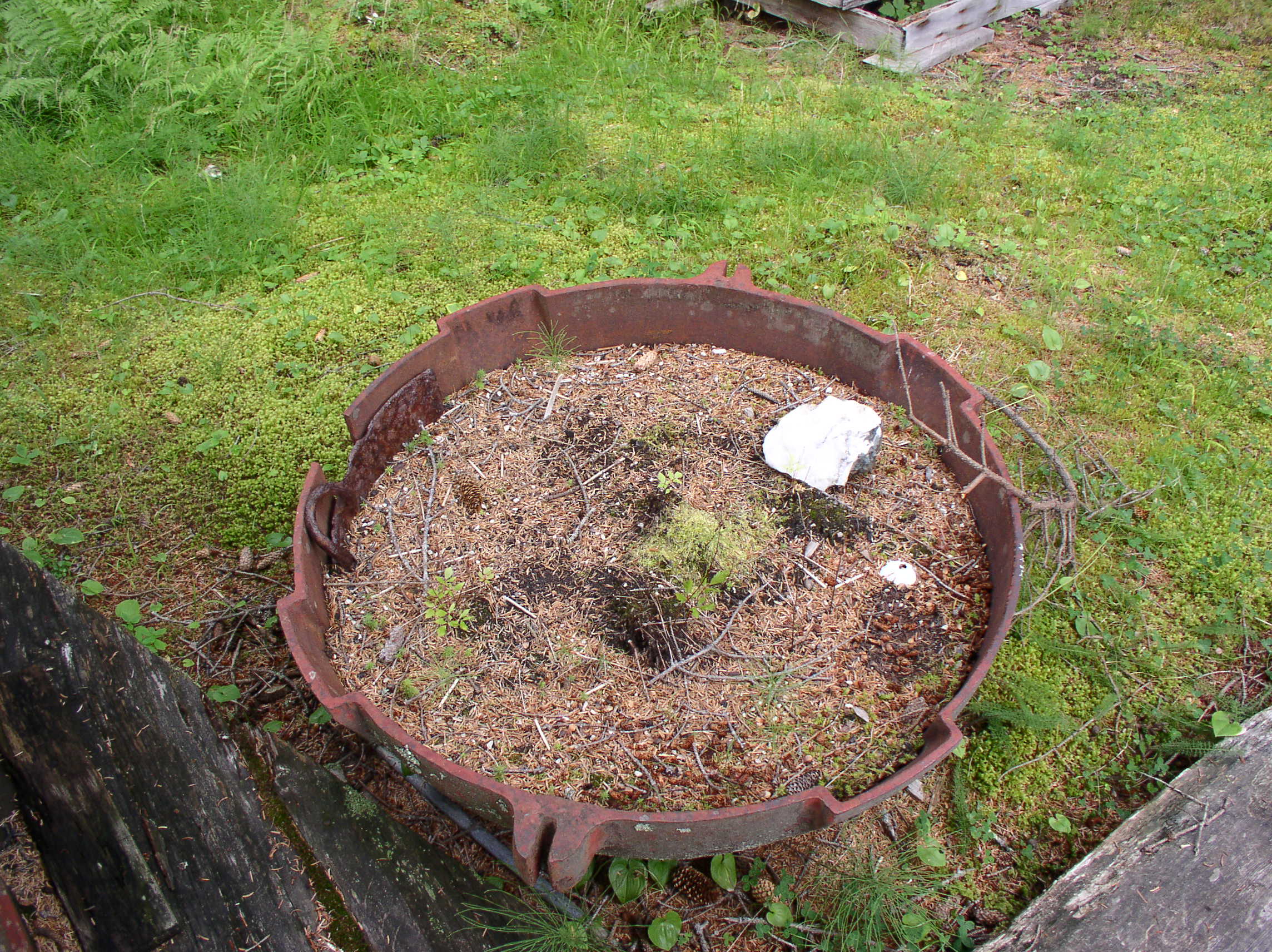
This hemispherical planter is likely the pressure door from one of the cannery retorts:
OLYMPUS DIGITAL CAMERA

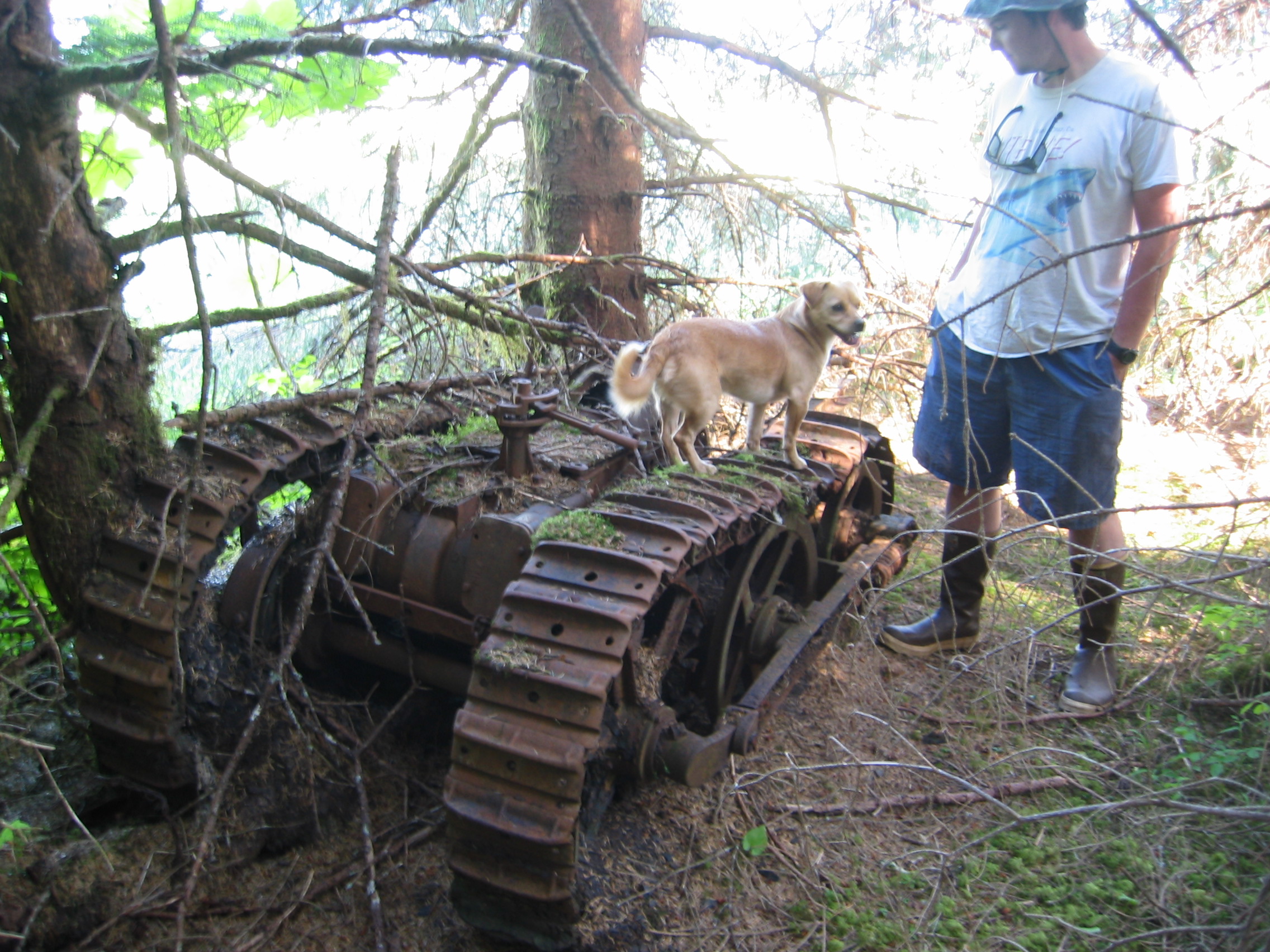
And this small tractor is a mystery to me, as I don’t remember where in the bay I found it! I believe it was somewhere in the woods near the cannery:

IMG_1166


Funter Bay History: Post Office

August 26, 2014

postmark2

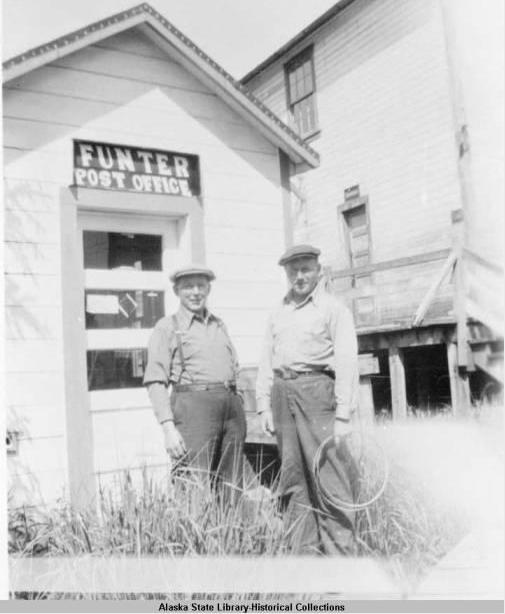
The Funter post office opened in July of 1902. Located at the Thlinket Packing Co cannery, It served local residents, cannery and mine workers, and outlying homesteads and fox farms. I’ve previously mentioned the post office in discussions of communication and mail boats.

po_crop

Photo by Harold Hargrave. Undated (post-1941). Courtesy of Alaska State Library, Place File. ASL-P01-3753.

Even before a formal post office was founded, a number of mail boats would stop at Funter on a regular basis to serve the mines there, relying on passenger and freight traffic to cover their costs.

flosie

An article in the January 1903 Daily Alaska Dispatch noted that Funter Bay had a post office, but did not yet have a contract for mail delivery.  In March of 1903 the assistant postmaster general for Alaska reportedly was considering “the establishment of better mail facilities for Funter post-office” (Daily Record-Miner). By June there was an initial contract with Henry Shattuck to deliver mail every 6 weeks. Shattuck reportedly arranged to buy the steamer Prosper from the Alaska Steamship Co in July of 1903, then formed the Juneau Steamship Co in August and decided to buy the Georgia instead. He is better known for his real estate and insurance ventures, but maintained ownership in various mail boats for some time as well.
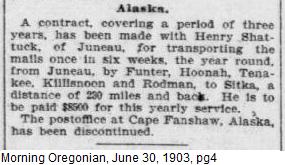
mail contract

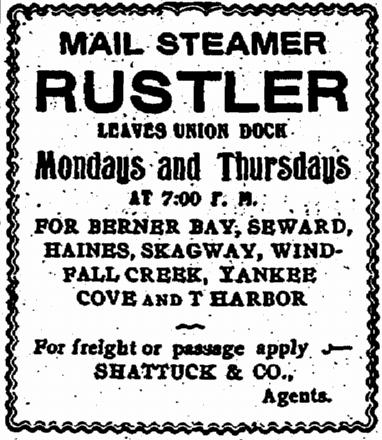
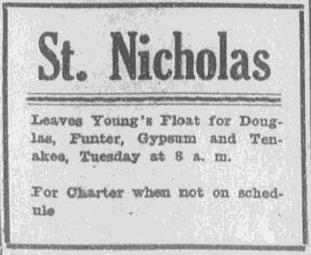
Various boats which carried the mail, either under government contract or on an ad-hoc basis, included the Flosie, Rustler, Georgia, Seolin, St. Nicholas, Ramona, Estebeth, Forester, Margnita, and likely several others.
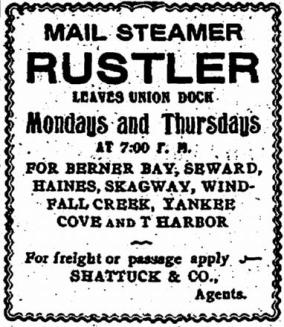
Mail Steamer Rustler 1903

In 1906 a government report described “A cannery, a store, and a post-office with weekly mail service via Juneau” at Funter Bay.
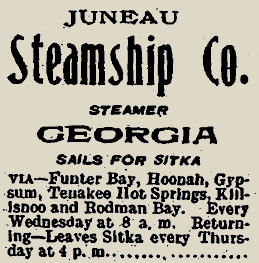
georgia

1906 Mail Steamer ad

A 1912 Dispatch article discussed the mail service to outlying communities, including Funter Bay. Mail from outside was received in Juneau on steamships, then sorted and distributed to mail boats serving the surrounding area. The Juneau postal staff complained of the burden of meeting late or irregular boats.

St Nicholas ad 1915

1915 Advertisement

The Funter post office served an area extending across Lynn Canal to Point Couverden (with several fox farms), and down Mansfield Peninsula to Hawk Inlet. A cannery opened at Hawk Inlet around 1911, and several mines were operating around 1900, but there was no post office there until 1913. Prior to that year, someone had to row 15 miles to Funter or walk over the mountain to pick up the mail. This was not without risks, as mentioned in a previous post, a Mr. J. Caper fell and broke his ankle while crossing the mountain on a 1910 mail run.

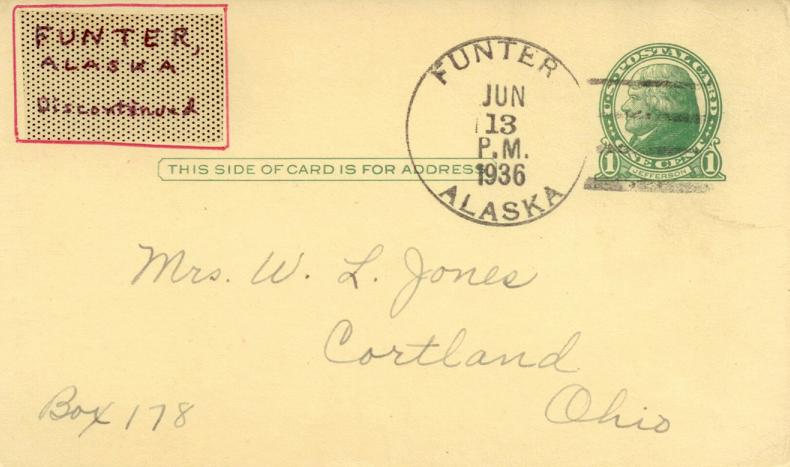
Mail at Funter was general delivery, recipients had to visit the post office to pick up their mail. Addresses consisted of the recipient’s name with “Funter, Alaska” or “Funter Bay” underneath, zip codes were not used until the 1960s. Much of rural Alaska shared the 5-digit 99850, Funter Bay’s full zip code was 99850-0140. The USPS serial number for the Funter post office was 05544.
postal cover 2

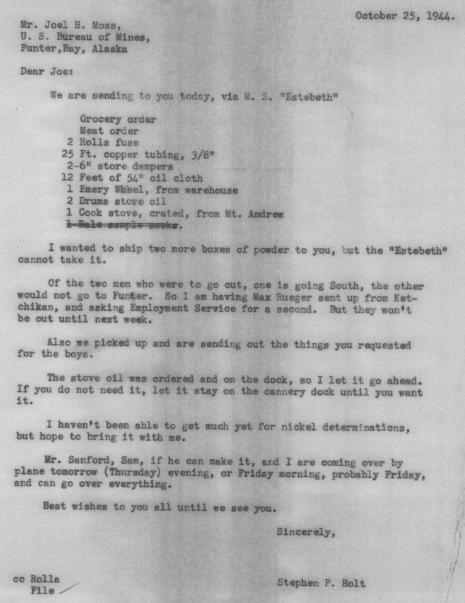
Freight could also be sent this way, although the following letter (found in government archives) notes that the mail boat would not carry certain items like blasting powder.

letter2

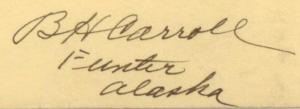
This history of postmasters at Funter is somewhat patchy, and seems to include several people who resigned or left suddenly, leaving other residents to fill in until being officially recognized by the USPS. A list of Postmasters with their start dates is below, based on various government and journal records as well as Melvin Ricks’ Alaska’s Postmasters and Postoffices; 1867-1963.

Postmasters at Funter Post Office:

-James T. Largan, appointed July 3rd 1902.

-James T. Barron (Cannery owner), appointed June 24 1904. Received $10.00 in compensation for the position. (ref) (As Barron was only on-site in the summers, there may have been a cannery caretaker covering the position unofficially in the winters, handling mail for the mines and other residents).

-William N. Williams, appointed 5-7-1926. Listed as the cannery superintendent in 1929 (per Pacific Fisherman, Vol 27, 1929).

-Raymond A. Perry, appointed 5-13-1930. Resigned in June of 1931, Clarence Withrow or Charles Otteson suggested as replacements.

-Clarence A Withrow (or Winthrow?). Appointed 6-29-1931, status changed / “assumed charge” again on 9/30/1931 (perhaps confirmed as permanent from a temporary status?). Also a cannery employee. Taken ill with appendicitis in November of 1934, requiring an operation (per Pacific Fisherman, Vol 32, 1934).

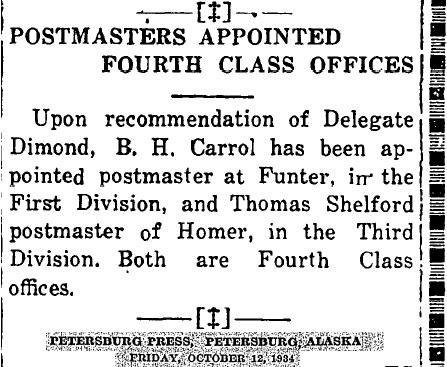
-Burdine H. Carroll. Appointed (took over after Withrow fell ill?) on 9-12-1934, “Assumed Charge” again 11/17/34 (again, this probably indicates the date he was confirmed as permanent). Resigned without official permission 10-1-1939. Some genealogical information is here. According to the Petersburg Press, Carroll was appointed in October.
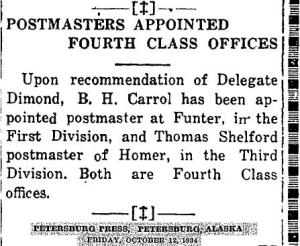
Carrol appointed postmaster

-John H. Hibbs, appointed 10-24-1939, also “Assumed Charge” / confirmed 11-19-39. Died in office, no date given, probably 1941.

-Hans Floe, appointed 7-8-1941. As with predecessors, “Assumed Charge” 9-19-41. Removed from office (no date, probably 1944). Employee of the P.E. Harris Packing Co, who owned the cannery at the time. Had previously been the superintendent at the Hawk Inlet cannery (per Pacific Fisherman, Vol 39, 1941). According to Kinky Bayers’ notes, Hans came to the US from Norway in 1905, started with P.E. Harris in 1911, and died in 1947 at age 61. His wife was Marie Hansine Floe and daughters were Marie, Odney, Haldis, and Agnes.

<Post office discontinued in 1944, effective December 31st, but order rescinded on November 27th>

-Harold F. Hargrave, appointed 11-30-1944. (Some sources say he served as Postmaster starting in 1941). AC/confirmed 1-1-1945. May have “officially” been the postmaster until ~1955 with others filling in during the later years. Lived at Funter until the 1980s.

Harold Hargrave Bears

Harold Hargrave at Funter Bay in the 1940s. Photo courtesy of Alaska State Library, Place File, ASL-P01-3842

-Virgil S. Aubert. Unlike predecessors, he is noted as “Assumed Charge” on 11-6-1953, with no formal appointment. He is listed as “Acting” Postmaster on 12-14-1953. May have been filling in for Hargrave. Some genealogical information is here.

-Stanley Warnock. Also “Assumed Charge” on 7-9-1954, without a full appointment, listed as “Acting” 8-6-1954, formally appointed 8-5-1955, and again “Assumed Charge” 9-30-1955. Probably the same person as “Curly” Warnock who lived in Funter Bay with his wife Cora (per Lazette Ohman).

The American Philatelist, Volume 68 of 1954 notes that:

“Funter is a mining-fishing town on Funter Bay, Admiralty Island, at the mouth of Lynn Canal. It was named in 1883 by Dall for Captain Robert Funter, an early explorer-surveyor. Mining, hunting, fishing, and trapping provide work for the employables among the ten white and Indian residents. There are no schools or churches. Office opened July 3, 1902 (James T. Largan). Present Postmaster, Harold T. Hargrave.”

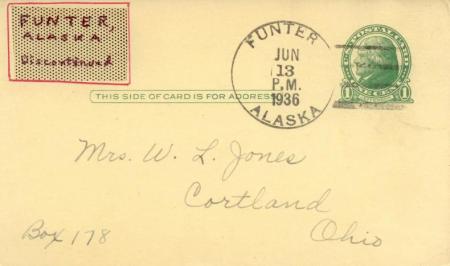
After the cannery stopped regular packing operations in 1931, a year-round watchman remained on site. He operated the company store and the post office. The postal guide for 1931 noted that it was open year round, but did not issue money orders. The company store remained open, and the property was still used for fish trap and vessel maintenance.
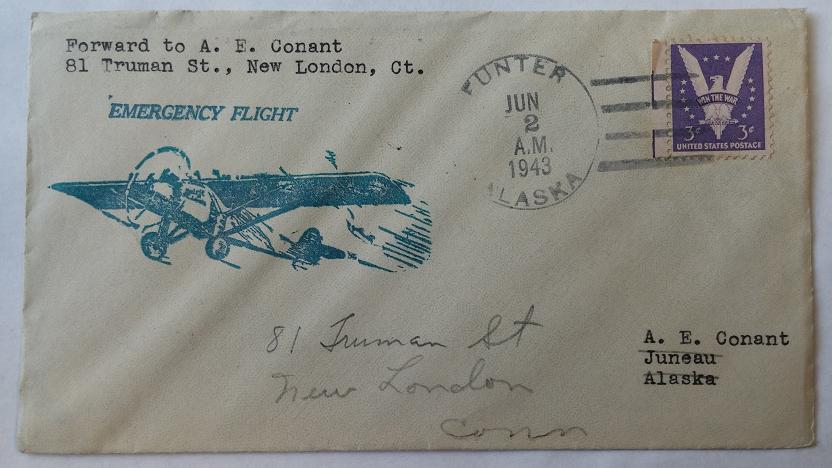
postal cover 1

In the 1940s the post office was inside the company store at the cannery. It was reportedly a partitioned room in the southeast corner of the building, which also housed the canteen and dining room.

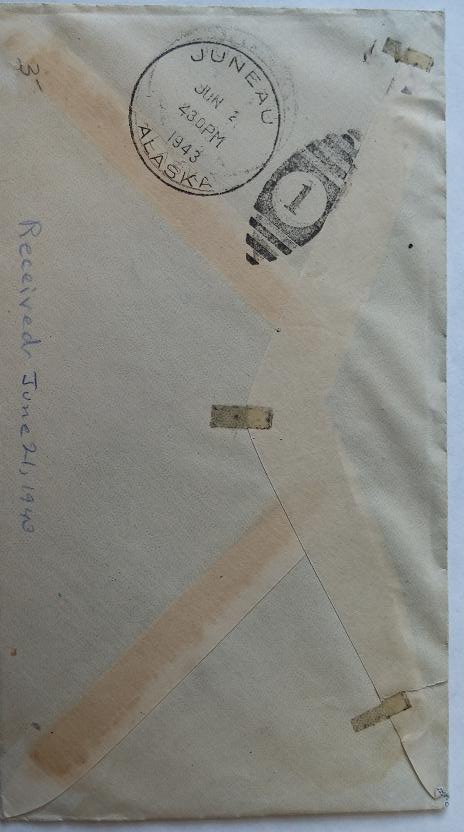
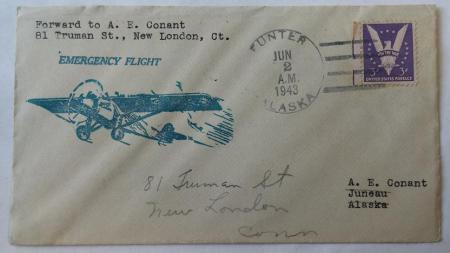
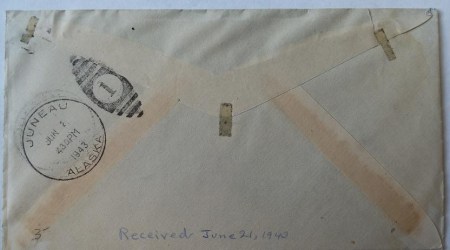
Below is a WWII-era postal cover with Funter postmark. The “Emergency Flight” stamp appears to be a reference to Emergency Air Mail, a federal law allowing air mail at ground postage rates for communities cut off from normal surface mail. This was intended for communities affected by floods or other problems, but became popular in rural Alaska. It seems to have been common to mail these to the nearest major post office (in this case, Juneau), then have a forward or return address for the final intended address.
Letter3a Letter4a

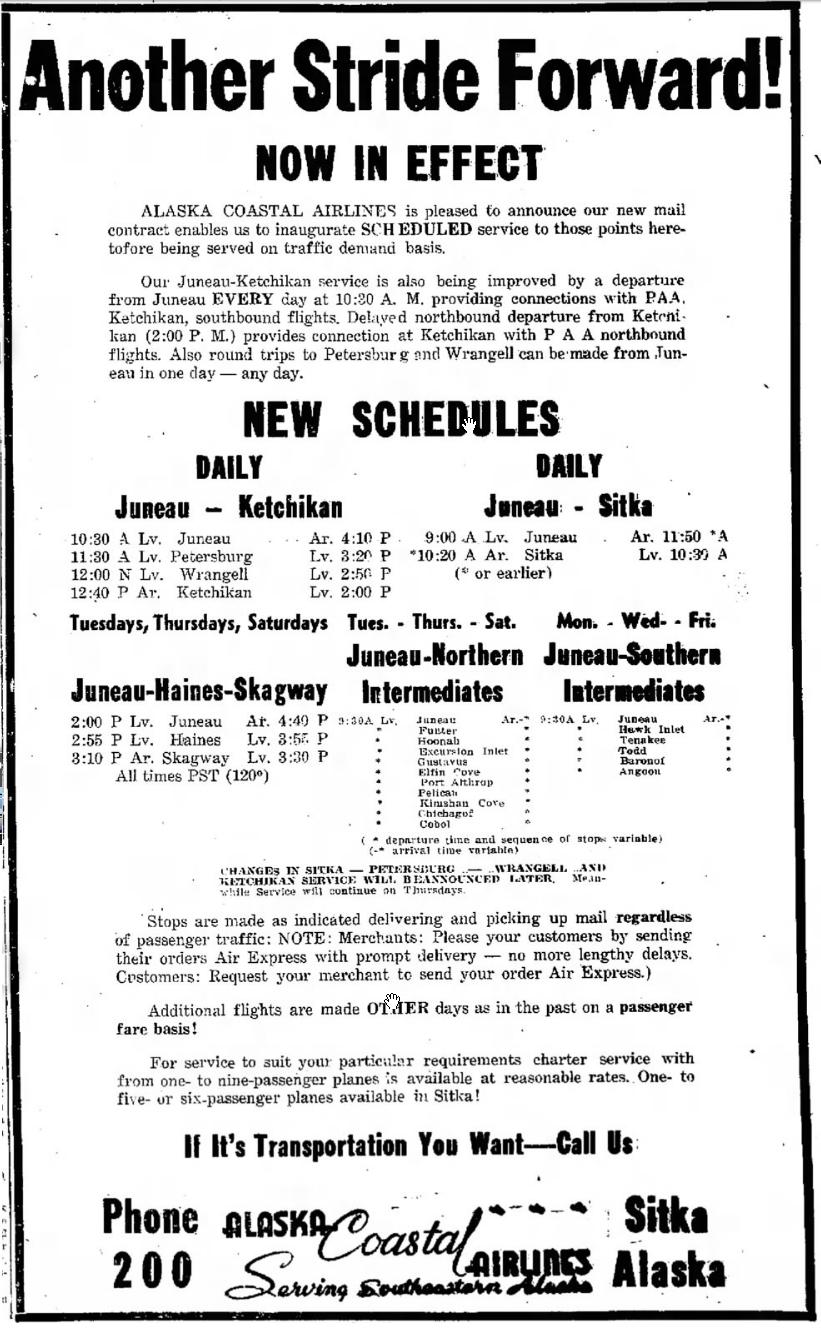
Air mail began appearing around the 1930s, with the government experimenting with different air carriers and contracts for rural service. A 1947 advertisement for Alaska Coastal Airlines notes that “Air Express” service was available to and from Funter and other small communities by request on a variable schedule.

Alaska Coastal Ad - Daily Sitka Sentinel - 9 Jul 1947

After WWII, the post office was apparently in a separate small building for some time. This building had been the US Fish & Wildlife Service office during the Aleut internment.

The Funter post office was discontinued for the second and final time on April 19th, 1957. After the post office closed, Funter Bay became a mail stop or drop, the cannery watchman would meet the weekly plane at the dock and residents could pick up their mail at his residence. There was no longer a paid position under the USPS, and mail was postmarked in Juneau.

Sometime after Hargrave’s tenure as postmaster, a cannery watchmen and his wife apparently operated a house of ill repute at the property. By some accounts there was an illegal bar and even occasionally “ladies of negotiable affection” (as Terry Pratchett might say). They also supposedly ran some kind of mail-order scam against Sears and other catalogs.  I will try to expand on this in a future post as I find more details!

The watchman in 1972 was Scotty Todd, a retired mine driller. Reportedly when the mail brought his social security check he would drop everything, jump on the plane, and go to Juneau bars until the money was gone. Neighbors would pick up and sort the mail and turn off Scotty’s generator on the occasions when he disappeared.

My Dad provided some information on mail service in the 1970s:

“The Forester was the first mail boat I rode on to Funter in 1972, owner/operator was Dave Rischel (sp?). Then he got the Betty R, had a hell of a time getting it Coast Guard approved.  The Forester was approved amazingly enough with 4 automatic bilge pumps and one was always running.  Dave did the run to Angoon, Tenakee, Hoonah, Elfin and Pelican and of course all the little places where anyone lived like Funter, Hawk Inlet.  So when the Ferry system started up Dave got put out of business….

When I first moved there the mail boat came once a week (weather permitting).  You would give Dave your list and he would buy what you wanted and charge a minimal fee.  Everything from food to bringing me the plywood for my dory.  We had twice a week plane service also, which was pretty handy for getting back and fourth to town.  Seat fare was something like $20.  Per usual lots of drinking and talking at the cannery when you got the mail from Scotty and then Jim and Blanche.”

Around 1978 the Federal government began “Essential Air Service” aka “Essential Air Transportation” which guaranteed weekly mail delivery to Funter Bay and other rural Alaskan communities. This service continues in many rural communities today.


EAS 1992

Jim and Blanche Doyle took over the caretaker job and the mail sorting around 1973 or ’74. After they moved across the bay (around 1983), mail planes generally came to the beach at Crab Cove. The actual spot depended heavily on the tide, weather, and any passengers. Outgoing letters and packages could be left with whoever met the weekly plane. Absent residents could pick up their mail from the big mail box near the usual spot for the plane to come ashore
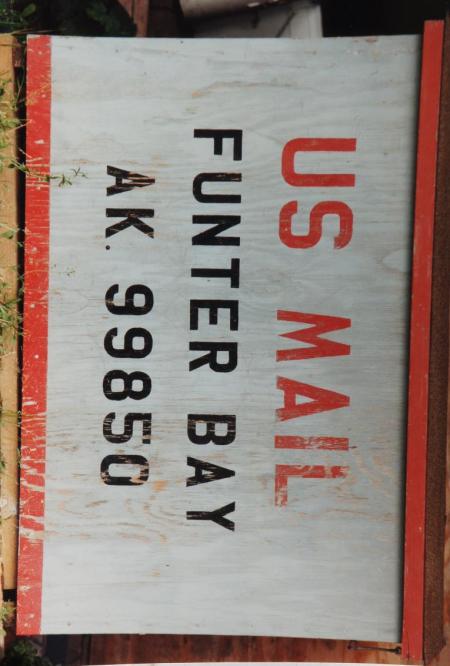
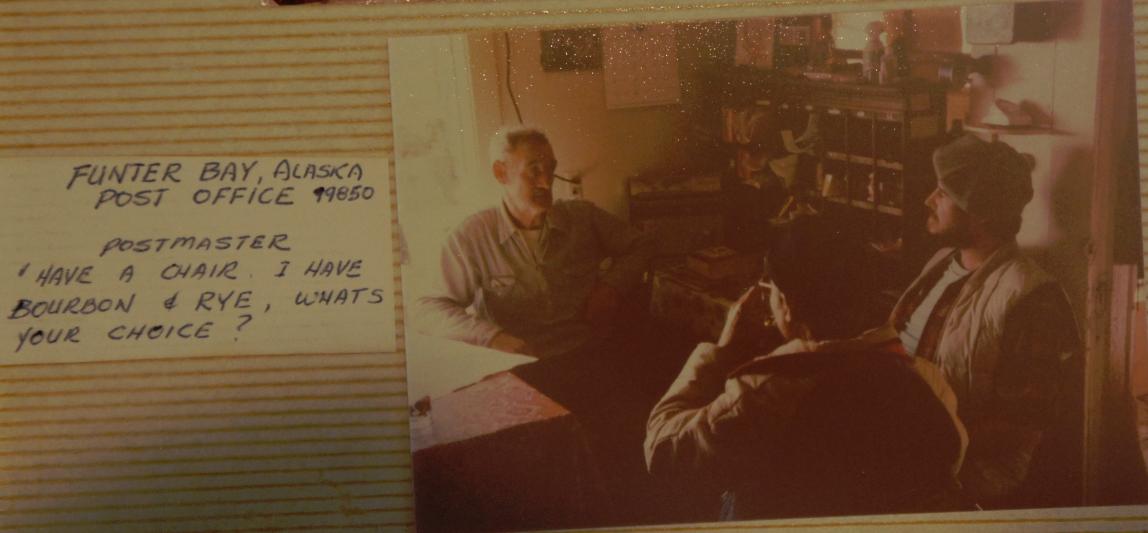
My Dad’s photo of the post office and “Postmaster” Jim Doyle in the 1970s deserves another use!
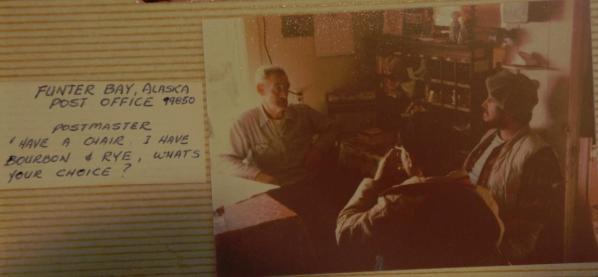
postmaster


Funter Bay History: More 1929 Photos

August 20, 2014

I recently came across some additional photos from the 1929 Alaskan Aerial Survey, conducted by the US Navy. Thanks to Richard Carstensen for sharing these! Richard had an excellent website at juneaunature.org. Also thanks to Kim Homan with the Southeast Alaska GIS Library for providing some reference information. They have put together An ArcGIS interface for locating and viewing additional aerial photos from this set.

These are very large photos, click to open them full size (may take a while to load on a slow connection).

Funter Bay viewed from the North, looking almost directly South down Chatham Strait towards Chichagof Island:

ob07016_funter75

1929 US Navy Alaska Aerial Survey Expedition (Sargent, R. and Moffit, F. 1929. Aerial photographic surveys in Southeast Alaska. USGS Bull 797-E.)

Green Mountain is in the foreground on the left. Mt Robert Barron is further ahead on the left. The large island at the head of the bay is Highwater Island, with a medium tide filling the estuary behind it, but not covering the sandbar connecting it to shore.

The next photo is not at Funter, but across Lynn Canal at Swanson Harbor (behind Point Couverden). This location was used by the Thlinket Packing Co to store fish traps in the winter, and as a convenient harbor for packers during rough weather. I found it interesting because several complete and partial fish traps are seen stored in the shallows at the head of the harbor.

ob05023_swanson

1929 US Navy Alaska Aerial Survey Expedition (Sargent, R. and Moffit, F. 1929. Aerial photographic surveys in Southeast Alaska. USGS Bull 797-E.)

This area goes dry at low tide, as seen in the modern photo below:

se05_ml_6682

Photo from NOAA Alaska Shorezone (https://alaskafisheries.noaa.gov/shorezone/) used as public domain.

The traps have long since disintegrated from weather and tides, ending up as mossy logs on the beaches. The pilings driven into the mudflats in the 1929 photo have also disappeared.

In addition to use as a fish trap staging area, Swanson Harbor was tied to Funter by mail service. A few homesteads and fox farms at Point Couverden received their mail at the Funter Bay post office. A cannery was reportedly begun at Swanson Harbor around 1902 by Buschmann, Thorpe & Co, but the company failed before construction was completed. There may have been a cannery or saltery prior to this, 1897 nautical charts indicate a cannery in the same location.  An 1880 map of Swanson Harbor shows an “Abandoned Indian Village” in the location of the structure seen in 1929. This is drifting further off topic, but I found it interesting enough to include here:

Swanson 1880


Funter Bay History: Piledrivers

July 19, 2014

Construction in intertidal zones relies heavily on pilings. These posts are driven into the sand and mud of the tide flats and ocean bottom. This common construction method was (and still is) used to install docks, fish traps, wharves, and buildings extending out into the water. Pilings are similar to telephone poles in length and diameter. Installing pilings is much like hammering a nail, a large heavy object is used to repeatedly hit the top of the pole, driving it into the ground.

piledriver3


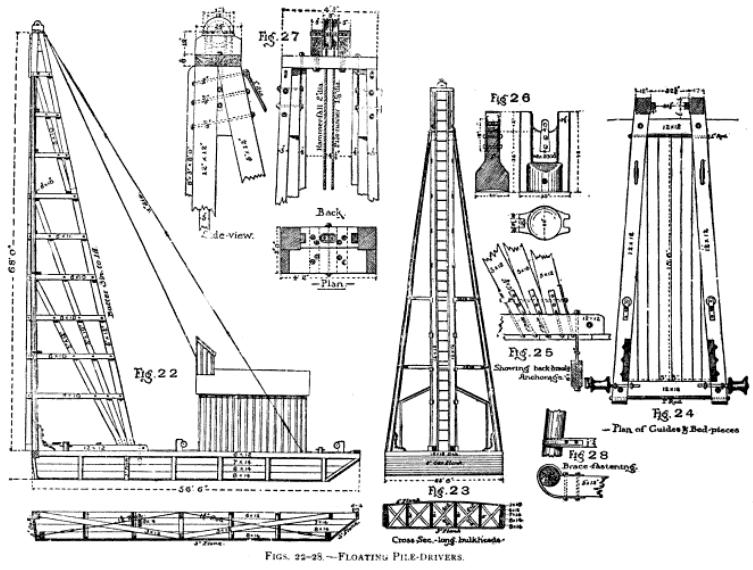
Diagram of a piledriver, from Foster, Wolcott C, “A Treatise on Wooden Trestle Bridges and Their Concrete Substitutes: According to the Present Practice on American Railroads”. 4th Edition, New York, John Wiley & Sons, 1913.

In the above design, the hammer (usually a cast metal weight) slides up and down on the vertical section of the tower, pulled by cable from a winch at the rear. Piledrivers could be mounted on skids, barges, rail cars, or other platforms as needed. This design is essentially unchanged from Roman times, when drivers were powered by animals or humans. They later evolved to use steam and then internal combustion power, but the appearance largely stayed the same until the advent of diesel impact, pneumatic, and vibratory hammers.

Tractor-powered pile driver in Alaska in 1942, courtesy Library of Congress:
piledriver1

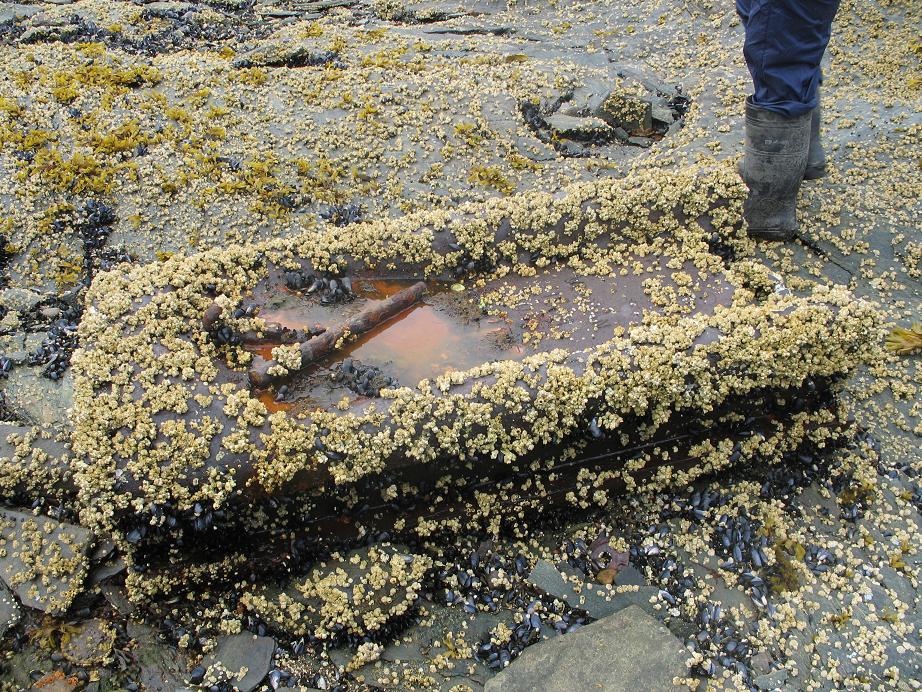
Piledriver hammer found underwater at Funter Bay and pulled out on shore. Note the slots on the side where the hammer would ride the vertical support rails:
hammer1

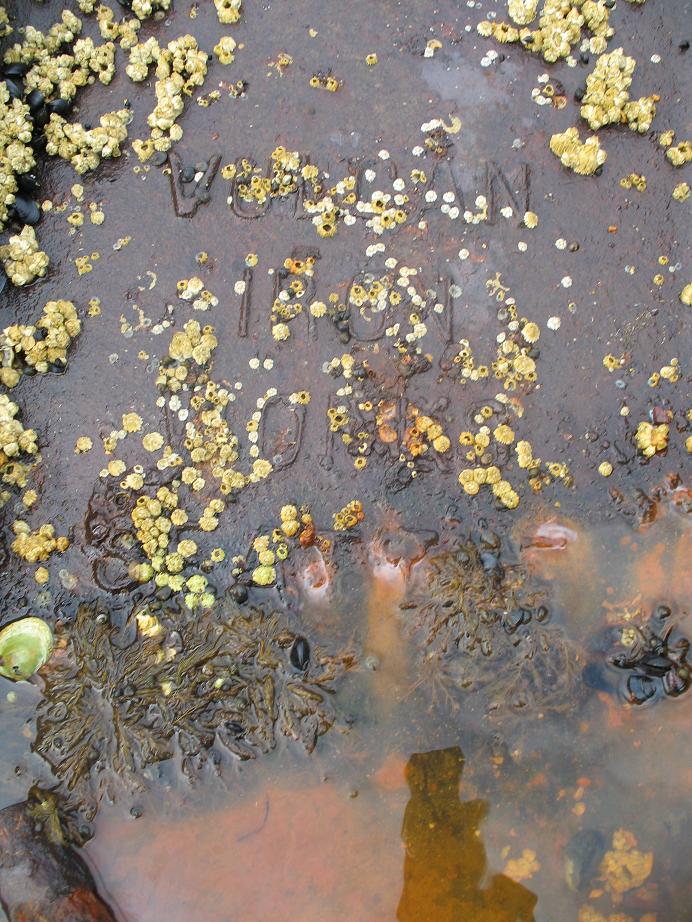
Closeup showing the maker of the hammer: Vulcan Iron Works of Seattle:
hammer2

Some information on Vulcan pile driver history can be found here.

A 1926 photo of a pile driver in Funter Bay can be seen below:
piledriver

While modern docks generally use creosote-coated (or metal) pilings for rot resistance, early installations used untreated pilings. These have largely decayed and disappeared above the water line, although the buried sections and pilings that are above mean water level are more preserved.

Pilings at Scow Bay, as seen previously on this site:
OLYMPUS DIGITAL CAMERA

Stubs of pilings which seem to have been cut off at ground level:
OLYMPUS DIGITAL CAMERA

Complex piling structure supporting the approach ramp to the cannery dock:
pilings

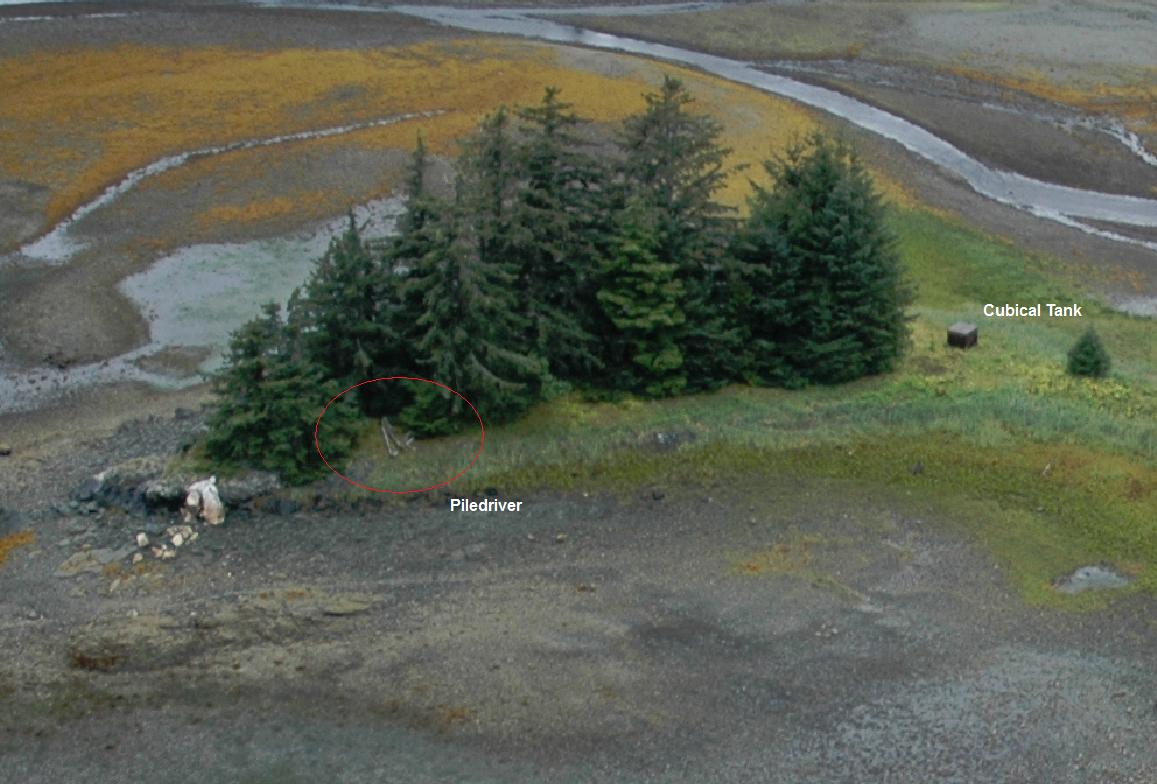
An old pile driver is abandoned on “The Point” in Crab Cove. This was a smaller unit mounted on a skid base, it may have been part of Ray Martin’s scheme to build a logging railroad dock there, or could be leftover from some other project in the bay. The A-frame support collapsed sometime in the last 20 years, I remember when it was still standing. Power was provided by a small stationary gas engine. The large cubical tank or boiler nearby is of unknown origin.

piledriver2


Funter Bay History: Aids to Navigation

May 29, 2014

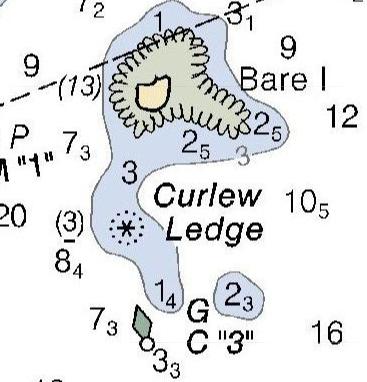
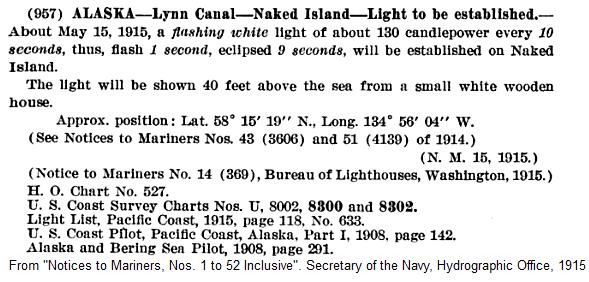
Several navigational aids exist in and around Funter Bay to guide vessels entering and traversing the area. These include the Clear Point light, the “Green Can”, and the Naked Island light, as well as some informal private markers and buoys.

Green Can chart

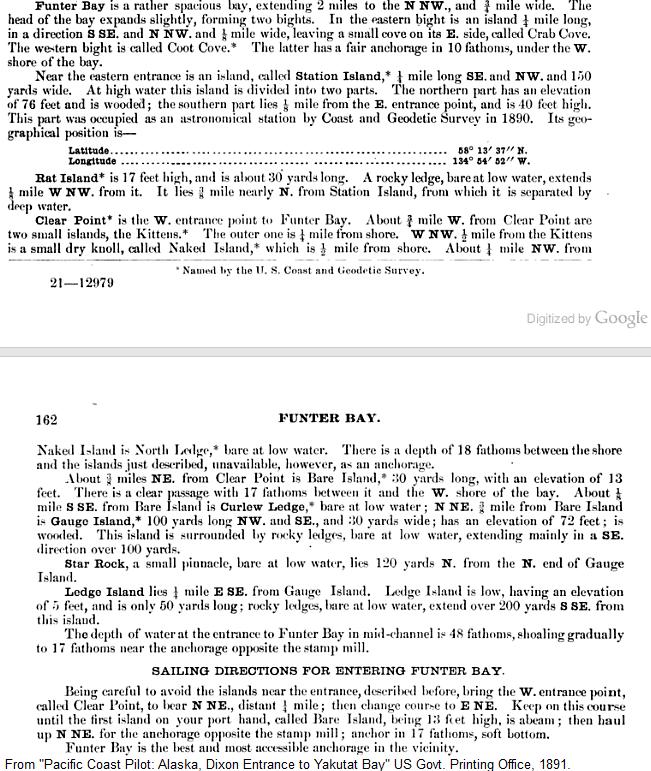
Prior to establishment of lights and buoys, navigators relied on written descriptions of which course to take based on local landmarks, such as these published in the 1891 Pacific Coast Pilot:

1891 Sailing Directions

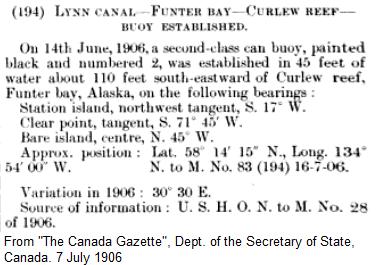
The “Green Can” buoy near the entrance (Marking Curlew Reef) was the first official navigation marker in Funter Bay. It was originally a Black Can when installed in 1906. It was located slightly to the NE from the current Green Can. This buoy indicates that vessels should pass to the right when entering (keeping the buoy off the Port side) to avoid the reef off Bare Island.

1906 Can

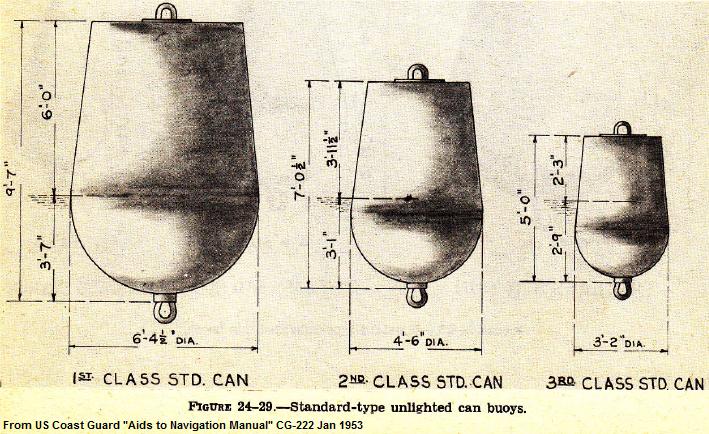
cans

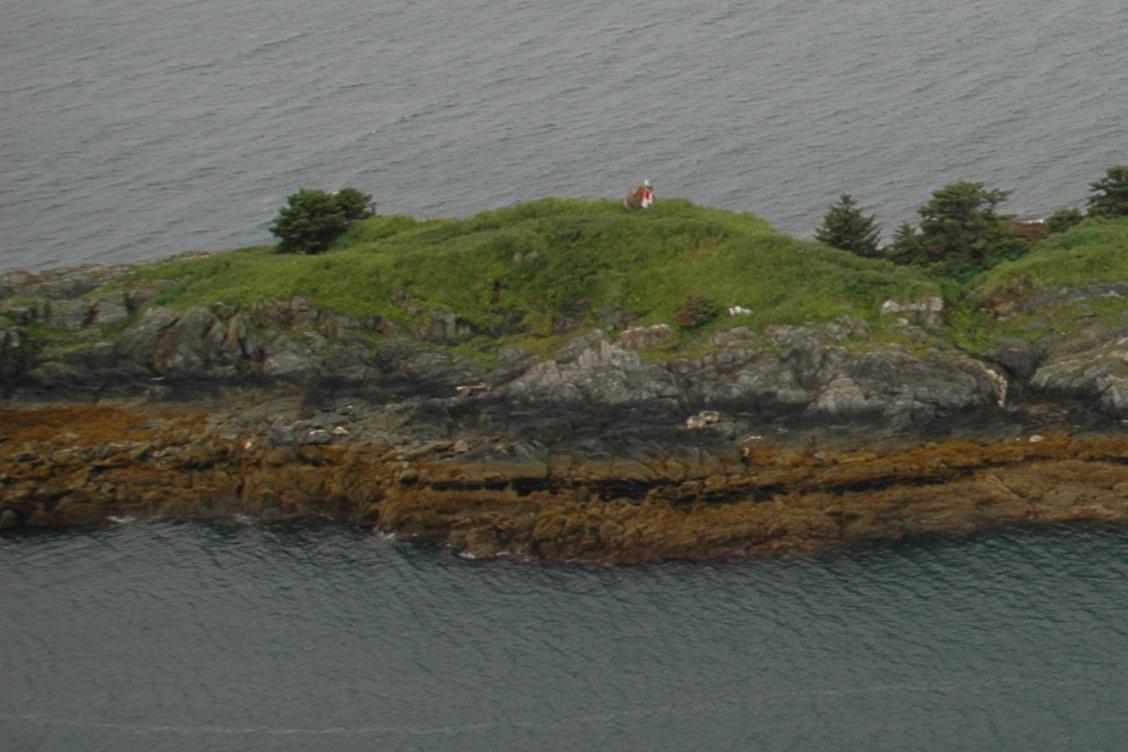
The Naked Island light was established in May 1915, as described below:

naked

Naked2
Naked Island Light. Photo from Alaska Shorezone project, used as public domain.

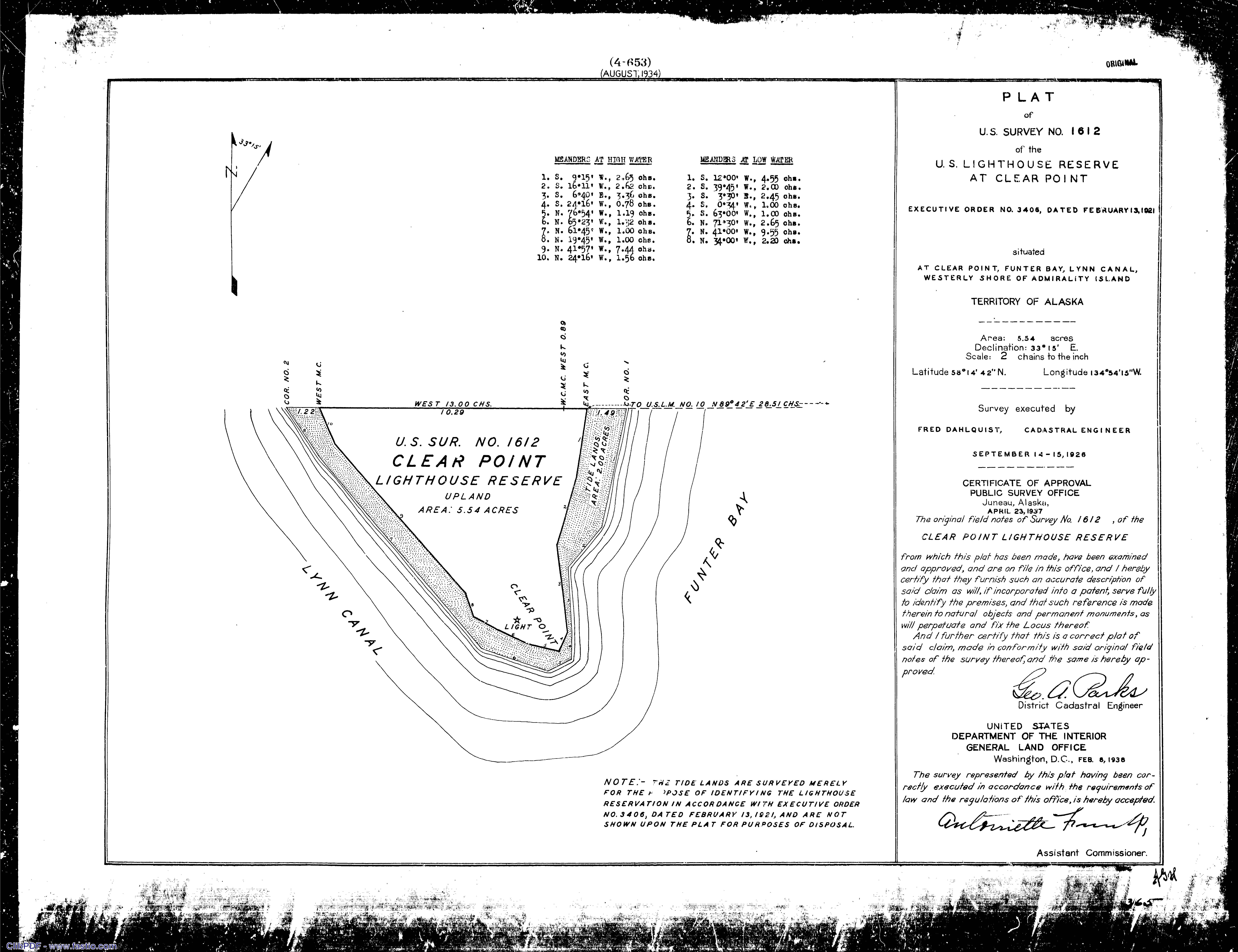
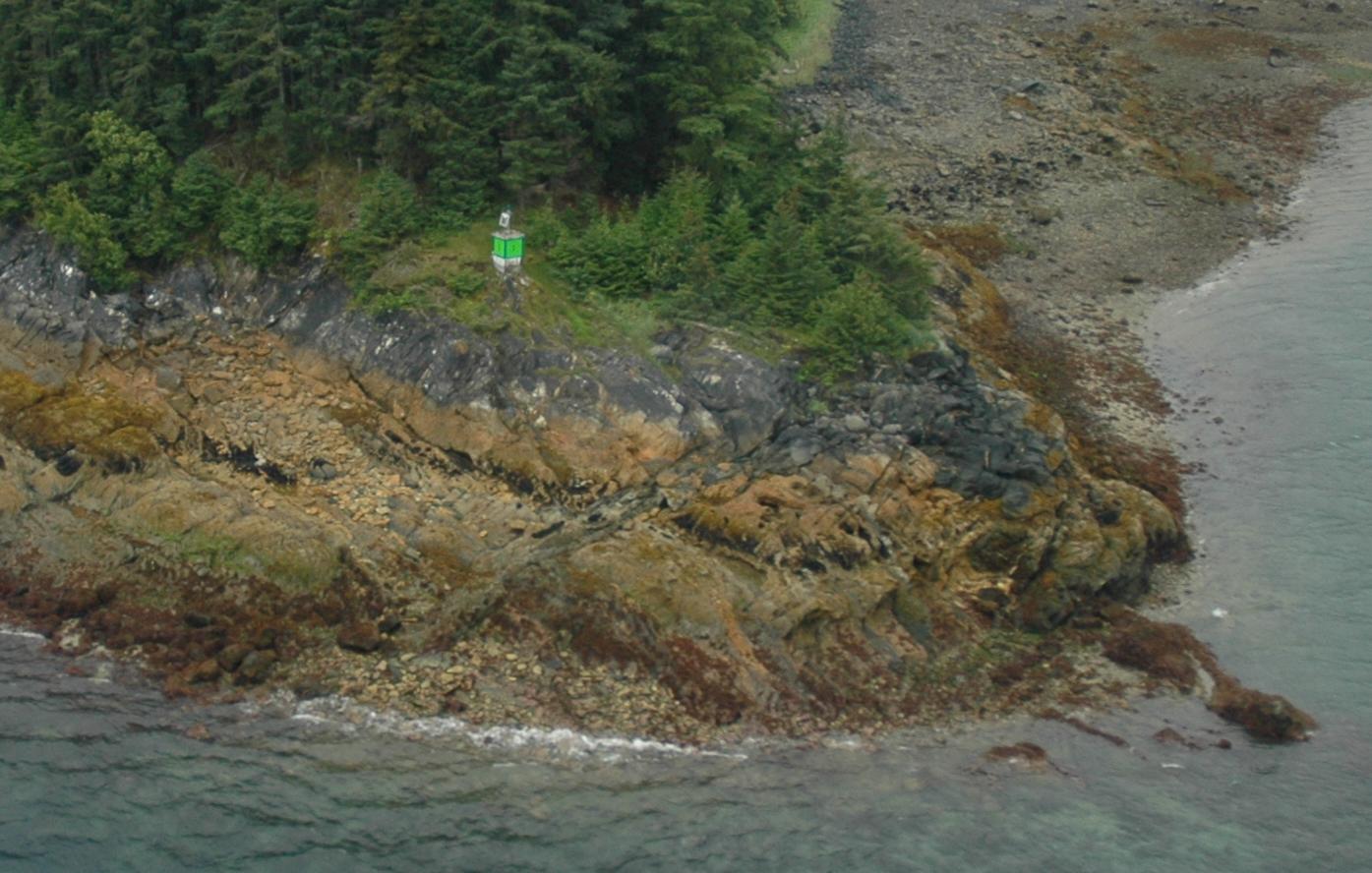
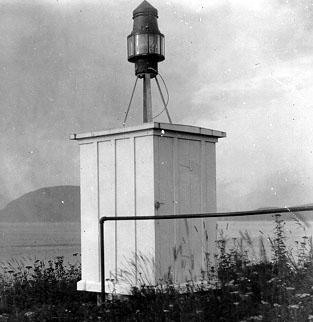
The Clear Point light was established in August of 1915, and consisted of a flashing white light of 15 candlepower, with “flash 0.2 second, eclipsed 1.8 seconds”, installed in a “small white house on Clear Point, northern side of the entrance to Funter Bay”.

1934 Survey of Clear Point Lighthouse Reserve:
Clear Point Lighthouse Survey

Modern Clear Point Light:
Clear Point
Photo from Alaska Shorezone project, used as public domain. 

The descriptions of both lights resemble the one seen below (from nearby Point Retreat):

pointretreatMinor
Public Domain photo from US Coast Guard

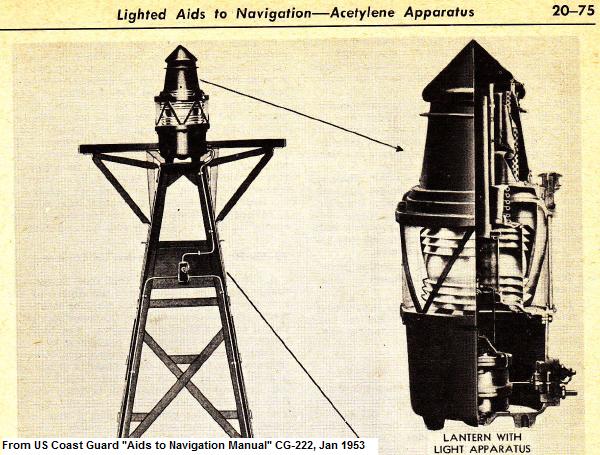
Both were originally listed as acetylene gas lights, some information on such lights can be found here. Devices invented early in the 20th century allowed gas lights to flash automatically at night and shut off during the day through use of a heat-operated “sun valve”. Early acetylene lights used calcium carbide with a water drip system to generate the gas, similar to a miner’s headlamp, as it was considered unsafe to compress acetylene. Later systems used compressed storage tanks after the technology had improved.

gas lantern 3

Solar panels and batteries began replacing gas lights in navigational aids in the 1950s, although some lighthouses and beacons used acetylene into the 90s. Based on the changed notation on charts, Naked Island’s light seems to have been upgraded around 1971, and Clear Point around 1974.

Color tests in 1979 proved that green-colored buoys were more visible that traditional black cans. The can at Curlew Ledge changed color between 1978 and 1987 according to navigational charts.

can2

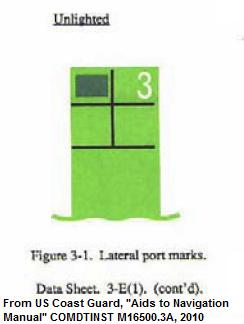
Modern charts describe the Clear Point light as green with a 2.5 second period, 16ft above mean sea level on a platform marked “1”. The Naked Island light is noted as being 44′ above sea level with a 6-second period, not numbered. The Green Can is marked with a number “3”. The original Black Can was in almost the same location and was first marked “2”, and is shown on later charts marked “1” No marker numbered “2” is nearby presently.

Buoys and lights were initially installed and maintained by the US Lighthouse Commission, today they are under the jurisdiction of the US Coast Guard. Special buoy tender vessels provide regular maintenance to these navigational aids.

The closest manned light station was the Point Retreat Lighthouse at the Northern tip of Admiralty Island. Initially completed in 1904, it was later unmanned and downgraded in 1917, then rebuilt and re-manned in 1924, then automated again in 1973. It is now privately owned and there are plans to make it a museum and B&B.

Private navigation markers are sometimes placed on rocks, reefs, wreckage, or other obstructions, and are not consistently styled or maintained. The most common is a stick or pipe which protrudes above the water surface at high tide, marking a submerged object which could endanger a boat. Small buoys may also be anchored to such obstructions, although they tend to become covered with barnacles and sink after a few years if not maintained.

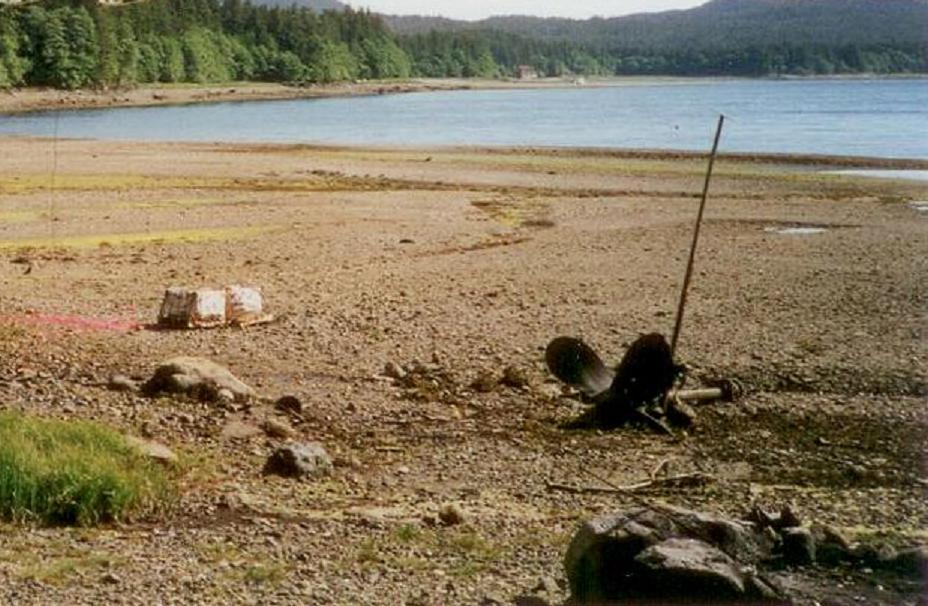
Below is a pole marking the old tugboat propeller in our front yard, at high tide the water would often cover the propeller, hiding it from skiffs and planes coming ashore. The pole was a popular perch for birds, especially kingfishers.
stick

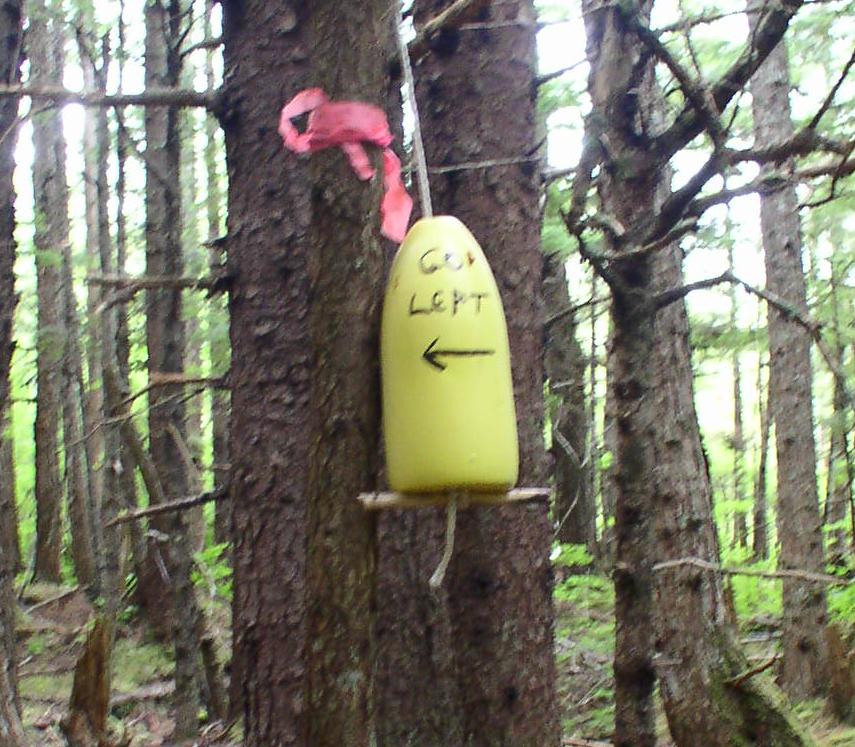
And occasionally you’d get an “aid to navigation” that was completely out of place but still appropriate, such as a float buoy used as a trail marker on land:

OLYMPUS DIGITAL CAMERA


Funter Bay History: Weather

May 8, 2014

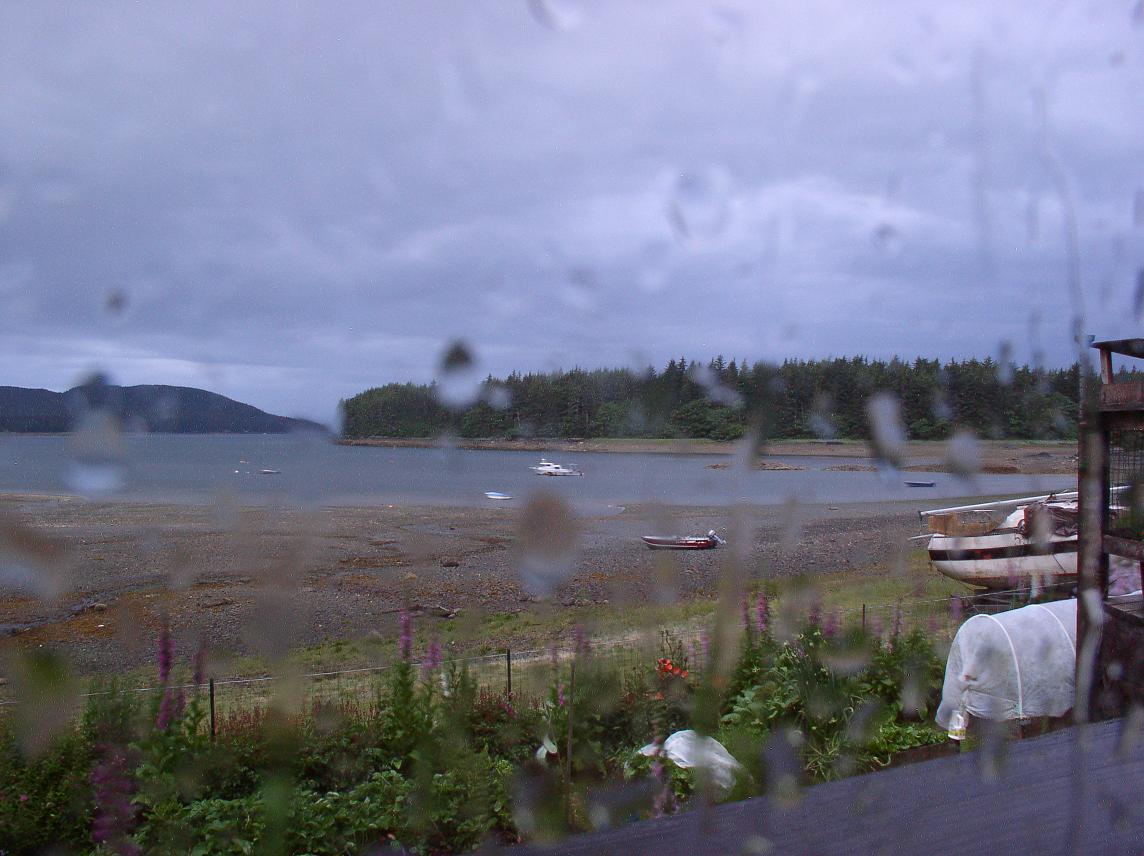
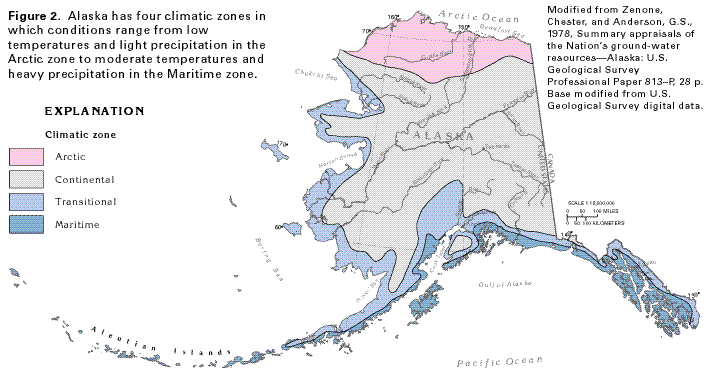
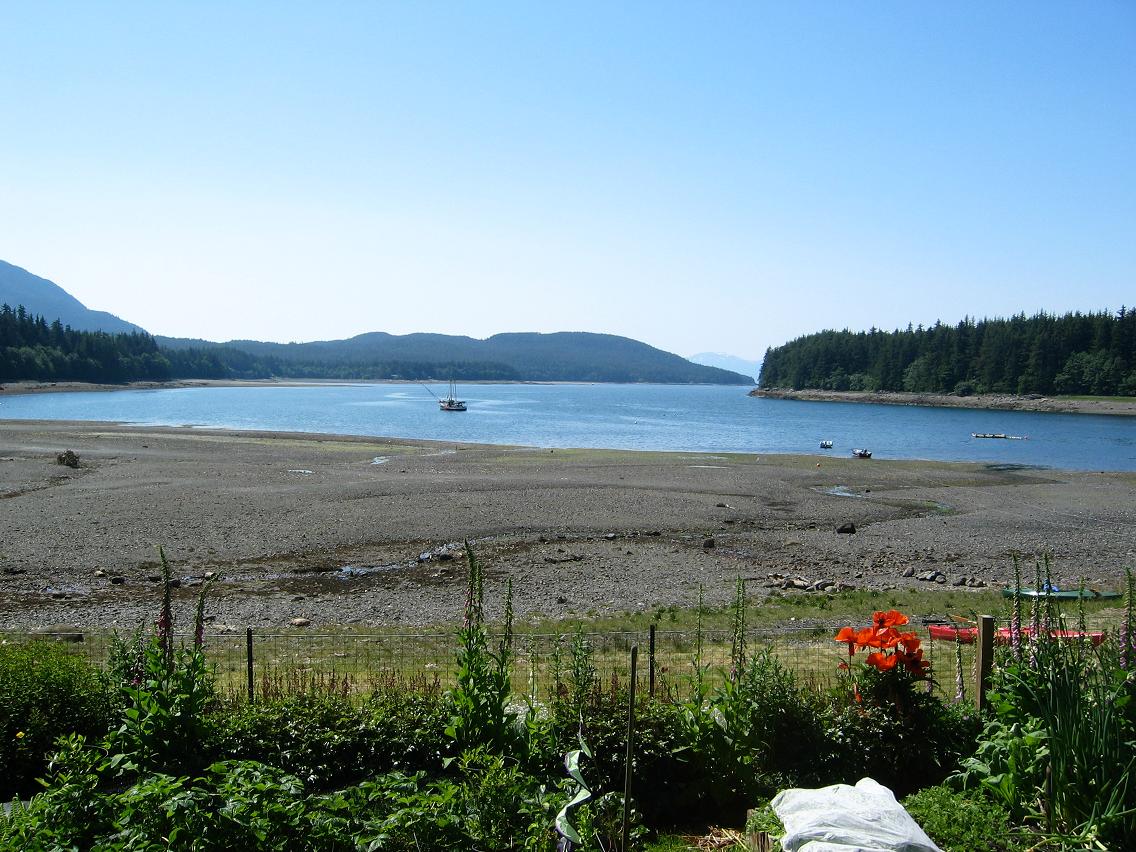
Many people from outside Alaska inquire about the cold and snow, which usually leads into a discussion of Southeast Alaska’s climate (the rainy season, and the lots-of-rain season). The temperature rarely falls below 0°F in the winter, due to warm ocean currents which reach Southeast Alaska from the Pacific Ocean. In general the climate is similar to Seattle (although wetter and about 10° cooler on average). Between 1980 and 1996 there were on average 214 days a year with precipitation. Rainfall averages about 60″ per year (compared to 37″ for Seattle and 45″ for Vancouver BC). However, it’s not as wet as other parts of Alaska like Whittier (156″), Yakutat (155″) or Ketchikan (141″).
OLYMPUS DIGITAL CAMERA

N002Graphic from http://pubs.usgs.gov/ha/ha730/ch_n/N-AKtext1.html

Average air temperatures are in the 60s in summer and 30s in the winter, with extreme highs in the 80s and extreme lows in the negative single digits.

The water temperature at Funter varies between about 37°F in the winter and 50°F in the summer. Warm enough for summer swimming, especially near the shore. Dark rocks and gravel warm up in the sun at low tide, then help to warm the shallows as the tide comes in.

weather5

When it does snow, the accumulation can initially be deep (15″ in a 24hr period and 34″ total depth are some of the records). The snow does not tend to last long, instead melting into slush or getting rained on, so total buildup does not get as impressive as other parts of Alaska such as Prince William Sound and Southcentral Alaska.

weather1OLYMPUS DIGITAL CAMERA

Wind is the major hazard of winter weather. While many sites on the shore are protected from the worst wind by their location and nearby trees, the center of the bay can experience powerful gusts coming in from Lynn Canal and Icy Strait, as well as North wind out of the pass behind the bay. Weather Data from Point Retreat lighthouse shows several storms with 50-60mph winds in Lynn Canal in recent years.

Winds coming in from the channel can sometimes whip up large williwaws or small waterspouts in the bay:
OLYMPUS DIGITAL CAMERA

Unsuspecting boats have been driven ashore on occasion after anchoring in the middle of the bay (a location shown as a good anchorage on some charts). The public docks are usually better options for secure moorage if a storm is forecast.

Weather data from 1961-1996 for Funter Bay, with various summary tables and calculations, can be found here.

Another collection of weather data for Funter Bay (from 1980 to 1996) is available here.

Weather reporting from Funter Bay was part of the National Weather Service’s Cooperative Observers program. This provided vital information for pilots, fishermen, and other travelers, as well as supporting weather forecasting on a wider regional scale. Funter residents Jim and Blanche Doyle operated the Funter station and called in regular weather observations or “obs” to the local NWS office. An index from 1980 showing some of these stations (including Funter Bay) is below:

weather 1980

In 1985 the Doyles moved across the bay, the weather station was placed on the inactive list in June, then relocated and reactivated in August (per NOAA / National Cooperative Observer Newsletter).

A newspaper column on Alaska weather noted that Funter Bay had the statewide high of 60°F on November 25, 1987 (vs 45° at Juneau and a statewide low of -39° at Umiat that same day).

OLYMPUS DIGITAL CAMERA

Also of importance to residents and travelers are the tides, which can change the water level 20 vertical feet in a 6-hour period. Tides are a predictable phenomenon based on the gravitation pull of the sun and moon, so tide tables are calculated and published well in advance. However, currents and geography can cause some local variations. For this reason, the government has established tide gauges at various places around Alaska in different years, including at Funter Bay. These would show the offset in minimum and maximum tidal fluctuations. Government documents refer to self-registering tide gauges installed at Funter Bay in 1894, in 1903, 1923, and 1960. NOAA’s tide data and upcoming tide tables for Funter Bay can be found here.

tide


Funter Bay History: Ships Part IV

April 16, 2014

A 1907 article noted that the steamship Humboldt traveled from Funter Bay to Seattle in September, bringing 85 passengers and 7,875 cases of salmon (this included some cases from Petersburg as well as Funter).

humboldt

An article in the San Francisco Call of November 18th, 1911, described the Bark J.D. Peters arriving from Funter Bay, where it served as a cannery tender. Unlike the Thlinket Packing Co’s General Fairchild and other old ships converted to barges, the Peters seems to have remained a sailing vessel. It is shown in a 1911 photo with furled sails. Another photo (which also appeared in the Seattle Daily Times dated 1911) shows the ships with sails raised.

Peters
The merchant vessel registry describes the Peters as a 182ft sailing bark built in 1875 in Bath, Maine, and operating out of Port Townsend, Washington. It had a crew of 15 and a gross tonnage of 1,085. Registry number was 75809, and call numbers were J.R.L.F. It was owned by the Northwestern Fisheries Co during that time, and probably transported fish from multiple canneries in Alaska.

Peters2

In 1912 it was listed as a schooner, vs a bark. A bark has 3+ masts, all with square sails except the aft-most, and were a common type of slow cargo ships with smaller crews. A schooner has 2+ masts with fore-and-aft sails, even simpler to operate and requiring fewer crew than a bark, but does not necessarily perform as well. The Peters remained on the registry until at least 1928, when it had a crew of 5 and was hauling freight for the Booth Fisheries Co.

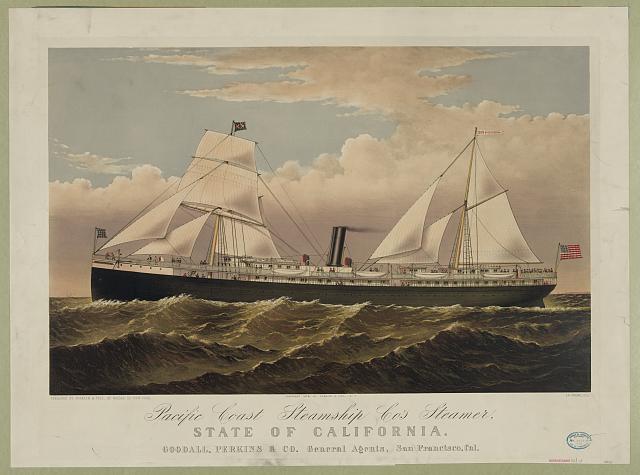
Also in 1911, the sailing steamship State of California went aground for four hours at Funter Bay, probably due to a misreading of the tide tables.

state of california
Image courtesy of the Library of Congress.

Daily Colonialist - City of California Aground at Funters Bay

The State of California sank in August 1913 in Gambier Bay, on Southern Admiralty Island, after striking an uncharted rock. More information on the ship is here.

Two photos show a hull on the beach at Funter in 1929 and 1935. The vessel is unidentified, but may be the fishing vessel Pilot. A 1950’s article mentions a “rotting hulk in Funter Bay” in this area, with the registry number 150650. This number was assigned to the Pilot, listed as abandoned in 1925. It was a 50ft long fishing boat from Juneau with a 20hp gas engine and crew of 5, built in Seattle in 1893. It had possibly been a steam tugboat previously.

1935 wreck

1935 image of abandoned vessel at Funter Bay

1929 Wreck

1929 aerial of abandoned vessel at Funter Bay

More shipping and vessel information will probably show up in a future post as I dig up more on the subject!