Funter Bay History: Tall Tales

October 29, 2013

One of the finest traditions of Alaskan culture is the Tall Tale or “BS Story”. Whether a heroic adventure, unlikely wildlife encounter, lost treasure, or exaggerated fish, Alaskans have made an art of far-fetched claims. These days they’re usually related in person, over the marine radio, or at the bar, but in the old days you could get them printed in the newspaper! Actually, you probably still can in certain less-rigorously-edited publications!

One common “BS” news story in the early 20th century was the ever-popular “Next Treadwell” mine. Newspaper editors knew that attracting outside investors to the state would help grow their small towns’ economies, so almost every mine, no matter how small, was compared favorably to Treadwell (an operation known to be highly profitable). The Sitka Alaskan of Feb 27, 1886 describes deposits in the Funter Bay area as “equally as large and rich [as the “great gold belt of Douglas island”]”. After Treadwell caved in and flooded in 1917, local editors had to come up with more general terms like “the great Juneau mines”.

Of the two Juneau papers at the time, the Daily Alaska Dispatch seemed to talk up Funter Bay the most, although the Daily Record-Miner was also favorably biased towards local mines. The Dispatch referred to Funter Bay as “One of the very best camps in the district” (May 8, 1903), “The best copper proposition in this district” (Apr 16, 1909), and as having “claims which will unquestionably become good producers within a short time” (Oct 15, 1915). A July 31, 1902 article describes a Funter Bay claim “richly impregnated with gold” as well as being “40% copper”, and being “highly mineralized all the way through” and “a great big chunk of the world’s wealth”.

Reading these articles leads one to think that Funter Bay was constantly poised to become a major competitor in the national economy, but the mines referred to in these articles were mostly one or two-man prospects that never got beyond 50ft of tunnel, such as the Mansfield Mine.

Otteson’s Dano mine was also mentioned in the Dispatch, described as having a “big and rich ledge” (3 Aug 1909) and producing “rich gold bearing samples” (27 July 1919). Despite all this richness, the mine did not develop into a major producer. The papers handled such delays in promised wealth with their usual optimism, an 1903 article mentions that barren rock encountered in the first 50ft of a mine at Funter must have been “all cap-rock”, and “a change has taken place… the values in the quartz now are very good”. Any mine which failed or went bankrupt, if mentioned at all, was promptly blamed on the incompetence of the prior managers, and never on the geology of the claim.

Another great tall tale appeared in the Dispatch on Sept 12, 1912.

Explores Unknown Region on Admiralty Island

W. C. Miller Finds Lake and River Alive With Mountain Trout and Tremendous Wall of Ice.
—————————
W.C. Miller, a well known Alaskan who has valuable prospects at Funter Bay, has just returned from an exploration of the “unknown country” of Admiralty Island, and this trip is believed to be the first exploration of that region. The country lies near the center of Admiralty Island, between Hawk Inlet and Seymour Canal. Mr. Miller was accompanied by his nephew, F. E. Koeper.
“The entire territory,” said Mr. Miller, “is worthless to the prospector. We found a little gold, but nothing worth while, except mountain trout.”
At the head of a river Mr. Miller found a lake four miles long and a mile wide, alive with mountain trout of unusually large size. “We had no bait but venison,” said Mr. Miller, “but a crowd of fish entered into competition for the hook as often as Koeper threw it in.” Miller and his companion came back by a shallow river, a hundred feet wide, and this stream was also alive with trout. No salmon were seen, and Mr. Miller believes that on account of the swiftness of the current the salmon are not able to swim a very great distance in it. Mr. Miller named the lake “Isaac Walton Lake” in honor of the great angler.
The explorers found a new glacier with a wall of ice sixty feet high, running along the top of the range for miles. (From Daily Alaska Dispatch, Sept 12, 1912).

For those unfamiliar with the area, Admiralty Island has no glaciers,  and mountain top snow of that thickness is unlikely in September . The size and location of the lake and river are also quite questionable!

On May 25th of 1937, lighthouse keepers at Point Retreat reported that they had seen a “Ragged wild man”. This was said to possibly be Bud May, a trapper from Funter Bay who had been missing for some time. However, a few days later, 65 year old Albert Miles arrived at Point Retreat and claimed that he is not “wild”, he had simply walked there after wrecking his boat near Cordwood Creek. Miles was later ruled to be insane (per Kinky Bayers’ notes).

I might have a few more of these lying around for a later update. If any readers have a contribution I would be glad to publish it! Names can be withheld or changed to protect the guilty!


Funter Bay History – Hunting

August 28, 2013

While browsing through old newspapers I found quite a few references to hunting around Funter Bay. The area has many deer and bear, and has long been an important hunting ground for Tlingit natives. Subsistence hunting was important for local prospectors and fishermen, and sport hunting brought people from elsewhere in Southeast. Here are a few names and hunting stories that I found during my research.

A snarky article in 1907 listed  a party of “cannibals, highwaymen, and Indian warriors” hunting at Funter Bay, including “Big Eatmuch of Oshkosh, Sitting Bull of Ohio, and Highbinder of West Virginia” (Highbinder was slang for either a gangster or a corrupt politician). An article a few days later mentioned that “Messers Page and Snyder, the two Skagway nimrods who put in a month at Funter Bay” had an excellent bag of game, this may have been the same party.

Snyder was mentioned again in November 1908, when he along with a Mr. Woodburn and a Mr. Kirmse (all of Skagway) accompanied the famous big game hunter Z.R. Cheney to Funter Bay.

In 1909 the Juneau Record-Miner reported that Abner Murray, E.E. Smith, L. Keist, and Billy Stubbins had gone hunting in the Funter Bay area. Smith wounded a deer, and Keist and Stubbins both shot at an eagle and missed. Others in the party were reported to be Messrs. Hopp, Fox, Judson, McWilliams, Dick McCormick, A. Baritello and A. Reidl.

Fred Hastings and Bob Evans were hunting in the Funter Bay area in 1909. Also in the area were Wm. Geddes “and a party of big game hunters”.

In Nov of 1909, Phil Snyder and Frank Page are mentioned again. Snyder was a Skagway Alderman, and the pair are reported as coming down every year with a pack of hunting dogs to spend a month in the Funter Bay area. They were reportedly after bear on the 1909 trip.

In December of 1909, a soldier from Fort Seward (at Haines) was injured while hunting and sent to St. Ann’s hospital in Juneau. His name is given as John Carr or Karr, and his injury reportedly was from “falling on the edge of an axe”. The unfortunate hunter tripped on a rock and landed neck-first on the axe, but fortunately a trained nurse happened to be at Funter Bay and was able to stitch the wound. Carr’s hunting party was already overdue after a storm, and were thought lost for a time.

In October of 1910 a hunting party consisting of Willie Winters, Geo Rose, Oliver Oleson and Lawrence Erickson became lost between Hawk Inlet and Funter Bay. They were forced to build a fire and spend the night in the woods, but found their bearings the next day. 

Peter Williams Sr, a hunter from Sitka, died at Funter Bay in August of 1914 in a hunting accident. He had been carrying a deer and fell off a cliff.

Mr. and Mrs. E. C. Russell and Mr. and Mrs. Ray Stevens spent a week in Sept. of 1915 hunting and fishing at Funter Bay. Ray Stevens worked at the First National Bank.

Funter Bay resident and mine owner Charles Otteson related this story to the Daily Alaska Dispatch in November 1916:

“Shortly after the deer season opened – I was engaged in mining in the Funter Bay section – and one evening about nine o-clock, when a bright moon was shining, I went out to the little garden adjacent to our house on the mining property, accompanied by my wife, and there was a fine, big deer standing erect by the garden. I went within two feet of him and he did not move; I flashed a small search light several times in the animal’s face, and this did not disturb him in the least, he stood there just looking at us. I got my firearms with the intention of laying in a supply of venison, as we needed meat, but upon returning and going up close to the deer again I simply couldn’t muster up courage enough to fire. Who could?” (From “Couldn’t shoot the seemingly pet deer” Daily Alaska Dispatch (Juneau) 14 Nov 1916).

Not every hunter was so kind-hearted, there are stories of several other “pet” deer walking up to people in the woods and ending up in the freezer. Our neighbor Harvey Smith had a deer which learned how to open his door and would sleep inside by the fire. Lassie Ohman had a young deer which lived at their cabin and sometimes on their fish scow. Both of these “pets” later ran afoul of hunters.

“Bud” Walker, a friend of Funter Bay resident Max Dorman, went missing in October of 1942 while hunting grouse. The bears were reported to be “very irritable” that year due to poor salmon runs, and searchers feared the worst. Walker showed up a day later about 15 miles away in Hawk Inlet.


Funter Bay History – Fish Trap Locations

August 10, 2013

I’ve talked about fish traps in several previous posts. Recently I came across a set of maps showing the locations of  traps around Southeast Alaska in 1918. This is a fascinating series, part of a government report from that year on the Southeast Alaska fishing industry.  An excerpt from the Lynn Canal and Stevens Passage map is below, highlighting the region around Funter Bay (click to view a larger version). I will link to the originals at the end of this post.

1918 Fish Traps

I have yet to find the original report which goes with these maps, so unfortunately there’s no key corresponding to the trap numbers. However, a quick glance at this map tells you a lot about where the salmon were to be found! The area of densely packed traps between Excursion Inlet and Point Couverden is known as Homeshore, and is still a popular fishing area today. Across all three maps in this set, covering most of Southeast Alaska, that one stretch of shoreline has the most fish traps per area.

Note that most of the traps shown on the map are the “permanent” pile-driven type. A 1919 report stated that the Thlinket Packing Co at Funter Bay had 21 traps that year, only 4 of which were floating traps. Pile-driven pound nets seem to have fallen out of favor towards the middle of the century, probably due to the expense of maintaining them and repairing winter ice and storm damage. By the time fish traps were banned at Alaska statehood, floating traps predominated.

I have previously noted some traps on the beach at Funter Bay in old aerial photos, floating traps were often taken ashore or anchored in shallow water for winter storage. The traps at Funter have all been beaten into individual logs by decades of storms, but I recently noticed a few semi-intact traps in Excursion Inlet. These are visible on the Alaska Shorezone project’s imagery.

beached traps

The full versions of the 1918 trap location maps are available through the Office of Coast Survey Historic Map and Chart Collection. They are as follows:

Lynn Canal and Stephen’s Passage

Clarence Strait Revillagigedo Channel and Portland Canal

Dixon Entrance to Chatham Strait Alaska


Update on the cannery tender Barron F

August 6, 2013

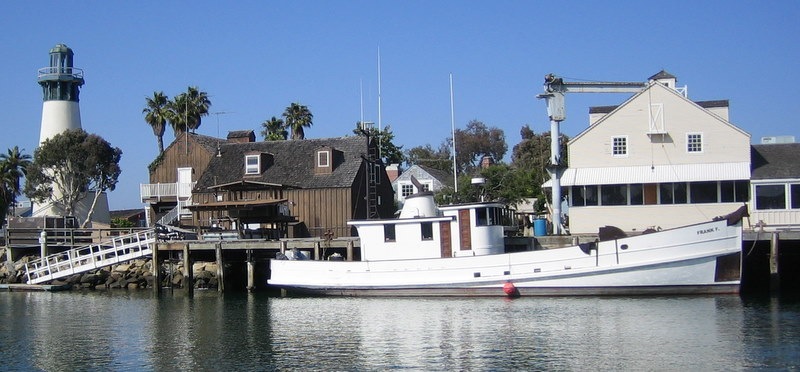
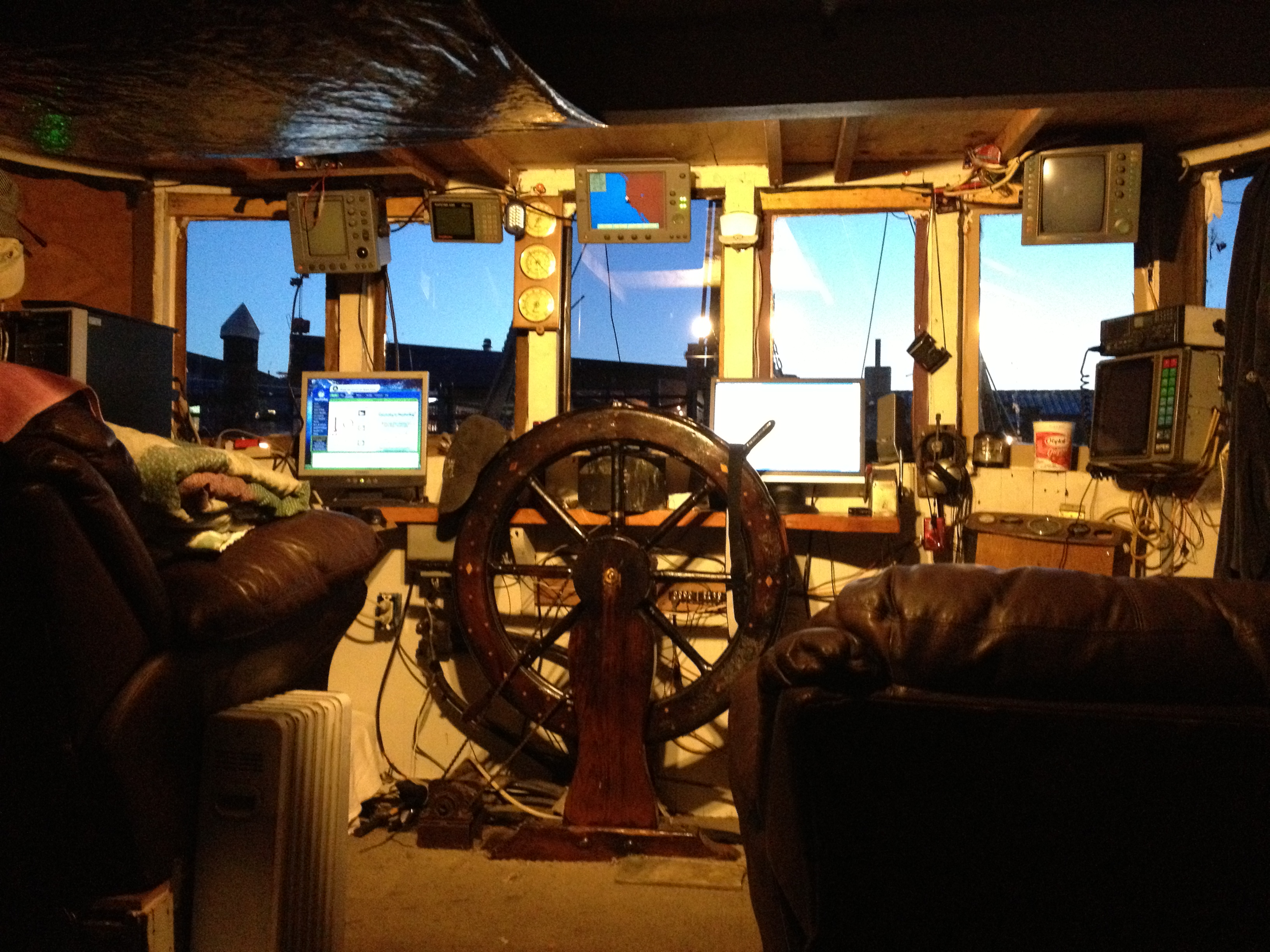
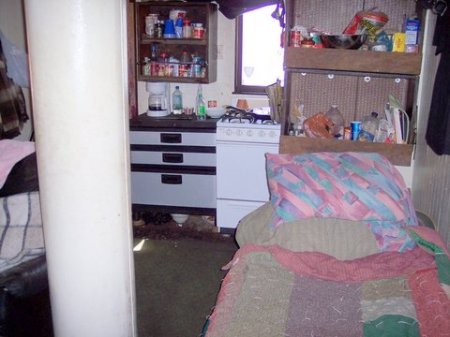
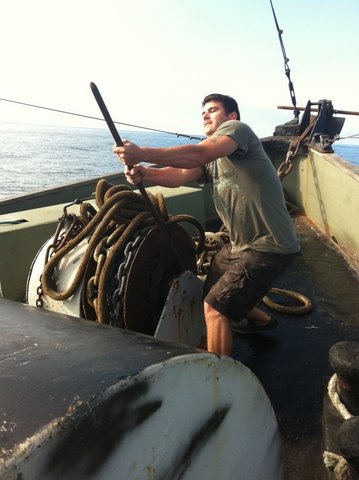
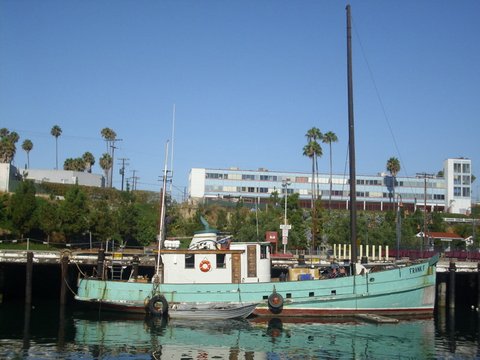
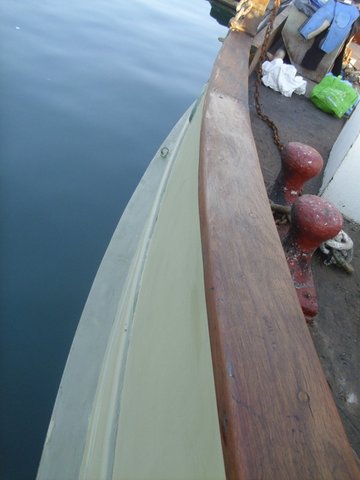
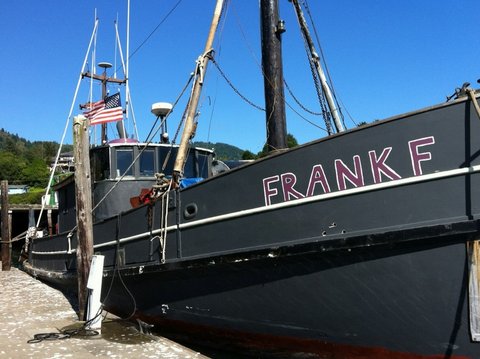
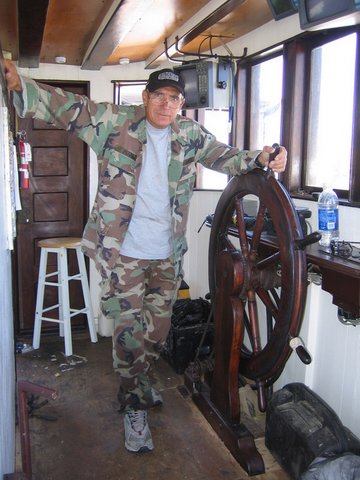
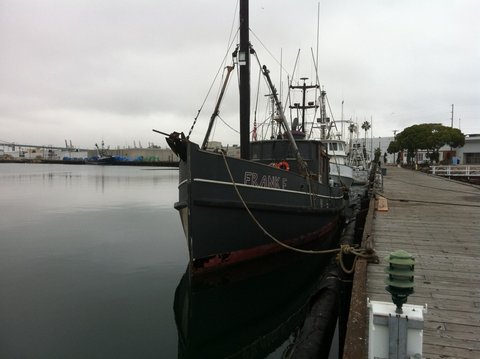
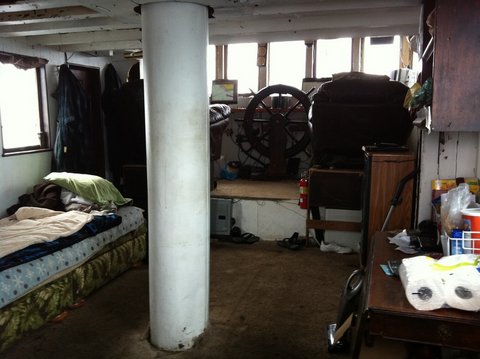
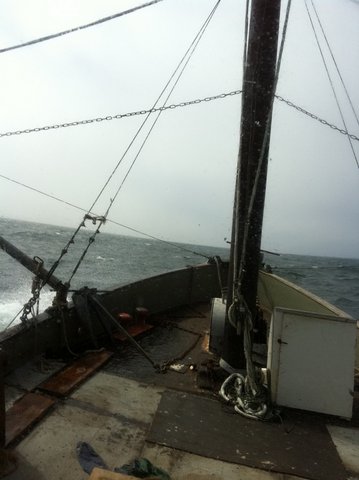
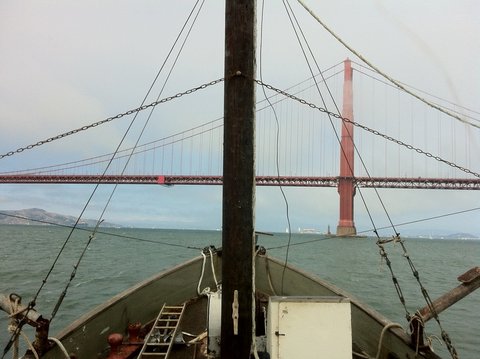
I recently heard from the current owner of the Barron F, who very generously sent some photos of the boat. Steven Starnes is planning to drop the current name “Frank F“, and return the boat’s original name. He is hoping to bring her back to Southeast Alaska for her 100th birthday, and would like to see her in a museum.

june2013 266

I also found a few more details on the boat’s history, which I will post below. As I mentioned in some earlier posts, the Barron F was one of the Funter Bay cannery tenders owned by James T. Barron.

iphone 2 371 home apple 5 497 DSCI0883 DSCI0970 IMG_3773   Picture 117-001 Picture 248 Picture 340 Picture 480 Picture 553

Swat_-_COASTAL_CONSULTANT_-_CARD_1.05 (1)

The US Merchant Vessel Registry from 1918 says the Barron F was built in 1917 in Seattle and home port was Portland, OR. 65.2ft long, 17ft beam, 7.3ft draft. Fishing service, crew of 7. 85hp gas engine. 50 Gross tons, 42 Net tons. In 1919 the home port is listed as Juneau.

The H. W. McCurdy Marine History says that the Barron F was built by the National Shipbuilding Co of Seattle. That company was founded on Jan 1 1917. Their 4-acre yard was located at 655 Gordon St in Seattle, and executive offices at 1023 Alaska Bldg. Officers were J.F. Lane, J.L. McLean, and Loren Grimstead. They had about 200 employees in the yard. (from Pacific Ports Annual, 1919).

In 1918 the owners pulled out the Barron F‘s 3-cylinder Atlas “distillate engine” and sold it, it was said to be installed in the spring of 1917 and only used for 3 or 4 months. It was listed for sale for $4,900. (from Pacific Motorboat, Vol 10)

In 1959 the Frank F was mentioned as the “old Barron F, a Nakat tender”. It was owned by Rollin Crump of Astoria and had been converted to a dragger working out of the Columbia River. It had an A-C 21000 (probably Aliss Chalmers 6-cylinder) with a Capitol 3.88 to 1 reduction gear, which got it up to 10 knots, noted as “a good two knots over any previous known speed for the boat”. During a 14-day trip the vessel used 1000 gallons of diesel. (From Pacific Fisherman Yearbook Vol 57).

Thanks again to Steven for letting me use his photos!


Funter Bay History – Cannery Employees

August 6, 2013

The Thlinket Packing Co at Funter Bay employed a number of different people over the years in a variety of positions. Below is a partial list, gleaned from early 20th century newspapers. Keep in mind that consistent spelling of names in the early 1900s was somewhat optional!

_____________________________________________________________

James T. Barron – Owner and Manager, 1902 – ~1926. More on the Barron family here.

_____________________________________________________________

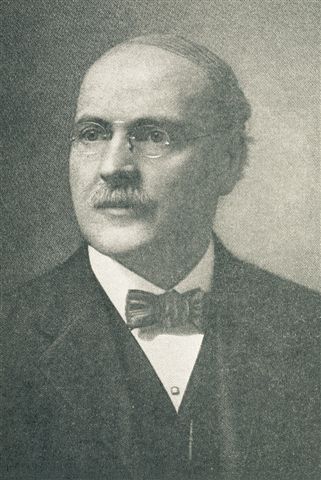
Judge Michael George “MG” Munly (1854-1923)

Munly

The family name was originally spelled “Munley”, but Michael later dropped the E. He was company Secretary and brother-in-law to James Barron. He married Mary Nixon, sister of James Barron’s wife Elizabeth. Munly was admitted to the Pennsylvania bar in 1882. He was deputy city attorney in Portland, and was appointed a judge of the Oregon circuit court from 1892-1894. Munly ran unsuccesfuly for mayor of Portland in 1909. Along with the Barron family, Munley and family were frequent visitors to the Funter Bay cannery.
Judge Munly’s grave and additional information.
1922 Biography of M. G. Munly
1928 Biography

_____________________________________________________________

C. F. Whitney was Sales Manager at the company, based in the Portland office. He seems to have rarely visited the Funter Bay operation. Prior to taking this position, Whitney had been sales manager of the New York Life Insurance Co.

_____________________________________________________________
Mr. and Mrs. Norton – Listed as winter caretakers at the cannery in 1903. Left in February to develop some timber claims in Oregon.

_____________________________________________________________

James Lawlor – (Sometimes spelled Lawler) was caretaker and winter foreman(?) from at least 1903-1909. He took over from the Norton’s in Feb 1903 and began preparations for the upcoming coming packing season.

_____________________________________________________________

Chris Houger (Sometimes spelled Hooger, Hugher, Hager, etc) was “Outside Foreman” at the Funter Bay cannery from at least 1903-1919. ?He was in charge of piling crews, trap installations, nets, etc. His wife was noted as being the cannery’s bookkeeper in 1914. In 1917 Western Canner and Packer referred to him as Manager of the Thlinket Packing Co.

_____________________________________________________________

Captain Haly of the Rainier – hired to bring up the “fishing steamer Barron” from the South for the 1903 season.

_____________________________________________________________
Mr. and Mrs. A. C. Bogarth – Operated fish traps near the Funter Bay cannery for several years around 1903.

_____________________________________________________________

Captain Crockett – skippered the Anna Baron during at least the 1904-1907 seasons.

_____________________________________________________________

Captain Mason was listed as skippering the Anna Barron in 1911.

_____________________________________________________________

Captain Martin Holdst (Also listed as Martin Olson) of the Belle was employed in the winter of 1909-1910 repairing the water and power systems at the cannery.

_____________________________________________________________

Pat. F. Mulvaney was the storekeeper at the Funter Bay cannery from at least 1909-1917 and listed as watchman in 1918 -1919.

_____________________________________________________________

Fred Barker (Or T. H. Barker) was listed as cannery superintendent in 1911. His brother “Billy” Barker was the assayer at the Perseverance mine.

_____________________________________________________________

Cannery employees listed as arriving in spring of 1911 were: H. H. Harvey, C. W. Young, G. W. Scott, E. A. Harriman, Thos. Redwood, F. Phelps, W. F. Brillian and H. Wills.

_____________________________________________________________

A. M. “Bob” Bell was listed as a canneryman at Funter Bay in 1912. There is also an A. E. L. Bell mentioned, and possibly another Bell who ran the Glacier cannery.

_____________________________________________________________

F. Hilder was an employee at the cannery in 1914.

_____________________________________________________________

George W. (or L.) Bowman was listed as cannery superintendent in 1914. He formerly worked for the Northwestern Fisheries company.

_____________________________________________________________

J. F. Bennett was listed as a cannery employee in 1915, his arm was caught in a rotating shaft in June and he required skin grafts at the Juneau hospital.

_____________________________________________________________

Harold W. Chutter (Or Chuttes or Chutte or Shutter or Chutler) is listed as the “popular superintendent of the Funter Bay Canning Co” in 1916 and 1917. In Feb. 1917 it was reported that “Mrs. Chutter, formerly of Funter Bay” had left to marry the former accountant for the Juneau Electric Light company. In December of 1917 it was reported that Chutter was closing up his affairs at the cannery and leaving for Bremerton to join the Navy. Sales Manager Whitney planned to come North from Portland to temporarily fill in as manager.

_____________________________________________________________

C.L. Cook is listed as bookkeeper in 1917.

_____________________________________________________________

G.C. Coffin, an employee of the cannery, was at the Juneau hospital in 1917 for eye treatment.

_____________________________________________________________

E. W. Hopper is described as the superintendent and/or manager of the cannery in 1918. His wife and daughter also resided at Funter in the summers.

_____________________________________________________________

Capt. John Maurstad skippered the Barron F. in 1918. According to the Kinky Bayers notes, he came to Alaska in 1909 and was a resident of Angoon. He did some logging and built a sawmill and Kasnaku Bay (Hidden Falls) in 1927. In 1940 he was in charge of a CCC crew building roads near Angoon. He may have died around 1942 at age 53.

_____________________________________________________________

D. J. Wynkoop, formerly of the Treadwell mine, was employed at the cannery in 1918.

_____________________________________________________________

Captain A. Woods is listed as running the Anna Barron in 1918. He fell from a 20ft ladder in February and was in St. Ann’s hospital expected to fully recover.

_____________________________________________________________

Chinese, Filipino, and Native Alaskan employees were usually only mentioned in passing, with no names given. A 1914 article lists the following “strange names” of Chinese workers bound for Funter Bay, but states that the purser of the steamship City of Seattle may have been kidding around: “Ten Pin, Hinge Lock, Wong Toon, Mop Dip, Wong Chuck, and Sam Lea“.

I’ve tried briefly looking into each of these people, but have not found any detail on most of them. I may try to come back to this post if more information becomes available. If you know anything about any of them, please feel free to contact me!


Alaska’s Historic Canneries Blog

August 2, 2013

I was recently invited to write an article on the Funter Bay cannery for the Alaska Historical Society. The article is on their excellent blog of Alaska’s Historic Canneries, and can be viewed here:

http://alaskancanneries.blogspot.com/2013/07/the-funter-bay-cannery.html

I’d like to thank Anjuli Grantham of the AHS for getting this set up for me, and my sister Megan for proofreading.


Funter Bay History: Wreck of the Mariechen

July 26, 2013

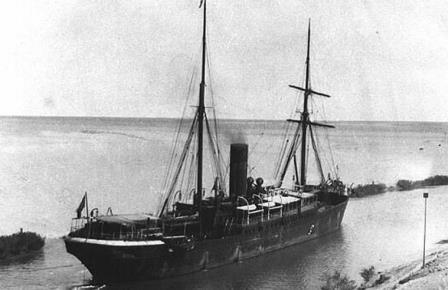
In late 1905, a German-registered tramp steamer named the Mariechen set out from Puget Sound to Vladivostok, Russia. The steamer was owned at the time by Diederichsen, Jebson & Co of Hamburg, and was known for running contraband to Russia and Hong Kong. In 1905 she was reported as planning to run a blockade on the Vladivostok Harbor.

wp718d5a94_05_06
Photo courtesy of the British & Commonwealth Shipping Company record website.

The ship was originally built in 1883 as the Clan Matheson of 3,917 tons. The ship had a history of problems, including fires on board and a prior grounding in the Suez Canal.

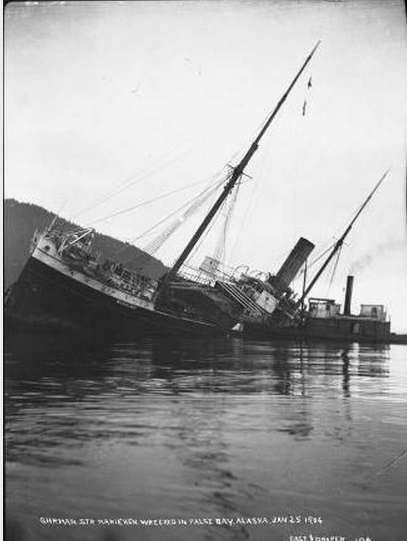
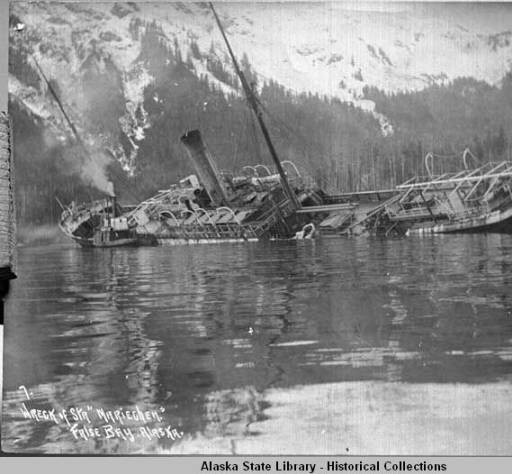
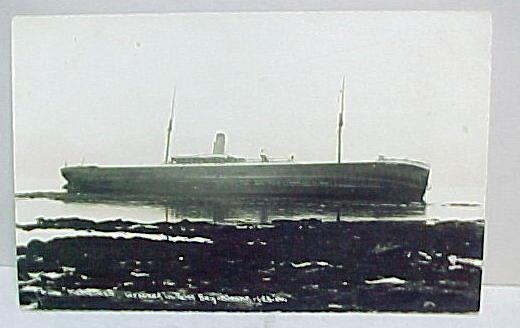
Traversing the outside coast of Alaska in December is a risky proposition even today. The ship ran into typical winter storms, then suffered an engine breakdown. Conflicting reports then state that the ship was either adrift for a month, or “beating around near Point Retreat” looking for an anchorage. The ship likely had customs issues which would have dissuaded the crew from seeking a port like Juneau or Skagway. Marine radio technology was fairly new and temperamental, and the ship may not have had a working wireless set. It’s possible the vessel was trying to use sails after the engine died, the first photo shows very tall masts and spars indicating square rigged sails, but some of the spars are missing in the post-wreck photos.

In late January of 1906, the ship finally went aground at False Bay, south of Funter on Chichagof Island. Excerpts from the wreck report note that the compass froze up, the steamer had no charts of the area, and visibility was low due to a snowstorm.
mariechen
Courtesy of Alaska State Library, William R. Norton collection, P226-743

The master of the ship was listed as Captain Rudolph Heldt, with Chief Officer Charles Pruet. The crew was mostly Chinese, who were “rounded up and deported” after the wreck. There were apparently no fatalities, but the cargo was lost. One document blames “local Indians” for the loss of the cargo, but period articles mention many local vessels salvaging “Food, flour, and beer” from the hulk, and selling some of it in nearby towns. An article from December 1906 described a feud over “several loads” of beer looted from the wreck by Robert Reid of Tenakee. Local tough Norman E Smith demanded a cut of the loot, and threatened Reid’s family. Reid then killed Smith with a shotgun at Snyder’s store in Tenakee.

mariechen2
Courtesy of Alaska State Library, William R. Norton collection, P226-612.

After the wreck, the British Columbia Salvage Co had the contract to refloat the vessel and tow it South for scrapping. The salvage tug Salvor was sent to the area, and the crew used Funter Bay as their base of operations. The tug would periodically stop at the cannery for fresh water and safe anchorage during storms. A March article notes that the water pipes at the Funter Bay cannery were frozen, so the Salvor had to come to Juneau for water. In April of 1906 the Salvor finally got the Mariechen floating, and towed the hulk into Funter Bay. It was further patched at Funter before being towed to Juneau in May, then on to Victoria, BC.

“The German steamer Mariechen is again afloat on the high seas. The steamer Rustler brings word that she was floated and is now at Funter Bay where she will remain until patched up for her tow to Victoria, where a British firm has the contract to repair her.” (from Daily Alaska Dispatch [Juneau] 28 Apr. 1906)

Postcard of hull from beach.

A detailed report of the salvage operation, including a photo of the damaged hull in drydock, is available here.

Sources:

“Steamer For Sale.” Daily Alaska Dispatch [Juneau] 15 Oct. 1906

Daily Alaska Dispatch [Juneau] 19 Mar. 1906

Good, Warren. “South East Alaska Shipwrecks (M) ” Alaska Shipwrecks. Web. 16 July 2013. <http://alaskashipwreck.com/&gt;.

“SS CLAN MATHESON Built by Napier Shanks & Bell Yoker.” Clydebuilt Ships Database. Web. <http://www.clydesite.co.uk/clydebuilt/viewship.asp?id=8212&gt;.

“Clan Matheson.” The British & Commonwealth Shipping Company; A Record of The Ships And The People That Served Them. Web. <http://www.bandcstaffregister.co.uk/page542.html&gt;.

“Salving the Mariechen.” Marine Review 34 (1906): 16-17.


The Funter Bay Railroad

July 17, 2013

In the first half of the 20th century, Funter Bay had a small railroad running to mine workings at the base of Mt. Robert Barron (originally known as “Funter Mountain”).

rail1

A short mine railroad was first reported in 1895, when a newspaper article described plans for “about 1,000 feet of railroad track” running along the beach to various mine tunnels. This would likely have carried ore carts pushed by hand or pulled by draft animals.

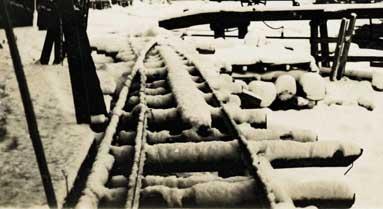
Newspaper reports state that workers began laying 36-inch narrow-gauge rails towards the mountain in 1912. Originally, this track consisted of 4×4 wooden rails, spiked to an existing corduroy wagon road bed. The rails could have had strap iron on top, as did other wooden tramways in the area.  A 1920 inventory of company assets describes the line as 4000′ of 36″ gauge surface tram, and a 1921 map labels it “wooden tramway”. It was elsewhere listed as a “tram road” (many of these terms are used interchangeably in describing small railroads). Initially four ore cars of about 3 tons were used, these had steel wheels and wooden boxes, and were hauled by mules along the wooden track. Although a “locomotive boiler 40hp with 40hp engine” is inventoried in 1920, this seems to have been connected to a sawmill at the time and not related to the tram.
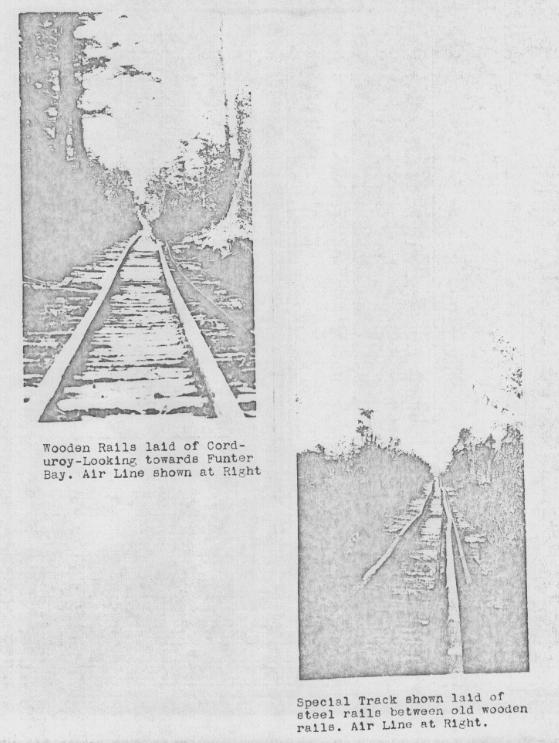
Between 1920 and 1926, the track was upgraded with steel rails, laid on the same corduroy grade in between the existing wooden rails (which had become rotten by that time). The new line was approximately 25″ gauge, and seems to have used 20 or 25lb steel rails (30 tons of 20lb rails were purchased around 1926, along with frogs and switches, to supplement an existing stock of 11 tons of 20 and 25lb rail). Twelve additional all-steel ore cars were purchased second hand from the Gastineau Gold Mining Co in Juneau (which had shut down and begun selling off equipment in 1921). Also in 1926, consulting engineer A. A. Holland recommended that the track be straightened, graded, and ballasted to prevent derailing. Holland suggested that cars should be hauled by cable due to the grade near the mountain, noting that locomotive haulage would require new track to take the steepest part of the hill more gradually.

1926 photos showing wooden rails with and without steel rails laid between them:
Funter Track

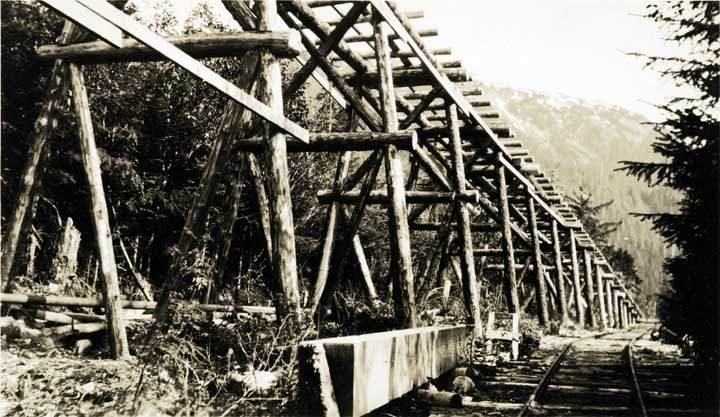
Some of Holland’s suggested improvements were implemented over the next few years. A 1928 letter to Governor Ernest Gruening reported construction of a “surface railroad” and purchase of a locomotive and cars. The 1930 stockholder report describes “railroads, 24″ gauge, 20lb rails” and an 8-ton steam locomotive. Within a few years the wooden roadbed was replaced with gravel from mine tailings. The 1931 Annual Report to the company stockholders stated that; “The Railroad Bed leading from the main tunnel to the mill located on the shore, and which was constructed of corduroy, was found too weak for continuous heavy loads and therefore has been ballasted the entire distance with crushed rock derived from the various workings in the main tunnel. New 8″ x 8″ x 9′ long ties have been secured and thus the road made substantial for any load at present under contemplation”. The report also mentions a branch of the railroad along the shore to the wharf.

Beginning in the 1930s, the line is referred to on maps and documents as a railroad, vs a tramway. This distinction may have had two factors behind it. For one, many early tram/railroad lines in Alaska used wooden trestles or ungraded track for their entire length to avoid the cost of permanent gravel grades. The switch from corduroy to graded roadbed at Funter was a significant upgrade. Secondly, the use of a steam locomotive seems to have boosted the status of small operations. Short lines with locomotives were more often called “railroads” while longer horse-drawn lines often remained “tramways”.

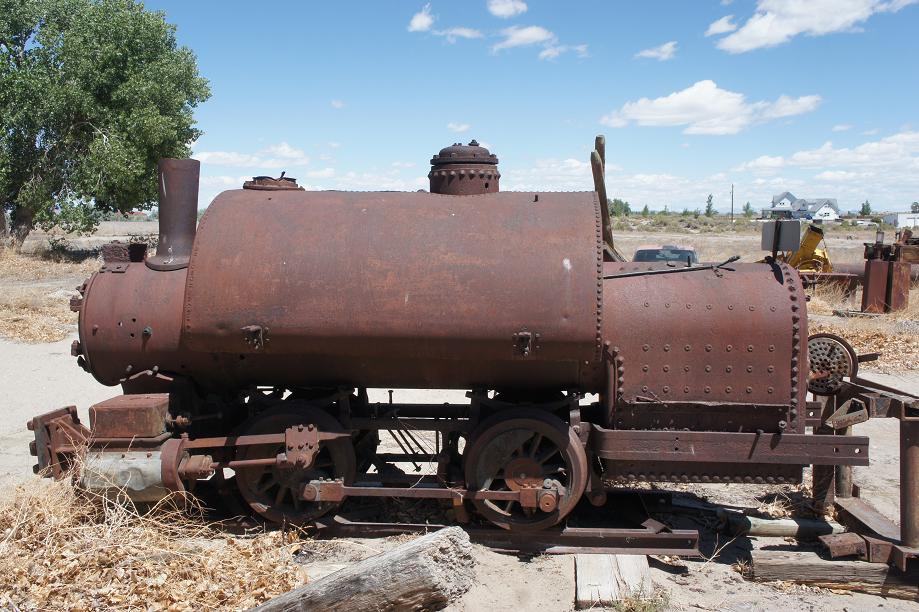
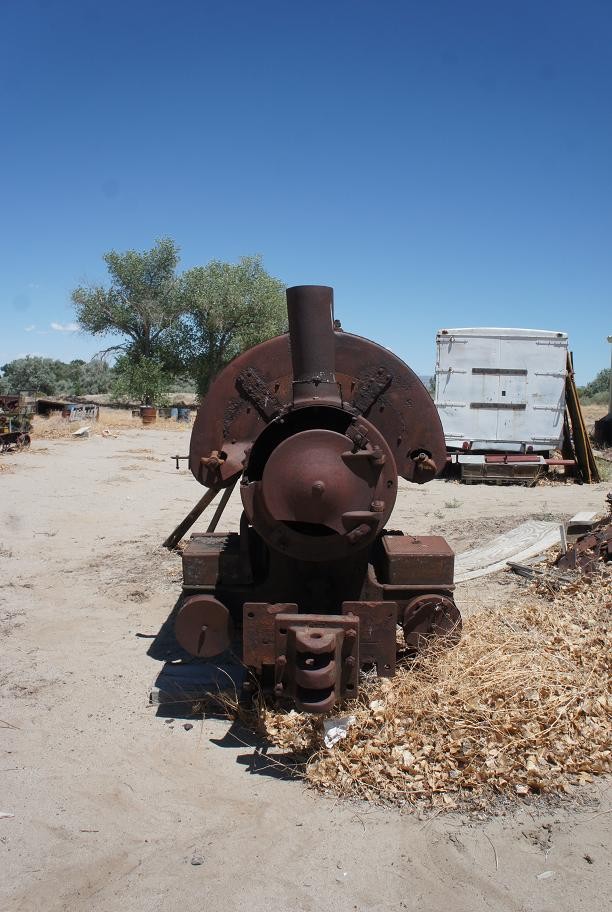
The company acquired a used 0-4-0T “Dinky” saddle tank steam locomotive around 1928. It seems to have been built by the Davenport Locomotive Works and was categorized as an 8-ton engine. Unfortunately no identifying marks are left, so the construction number and year are uncertain. It is anecdotally reported to be surplus from the Treadwell mines, which used steam locomotives at least until 1912-1913. Treadwell suffered a collapse in 1917 and finally shut down the last shaft in 1922, then sold the remaining equipment and property to the Alaska Juneau mine in 1928. As the AJ used electric locomotives of different gauge, the surplus steam locomotives were probably made available at bargain rates.

0-4-0T locomotive from Funter Bay:
SONY DSC

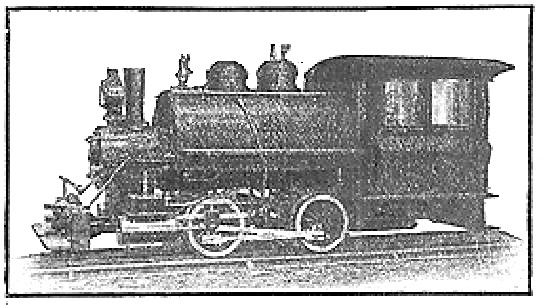
The locomotive may have looked something like this when operating.
modified

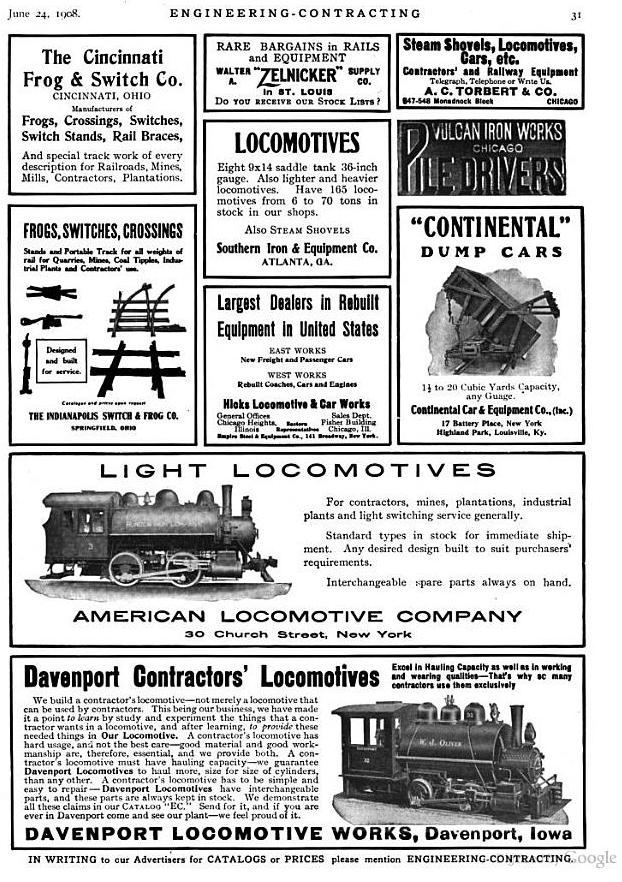
The total height is about 6′ (Treadwell’s specs called for a 5’7″ maximum clearance). This would have been considered a “contractor’s locomotive”, a type frequently used on temporary track in construction sites, to move dirt or materials around before dump trucks became common. Mines found them convenient due to their light weight and ability to handle uneven, steep, or sharply curving rails. I am not sure if the locomotive had an open cab (as apparently did most of the steam locomotives at Treadwell), or if it had an enclosed or even removable cab (at least one Treadwell locomotive was ordered with a removable cab, and a wooden cab could have been added later). Southeast Alaska’s climate would make at least a roof desirable, other small locomotives in the area had standing-height cabs when there were no clearance restrictions.

Here are some similar locomotive configurations that could have resembled this one:
Davenport locomotive with enclosed cab (larger version than this one).
Small locomotive with open cab.
Similarly sized locomotive (this one a Porter) with low-profile cab.

Such locomotives and light railroad equipment could be mail-ordered new or used from catalogs or classified ads in industry magazines.

ad

Front view of Funter Bay steam locomotive:
SONY DSC

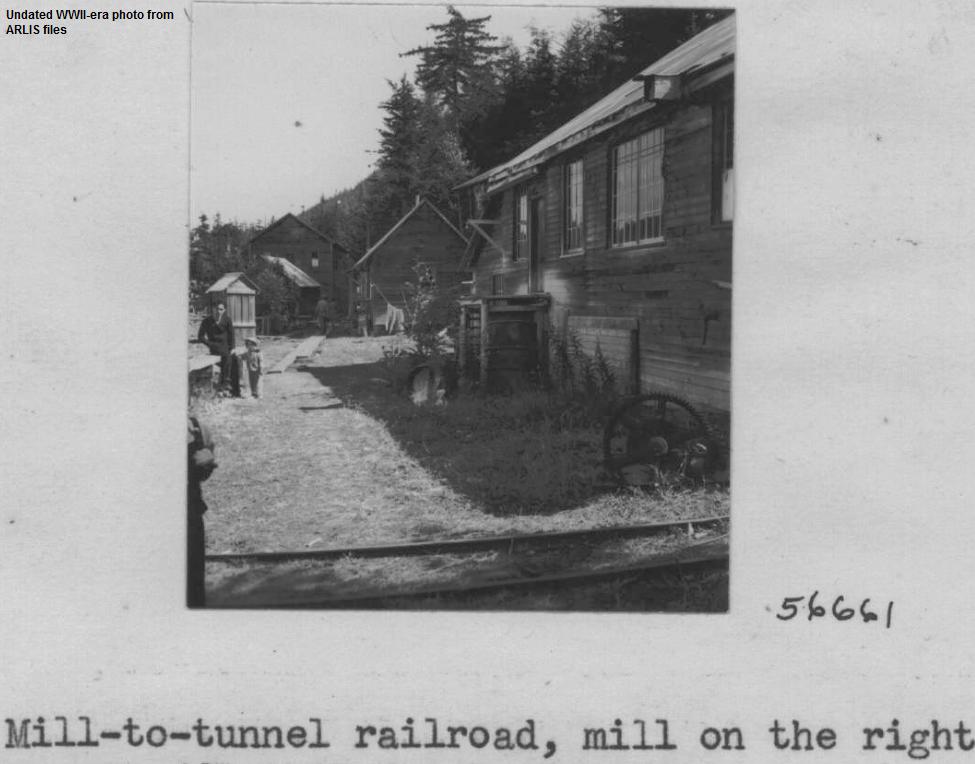
Eventually, the rail line from the beach to the mountain was 4100ft long. A branch of about 1500-2000ft ran parallel to the beach just above high-tide line, connecting older mine workings along the shore. A report from around 1915 mentions “several miles of railroad” running “along the shore and back into the various tunnels”, but this seems a bit optimistic. Below the surface, ore carts were hauled through the tunnels by mules, and later by electric battery locomotives. Several documents mention multiple electric locomotives purchased prior to 1956, including a 3-ton GE. The tunnels along the beach are now collapsed or flooded.

Funter Track 2

Two sizes of rail wheels and axles lying on the beach at Funter Bay, the larger gauge set may have been from the 36″ gauge mule tram:
IMG_1382

Railroad trestle at Funter Bay in the 1920s:

asl_ms247_1_03

Courtesy of Alaska State Library, MS 247 1_02

The following picture shows some track along the beach and what might be a switch:

dual gauge

Courtesy of Alaska State Library, MS 247 1_01

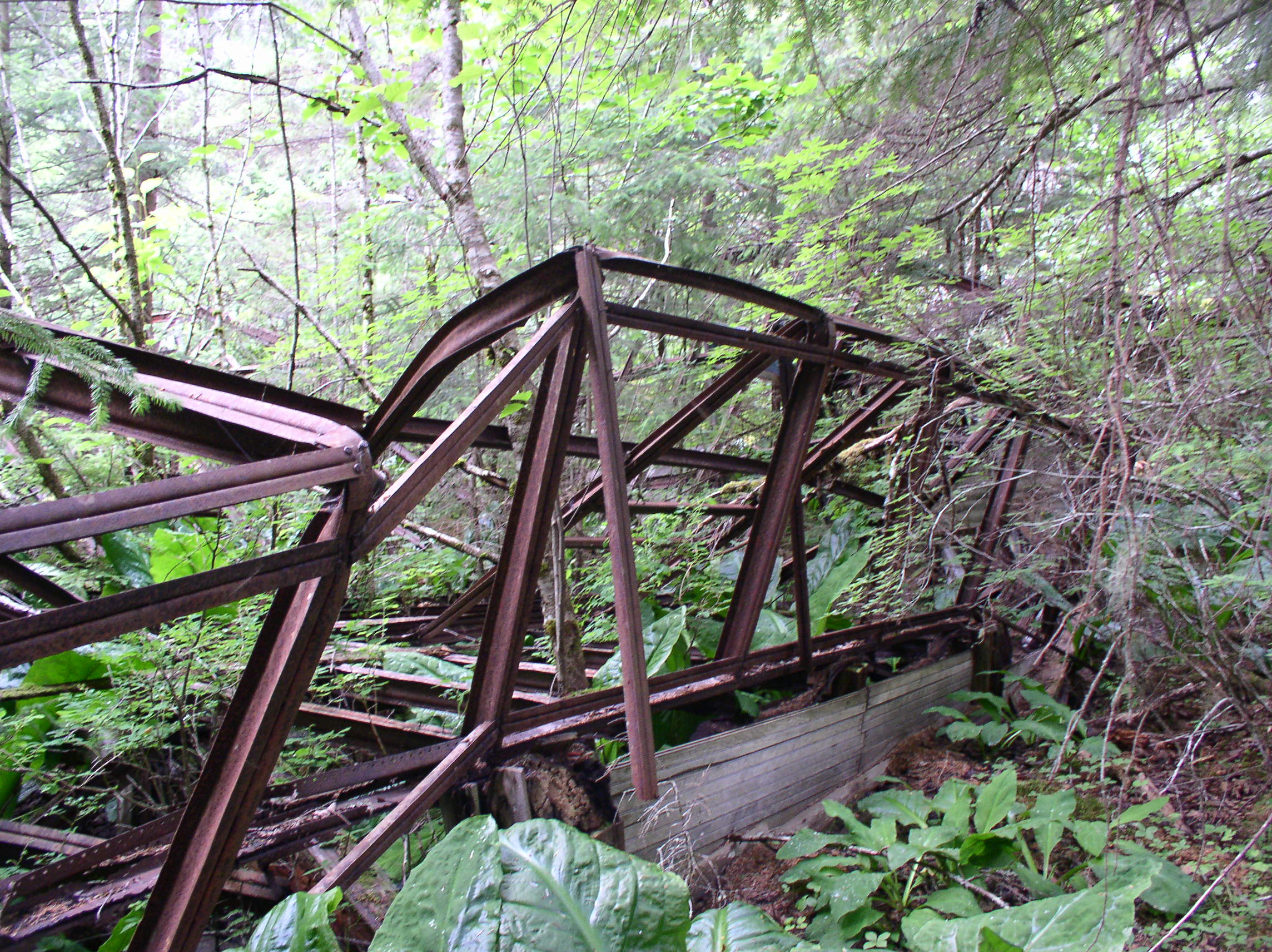
Today the beachfront track is mostly washed out, rusted away, or buried under decades of organic debris which are slowly forming new soil on top of the railway.

rails2

The steam locomotive was used until around 1951, when the owners seem to have decided it was inefficient. I am not sure if it was fueled by wood or coal, but feeding it would have been time consuming either way. The owners attempted to “modernize” the unit by converting it to a Plymouth gasoline engine. Such was sometimes the fate of other steam locomotives in Alaska and elsewhere. An untitled, undated (but probably from 1951 or ’52) note in government files mentions that the conversion cost $1,000. Another note in the file mentions work on a Plymouth engine cowling and head in April 1952. Another sheet mentions that “A steam locomotive for use on the surface tramway was being converted to gasoline power.” and that the $1,000 price tag included “Repairs to locomotive surface and aerial tram (haulage)”.

locomotive conversion

Since the front of the dinky locomotive was cast to the frame, it would have been hard to simply cut the boiler off. The miners used the old standby of Alaska repairs: If you don’t have the right tool, try dynamite! The story goes that they simply blasted the boiler off the frame, resulting in severe cracking to the front casting:

SONY DSC

The gas engine conversion proved to be underpowered; the unit worked on level ground but was unable to make it up the hill between the waterfront branch and the main line to the mountain. The whole rig was abandoned until the early 1970s, when it was salvaged by railroad enthusiast Jim Walsh and moved to Nevada.

A map showing part of the former rail line. The beach section is not shown.

RR map 2

By the late 1950s, maps begin show the line as a road rather than a railroad or tramway, the mine having switched to trucks for transportation. Today there is essentially nothing left of the railroad at Funter Bay. The tracks have all become buried or salvaged for other projects (such as Ray Martin’s marine railroad and planned logging railroad). The land is privately owned and not generally open to visitors.

The locomotive is probably the last major artifact left from this line, and I am greatly appreciative of Jim Walsh’s time and generosity in letting me see it! I am still searching for additional information on this locomotive, such as the construction year, ownership history (Treadwell or otherwise), mechanical specifications, or even old blueprints, but I’ve been unable to track down many details (I spun off another page on small Alaska railroads based on information found during this research). If any readers know of a source for such information, or a possible line of inquiry, I would love to hear about it! As usual, my email address is (replace <AT> with @): gabe <AT> saveitforparts.com


Funter Bay History: Moonshine

July 8, 2013

Moonshine is another tradition of Alaska life which had an impact on Funter Bay. In fact, moonshining in the area had an impact on the English language! The word “Hooch”, a popular term for homemade alcohol, originated on Admiralty Island:

hoochinoo   hoo·chi·noo, noun, plural hoo·chi·noos.
A type of distilled liquor made by Alaskan Indians.
1875–80,  Americanism; orig. the name of a Tlingit village on Admiralty Island, Alaska, reputed to be a source of illicit liquor; alteration of Tlingit xucnu·wú  literally, brown bear’s fort ( xú·c  brown bear + nu·w  fortified place)

From http://dictionary.reference.com/browse/hoochinoo

The word is commonly spelled “Kootsnoowoo” today, meaning “fortress of the bears”, the Tlingit name for Admiralty Island. The village is now called Angoon.

More information here, from the Merriam-Webster New Book of Word Histories.  Also here, and in this articleThis site also has some good information on Alaskan alcohol history. I found it interesting that kelp was sometimes distilled into moonshine, and that native distillers often supplied booze to white settlers, not necessarily vise-versa!

During prohibition (which started early in 1917 in Alaska), fox farms were a popular front for moonshining operations. The premise of a fox farm gave operators a reason to live on a remote homestead and have a large amount of grain on hand (fox diets were supplemented with corn or other grains). Bootleggers would drop off a crew on an island along with a still and supplies, and come back occasionally to pick up the product. Alcohol was also brought in on vessels from Canada, and was sometimes dropped off in secluded coves where bootleggers could collect it without fear of discovery. Here is a tale of a bootlegger’s attempt to scam a cannery over the loss of their smuggling boat. In another case, some bootleggers apparently decided to lower their up-front costs and switch to piracy; an article from January 1922 mentions that the vessel Clara (a 46′ fishing boat from Juneau) robbed the Canadian boat Vesta of her cargo of whiskey in Whale Passage.

Below is a diagram of a still (appearing to be made from surplus plumbing parts), from the Investigative Case Files of Prohibition Violations, 1924-1933, NARA Alaska-Pacific Region:
Portrait

Here’s a photo of a moonshine still in he woods from Alaska’s state library collections. Lazzette Ohman reports finding several stills in the woods around her family’s home in Juneau in the 1920s.

Bootlegging was apparently as hard to prosecute as fish piracy, the bootleggers were often seen as local heroes and Alaska residents delighted in confounding “the law”.  One story relates a speakeasy in Wrangell whose owner was let off by a hung jury despite apparently damning evidence. Another great story from the biography of area geologist John Mertie (who has a geologic deposit named after him at Funter Bay) showed what happened when unwilling citizens were roped into Jury Duty:

“I was waylaid by the town marshall and asked to serve on the jury…I had no interest in sitting on the jury but the marshall prevailed upon me… This was during the days of prohibition and involved a young man who had been arrested for making home brew beer… As the jurors left the court room to deliberate, a couple of them managed to appropriate the beer. We twelve sat around the jury room drinking the evidence. When it was gone we rendered a verdict of “not guilty”. The young man was elated and thanked the jurors individually. We in turn complimented him on his fine beer.”
Excerpt from “Thirty Summers and a Winter” by Evelyn Mertie.

To catch the smugglers, “Dry Units” and customs officials relied on fast patrol boats, some of them captured from bootleggers. A 1929 article notes that the 30-knot speedboat Three Deuces (AKA the 222), formerly belonging to notorious Puget Sound smuggler Roy Olmstead, had been brought to Alaska “to chase rum-runners”.

US Marshals destroy liquor in Alaska during WWI:
prohibition

As mentioned in an earlier post, a boat named Sandy from Funter Bay had a cargo of moonshine when it caught fire in Auke Bay on August 9th, 1928. The Sandy‘s crew were apprehended by customs and prohibition officers. They were not named, but owner L.F. Morris (a Juneau building contractor) was sentenced to jail on August 30th for bootlegging. Previously, in 1926, Morris’ nephew L.H. Cays was reported missing in a small open boat after leaving Horse Island (across the Bear Creek Trail from Funter Bay). This information is listed in Kinky Bayers’ bootlegging file, so it is likely that Cays was coming from a still on Horse Island.

The Bayers notes also mention that Neil Gallagher (of the Point Couverden fox farm, which got its mail in Funter Bay) was arrested in 1925 for bootlegging conspiracy, and again in 1928 for “rum running”. The later case got him 6 months in jail. The end of prohibition apparently did not end the family side business; Don Gallagher and Phil Cummings were “arrested and evicted” from Excursion Inlet for bootlegging liquor in June of 1943. This was well after Prohibition, but could have been due to military regulations (Excursion Inlet was a US army base and POW camp during WWII). Don Gallagher is also mentioned in an interview in T.B. Bott’s book The Greybeards; Gallagher operated the mail boat Forrester and supposedly ran into trouble for supplying alcohol to dry towns like Hoonah after WWII.

The troller Ada May with Scotty Boyce and his wife, and Ed Hibler, was apprehended after a long chase off Point Retreat in June 1930, with a quantity of bootleg whiskey on board. The Ada May was listed as visiting Funter Bay in another publication.

One moonshining operation was just south of Funter Bay. After prohibition ended, Funter resident Gunner Ohman appropriated the abandoned cabin for use as a summer fish camp. Local information says that during the moonshining days, some brown bears got into the product and went on a drunken rampage. Eventually the forest service had to come out and shoot them (They must have kept returning or started visiting other cabins looking for booze). This was not the only time drunk bears have been a problem at Funter, in the mid 90s some juvenile bears learned to associate cabins with food, and were known for opening coolers and biting beer cans. Supposedly they preferred Miller over Budweiser.

One still at Funter Bay was reportedly run by Ed “Frozen Foot” Johnson, formerly of the Arctic Saloon in Nome. He operated a still at Funter from 1917 to 1922 when he was caught. He managed to bribe the arresting agents and escape. Other agents then burned down his cabin. Kinky Bayers reported that Johnson also operated a still at Point Howard, across Lynn Canal from Funter Bay.

The end of Prohibition in 1933 is noted by Sarah Isto as a blow to fox farm profits, which were already suffering from the effects of the depression. Personal-use brewing, distilling, and smuggling continued on a smaller scale in some places, and is still around today. You can even buy a how-to book on Alaskan moonshining.

My Dad relates this about a former resident of Funter Bay who returned to visit in the 1970s:

“… he was looking for his mother’s still. … This guy reached under the porch step and pulled out a mason jar of moonshine, said it was where his mother hid it, we all had a sip. “

Bootlegging is still an issue in Alaska today, as many rural communities are “dry” or have banned alcohol. The profits from smuggling can be huge, but so can the penalties. While I was attending UAF in Fairbanks, one of our economics professors helpfully provided a case study in the economy of smuggling! Dr. Robert Logan was arrested in 2003 for flying drugs and alcohol to rural villages, and had his plane confiscated. Curious as to Prof. Logan’s current whereabouts, I came across this page. If that’s the same Bob Logan, he may have dipped into the products a little too heavily!


Funter Bay History: Aleut Evacuation and Internment

July 7, 2013

A darker page in the history of Alaska came during WWII, when the US government “evacuated” native populations in the path of Japanese invasion. This essentially meant shuffling them out of the way and then ignoring them. Funter Bay was one of the sites used as an internment camp for evacuees during the war.

Charles Mobley has an excellent report documenting the evacuation and internment of Aleuts, and examining the architectural and archeological remains at Funter Bay. It came out in 2012 and is available from the National Park Service. It is also available online in PDF form at the prior link. Another article on the internment is available here. There is a documentary film available here. Some of the original WWII logbooks (excerpted below) can be found here.

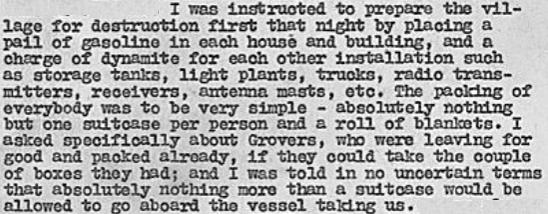
Japanese invasion of Alaska’s Aleutian Islands occurred in early June of 1942. The US government immediately forced native populations in that region to evacuate, with little notice and taking only what they could carry.  This was supposedly for their own protection (villagers on Attu had been captured and taken to Japan). However, the military also wished to deprive the invaders of potential supplies and facilities (some villages were burned by the navy while the residents watched). As noted by Mobley, “The U.S. Military viewed the buildings as a potential asset to the enemy’s advance”.

evacuation2
Fish & Wildlife Service employee’s account of the St. George evacuation. Courtesy of the National Archives. Pribilof Island Logbooks 1878-1961, ID 297024 


Islands which were evacuated included the Pribilof group of St. Paul and St. George, which lie north of the main Aleutian chain. These islands were settled permanently during the Russian development of Alaska, when Aleuts from other islands were moved there to hunt seals. Most of the residents were considered Russian citizens, became Russian Orthodox followers, and had Russian last names. After the US purchased Alaska, the Federal government closely controlled the islands. Ironically the American government was more oppressive towards religion, culture, and general freedom than the Russian government had been. Residents were kept under the thumb of the Fish and Wildlife Service, and were paid a small wage to hunt seals and maintain fox farms which profited the US treasury.

In mid June of 1942, Aleutian evacuees were transported to several sites in Southeast Alaska. The Pribilof residents were moved to Funter Bay, where the government leased the dormant cannery and mine to house them (Mobley notes that leasing agreements were still being finalized while the ships of evacuees were underway). Planning and funding were minimal to nonexistent, and evacuees were left largely to fend for themselves in un-maintained buildings with limited food or medical care.  Islanders had at the last minute been allowed to bring a few small boats with them, and were expected to hunt and fish for much of their own food.

Two USF&WS employees (Daniel Benson and Carl Hoverson) and their wives, along with two school teachers, Mr. and Mrs. Helbaum, were stationed at Funter Bay. These local agents repeatedly pleaded for support from their superiors and even attempted to resign over conditions at the internment camps, but were largely ignored. General knowledge was that German Prisoners of War housed in nearby Excursion Inlet had better conditions and better food than the Aleuts (US civilians) housed at Funter. By the time residents were allowed back to their homes permanently (except for islands taken over for US bases), over 10% had died in the internment camps.

Despite the poor level of care, The Fish and Wildlife Service still considered the Aleuts to be their wards, or perhaps their indentured servants. In 1943 the F&WS coerced Pribilof men to leave their families at Funter and return to the theater of war to hunt seals and care for foxes on the government fur farm.

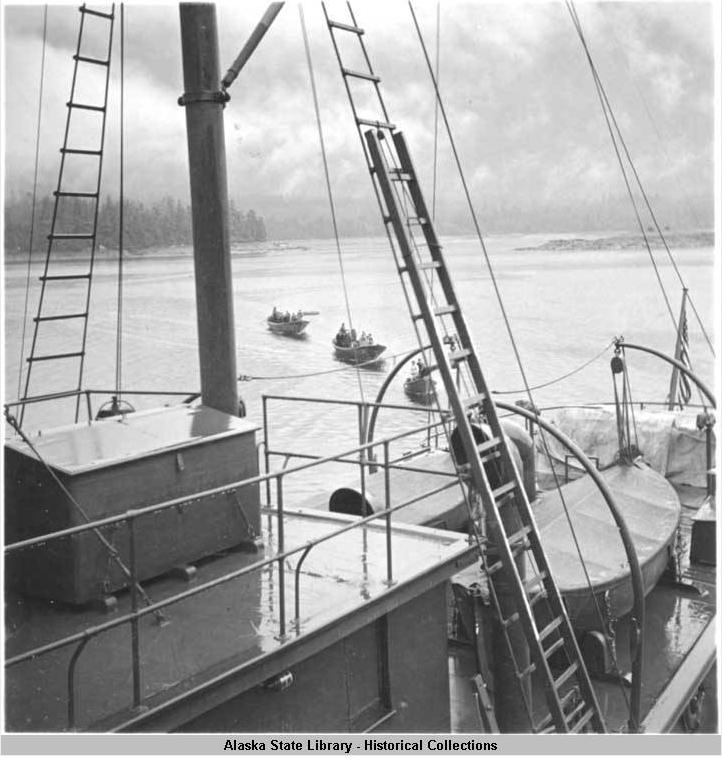
Pribilof Islanders arriving at Funter Bay cannery in 1942:
Boats
Courtesy of Alaska State Library, Butler and Dale collection. P-306-1093

Untitled
Courtesy of Alaska State Library, Butler and Dale collection. P-306-1091

I am not sure which ship is shown above. It appears to be smaller than the Delaroff, which transported evacuees from the Aleutians. USF&WS vessels which supplied the camps at Funter Bay included the Brant, the Penguin, the Crane, the Swan and the Scoter. These were closer in size to the vessel shown above. The boat tied to the scow appears to the the towboat Ketchikan. The Scoter was eventually assigned to spend the winter at Funter.

Pribilof names written on a door at the cannery:
OLYMPUS DIGITAL CAMERA
The names I can make out are “Nekita Hapoff” and “Jacob Kochutin”. A Nekita Hapoff is reported to have died at Funter Bay.

Quonset hut erected as temporary housing at Funter Bay:
OLYMPUS DIGITAL CAMERA

Not only had the cannery buildings been disused for over a decade, they were not designed for winter habitation. Bunkhouses and cabins were occupied in the summer while the cannery operated, and were typically not insulated or heated. Some of the log books kept by government employees at the internment camps are available here. They detail the amount of effort needed to make the camps livable. During the first three months of their internment the Pribilof islanders were at work “constructing bunks, making beds from chicken wire, repairing leaking roofs, broken windows, rotten flooring, dilapidated outhouses”, etc. On Sept 30, 1942, there were “50 native workmen… hauling garbage, repairing plumbing, repairing light wires… razing dock and warehouse for salvage lumber”. By October they were still digging ditches for water pipes and repairing buildings and the water supply dam, and in December they were still trying to get a sanitary water system working. On Feb 12 the agent’s log reported:

“During the past cold spell it has been impossible to heat the houses and quarters occupied by the Natives. At night they have huddled around the stoves and in the dining room getting what little sleep possible. Most of the water pipes are still frozen and there still is no water in the reservoir behind the dam”.

Between the lack of heat and water and the new diseases and climate that residents were exposed to, sickness was almost inevitable. The log books detail the poor medical care provided to internees:

“Wednesday, Oct 27 1942: Three men down with bad colds, sore throats, and chills; this would indicate another outbreak of measles. All were medicated and sent to bed to ‘sweat it out'”.

Another series of log entries chronicles the spread of the flu in late December, 1943. On Christmas Eve, 3 men at the St. George camp were sick, and by the 27th 10 at St. George and “Most of the workmen” in the St. Paul camp were sick. By December 31st, it seemed that only one man from each camp was well enough to work, at the sad task of building caskets. The log reports “All other men sick” (sick women and children were not listed).

sick

Tuberculosis and other respiratory issues were a major problem, possibly exacerbated by high local humidity (about double that of the Pribilof Islands). Infants and the elderly bore the brunt of illness and death. TB patients were sometimes sent to the hospital in Juneau, but flu and measles cases were ministered to mainly by F&WS staff. There were occasional visits from a doctor whose duties were split between multiple camps all over Southeast Alaska. When the doctor did visit he would only attend one camp at Funter, sick residents at the other camp had to be brought to him. An interview excerpt in Charles Mobley’s report notes that residents also became sick from eating unfamiliar foods such as out-of-season shellfish.

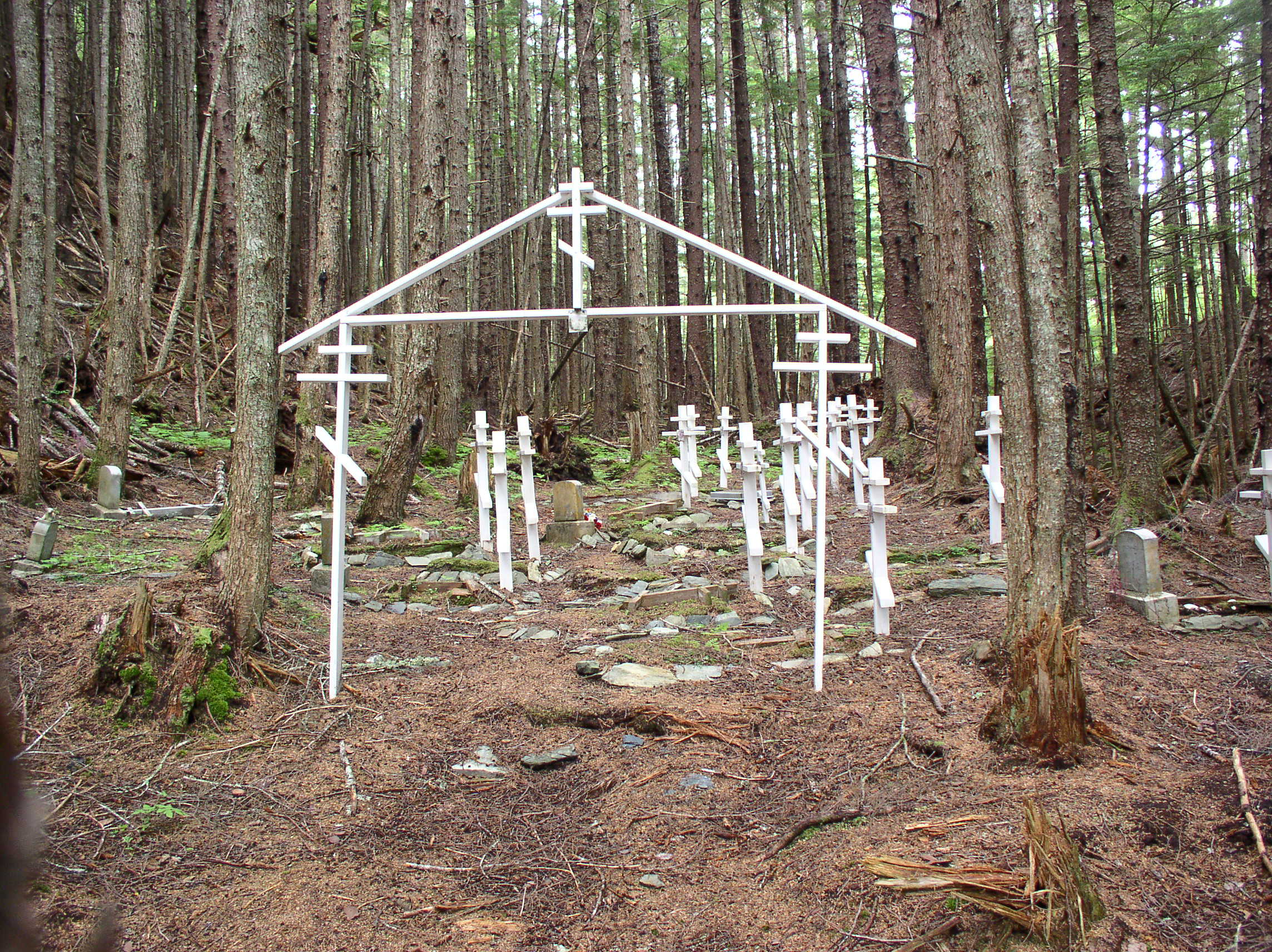
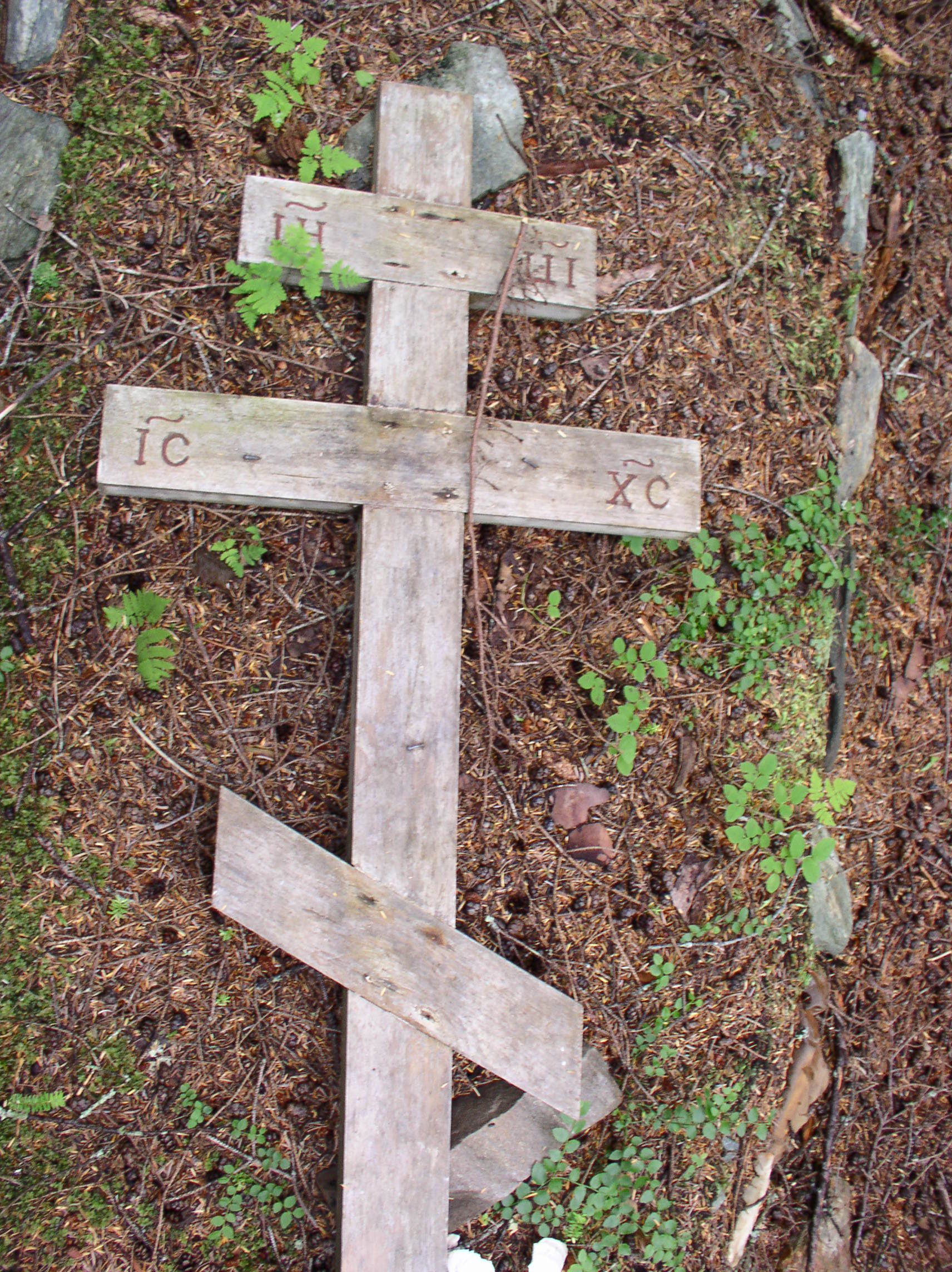
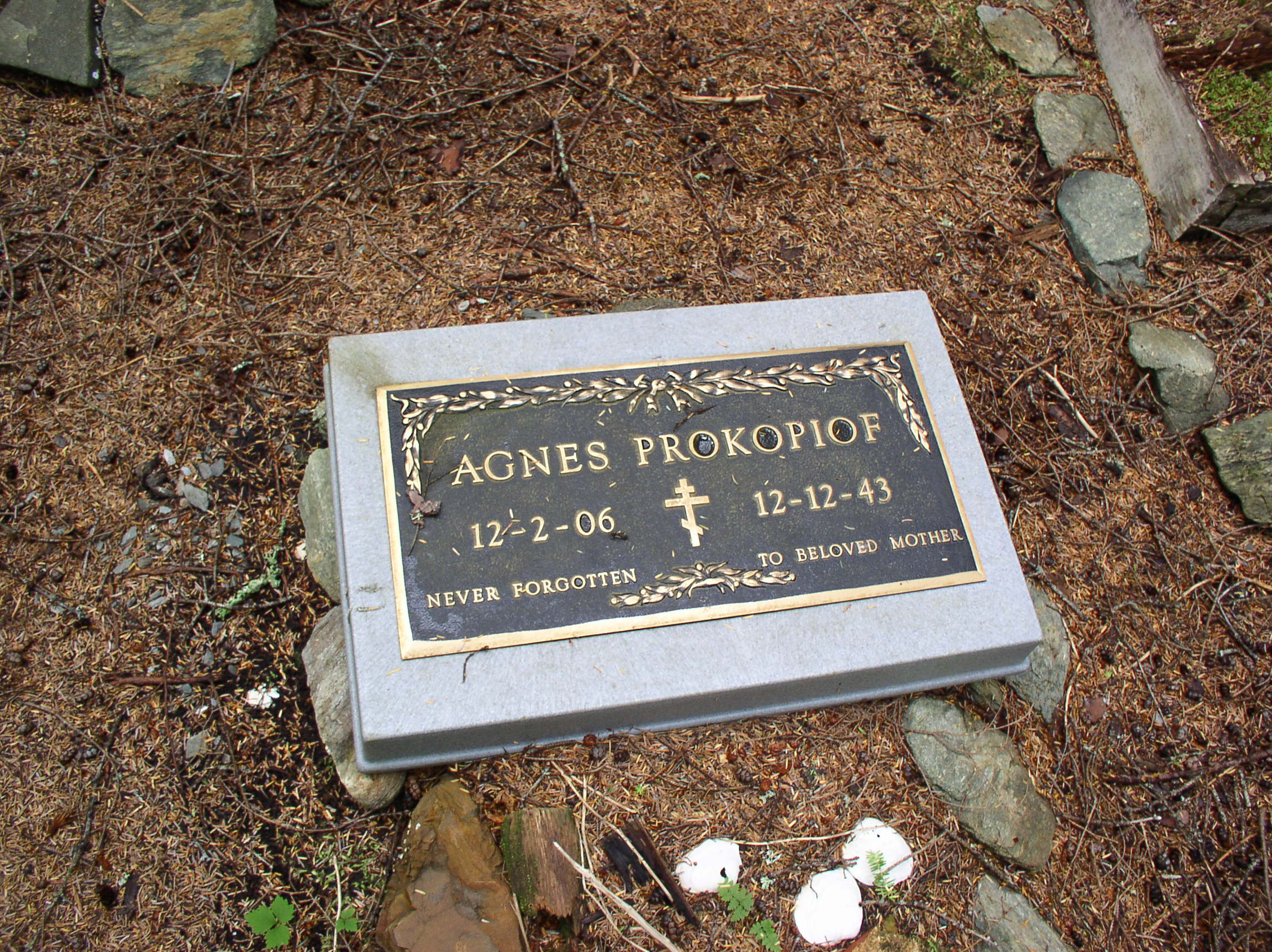
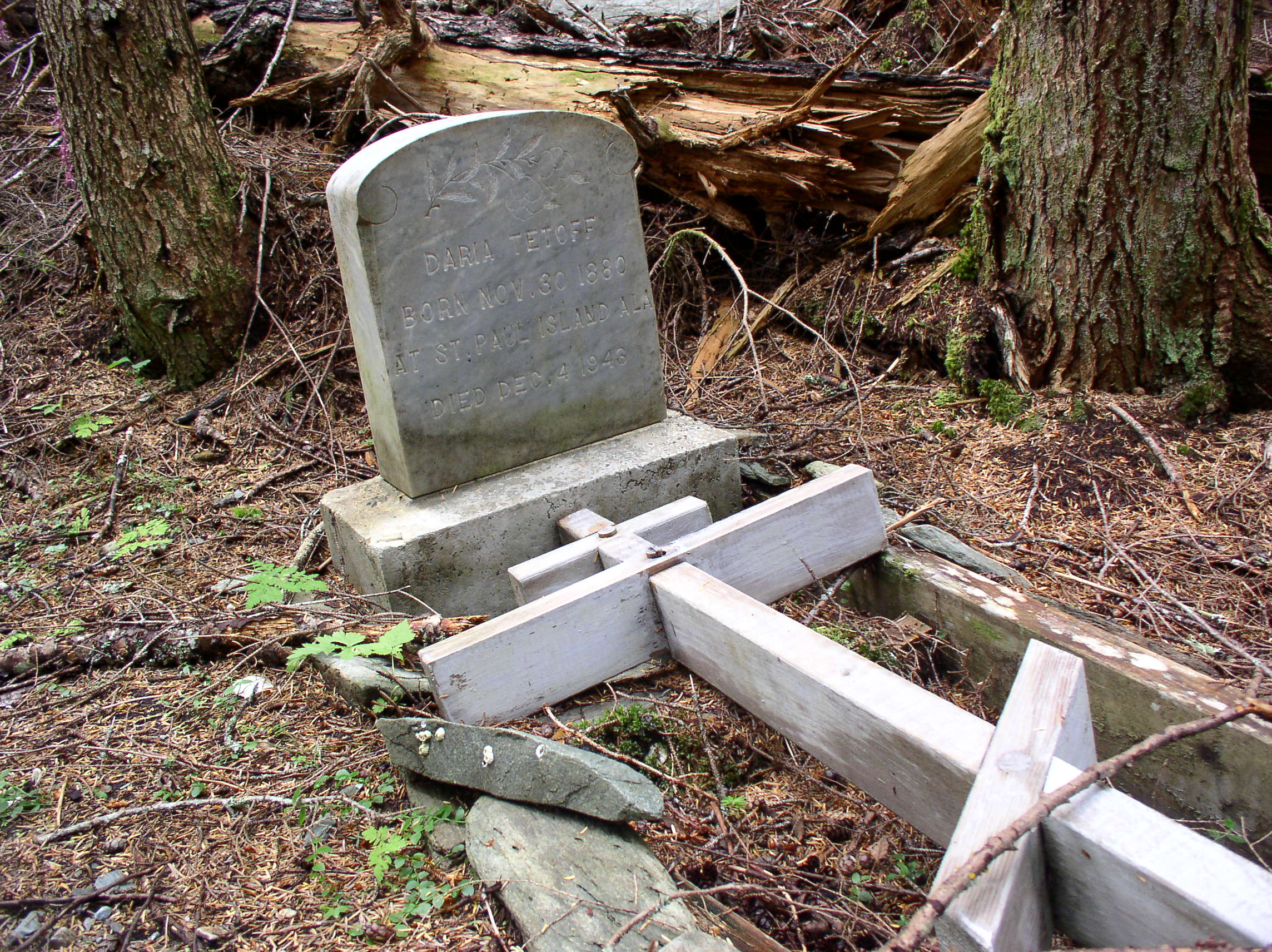
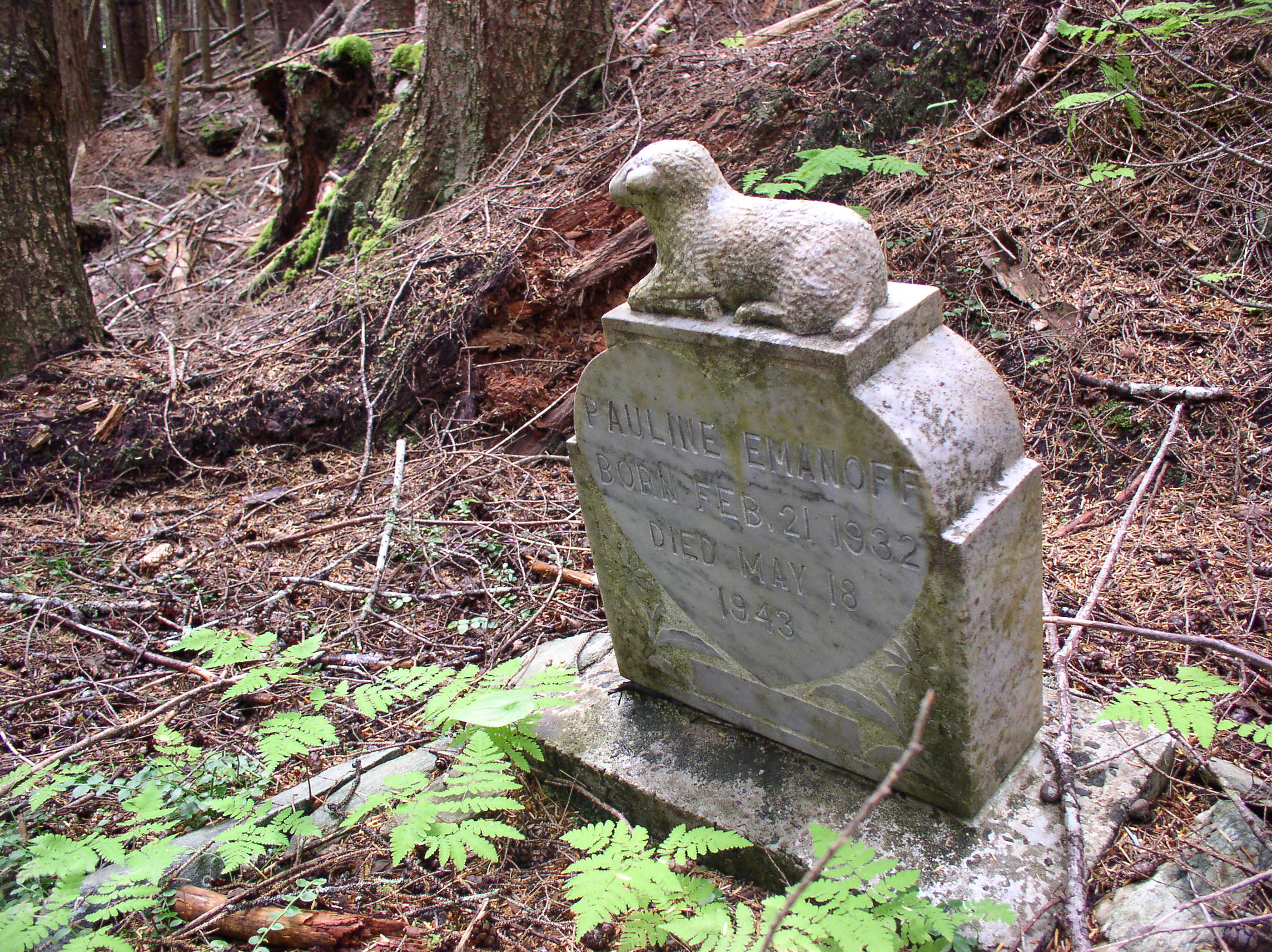
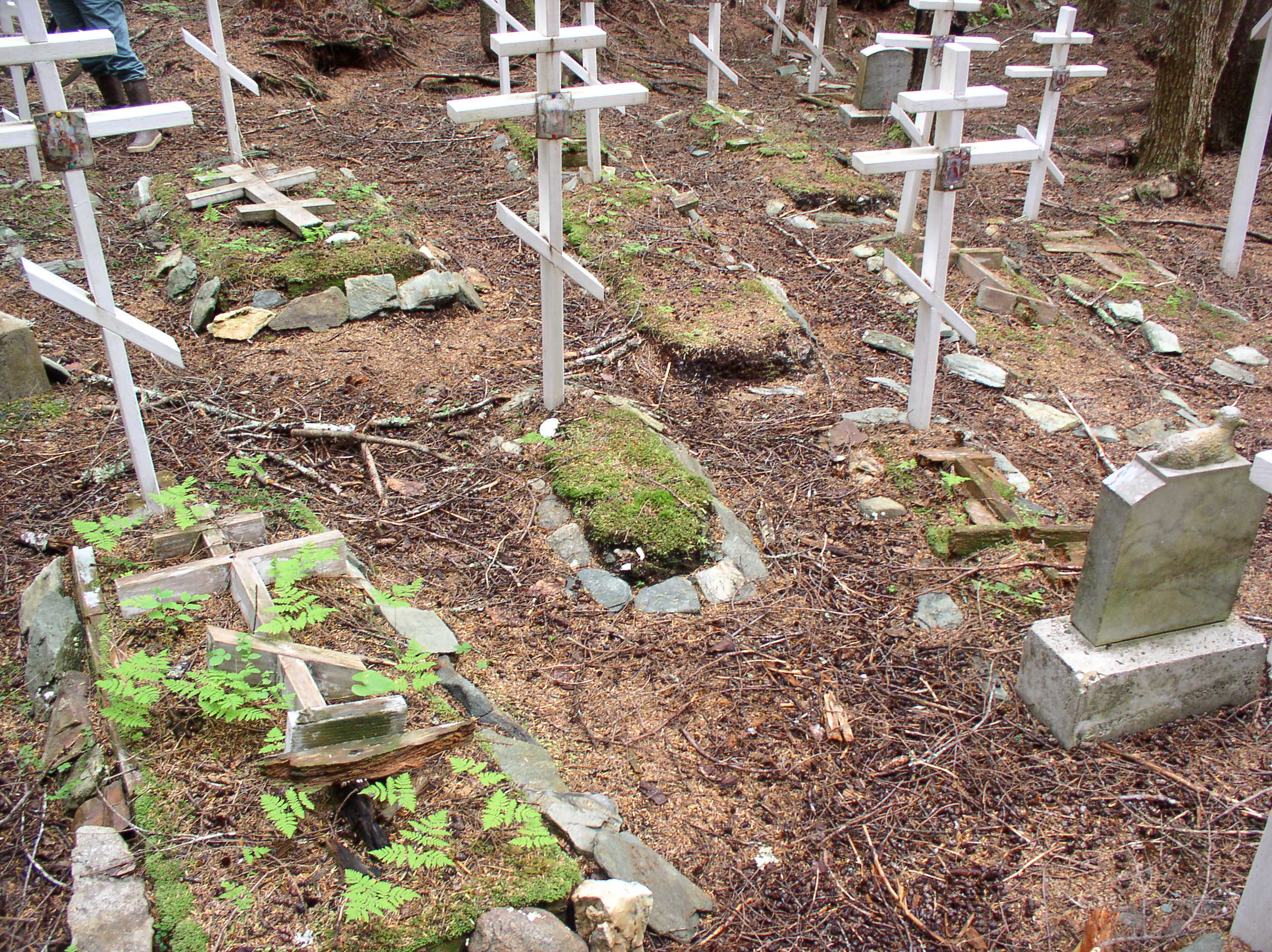
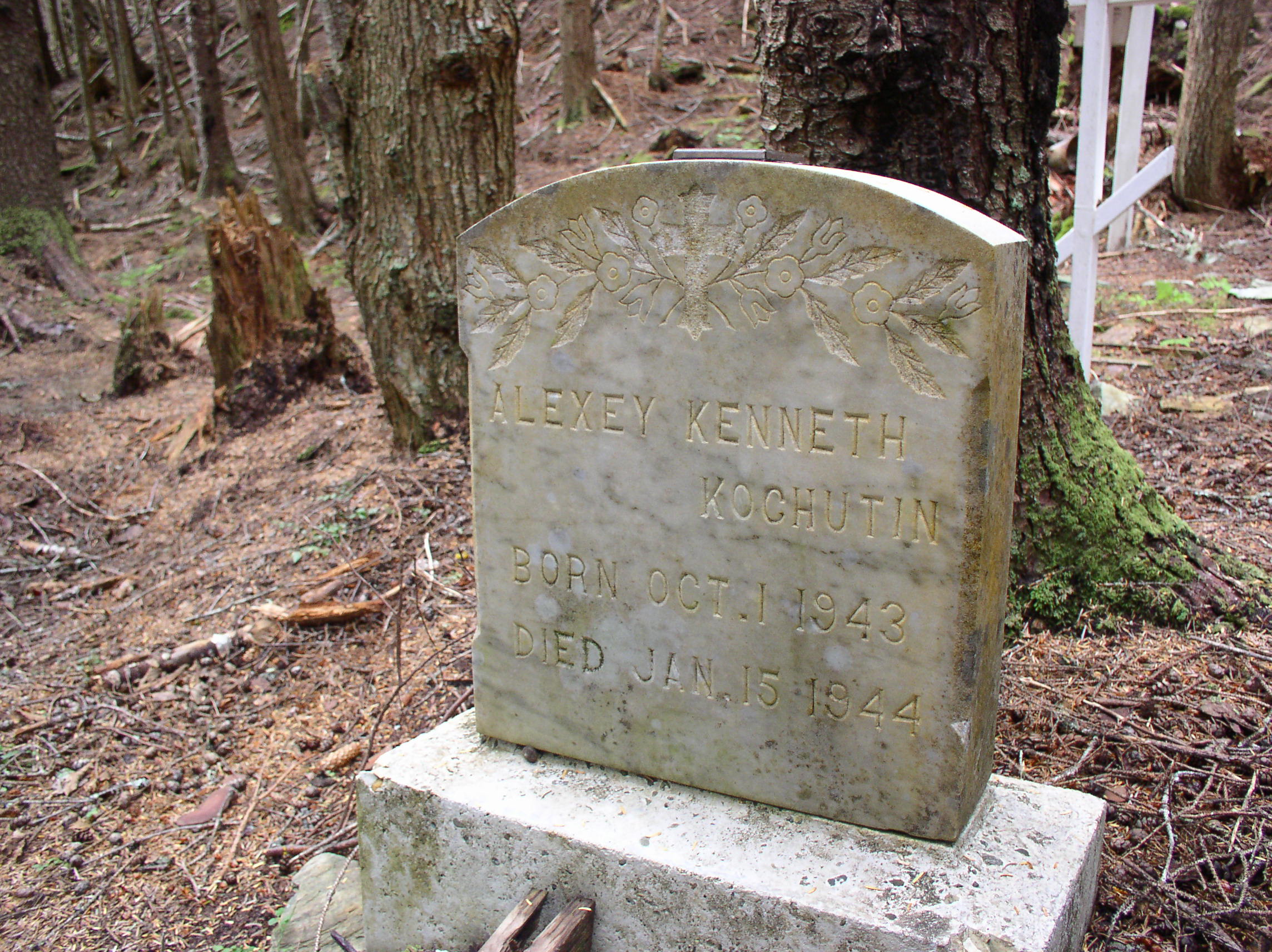
Within a few months of arrival at Funter Bay, it was already necessary to construct a cemetery. This was sited in the woods near the cannery. Thirty-two internees died at the Funter Bay camps or in Juneau hospitals. There are about 23 graves at the site, others are buried in Juneau.
OLYMPUS DIGITAL CAMERA

OLYMPUS DIGITAL CAMERA

OLYMPUS DIGITAL CAMERA

OLYMPUS DIGITAL CAMERA

OLYMPUS DIGITAL CAMERA

OLYMPUS DIGITAL CAMERA

OLYMPUS DIGITAL CAMERA

OLYMPUS DIGITAL CAMERA

OLYMPUS DIGITAL CAMERA

OLYMPUS DIGITAL CAMERA

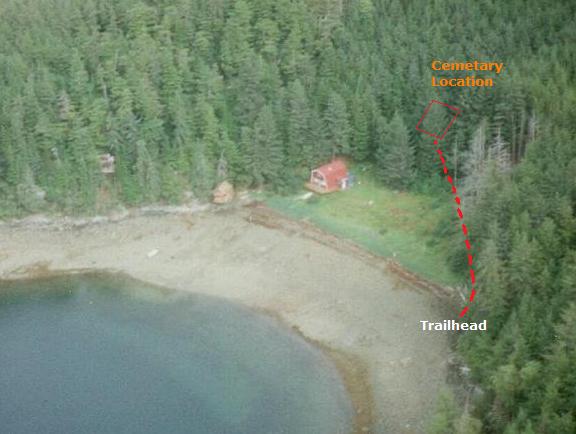
Note: If you are visiting the cemetery at Funter Bay, the best trail is on the right side of the beach, below the area of new growth trees. There is no access from the left side or middle of the cove. Please be respectful of the site, and of adjacent private property (all of the cleared area behind the beach is private). The cemetery is still visited and maintained by the families of those buried here.

trail1

Islanders were allowed to return to their homes in 1945, two years after the Japanese had withdrawn from the Aleutians. The experience of Aleut internees in Southeast Alaska led to greater independence and less government control of their home islands, and eventual lawsuits and reparations for the government’s mishandling of the evacuation.