The Funter Bay Railroad

July 17, 2013

In the first half of the 20th century, Funter Bay had a small railroad running to mine workings at the base of Mt. Robert Barron (originally known as “Funter Mountain”).

rail1

A short mine railroad was first reported in 1895, when a newspaper article described plans for “about 1,000 feet of railroad track” running along the beach to various mine tunnels. This would likely have carried ore carts pushed by hand or pulled by draft animals.

Newspaper reports state that workers began laying 36-inch narrow-gauge rails towards the mountain in 1912. Originally, this track consisted of 4×4 wooden rails, spiked to an existing corduroy wagon road bed. The rails could have had strap iron on top, as did other wooden tramways in the area.  A 1920 inventory of company assets describes the line as 4000′ of 36″ gauge surface tram, and a 1921 map labels it “wooden tramway”. It was elsewhere listed as a “tram road” (many of these terms are used interchangeably in describing small railroads). Initially four ore cars of about 3 tons were used, these had steel wheels and wooden boxes, and were hauled by mules along the wooden track. Although a “locomotive boiler 40hp with 40hp engine” is inventoried in 1920, this seems to have been connected to a sawmill at the time and not related to the tram.

Between 1920 and 1926, the track was upgraded with steel rails, laid on the same corduroy grade in between the existing wooden rails (which had become rotten by that time). The new line was approximately 25″ gauge, and seems to have used 20 or 25lb steel rails (30 tons of 20lb rails were purchased around 1926, along with frogs and switches, to supplement an existing stock of 11 tons of 20 and 25lb rail). Twelve additional all-steel ore cars were purchased second hand from the Gastineau Gold Mining Co in Juneau (which had shut down and begun selling off equipment in 1921). Also in 1926, consulting engineer A. A. Holland recommended that the track be straightened, graded, and ballasted to prevent derailing. Holland suggested that cars should be hauled by cable due to the grade near the mountain, noting that locomotive haulage would require new track to take the steepest part of the hill more gradually.

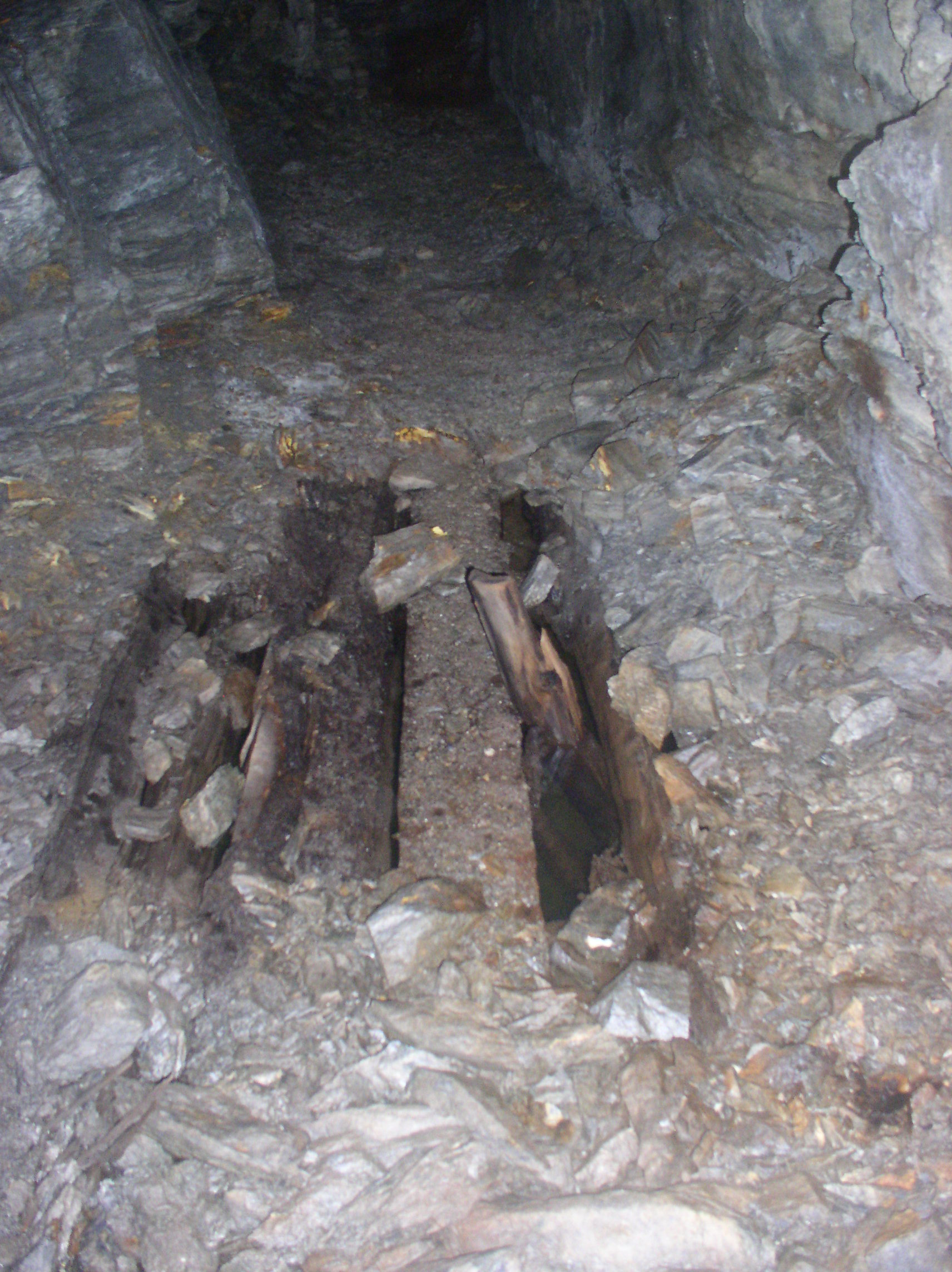
1926 photos showing wooden rails with and without steel rails laid between them:
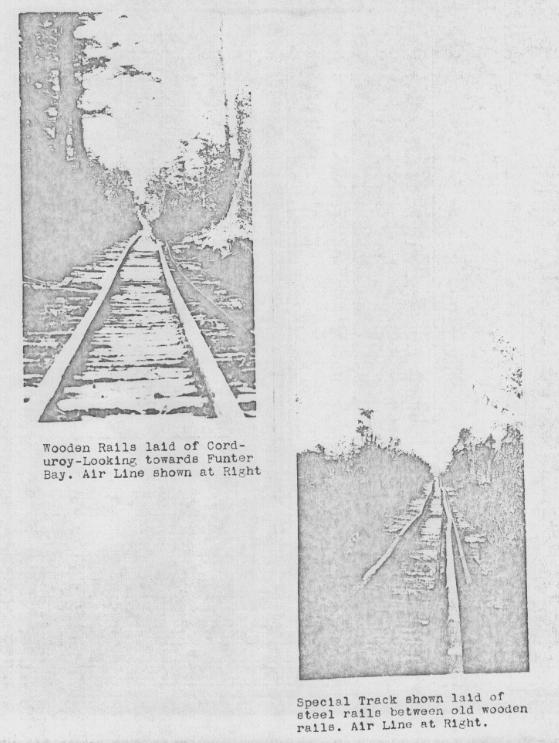
Funter Track

Some of Holland’s suggested improvements were implemented over the next few years. A 1928 letter to Governor Ernest Gruening reported construction of a “surface railroad” and purchase of a locomotive and cars. The 1930 stockholder report describes “railroads, 24″ gauge, 20lb rails” and an 8-ton steam locomotive. Within a few years the wooden roadbed was replaced with gravel from mine tailings. The 1931 Annual Report to the company stockholders stated that; “The Railroad Bed leading from the main tunnel to the mill located on the shore, and which was constructed of corduroy, was found too weak for continuous heavy loads and therefore has been ballasted the entire distance with crushed rock derived from the various workings in the main tunnel. New 8″ x 8″ x 9′ long ties have been secured and thus the road made substantial for any load at present under contemplation”. The report also mentions a branch of the railroad along the shore to the wharf.

Beginning in the 1930s, the line is referred to on maps and documents as a railroad, vs a tramway. This distinction may have had two factors behind it. For one, many early tram/railroad lines in Alaska used wooden trestles or ungraded track for their entire length to avoid the cost of permanent gravel grades. The switch from corduroy to graded roadbed at Funter was a significant upgrade. Secondly, the use of a steam locomotive seems to have boosted the status of small operations. Short lines with locomotives were more often called “railroads” while longer horse-drawn lines often remained “tramways”.

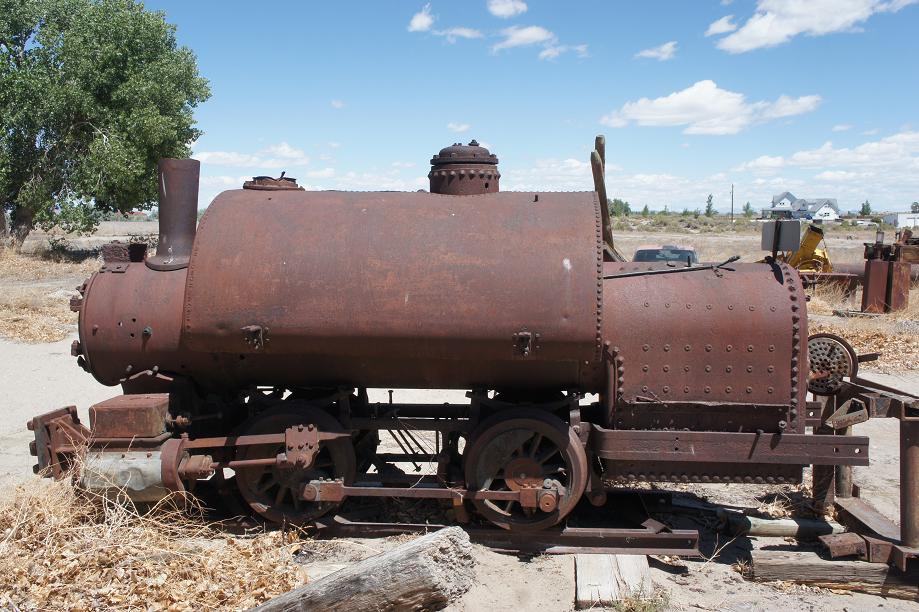
The company acquired a used 0-4-0T “Dinky” saddle tank steam locomotive around 1928. It seems to have been built by the Davenport Locomotive Works and was categorized as an 8-ton engine. Unfortunately no identifying marks are left, so the construction number and year are uncertain. It is anecdotally reported to be surplus from the Treadwell mines, which used steam locomotives at least until 1912-1913. Treadwell suffered a collapse in 1917 and finally shut down the last shaft in 1922, then sold the remaining equipment and property to the Alaska Juneau mine in 1928. As the AJ used electric locomotives of different gauge, the surplus steam locomotives were probably made available at bargain rates.

0-4-0T locomotive from Funter Bay:
SONY DSC

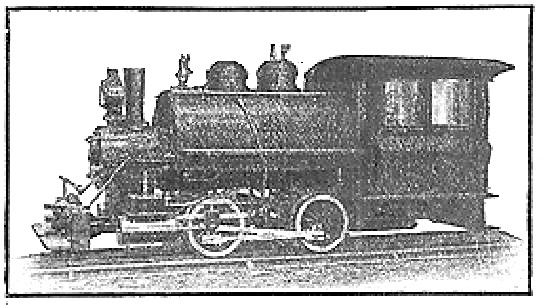
The locomotive may have looked something like this when operating.
modified

The total height is about 6′ (Treadwell’s specs called for a 5’7″ maximum clearance). This would have been considered a “contractor’s locomotive”, a type frequently used on temporary track in construction sites, to move dirt or materials around before dump trucks became common. Mines found them convenient due to their light weight and ability to handle uneven, steep, or sharply curving rails. I am not sure if the locomotive had an open cab (as apparently did most of the steam locomotives at Treadwell), or if it had an enclosed or even removable cab (at least one Treadwell locomotive was ordered with a removable cab, and a wooden cab could have been added later). Southeast Alaska’s climate would make at least a roof desirable, other small locomotives in the area had standing-height cabs when there were no clearance restrictions.

Here are some similar locomotive configurations that could have resembled this one:
Davenport locomotive with enclosed cab (larger version than this one).
Small locomotive with open cab.
Similarly sized locomotive (this one a Porter) with low-profile cab.

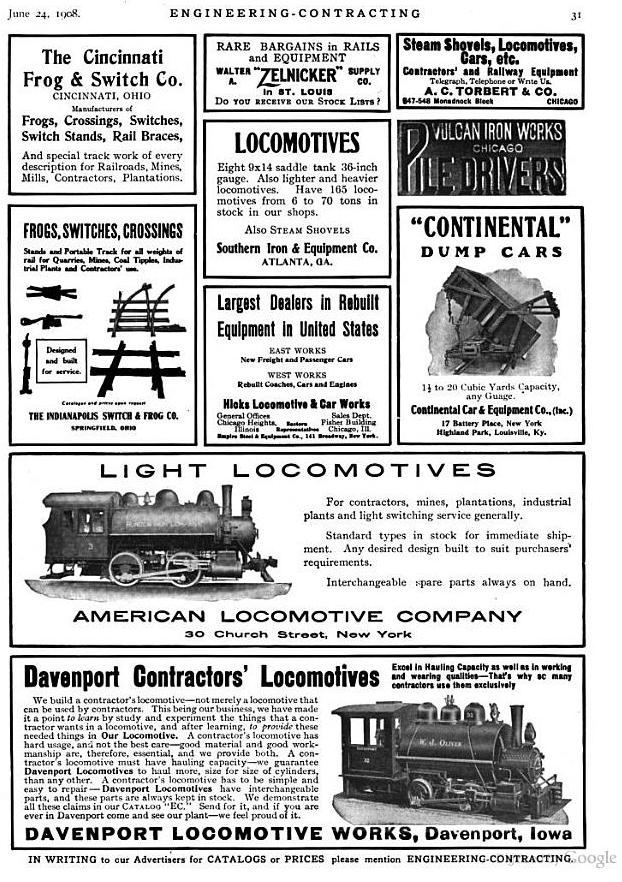
Such locomotives and light railroad equipment could be mail-ordered new or used from catalogs or classified ads in industry magazines.
ad

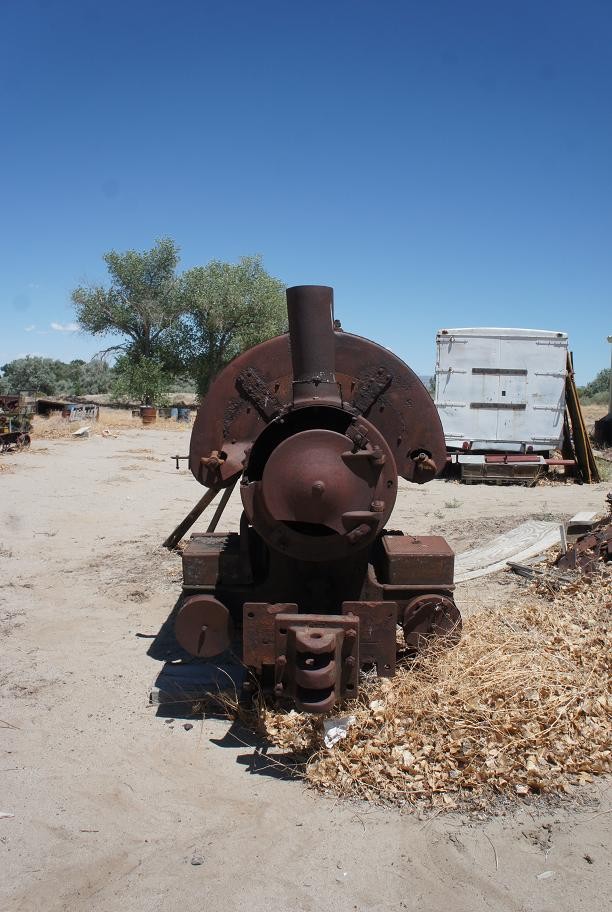
Front view of Funter Bay steam locomotive:
SONY DSC

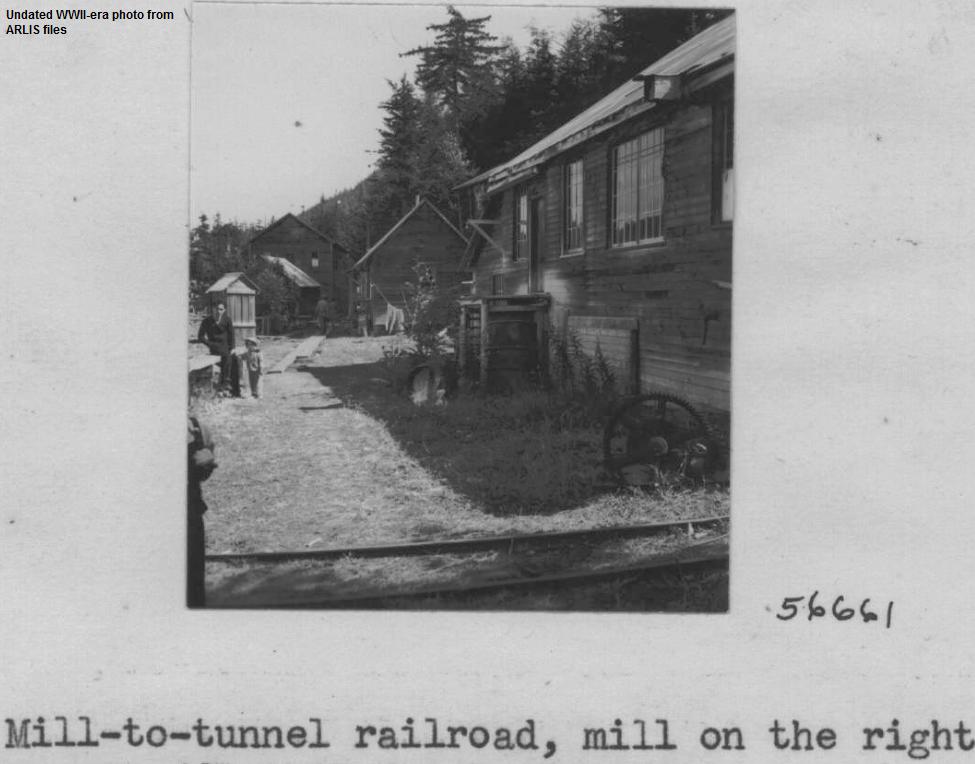
Eventually, the rail line from the beach to the mountain was 4100ft long. A branch of about 1500-2000ft ran parallel to the beach just above high-tide line, connecting older mine workings along the shore. A report from around 1915 mentions “several miles of railroad” running “along the shore and back into the various tunnels”, but this seems a bit optimistic. Below the surface, ore carts were hauled through the tunnels by mules, and later by electric battery locomotives. Several documents mention multiple electric locomotives purchased prior to 1956, including a 3-ton GE. The tunnels along the beach are now collapsed or flooded.
Funter Track 2

Two sizes of rail wheels and axles lying on the beach at Funter Bay, the larger gauge set may have been from the 36″ gauge mule tram:
IMG_1382

Railroad trestle at Funter Bay in the 1920s:
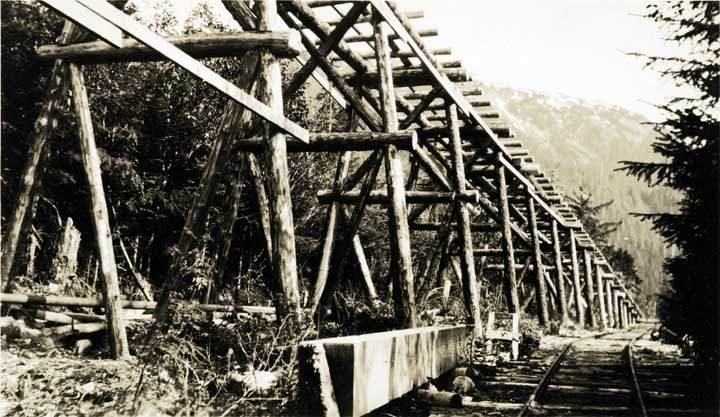
asl_ms247_1_03

Courtesy of Alaska State Library, MS 247 1_02

The following picture shows some track along the beach and what might be a switch:
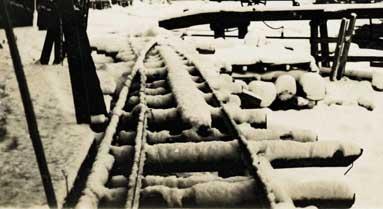
dual gauge

Courtesy of Alaska State Library, MS 247 1_01

Today the beachfront track is mostly washed out, rusted away, or buried under decades of organic debris which are slowly forming new soil on top of the railway.

rails2

The steam locomotive was used until around 1951, when the owners seem to have decided it was inefficient. I am not sure if it was fueled by wood or coal, but feeding it would have been time consuming either way. The owners attempted to “modernize” the unit by converting it to a Plymouth gasoline engine. Such was sometimes the fate of other steam locomotives in Alaska and elsewhere. An untitled, undated (but probably from 1951 or ’52) note in government files mentions that the conversion cost $1,000. Another note in the file mentions work on a Plymouth engine cowling and head in April 1952. Another sheet mentions that “A steam locomotive for use on the surface tramway was being converted to gasoline power.” and that the $1,000 price tag included “Repairs to locomotive surface and aerial tram (haulage)”.

locomotive conversion

Since the front of the dinky locomotive was cast to the frame, it would have been hard to simply cut the boiler off. The miners used the old standby of Alaska repairs: If you don’t have the right tool, try dynamite! The story goes that they simply blasted the boiler off the frame, resulting in severe cracking to the front casting:

SONY DSC

The gas engine conversion proved to be underpowered; the unit worked on level ground but was unable to make it up the hill between the waterfront branch and the main line to the mountain. The whole rig was abandoned until the early 1970s, when it was salvaged by railroad enthusiast Jim Walsh and moved to Nevada.

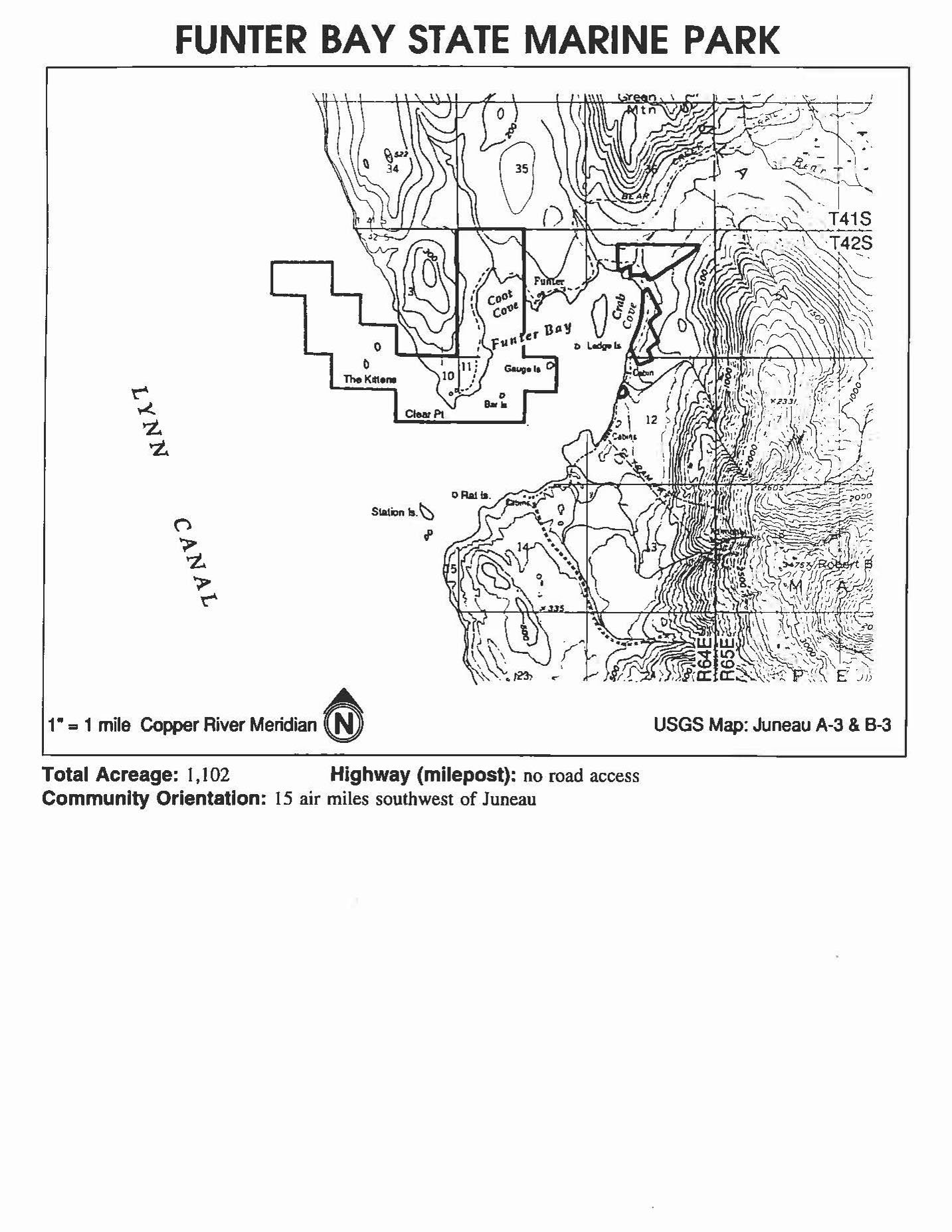
A map showing part of the former rail line. The beach section is not shown.

RR map 2

By the late 1950s, maps begin show the line as a road rather than a railroad or tramway, the mine having switched to trucks for transportation. Today there is essentially nothing left of the railroad at Funter Bay. The tracks have all become buried or salvaged for other projects (such as Ray Martin’s marine railroad and planned logging railroad). The land is privately owned and not generally open to visitors.

The locomotive is probably the last major artifact left from this line, and I am greatly appreciative of Jim Walsh’s time and generosity in letting me see it! I am still searching for additional information on this locomotive, such as the construction year, ownership history (Treadwell or otherwise), mechanical specifications, or even old blueprints, but I’ve been unable to track down many details (I spun off another page on small Alaska railroads based on information found during this research). If any readers know of a source for such information, or a possible line of inquiry, I would love to hear about it! As usual, my email address is (replace <AT> with @): gabe <AT> saveitforparts.com


Sidetracked: Obscure Railroads of Alaska

July 9, 2013

So… while researching AK history I accidentally found a whole bunch of forgotten railroads that aren’t well documented (if at all) in official rail histories. Kind of like finding spare change in the couch, but with more rust! I managed to get myself totally distracted from my Funter Bay history, while I typed up a quick list of these lines. I’ve tried to include links to supplementary information, but it’s a work in progress, and any information anyone might have would be appreciated!  Since it’s a long list, I’ve gone ahead and made it a separate page on the site, you can find it at the link below:

https://saveitforparts.wordpress.com/projects/lesser-known-and-obscure-railroads-of-alaska/


Funter Bay History: Moonshine

July 8, 2013

Moonshine is another tradition of Alaska life which had an impact on Funter Bay. In fact, moonshining in the area had an impact on the English language! The word “Hooch”, a popular term for homemade alcohol, originated on Admiralty Island:

hoochinoo   hoo·chi·noo, noun, plural hoo·chi·noos.
A type of distilled liquor made by Alaskan Indians.
1875–80,  Americanism; orig. the name of a Tlingit village on Admiralty Island, Alaska, reputed to be a source of illicit liquor; alteration of Tlingit xucnu·wú  literally, brown bear’s fort ( xú·c  brown bear + nu·w  fortified place)

From http://dictionary.reference.com/browse/hoochinoo

The word is commonly spelled “Kootsnoowoo” today, meaning “fortress of the bears”, the Tlingit name for Admiralty Island. The village is now called Angoon.

More information here, from the Merriam-Webster New Book of Word Histories.  Also here, and in this articleThis site also has some good information on Alaskan alcohol history. I found it interesting that kelp was sometimes distilled into moonshine, and that native distillers often supplied booze to white settlers, not necessarily vise-versa!

During prohibition (which started early in 1917 in Alaska), fox farms were a popular front for moonshining operations. The premise of a fox farm gave operators a reason to live on a remote homestead and have a large amount of grain on hand (fox diets were supplemented with corn or other grains). Bootleggers would drop off a crew on an island along with a still and supplies, and come back occasionally to pick up the product. Alcohol was also brought in on vessels from Canada, and was sometimes dropped off in secluded coves where bootleggers could collect it without fear of discovery. Here is a tale of a bootlegger’s attempt to scam a cannery over the loss of their smuggling boat. In another case, some bootleggers apparently decided to lower their up-front costs and switch to piracy; an article from January 1922 mentions that the vessel Clara (a 46′ fishing boat from Juneau) robbed the Canadian boat Vesta of her cargo of whiskey in Whale Passage.

Below is a diagram of a still (appearing to be made from surplus plumbing parts), from the Investigative Case Files of Prohibition Violations, 1924-1933, NARA Alaska-Pacific Region:
Portrait

Here’s a photo of a moonshine still in he woods from Alaska’s state library collections. Lazzette Ohman reports finding several stills in the woods around her family’s home in Juneau in the 1920s.

Bootlegging was apparently as hard to prosecute as fish piracy, the bootleggers were often seen as local heroes and Alaska residents delighted in confounding “the law”.  One story relates a speakeasy in Wrangell whose owner was let off by a hung jury despite apparently damning evidence. Another great story from the biography of area geologist John Mertie (who has a geologic deposit named after him at Funter Bay) showed what happened when unwilling citizens were roped into Jury Duty:

“I was waylaid by the town marshall and asked to serve on the jury…I had no interest in sitting on the jury but the marshall prevailed upon me… This was during the days of prohibition and involved a young man who had been arrested for making home brew beer… As the jurors left the court room to deliberate, a couple of them managed to appropriate the beer. We twelve sat around the jury room drinking the evidence. When it was gone we rendered a verdict of “not guilty”. The young man was elated and thanked the jurors individually. We in turn complimented him on his fine beer.”
Excerpt from “Thirty Summers and a Winter” by Evelyn Mertie.

To catch the smugglers, “Dry Units” and customs officials relied on fast patrol boats, some of them captured from bootleggers. A 1929 article notes that the 30-knot speedboat Three Deuces (AKA the 222), formerly belonging to notorious Puget Sound smuggler Roy Olmstead, had been brought to Alaska “to chase rum-runners”.

US Marshals destroy liquor in Alaska during WWI:
prohibition

As mentioned in an earlier post, a boat named Sandy from Funter Bay had a cargo of moonshine when it caught fire in Auke Bay on August 9th, 1928. The Sandy‘s crew were apprehended by customs and prohibition officers. They were not named, but owner L.F. Morris (a Juneau building contractor) was sentenced to jail on August 30th for bootlegging. Previously, in 1926, Morris’ nephew L.H. Cays was reported missing in a small open boat after leaving Horse Island (across the Bear Creek Trail from Funter Bay). This information is listed in Kinky Bayers’ bootlegging file, so it is likely that Cays was coming from a still on Horse Island.

The Bayers notes also mention that Neil Gallagher (of the Point Couverden fox farm, which got its mail in Funter Bay) was arrested in 1925 for bootlegging conspiracy, and again in 1928 for “rum running”. The later case got him 6 months in jail. The end of prohibition apparently did not end the family side business; Don Gallagher and Phil Cummings were “arrested and evicted” from Excursion Inlet for bootlegging liquor in June of 1943. This was well after Prohibition, but could have been due to military regulations (Excursion Inlet was a US army base and POW camp during WWII). Don Gallagher is also mentioned in an interview in T.B. Bott’s book The Greybeards; Gallagher operated the mail boat Forrester and supposedly ran into trouble for supplying alcohol to dry towns like Hoonah after WWII.

The troller Ada May with Scotty Boyce and his wife, and Ed Hibler, was apprehended after a long chase off Point Retreat in June 1930, with a quantity of bootleg whiskey on board. The Ada May was listed as visiting Funter Bay in another publication.

One moonshining operation was just south of Funter Bay. After prohibition ended, Funter resident Gunner Ohman appropriated the abandoned cabin for use as a summer fish camp. Local information says that during the moonshining days, some brown bears got into the product and went on a drunken rampage. Eventually the forest service had to come out and shoot them (They must have kept returning or started visiting other cabins looking for booze). This was not the only time drunk bears have been a problem at Funter, in the mid 90s some juvenile bears learned to associate cabins with food, and were known for opening coolers and biting beer cans. Supposedly they preferred Miller over Budweiser.

One still at Funter Bay was reportedly run by Ed “Frozen Foot” Johnson, formerly of the Arctic Saloon in Nome. He operated a still at Funter from 1917 to 1922 when he was caught. He managed to bribe the arresting agents and escape. Other agents then burned down his cabin. Kinky Bayers reported that Johnson also operated a still at Point Howard, across Lynn Canal from Funter Bay.

The end of Prohibition in 1933 is noted by Sarah Isto as a blow to fox farm profits, which were already suffering from the effects of the depression. Personal-use brewing, distilling, and smuggling continued on a smaller scale in some places, and is still around today. You can even buy a how-to book on Alaskan moonshining.

My Dad relates this about a former resident of Funter Bay who returned to visit in the 1970s:

“… he was looking for his mother’s still. … This guy reached under the porch step and pulled out a mason jar of moonshine, said it was where his mother hid it, we all had a sip. “

Bootlegging is still an issue in Alaska today, as many rural communities are “dry” or have banned alcohol. The profits from smuggling can be huge, but so can the penalties. While I was attending UAF in Fairbanks, one of our economics professors helpfully provided a case study in the economy of smuggling! Dr. Robert Logan was arrested in 2003 for flying drugs and alcohol to rural villages, and had his plane confiscated. Curious as to Prof. Logan’s current whereabouts, I came across this page. If that’s the same Bob Logan, he may have dipped into the products a little too heavily!


Funter Bay History: Aleut Evacuation and Internment

July 7, 2013

A darker page in the history of Alaska came during WWII, when the US government “evacuated” native populations in the path of Japanese invasion. This essentially meant shuffling them out of the way and then ignoring them. Funter Bay was one of the sites used as an internment camp for evacuees during the war.

Charles Mobley has an excellent report documenting the evacuation and internment of Aleuts, and examining the architectural and archeological remains at Funter Bay. It came out in 2012 and is available from the National Park Service. It is also available online in PDF form at the prior link. Another article on the internment is available here. There is a documentary film available here. Some of the original WWII logbooks (excerpted below) can be found here.

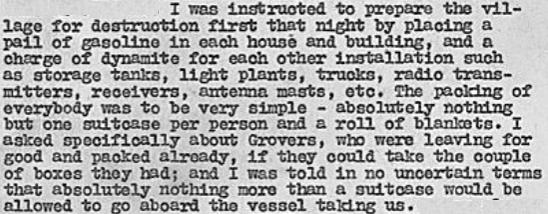
Japanese invasion of Alaska’s Aleutian Islands occurred in early June of 1942. The US government immediately forced native populations in that region to evacuate, with little notice and taking only what they could carry.  This was supposedly for their own protection (villagers on Attu had been captured and taken to Japan). However, the military also wished to deprive the invaders of potential supplies and facilities (some villages were burned by the navy while the residents watched). As noted by Mobley, “The U.S. Military viewed the buildings as a potential asset to the enemy’s advance”.

evacuation2
Fish & Wildlife Service employee’s account of the St. George evacuation. Courtesy of the National Archives. Pribilof Island Logbooks 1878-1961, ID 297024 


Islands which were evacuated included the Pribilof group of St. Paul and St. George, which lie north of the main Aleutian chain. These islands were settled permanently during the Russian development of Alaska, when Aleuts from other islands were moved there to hunt seals. Most of the residents were considered Russian citizens, became Russian Orthodox followers, and had Russian last names. After the US purchased Alaska, the Federal government closely controlled the islands. Ironically the American government was more oppressive towards religion, culture, and general freedom than the Russian government had been. Residents were kept under the thumb of the Fish and Wildlife Service, and were paid a small wage to hunt seals and maintain fox farms which profited the US treasury.

In mid June of 1942, Aleutian evacuees were transported to several sites in Southeast Alaska. The Pribilof residents were moved to Funter Bay, where the government leased the dormant cannery and mine to house them (Mobley notes that leasing agreements were still being finalized while the ships of evacuees were underway). Planning and funding were minimal to nonexistent, and evacuees were left largely to fend for themselves in un-maintained buildings with limited food or medical care.  Islanders had at the last minute been allowed to bring a few small boats with them, and were expected to hunt and fish for much of their own food.

Two USF&WS employees (Daniel Benson and Carl Hoverson) and their wives, along with two school teachers, Mr. and Mrs. Helbaum, were stationed at Funter Bay. These local agents repeatedly pleaded for support from their superiors and even attempted to resign over conditions at the internment camps, but were largely ignored. General knowledge was that German Prisoners of War housed in nearby Excursion Inlet had better conditions and better food than the Aleuts (US civilians) housed at Funter. By the time residents were allowed back to their homes permanently (except for islands taken over for US bases), over 10% had died in the internment camps.

Despite the poor level of care, The Fish and Wildlife Service still considered the Aleuts to be their wards, or perhaps their indentured servants. In 1943 the F&WS coerced Pribilof men to leave their families at Funter and return to the theater of war to hunt seals and care for foxes on the government fur farm.

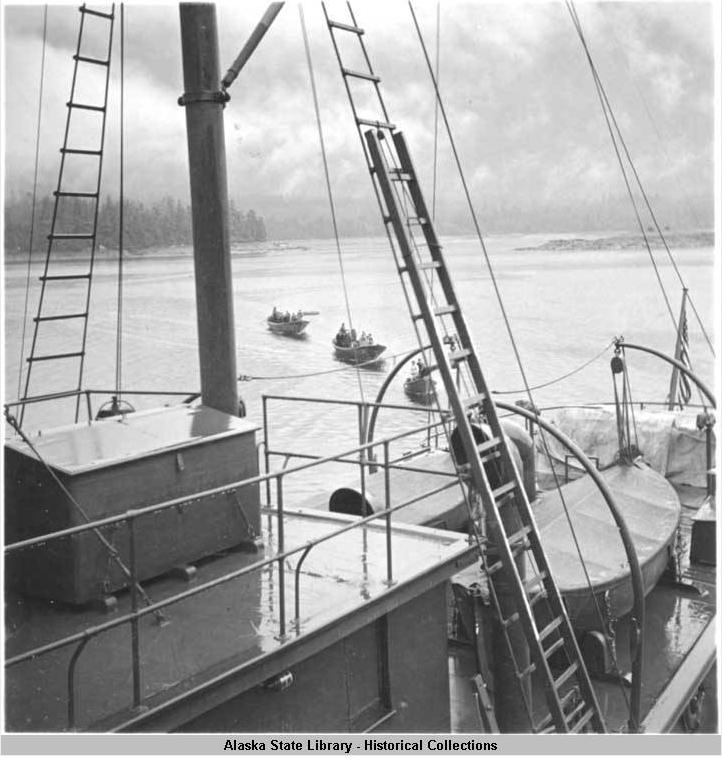
Pribilof Islanders arriving at Funter Bay cannery in 1942:
Boats
Courtesy of Alaska State Library, Butler and Dale collection. P-306-1093

Untitled
Courtesy of Alaska State Library, Butler and Dale collection. P-306-1091

I am not sure which ship is shown above. It appears to be smaller than the Delaroff, which transported evacuees from the Aleutians. USF&WS vessels which supplied the camps at Funter Bay included the Brant, the Penguin, the Crane, the Swan and the Scoter. These were closer in size to the vessel shown above. The boat tied to the scow appears to the the towboat Ketchikan. The Scoter was eventually assigned to spend the winter at Funter.

Pribilof names written on a door at the cannery:
OLYMPUS DIGITAL CAMERA
The names I can make out are “Nekita Hapoff” and “Jacob Kochutin”. A Nekita Hapoff is reported to have died at Funter Bay.

Quonset hut erected as temporary housing at Funter Bay:
OLYMPUS DIGITAL CAMERA

Not only had the cannery buildings been disused for over a decade, they were not designed for winter habitation. Bunkhouses and cabins were occupied in the summer while the cannery operated, and were typically not insulated or heated. Some of the log books kept by government employees at the internment camps are available here. They detail the amount of effort needed to make the camps livable. During the first three months of their internment the Pribilof islanders were at work “constructing bunks, making beds from chicken wire, repairing leaking roofs, broken windows, rotten flooring, dilapidated outhouses”, etc. On Sept 30, 1942, there were “50 native workmen… hauling garbage, repairing plumbing, repairing light wires… razing dock and warehouse for salvage lumber”. By October they were still digging ditches for water pipes and repairing buildings and the water supply dam, and in December they were still trying to get a sanitary water system working. On Feb 12 the agent’s log reported:

“During the past cold spell it has been impossible to heat the houses and quarters occupied by the Natives. At night they have huddled around the stoves and in the dining room getting what little sleep possible. Most of the water pipes are still frozen and there still is no water in the reservoir behind the dam”.

Between the lack of heat and water and the new diseases and climate that residents were exposed to, sickness was almost inevitable. The log books detail the poor medical care provided to internees:

“Wednesday, Oct 27 1942: Three men down with bad colds, sore throats, and chills; this would indicate another outbreak of measles. All were medicated and sent to bed to ‘sweat it out'”.

Another series of log entries chronicles the spread of the flu in late December, 1943. On Christmas Eve, 3 men at the St. George camp were sick, and by the 27th 10 at St. George and “Most of the workmen” in the St. Paul camp were sick. By December 31st, it seemed that only one man from each camp was well enough to work, at the sad task of building caskets. The log reports “All other men sick” (sick women and children were not listed).

sick

Tuberculosis and other respiratory issues were a major problem, possibly exacerbated by high local humidity (about double that of the Pribilof Islands). Infants and the elderly bore the brunt of illness and death. TB patients were sometimes sent to the hospital in Juneau, but flu and measles cases were ministered to mainly by F&WS staff. There were occasional visits from a doctor whose duties were split between multiple camps all over Southeast Alaska. When the doctor did visit he would only attend one camp at Funter, sick residents at the other camp had to be brought to him. An interview excerpt in Charles Mobley’s report notes that residents also became sick from eating unfamiliar foods such as out-of-season shellfish.

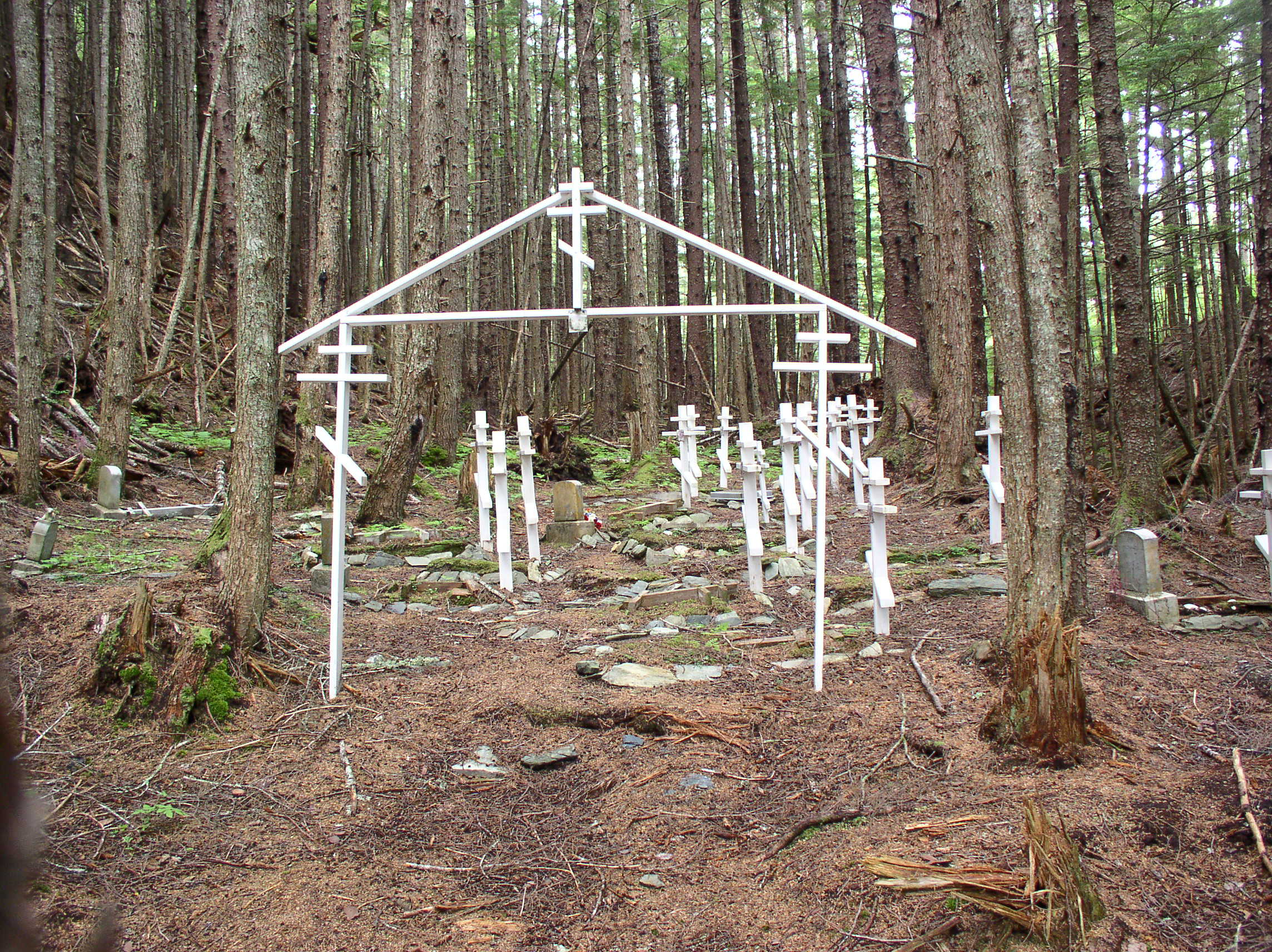
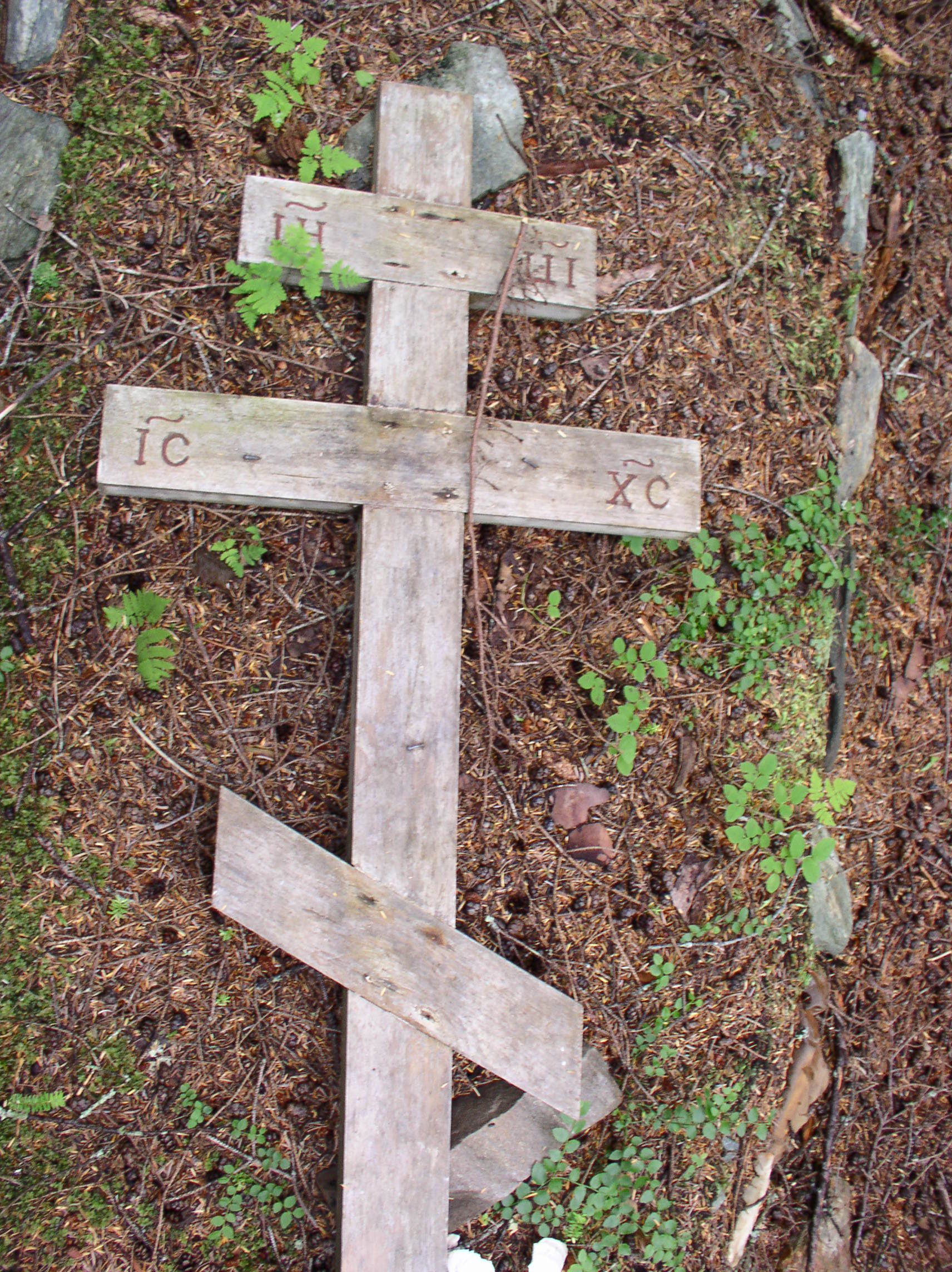
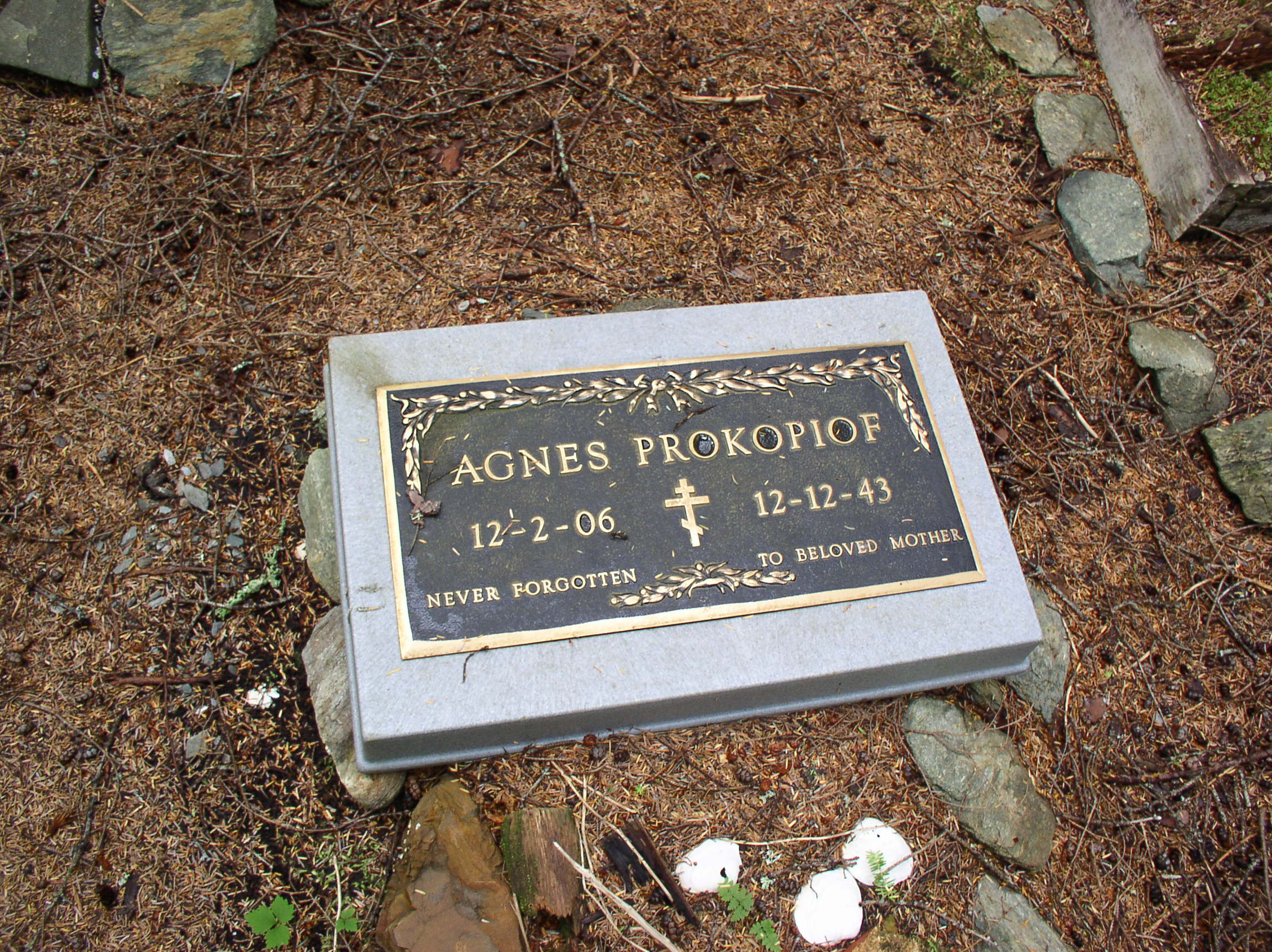
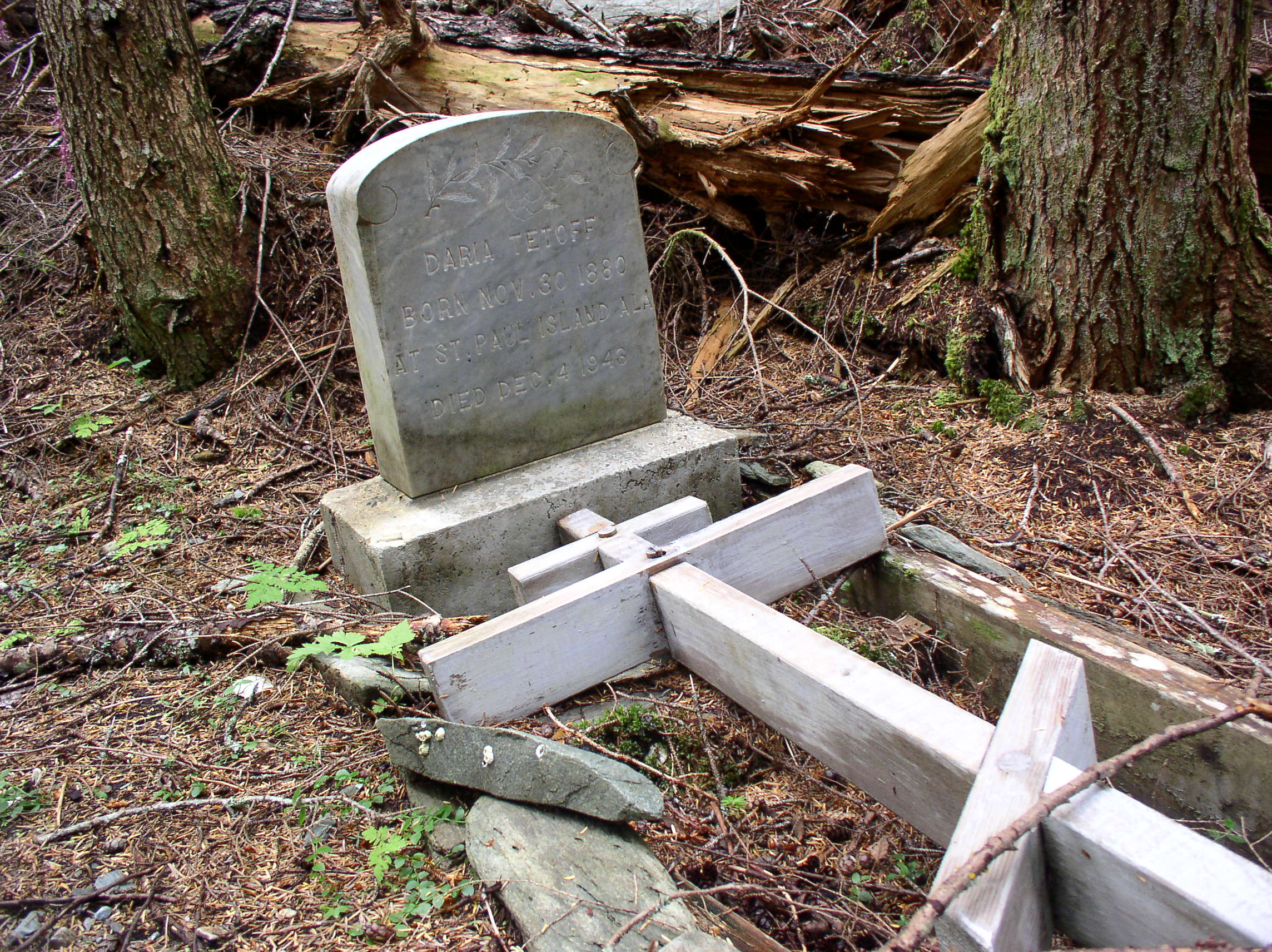
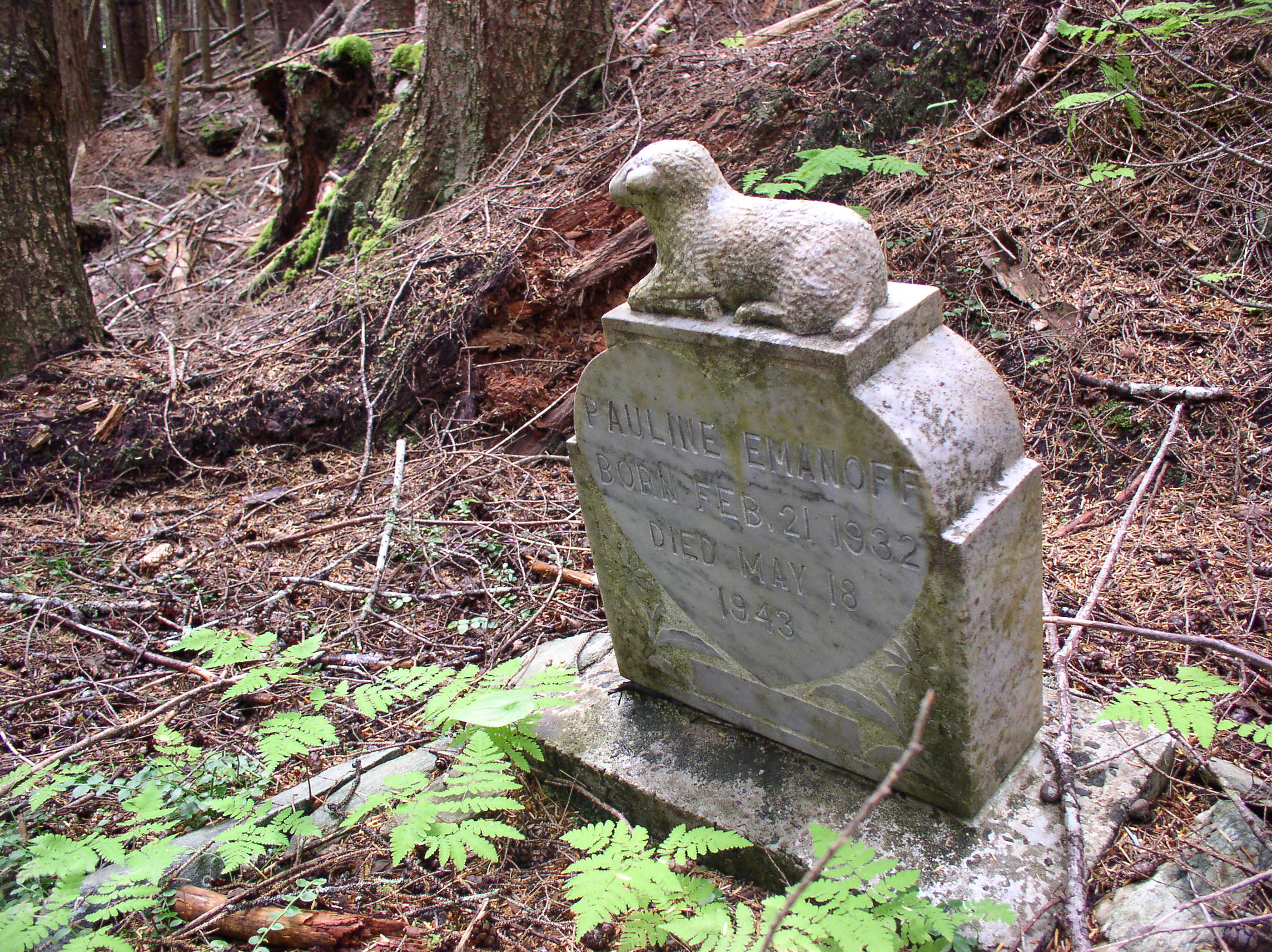
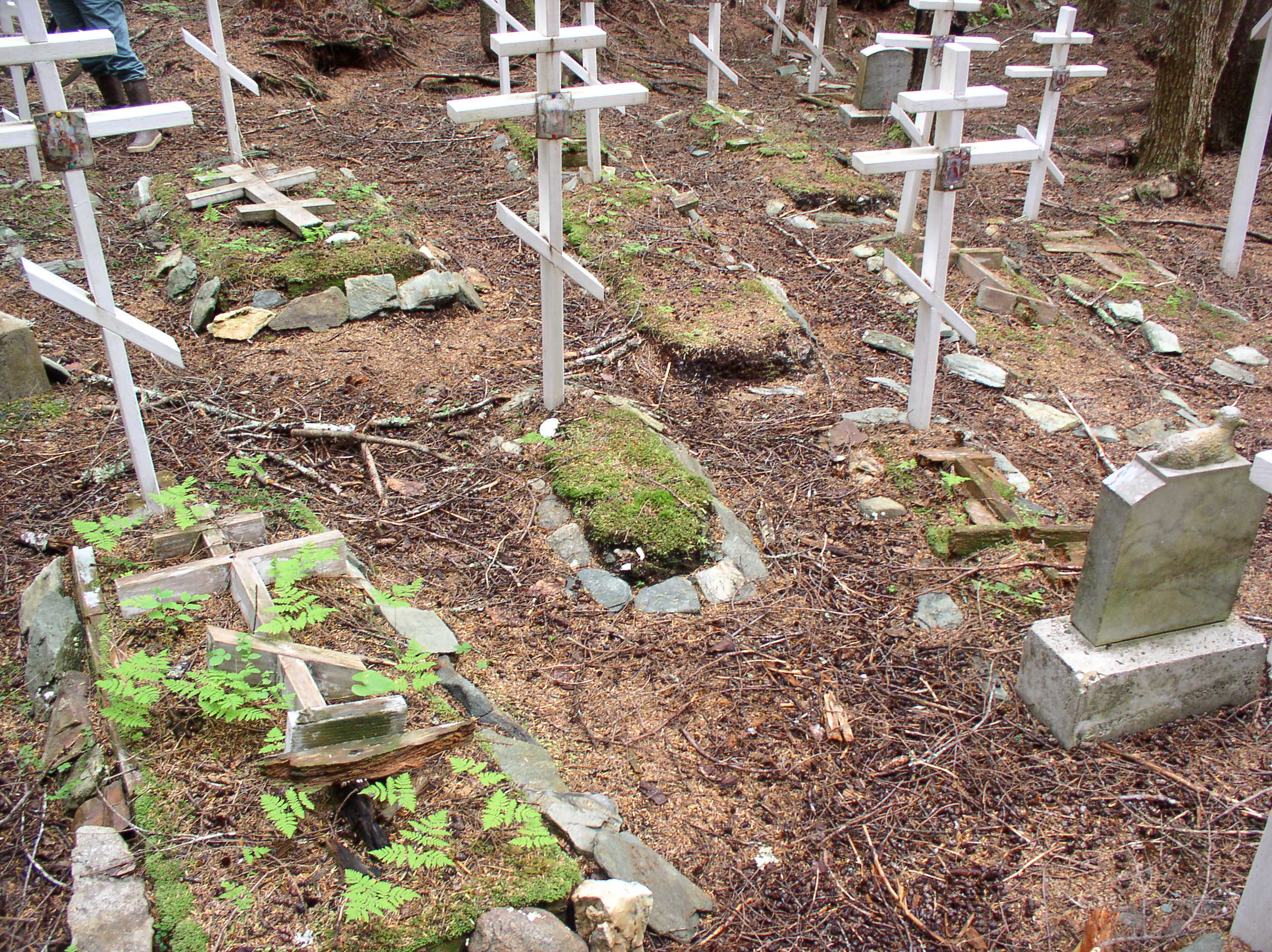
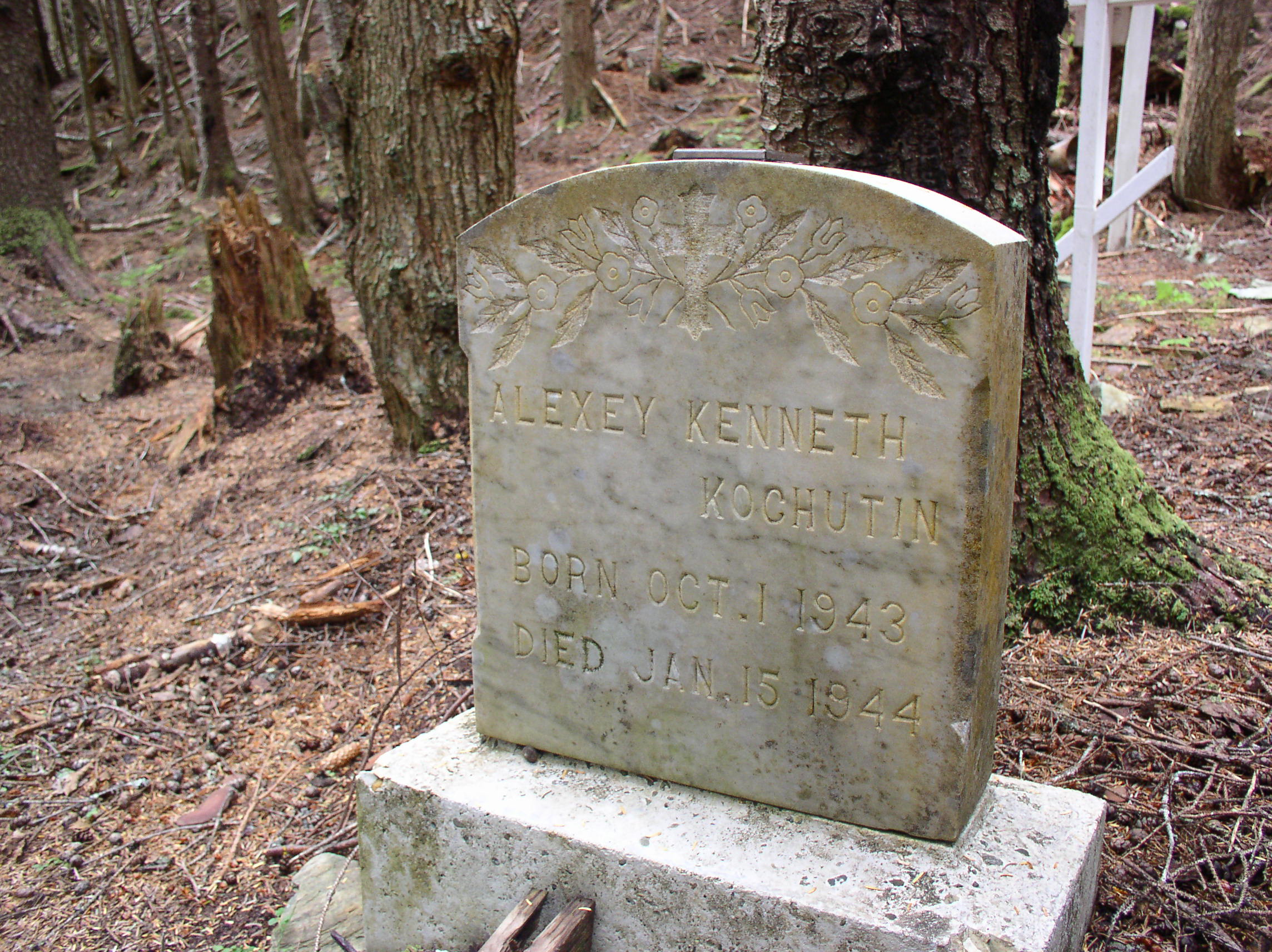
Within a few months of arrival at Funter Bay, it was already necessary to construct a cemetery. This was sited in the woods near the cannery. Thirty-two internees died at the Funter Bay camps or in Juneau hospitals. There are about 23 graves at the site, others are buried in Juneau.
OLYMPUS DIGITAL CAMERA

OLYMPUS DIGITAL CAMERA

OLYMPUS DIGITAL CAMERA

OLYMPUS DIGITAL CAMERA

OLYMPUS DIGITAL CAMERA

OLYMPUS DIGITAL CAMERA

OLYMPUS DIGITAL CAMERA

OLYMPUS DIGITAL CAMERA

OLYMPUS DIGITAL CAMERA

OLYMPUS DIGITAL CAMERA

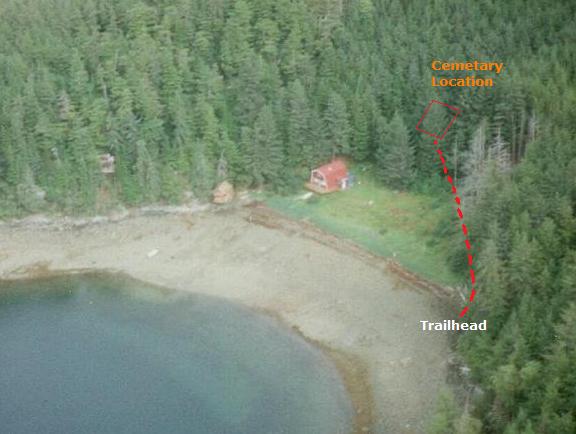
Note: If you are visiting the cemetery at Funter Bay, the best trail is on the right side of the beach, below the area of new growth trees. There is no access from the left side or middle of the cove. Please be respectful of the site, and of adjacent private property (all of the cleared area behind the beach is private). The cemetery is still visited and maintained by the families of those buried here.

trail1

Islanders were allowed to return to their homes in 1945, two years after the Japanese had withdrawn from the Aleutians. The experience of Aleut internees in Southeast Alaska led to greater independence and less government control of their home islands, and eventual lawsuits and reparations for the government’s mishandling of the evacuation.


Funter Bay Mystery Engine Part II

June 27, 2013

Funter Bay resident Gordon Harrison sent me some additional photos of the mystery engine at the cannery. He has marked it with a steel pipe and buoy so it’s more visible to boaters, being located close to the dock it’s something of a hazard to navigation.

Gordon - Engine 1

Gordon - Engine 2

Looking closely, it seems there are two cylinders and maybe two valve chests (one on each end). There also seems to be a round flywheel and rectangular tank at the base of the engine, with a pipe leading to the tank, although it’s hard to tell what’s metal and what’s rock under all the kelp and barnacles!

If anyone happens to recognize the specific type, model, or even just approximate age of this engine, I would love to hear about it! John Taubeneck reports that it looks like a “Fore & Aft” compound design.

As mentioned, I’m not sure if the engine reached its current home via a sunken boat at the cannery wharf, or if it was used or stored on the wharf and fell through as the structure rotted. Aside from potential salvage, there was another reason that engines and other equipment were sometimes moved around: Even if obsolete for propulsion, a big chunk of cast iron makes a nice anchor for a mooring buoy! Someone could tie a raft of logs to part of a wreck, float if off at high tide, and then drop it where they wanted to moor their boat. Various things around the bay probably are or were tied to rusty engines on the bottom. Maybe this one was in transit and got left where it now sits?

Here’s a diagram of a steamboat boiler and engine layout from around 1905:

(From Rankin Kennedy, Modern Engines, Vol V via Wikimedia commons).

On a side note, in the background of the 2nd picture above, you can see the small yellow sailboat that my sister used to have (now owned by Del Carnes), I had previously put some photos of it on my project page.

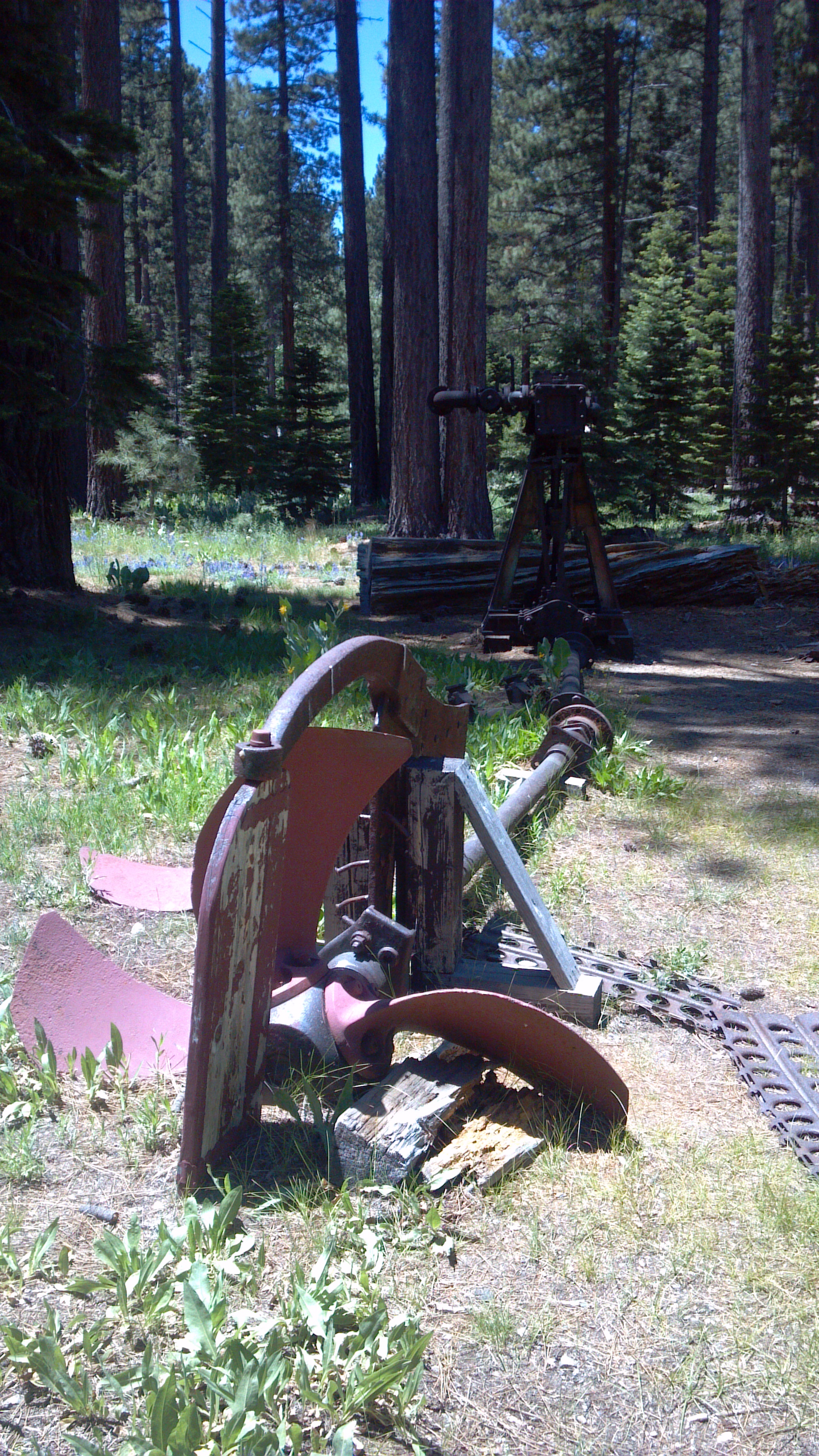
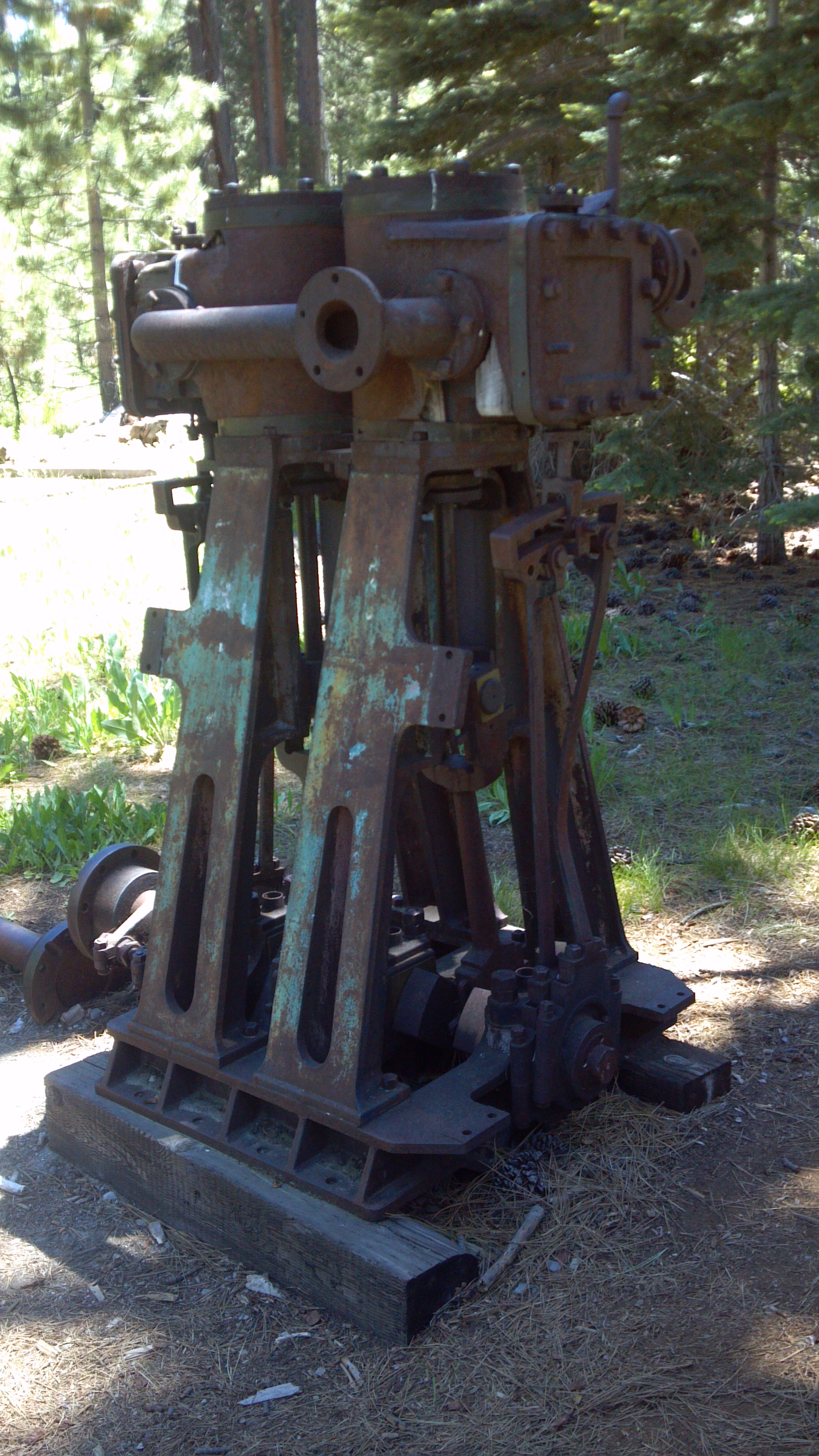
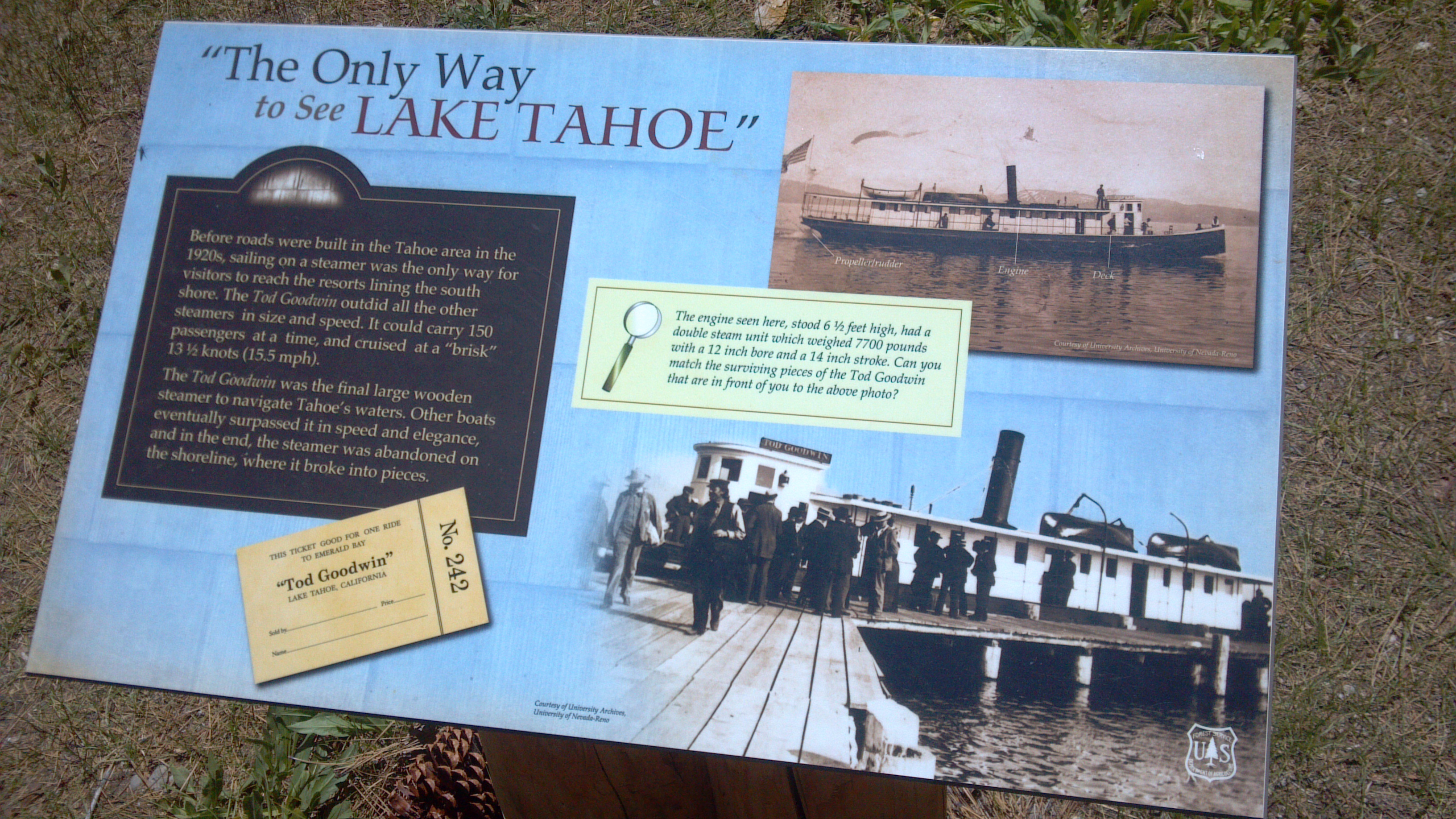
Coincidentally, I happened to be in the Lake Tahoe area last week, and stopped at the Tallac Historic Site. They happened to have a compound engine from a local steam boat, laid out on display with drive shaft and propeller. The valve chests and support frame look a little different, but this shows how such an engine would have been set up.

2013-06-21_12-54-45_511 2013-06-21_12-55-00_191  2013-06-21_12-54-11_469

This engine and drive train came from the steamer Tod Goodwin, which operated on Lake Tahoe from 1884 to 1898. More information is available in this book.

2013-06-21_12-53-35_228


Funter Bay History: Scow Bay Part II

June 10, 2013

I realized that I have a large number of photos from Scow Bay, so I’ve decided to follow up on one of my earliest Funter Bay History posts with more information on that location.

Scow Bay is one of the few parts of Funter Bay history that are publicly accessible. This side of the bay lies within the Funter Bay State Marine Park. Again, please note that the adjacent former cannery site is mostly private property. Also note that the Scow Bay area features extensive tide flats, keep an eye on the tides if you plan to land a boat here, or you may find it high and dry!

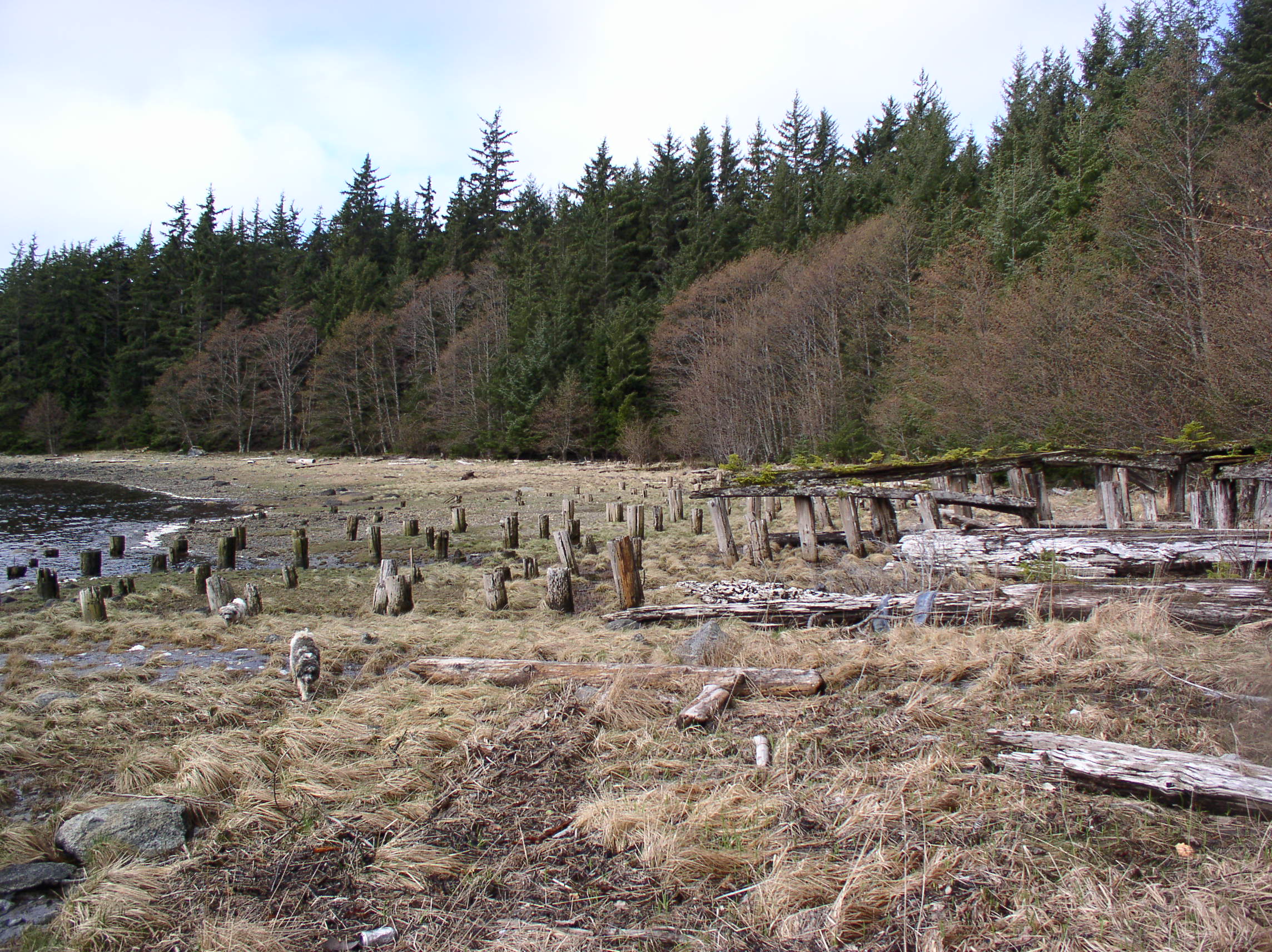
Slipway pilings at Scow Bay:
0a-scowbay

The name of one of the scows, which were large enough to require official documentation as Merchant Vessels:
OLYMPUS DIGITAL CAMERA

From the 1965 Merchant Vessel Registry on the above scow:

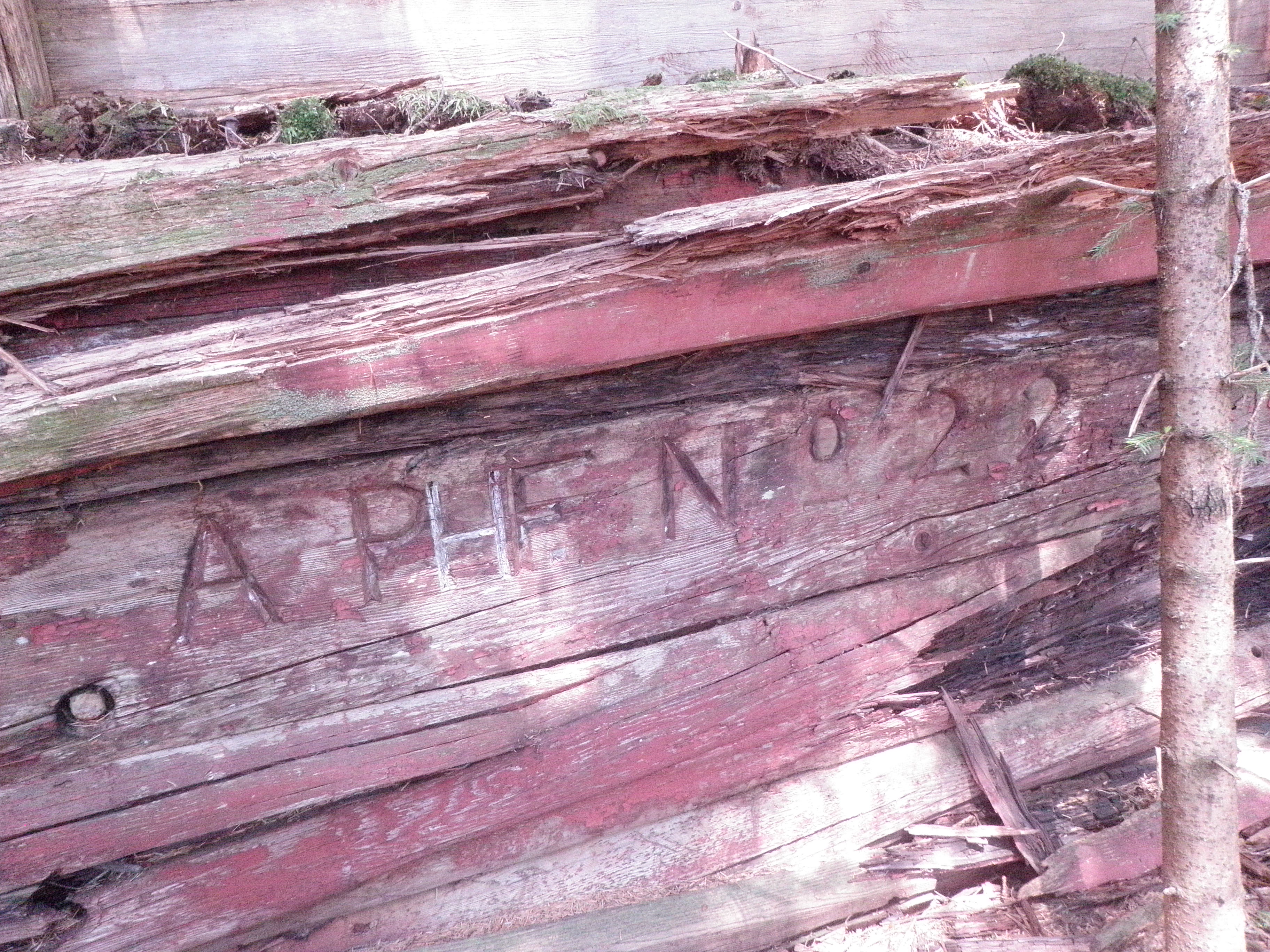
A.P.F. No 22 (wood) Barge, No 168899. 41tons gross/net. 61.1ft long, 18ft breadth, 4.4ft depth. Built 1924 in Houghton, WA for freight service. Owned by P.E. Harris Inc of Washington, home port Juneau.

The carved “H” seems to have slipped in between the P and F sometime after the official numbering, I’m not sure what it means. The other scows had equally imaginative names, like the No 19, No 20, etc.

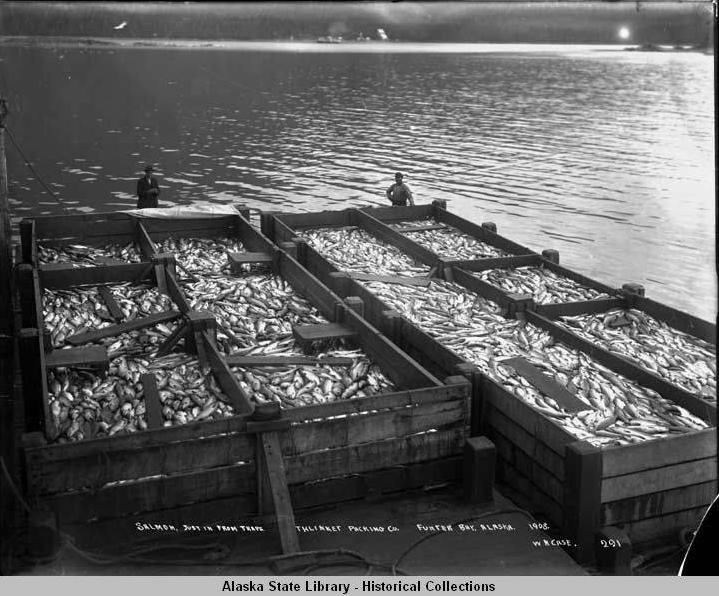
Here are some more views of these scows in operation in 1908. The wooden boards surrounding the top would have increased their load capacity:
Funter Bay Cannery2 1908
Courtesy of the Alaska State Library, William R Norton collection, P226-446

scows2
Courtesy of the Alaska State Library, William R Norton collection, P226-445

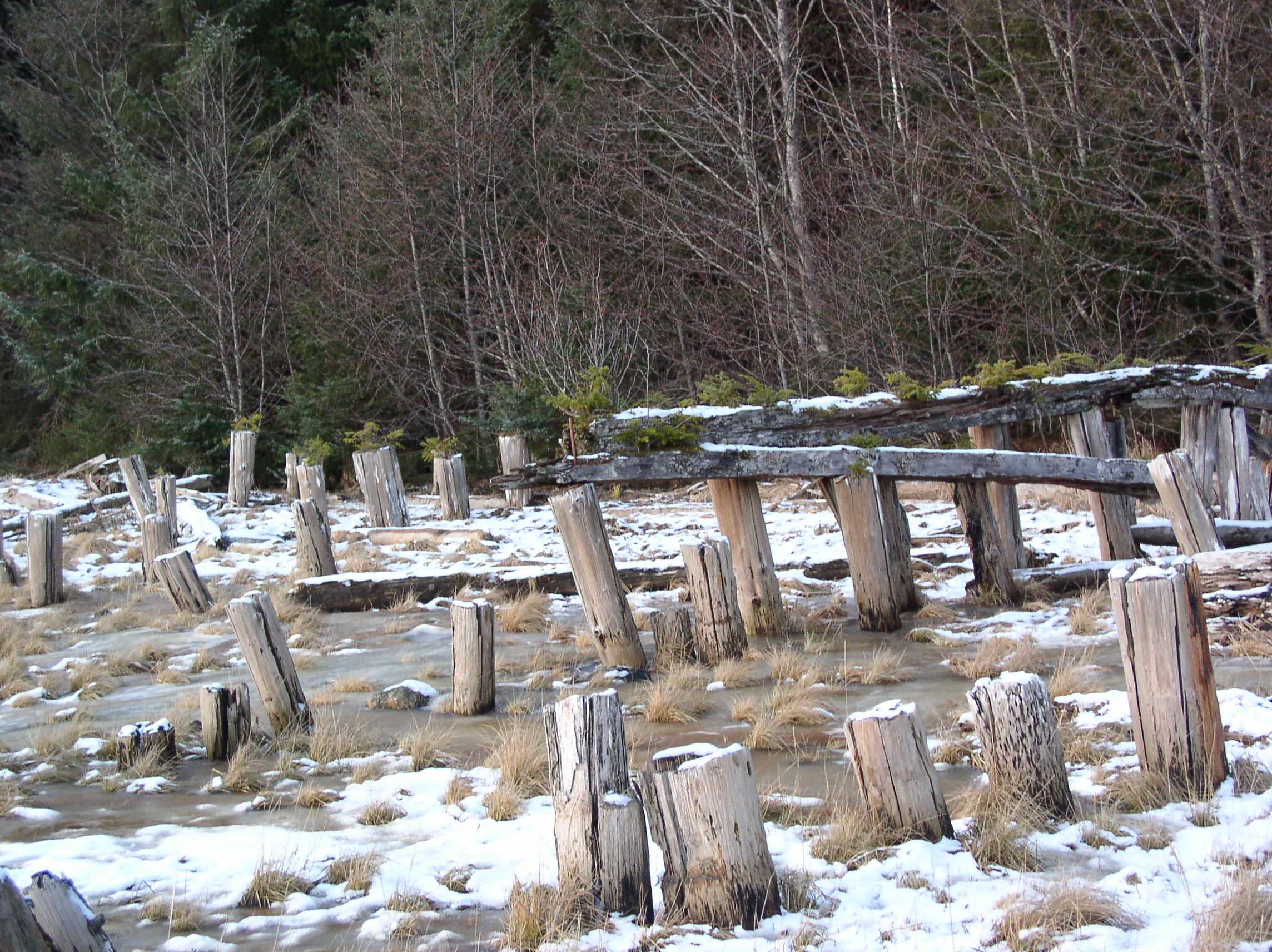
Two more views of the slipways, you can see some of the remaining top rails on the right, now home to small gardens of saplings:
OLYMPUS DIGITAL CAMERA

OLYMPUS DIGITAL CAMERA

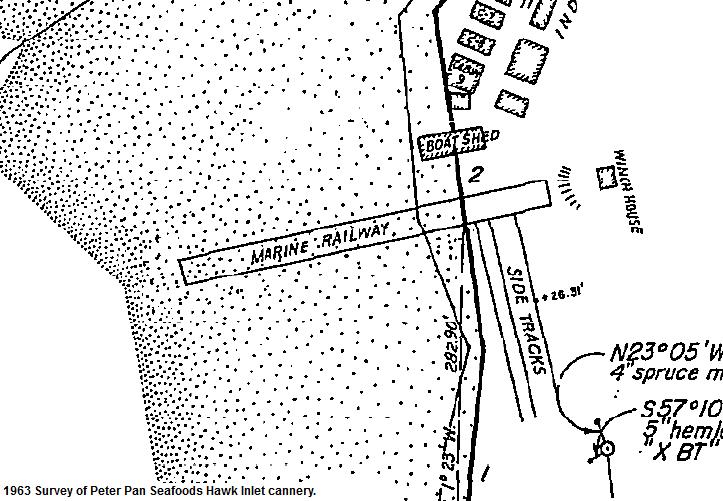
Here is a diagram of the scow slipways from a cannery of similar vintage. Typically there would be one main ramp leading from the water up to the woods above high-tide, and then scows would be pulled sideways onto parallel tracks for storage. At Funter they seem to have had multiple parallel tracks to the water, rather than side-tracks.

scow survey

Some of the collapsed top-rails that made up the storage tracks of the slipways, and one of the braided steel cables running back to the winch engine:
OLYMPUS DIGITAL CAMERA

A spool that would have held steel cable (also known as an Alaskan patio table!):
OLYMPUS DIGITAL CAMERA

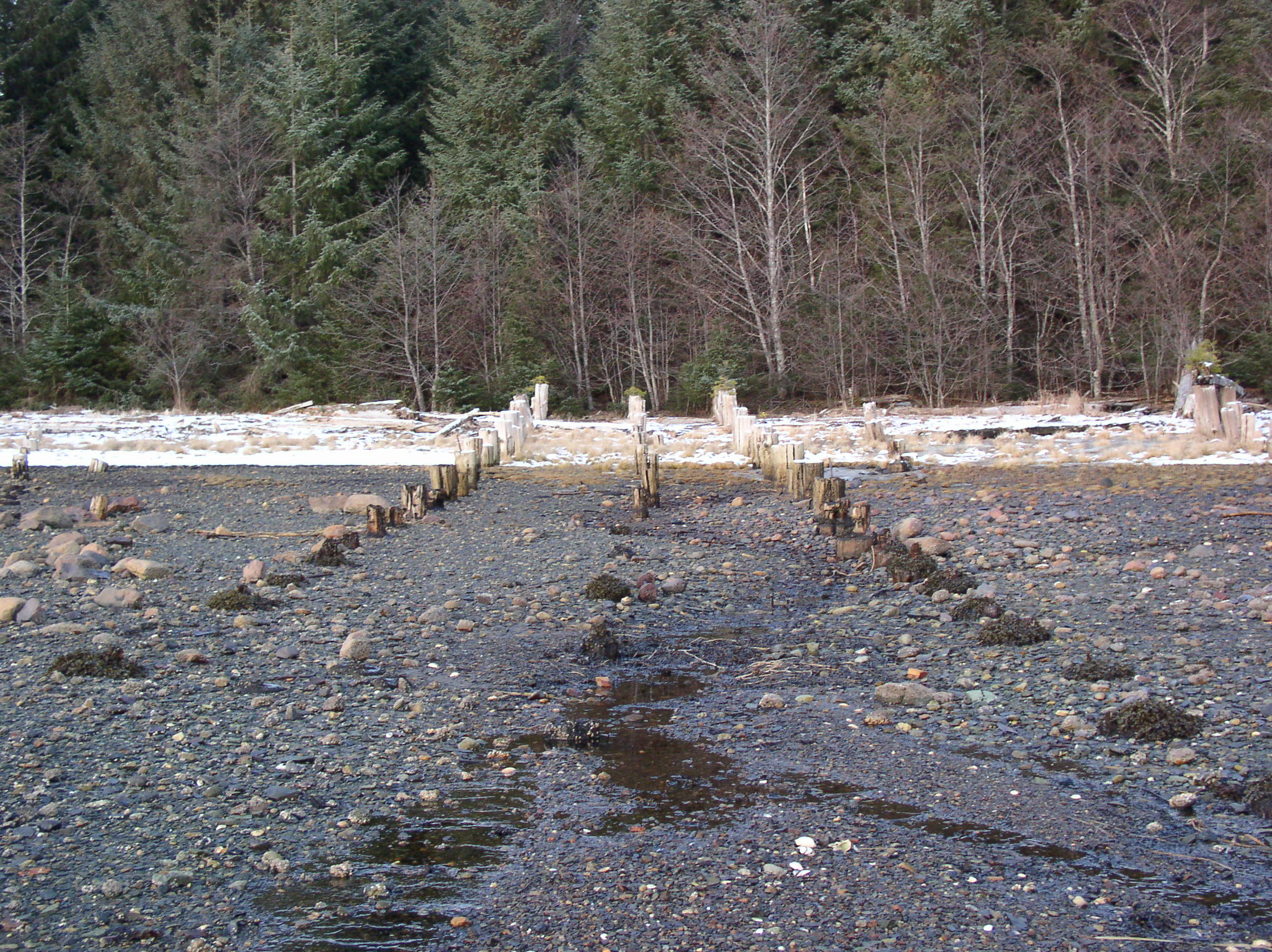
Parallel rows of pilings leading from tideflats to the woods:
OLYMPUS DIGITAL CAMERA

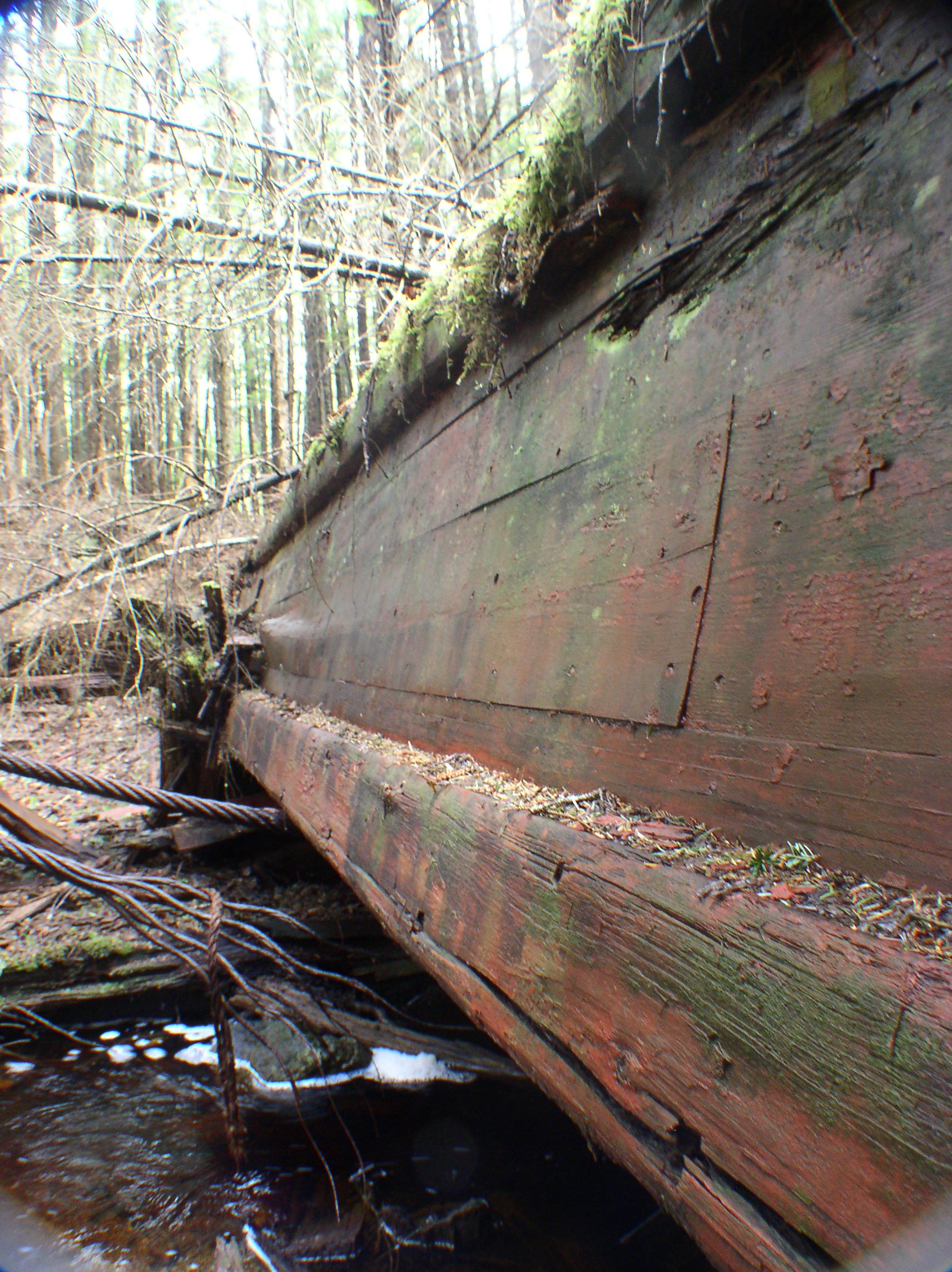
Closeup of a scow hull. The red paint was probably a copper-based anti-fouling bottom paint (to prevent barnacles and other marine life from growing on the wood):
OLYMPUS DIGITAL CAMERA

This picture shows how the scows have rotted into and through the rails they once sat on. In some cases, the pilings that held up the rails are now poking up through the rotten wooden hulls. A scow (on the left) has settled to ground level, while a rail is seen falling off its posts on the right:
OLYMPUS DIGITAL CAMERA

That’s it for now!


Funter Bay History: Trapping & Fur Farming

June 7, 2013

Fur-bearing animals have long been an important part of the Alaskan economy, and an iconic part of Alaska history. The image of the lone trapper in the wilderness is often a symbol of Alaskan life. Fur farmers institutionalized the production of furs, and helped prevent extinction from overtrapping. Alaska fur farming began with Russian settlement, and furs were assumed to be the most valuable resource in Alaska when it was purchased by the US. Fur sales met with varying amounts of success depending on the economy and styles of different periods, but boomed during the 1920s. The Alaska State Library has a collection of photos related to fox farming. Both fur farming and trapping coexisted and are still around today, although there are no active fur farms in Alaska at present.

fur coat

Sarah Crawford Isto has a great history of Alaska Fur Farming; “The Fur Farms of Alaska: Two Centuries of History and a Forgotten Stampede“. Her book goes into much more detail and has much more history than I can cover here. Sarah was quite helpful in straightening out some of my information.

Another good source is Larry Roberts’ Southeast Alaska Fur Farm Database. Larry was also a great help in answering questions and providing extra information.

Many trappers probably worked in the Funter Bay area at various times. They would have mainly been seeking various Mustelids, including mink, marten, and weasels/ermine. Foxes are not native to Admiralty Island. River otter could also be trapped, and sea otter were hunted from boats (sea otter harvest was made illegal in 1911, but today there is a subsistence exemption for Natives). While I have not found much specific information on local trappers, the Bayers notecards mentions an S.P. “Bud” May, a  Funter Bay trapper who went missing in 1937. Tlingit natives from Hoonah are noted as trapping mink and marten at Funter Bay, although at least one source speculates that marten could have been introduced to the island by fur farmers.

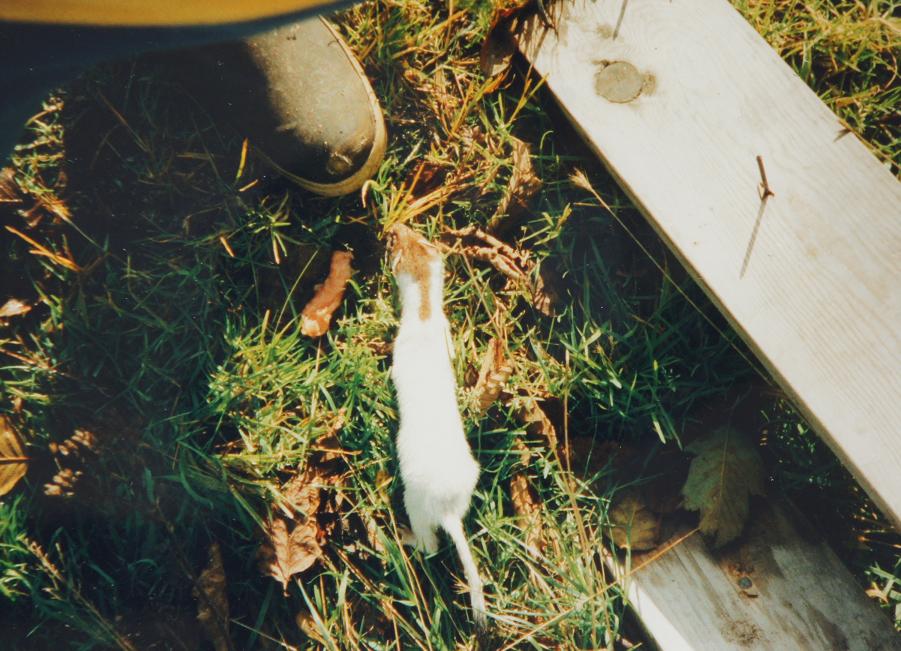
As a side note on animal behavior: the small mustelids are quite bold, and will sometimes come into houses or approach humans out of curiosity. By contrast, otters seem to have learned to fear kayaks (the traditional hunting boat), but will ignore larger power boats. River otters and mink like to use skiffs and docks as dining areas and/or bathrooms, and are often the source of smelly things found in your boat in the morning. River otters will also sometimes try to drown dogs, they attempt to call or tease the dog into the water where they can get on its head.

A curious weasel (partly in its winter ermine coat) examines someone’s foot at Funter:
Weasel 2

A marten visiting the bird feeder at Funter:marten

Large fox farms often involved leaving breeding pairs on an island, where the ocean served as a natural fence while the stock increased. Caretakers would sometimes live on the island to ensure the foxes stayed fed, healthy, and undisturbed by poachers. Pens and fenced enclosures were used with mink, which were more adept at swimming. Smaller backyard fox farms had pens if they were on a larger island or the mainland, and pens became more common in later years once researchers learned of parasite issues with free-range stock. Isloated island farms often let the foxes find their own food on the beach or in bird nests, but most farmers supplemented the diet with fish, wild game, and cereals. Farmers would sometimes buy fish byproducts such as heads and guts from local canneries (and some would reportedly rob fish traps for fox food). Fish could be salted or smoked to keep over the winter. Sarah Isto’s book mentions salted fish heads being used as fox feed, but also mentions that foxes preferred “freshened” fish with the salt rinsed out. Various experiments to introduce rodents onto islands usually met with failure as early as Russian farming days, but this didn’t stop farmers and the government from trying.

fox

Several possible fur farms have been identified around Funter Bay, although official documentation is scarce. Fox farms would likely have used blue foxes, as silver foxes were harder to raise. Some farmers had only a few breeding pairs and harvested only a few pelts each year. Backyard fur farming was often a side project for people who worked other seasonal jobs such as fishing, mining, or cannery labor in the summer.

The farms at Funter may or may not have been entirely legal. Small-time operators sometimes squatted without sanctioned land rights, and neglected to get a government permit. Other “farmers” live-trapped animals in the summer (or poached them from legitimate farms) and penned them until winter when their coats were thickest. Still others used fur farms as a front for the other big moneymaker of the 1920s: moonshining (more on this later).

One potential farm is at the cannery, with pens located behind the workers’ houses. I have sometimes heard this referred to as a fox farm. The other, referred to as a mink farm, was located behind Harvey Smith’s property in Crab Cove. That site has some fencing and a trash midden at the site of a former cabin.

foxy

A fur farm belonging to a Pat Kelly is listed at Funter in the SE Alaska fur farm database. His farm, record JUN-30, is shown near the cannery and listed as keeping mink and marten in pens around 1924. The Kinky Bayers notes list a Capt. Pat Kelly of the vessel A.R.B. 10 operating around Juneau in 1958. Bayers also lists a Pat Kelly serving as mate aboard the steamship Glymont of the Nelson Line in 1933. A Pat Kelly from Wrangell was arrested at Prince Rupert, BC in May of 1934 for stealing furs and the gas boat T-1957 from Stanley Jekell. Stanley had his own run-ins with the law, being charged with poaching deer in 1935.

I am not sure if these are all the same Pat Kelly, but there are common threads between them. Capt. A. J. “Pat” Kelly appears to have been a fish buyer for the A.R. Brueger Packing Co of Wrangell in the 1950s. The A.R.B 10 is in the merchant vessel registry as a 62′ wood fishing boat, owned by A.J. Kelly of Wrangell. It was formerly the No. 3145, built for the US Navy in Philadelphia in 1923. It sank in 1959 at Lituya Bay. This book mentions that Pat and Elsie Kelly were fish buyers.

Neil (or Neal) C. Gallagher had a fox farm at Point Couverden across Lynn Canal, and received mail at Funter Bay. He is listed as raising blue fox in pens prior to 1924. His wife was reportedly Mary Joyce. (Larry Roberts compiled most of the Gallagher information, and notes that the details are confusing. I’ve used the Bayers notes to fill in some more). Neil’s brothers Con (or Don) and Phillip R Gallagher were also involved with this fur farm, as was a person named Pat Mulvaney. Con Gallagher Sr, father of “Neal, Phil, and Con Jr”, is reported as building the first pile-driven fish trap in Southeast Alaska for the Alaska Packer’s Association of Excursion Inlet in 1900. “Neal Gallagher” was in trouble with the law for rum-running in 1925 and again in 1928, and a Don Gallagher was evicted from Excursion Inlet for bootlegging during WWII.

Some of the Gallaghers’ fox farming partners were Michael and Lylia Whalen. After Neil’s death, Mary reportedly sold her 1/6 share to Lylia for $1, and the Whalens sold the Point Couverden farm to August Goodman in 1928. Goodman abandoned it in 1934. Their farm, JUN-17, was noted as using several islands, probably on the East side of Couverden, South of Howard Bay.  Elizabeth Goodman (1919-1999) was the daughter of August and Isobel Goodman.

Several Funter Bay residents had formerly been involved in fur farming. Lazzette Ohman grew up on a fox farm near Petersburg in the 1920s, and her stepfather owned a small fox farm in Juneau later that decade. Harold F. Hargrave, the caretaker of the Funter Bay cannery in the 1940s and onward, is listed as owning fur farm JUN-24 on Douglas Island between 1937-1940.

Today there is not much left of the fur farms at Funter Bay, aside from some wire fencing, cabin ruins, and a few artifacts.

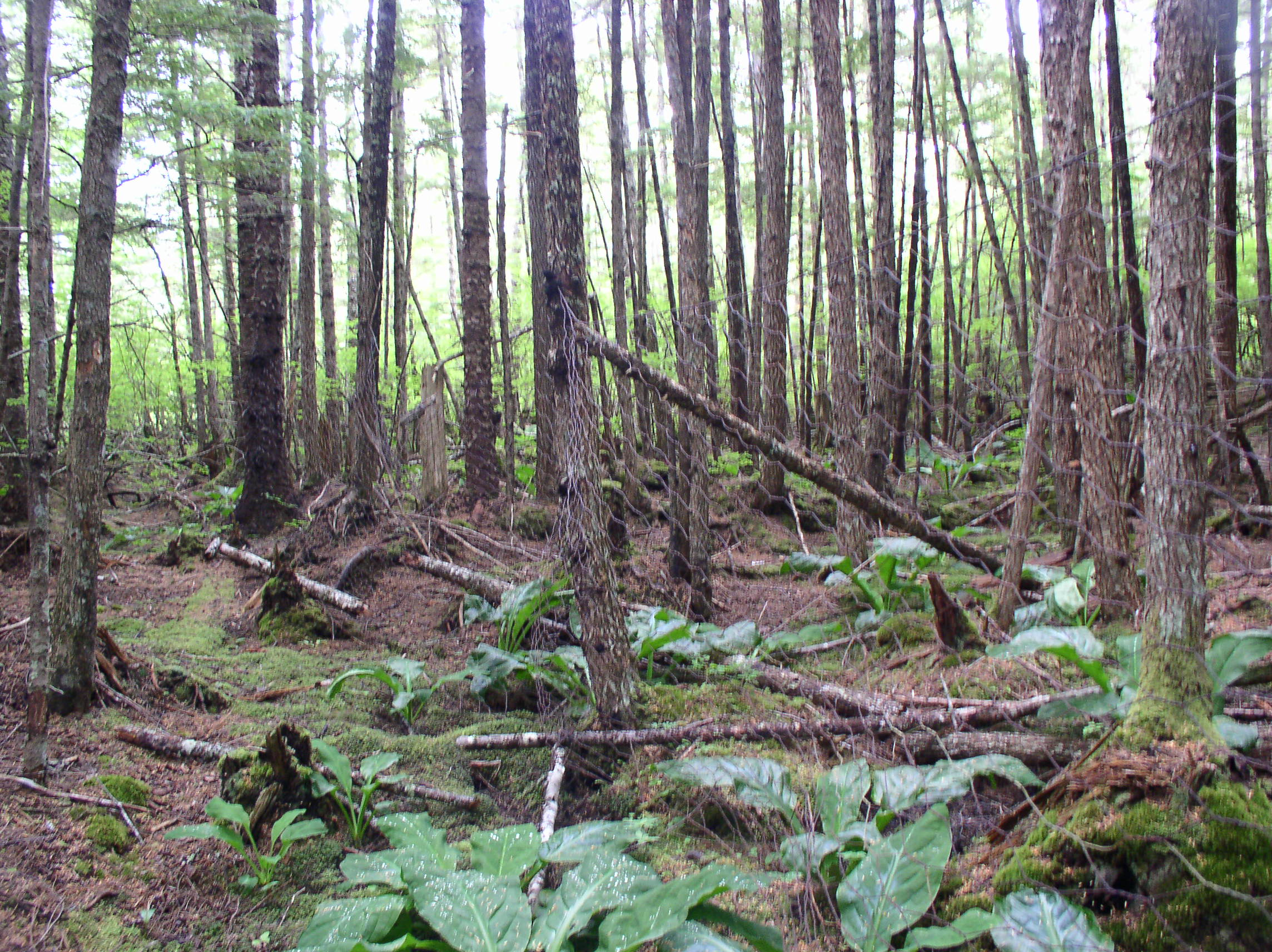
Chicken wire fencing stapled around trees at the Crab Cove fur farm:OLYMPUS DIGITAL CAMERA

Fencing behind the cannery in an area reported to be a fox farm:OLYMPUS DIGITAL CAMERA

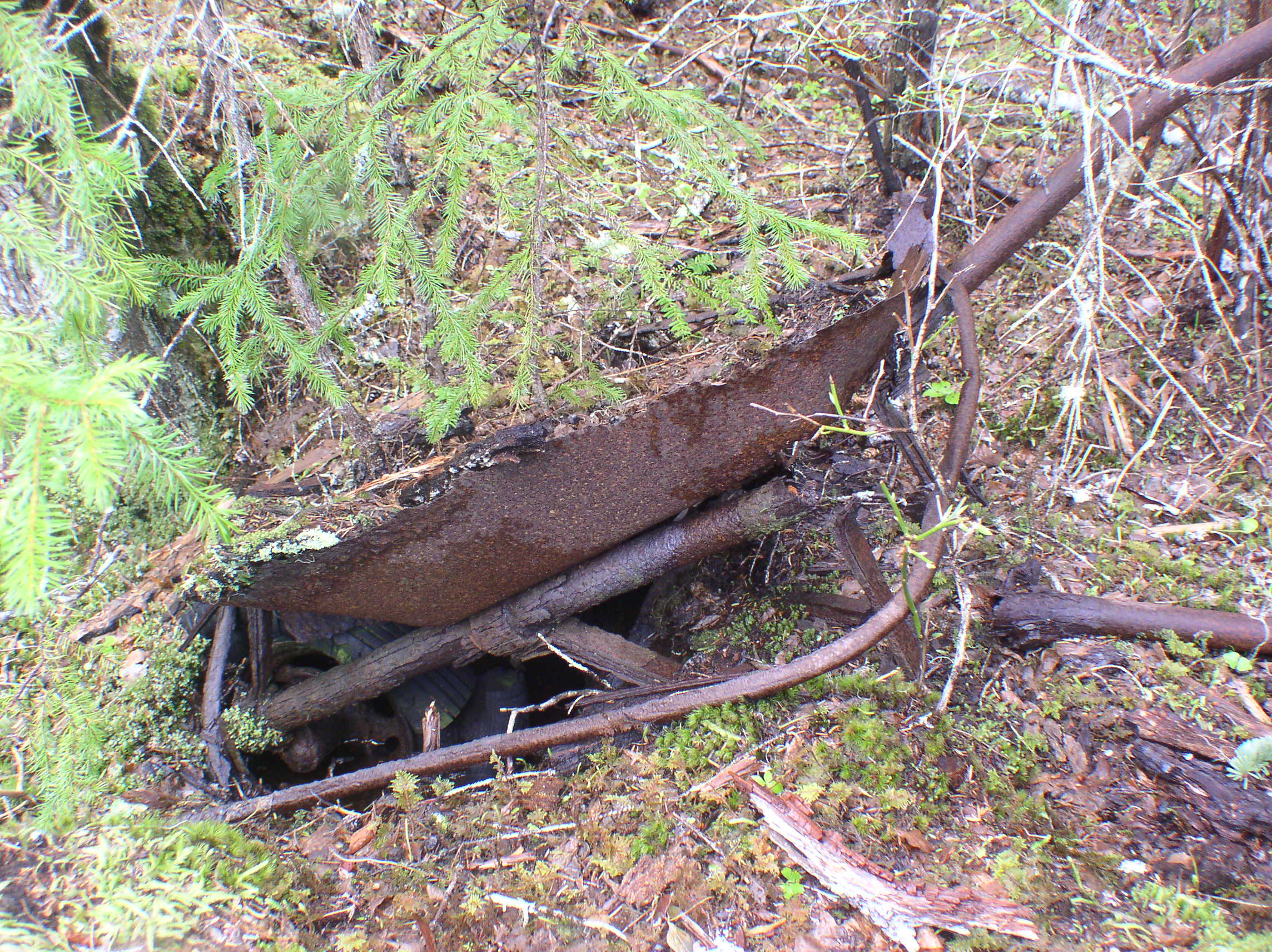
A wheelbarrow at the former cannery fur farm, possibly used to haul fish to feed the animals:
OLYMPUS DIGITAL CAMERA

Another fence near the cannery, this one with actual cut fence post, angle braces, and sections going underground to prevent critters from digging under (I realize these aren’t the most exciting photos, chickenwire on trees doesn’t provide much contrast!):
OLYMPUS DIGITAL CAMERA

Today, mink, marten, and weasels are all common around Funter Bay. As noted, some populations may have been introduced or escaped from farms. While foxes escaped from farms periodically, they were unable to survive on only a foraging diet. Blue and silver foxes are not indigenous to Southeast, and farmers had to provide significant dietary supplements to keep their stock healthy.

Another introduced species, red squirrels, seem to have been transplanted to Admiralty Island in an effort to aid fur farming, and have become an invasive nuisance animal. State and Federal wildlife agencies occasionally transplanted animals, including squirrels, marten, and others.  Local information indicates that the US Forest Service introduced red squirrels onto Admiralty Island in the 1930s as a cheap food source for foxes (I am not sure why they thought this was a good idea, squirrels are better climbers and would easily evade free-range foxes, and a farmer would have to shoot or trap a large number of squirrels to feed their stock). One source claims red squirrels arrived on Admiralty in the 1970s. Another claims they appeared in the late 1940s. This paper quotes the USDA Forest Service as saying red squirrels were released on Admiralty in the 1930s, and claims they are “not invasive”. Red squirrels were also released on Prince of Wales Island, but seem to have been out-competed by indigenous flying squirrels. While locals have long recognized red squirrels (aka wood rats or tree rats) as a non-native nuisance animal, official studies have finally begun to classify them as an invasive species. Squirrels are a major predator of local birds (mostly the eggs) and an annoyance to human residents (they steal insulation and chew wiring).  The Forest Service and ADF&G seem to claim no direct knowledge of their mysterious appearance on Admiralty Island.

Larry Roberts of the Alaskan Fur Farm Database was very helpful in compiling this information, both by email and with copies of his research materials. He is interested in sharing fur farming information with other researchers and the public. His contact information is below:
Larry D. Roberts
P.O. Box 4381
Grand Junction, CO 81502
970-640-7418

rockingrroberts@netscape.net

Sarah Isto was also very helpful with additional information on this topic.

References used for this writeup include:

Roberts, Larry D. Preliminary Select Bibliography in Relation to Historic Alaska Fur Farming. 1 May 2013. Grand Junction, CO.

Roberts, Larry D. “Search Database.” Historic Southeast Alaska Fur Farming. N.p., n.d. Web. 28 May 2013. <http://rockingr.com/home/search-alaskan-fur-farm-database/&gt;.

Roberts, Larry D. Place Names. N.d. A Preliminary Biographical Index to Historic Southeast Alaska Fur Farming; Second Edition. Grand Junction, CO.

Roberts, Larry D. Companies and Individuals. Mar. 2013. A Preliminary Biographical Index to Historic Southeast Alaska Fur Farming; Second Edition. Grand Junction, CO.

Isto, Sarah Crawford. The Fur Farms of Alaska: Two Centuries of History and a Forgotten Stampede. Fairbanks: University of Alaska, 2012. Print.

Ohman, Lazzette. Reflections: A Pioneer Alaskan’s Personal History from the Gold Rush of ’89 to 1980. N.p.: Vantage, 1988. Print.

“Fur Farming.” Wikipedia. Wikimedia Foundation, 07 Sept. 2013. Web. 1 Jun 2013. <http://en.wikipedia.org/wiki/Fur_farming&gt;.

Goldshmidt, Walter Rochs, and Theodore H. Haas. Haa Aani, Our Land: Tlingit and Haida Land Rights and Use. N.p.: University of Washington, 1946.

Bayers, Lloyd H. Captain Lloyd H. “Kinky” Bayers Collection, 1898-1967. N.d. Archival Collection MS 10. Alaska State Library Historical Collections, Juneau, AK.

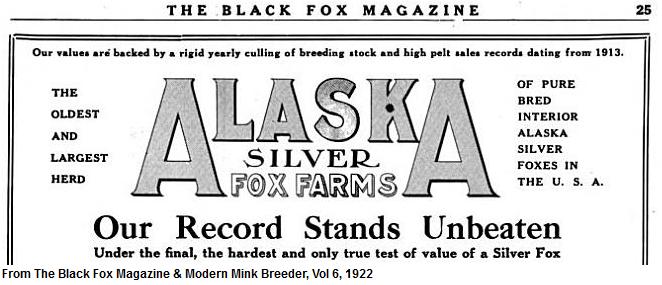
The Black Fox Magazine & Modern Mink Breeder Vol 6 (1922).
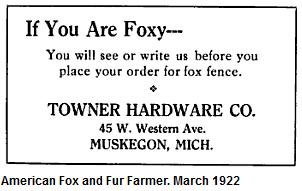
American Fox and Fur Farmer (1922).
American Fox and Fur Farmer Vol 1 (1921).
“Obituaries from End of the Trail.” Obituary for A. R. Brueger. Alaska Magazine, June 1963. Web.  <http://www.alaskaobits.org/obituaries/view.cfm/A-R-Brueger/id/225&gt;.
Good, Warren. “South East Alaska Shipwrecks ” Alaska Shipwrecks. Web.  <http://alaskashipwreck.com/&gt;.
George, Marilyn Jordan. Following the Alaskan Dream. [Petersburg, Alaska]: M.J. George, 1999.
“Obituaries.” Charlie George Sharclane. Juneau Empire, 9 Jan. 2000. Web. <http://juneauempire.com/stories/010900/Com_sharobit.html&gt;.

Alaska Department of Fish and Game. Division of Wildlife Conservation. Game Transplants in Alaska; Technical Bulletin #4. By Thomas W. Paul. 2nd ed. Juneau: n.p., 2009. Print.

United States Forest Service. Alaska Region. Assessment of Invasive Species in Alaska and Its National Forests. By Barbara Schrader and Paul Hennon. N.p.: n.p., 2005. Web. <http://www.fs.usda.gov/Internet/FSE_DOCUMENTS/stelprdb5269749.pdf&gt;.

MacDonald, Stephen O., and Joseph A. Cook. “The Land Mammal Fauna of Southeast Alaska.” The Canadian Field-Naturalist 110.4 (1996): 571-98. Web.

Aubry, Keith Baker., William J. . Zielinski, Martin George. Raphael, Gilbert Proulx, and Steven William. Buskirk. Biology and Conservation of Martens, Sables, and Fishers a New Synthesis. Ithaca [N.Y.: Comstock Pub. Associates/Cornell UP, 2012.


More Funter Bay Fishermen

June 5, 2013

Here are a few more commercial fishermen (and women) who I’ve come across while researching Funter Bay. This is to follow up on my previous post.

Funter Bay has been used as a landmark or boundary point for various fishing regulations through the years.

Pete Hobson, a Tlingit man from Angoon, reportedly died at Funter Bay in 1930 while on the seiner Myrtle. He was mentioned in my previous Funter Bay Fishermen post, it was implied that he owned the Myrtle, and in 1924 he pulled two trollers off the rocks at Funter.

The troller Ada-May was listed as visiting Funter Bay in 1942. She was a 31ft gas fishing boat built in Ketchikan in 1924, belonging to James Paddock of Juneau. (The Ada May was also busted for bootlegging in 1930 off Point Retreat, with Ed Hibler and Scotty & Mrs. Boyce on board).

Max & Ann Dorman lived at Funter around 1943. They had moved to Sitka in the 1970s and were described as retired trollers who lived at Funter and at Elfin Cove. They had the vessel Pal in 1937.

“Bell” and “Al” Schramen fished the boat Aurora, and Bess and Chet Kimmerly had the boat Bess Chet, fishing around Funter Bay. (Per Lazzette Ohman). Aurora is listed as a 38′ fishing boat built in Bellingham in 1948. Bess-Chet was a 37′ fishing boat built in 1957 in Tacoma.

In 1954 the troller Helen was found beached at Funter Bay by the crew of the Mabel CGeorge J. Harju, 48, of Juneau was found dead at the Helen‘s wheel of an apparent heart attack. (per Pacific Fisherman Handbook, Vol 52).

Cora and Curly Warnock were Funter Bay residents (Per Lazzette Ohman). I’m not sure if they fished, they may have been hunting guides.

An “officious and profane resident” fishermen in Funter Bay was reported in 1973. There are probably several people this could have been! (This is sometimes the attitude towards “yachty” boats, fishermen usually don’t want “tourists” tying up next to them due to conflicting schedules, or just general cussedness).
profane

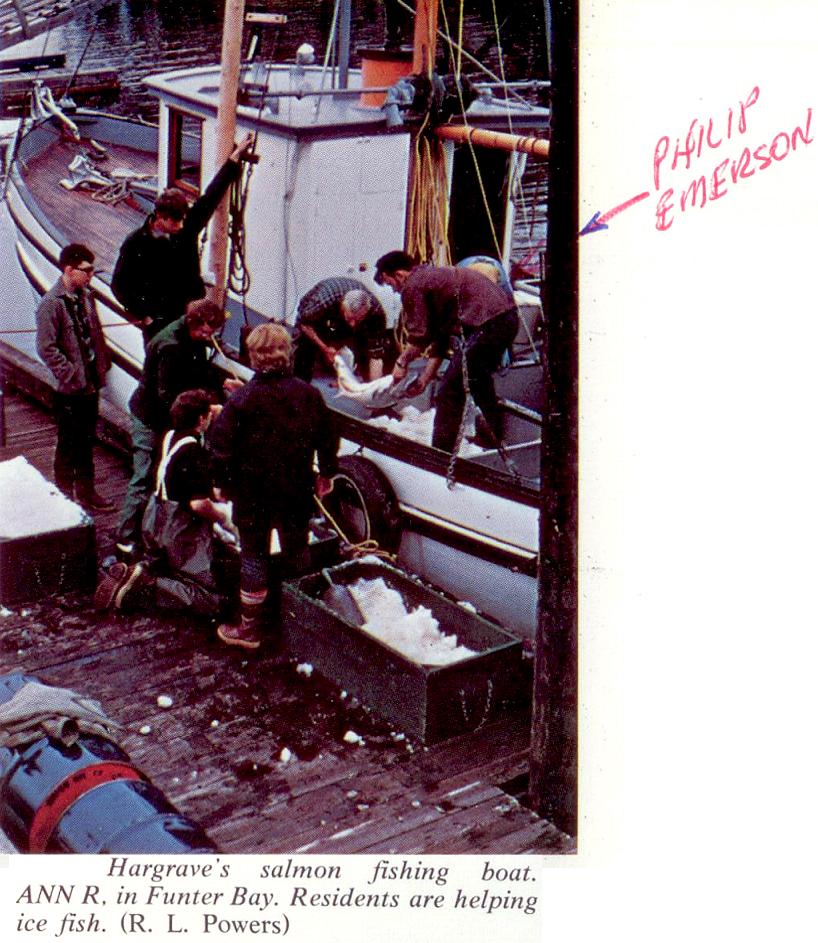
I’ll probably have another fishing update in the future, but to wrap this one up, here’s a picture from Alaska Geographic magazine with my Dad on Harold Hargrave’s boat. Thanks to Richard Powers of the Whaler’s Cove Lodge for giving me permission to use his photo! This was from the Summer 1973 issue  (Vol 1, No 3, “Admiralty…Island in Contention”).
Dad 1973


Funter Bay History – Dano Mine

May 27, 2013

The Alaska Dano Mining Co (aka Alaska Dano Mines Co, merged with Keystone Gold Mining Co) operated a medium-size mine at the South shore of Funter during the first third of the 20th century. Charles Otteson and Willis. E. Nowell were the chief developers of this mine. Some of the claims were apparently located by local prospector Richard Willoughby (more on him here).

dano closeup

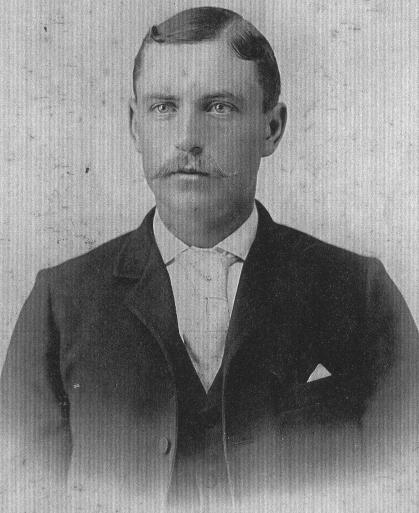
Charles Ottesen of Denmark left home early to become a sailor. He eventually ended up in Tacoma where in 1890 he married Mary Neilsen, also of Denmark. In the mid 1890s they moved to Juneau. Around 1900 (some sources say “prior to 1898”), Charles staked several mining claims around Funter Bay (some sources misspell his name as Otterson or Patterson). Both Charles and Mary lived and worked at Funter Bay and in Juneau, commuting back and forth in a sailing sloop. Charles later worked as a caretaker at Funter Bay until the late 1940s. Here’s a photo of the couple at Funter Bay.

Charles Ottesen:
Ottesen

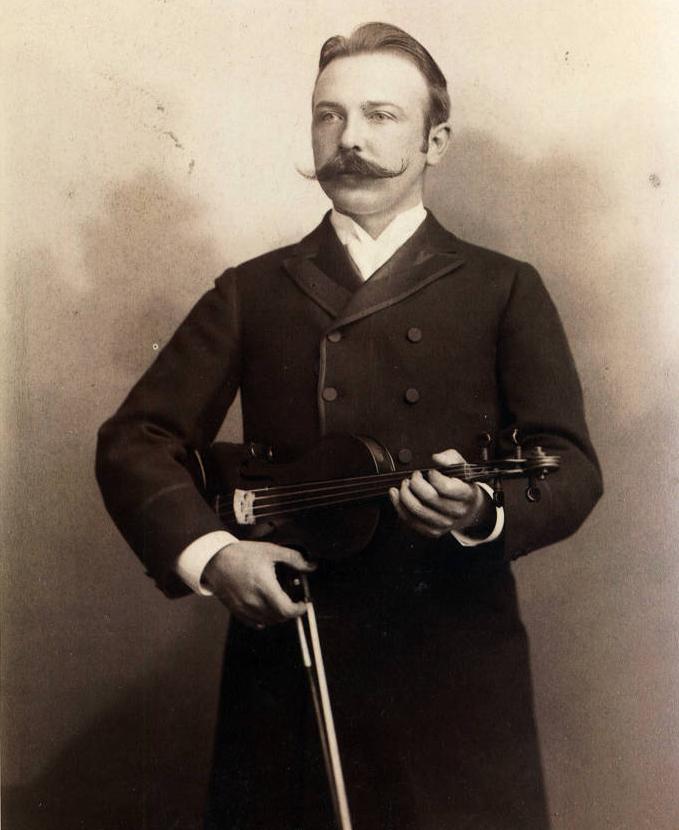
Willis E. Nowell came from a family of miners and mine managers. His father Thomas Nowell came to Alaska in 1885, along with his brothers George and Benjamin, helping to found the the Berners Bay Mining and Milling Co. The Nowell family did some mining elsewhere in the US, and was very active (though not always successful) in Juneau-area mining for several decades, including Berners Bay, Perseverance Gulch, Sheep Creek, Douglas, and other areas. Thomas’ son Willis Nowell Sr. was a prominent violinist, who switched his career to mining after visiting his father in Alaska. He continued to play the violin in Juneau. Willis also became an agent for the Alaska Steamship Company. Willis’ brother Frank was a noted photographer in Alaska. A street in West Juneau is named after the family.

Willis E Nowell with violin:
willis nowell
Courtesy of Alaska State Library, Nowell Family Photograph Collection, P402-03

Side note: I am tempted to start calling this blog “Funter Bay, a history of Mustache Enthusiasts”

The Alaska Dano / Nowell-Otteson mine included workings in several locations. Original claims and development occurred near the sandy beach at the South shore of Funter Bay. Later, the claims extended in a long swath to the SE, and included a longer tunnel high on the side of Mount Robert Barron (the apparent goal being to follow a “ledge” or vein, of quartz from its outcrop near the beach to a hoped-for “mother lode” in the mountain). The company built a corduroy road through the swampy muskeg from their beach camp to the base of the mountain, and trails to the various mine workings. They do not appear to have had much mechanization beyond ore carts, some small stationary steam engines, and the tractor for the road.  There were no major aerial trams or railroads (It’s possible that there was more equipment which was salvaged when mining wound down). The Dano mine later logged an area of old growth forest near the end of their road, leaving a clearcut which is still visible in infrared aerial photos.

Funter claims 1921

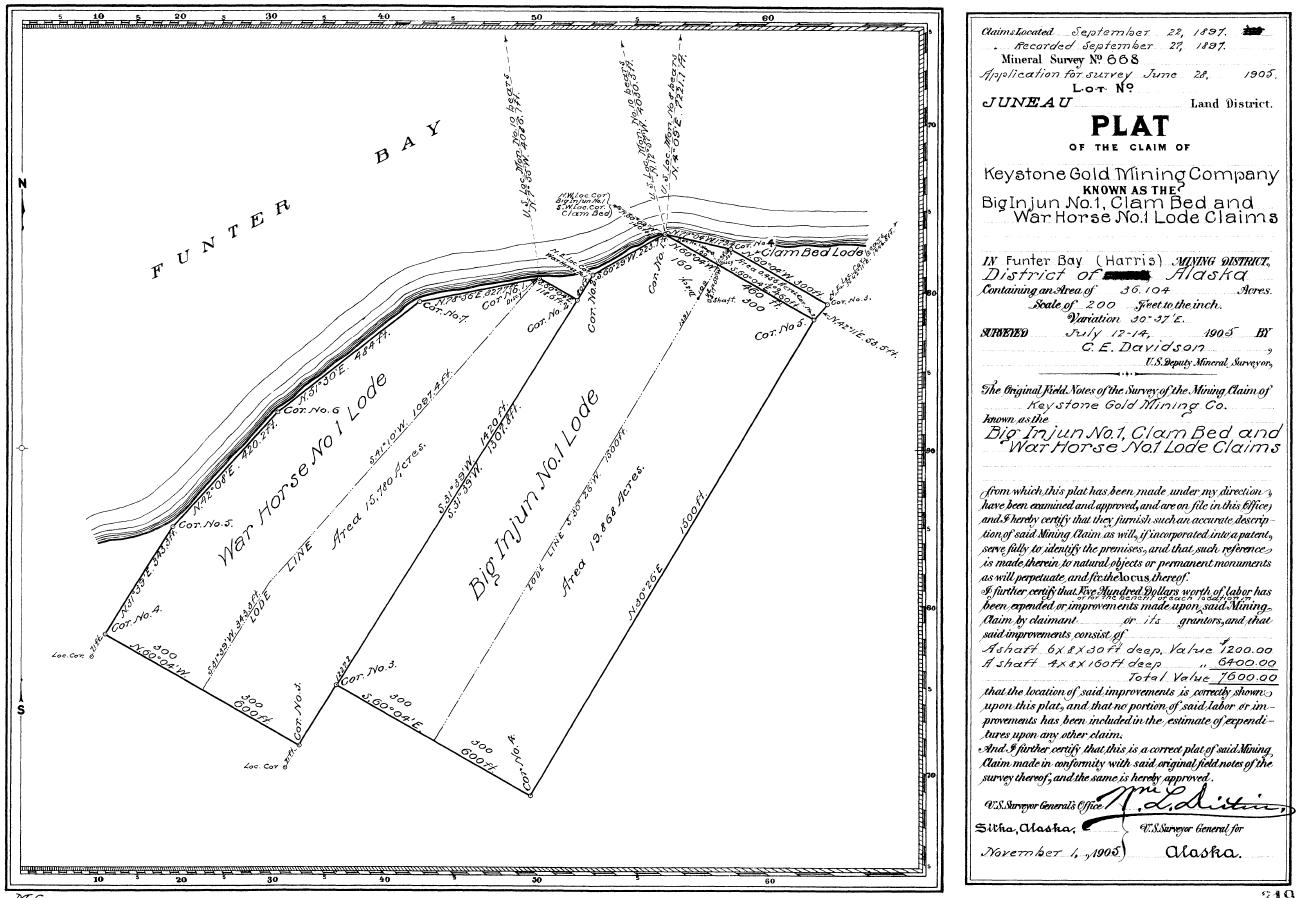
The first claims along the beach were staked by the Keystone Gold Mining Company in 1897. The War Horse Lode, part of Alaska Keystone’s properties, is listed as part of the Dano mine, so it is likely there was some consolidation of claims and mergers of companies (or different companies owned by the same people). There were several companies named “Keystone”in the late 19th and early 20th centuries, I am not entirely sure which, if any, were related. A 1906 government report notes that the Alaska Keystone Company did some development work on the War Horse Mine in 1897 and 1900, including a 48 and a 125′ shaft, and 320ft of drift. Ore was supposedly returning $100 of gold per ton. No work was reported between 1900 and 1906, although the company filed as a “foreign” (out of state) corporation in 1905. Later work on these claims is attributed to the Alaska Dano Mining Co, and the Dano company’s “Little Dandy” Lode was staked across the former War Horse and Big Injun claims of the Keystone company around this time. Also confusing is the appearance in the late 1920s of the “Williams Mine”, which was actually in Hawk Inlet on the other side of Mt. Robert Barron. Some modern-day documents refer to the upper Dano workings as the Williams Mine.

Keystone

Today, much of the beach property has been patented (made permanent private land, vs a temporary mining claim), and has been subdivided into private cabin lots. (Almost all of the sandy beach area above the high tide line is private property, if you are visiting Funter, please avoid trespassing).

The Dano operation does not appear to have had a permanent dock, relying instead on the smooth sandy beach and protected stream mouth in front of their camp to land boats.

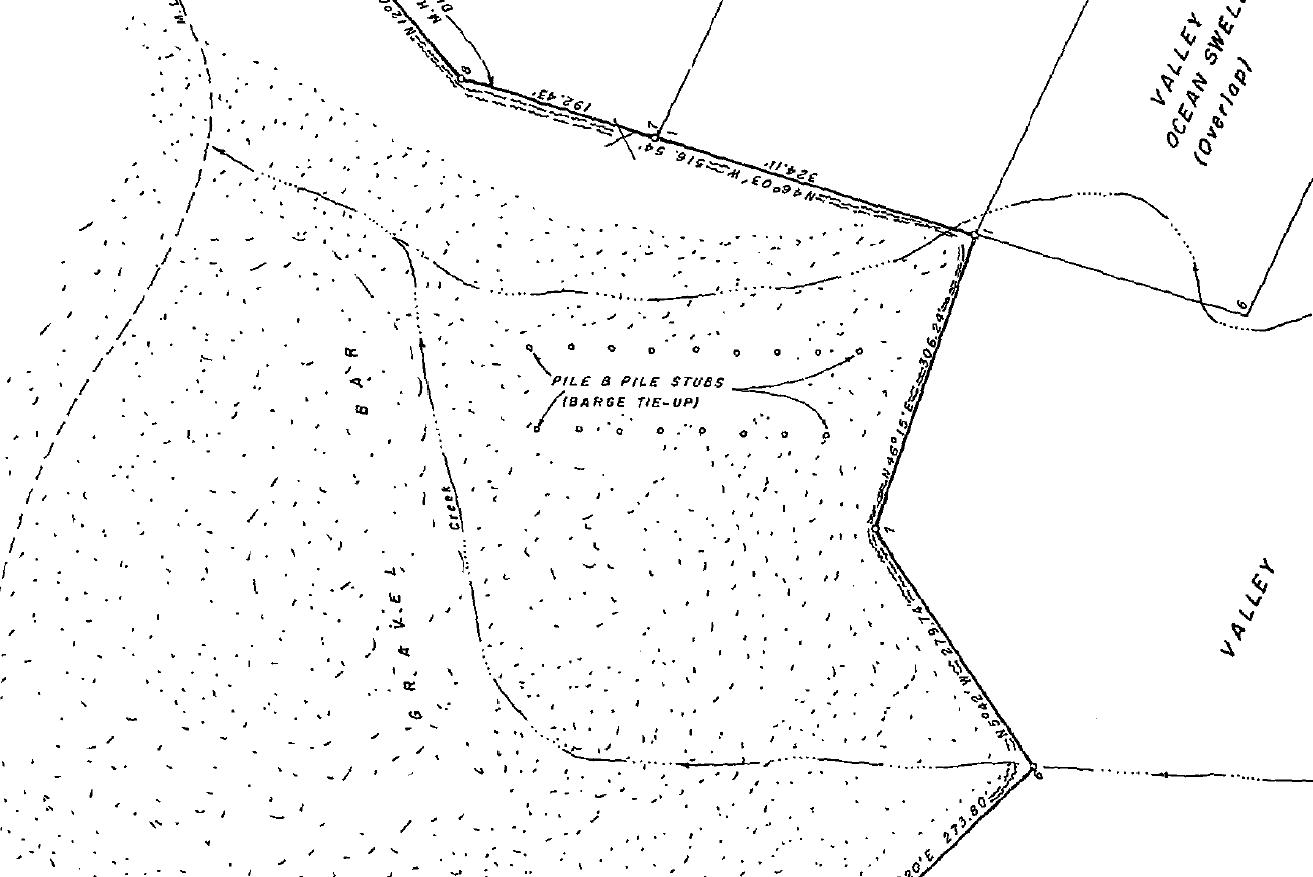
A barge tie-up on the tidal gravel bar at the mouths of Ottesen Creek and Dano Creek. (I previously had this listed as part of a cannery fish trap, but further review of the position, and the tidal location, leads me to believe it was related to the mine):
Pilings

dano 1921

A general timeline of operations at the Alaska-Dano:

(Context: Joe Juneau and Richard Harris “discovered” (were shown by natives) gold in Juneau in 1880. Mines quickly sprang up including the Treadwell, Perseverance, and other operations nearby. Prospectors soon spread out into the surrounding mountains and islands in search of more gold).

1868: Captain J.W. White of the survey vessel Wayanda notes some promising geology at Funter Bay.
1880:
George Pilz (who bankrolled Harris and Juneau) finds some gold at Funter Bay (per Roderick).
1887:
Prospectors Richard Willoughby and Aaron Weir (or C. Weir or Ware?) stake some claims at Funter Bay. (per Roderick’s Preliminary History and others).
1889:
The Nowell Company bonds some of “Willoughby and Ware’s” claims for $50,000. Nowell spent several thousand on development, backed by an Eastern Company, but one report states that they abandoned the initial dig since the ledge (vein) dried up as it got deeper.
1897
: Gold deposit discovered near the sandy beach, War Horse Mine development begins.
Pre-1898: Otteson stakes various claims at South shore of Funter Bay.
1900: Two shafts had been dug (50ft and 125ft), and 320ft of tunnel (This is probably the work of the Keystone Gold Mining Co).
1905: The Keystone Gold Mining Co files as an out of state corporation.
1916: “Otteson Group” of claims staked.
Before 1919: A “good trail” had been built from the bay to the top of Mount Robert Barron, and a 200′ tunnel was driven at an elevation of 1,050 feet.
1919: Geologist J.B. Mertie notes promising quartz outcroppings at the “Nowell Otterson” group of claims.
1920: The Alaska Dano company is formed.
1921: The company reported a large amount of “free gold”. 100′ of tunnel and a winze (angled shaft) had been dug.
By 1922 they had another 250′ of tunnel.
1924 and 25: “A limited amount of development work” was done.
1926: Some prospecting work was done, but no production was reported.
In 1927, Only the minimum work to maintain claims was done.
In 1928, “Prospecting work only” was carried out.
1929: “A little development work” included driving 76 feet of tunnel. The Williams Mine apparently had some leasing discussions with Dano.
1938: Property listed as “Idle”, with “Intermittent development”
1945: Willis Nowell passed away, his family applied to secure his stock in the Alaska-Dano mine.
1955: Charles Ottesen passed away.
1960s: Fred Eastaugh became involved with the property.
1968-69, the Dano company did some logging.
A 1981 report mentions that 265ft of tunnel was dug after 1900, and that only 100oz of gold was produced (some documents indicate that more was run through a neighboring mill under contract, and the output would be higher if listed seperately)
1991: Fred Eastaugh listed as president of the Alaska Dano Mines Co.
1994: Some surface mapping and sampling performed.
1996: “Alaska Dano Claimants” performed limited sampling and re-staked claims on federal land adjacent to the patented claims.

It appears the Dano’s investment money dried up during the 1920s and never really reappeared. The major workings completed included a 400′ tunnel, several shorter tunnels, some relatively shallow shafts, various open cuts, the road, timber clearcut, and other minor work.

Despite apparently limited returns, activity never quite stopped at the Dano claims. After the big gold finds in the Juneau area, prospectors were always hoping to find the “next big thing”, even into the 80s and 90s. The Greens Creek Mine across Mt. Robert Barron turned out to be the “next big mine” of recent times, and more recently the Berner’s Bay mines have begun reopening. Today, there is renewed interest in some other area mines, as gold prices continue to rise. Mining companies continually poke at the Juneau mines hoping to get approval to re-open. Dano maintained most of their claims, and continued doing development work to meet the maintenance requirements. The logging operation may have been an attempt to make more profit from the property outside of mining.

Present-day remains:

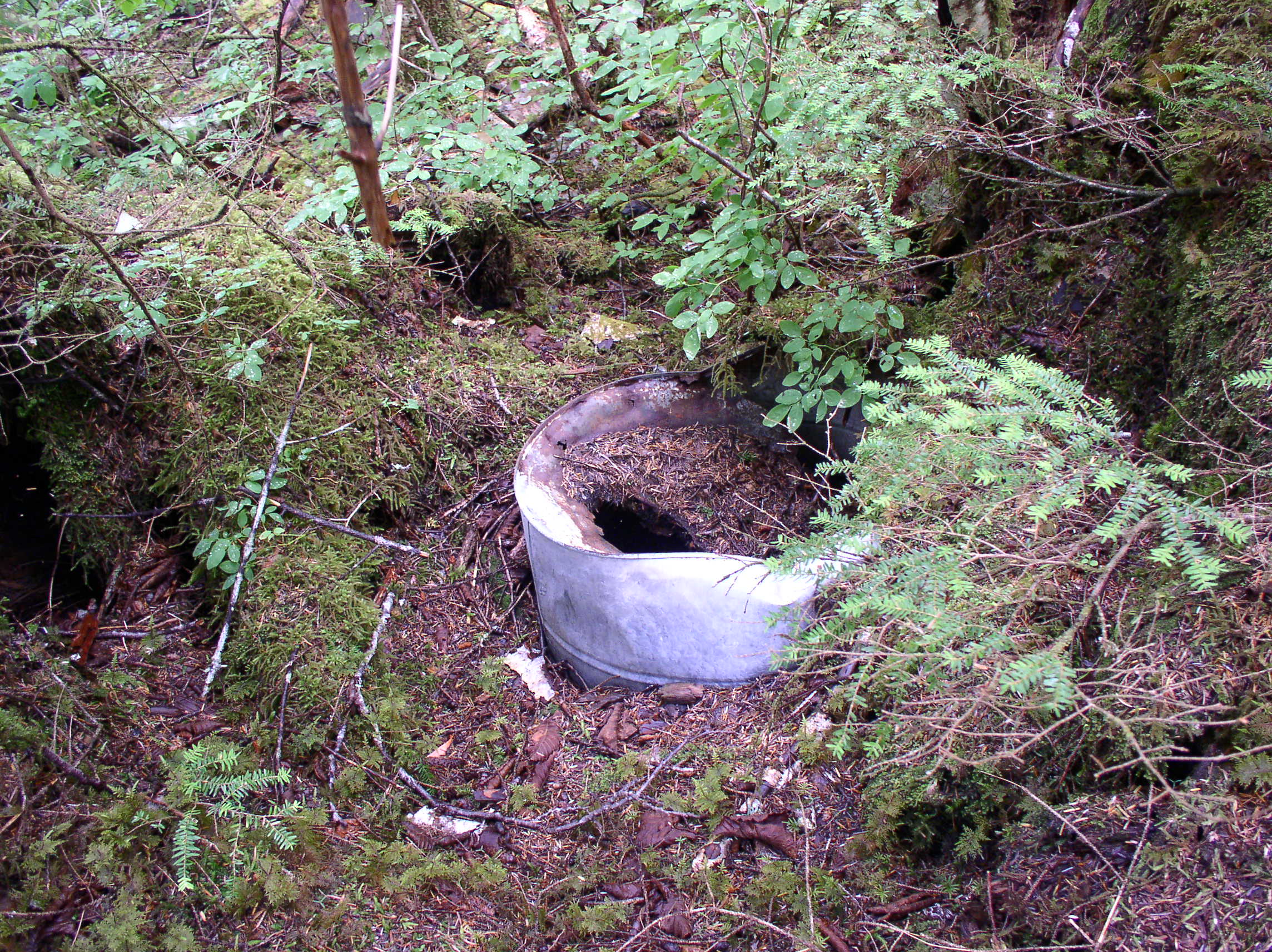
There are still a few remains of the Dano camp near the beach. Early work included a few open cuts, shafts, and tunnels. The most prominent remaining feature is the steam boiler which probably powered their shaft hoists and possibly other equipment.

Directly in front of the boiler is a semi-collapsed shaft, with a few logs over it and a metal pipe leading down into it (probably for a dewatering pump). Some of this wood might be the remains of a small headframe:

0a-dano-shaft-boiler

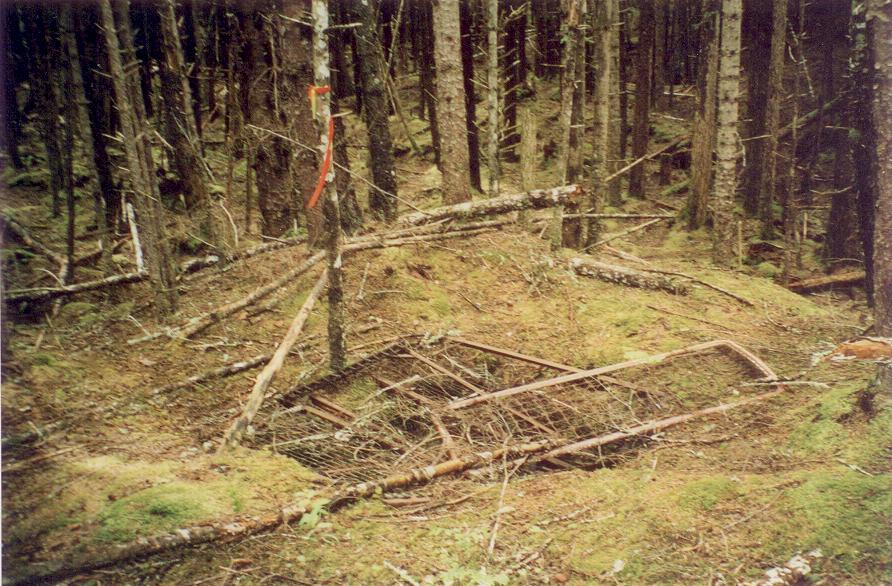
Another shaft nearby. This one has been made “safe” in the time-honored tradition of Western mining: Throw some bed frames over it and call it a day:

0a-dano-shaft2

Part of a winch found nearby, which may or may not be related to one of the shafts (it could also be part of a boat):

OLYMPUS DIGITAL CAMERA

Shorelines around Funter Bay tend to come in “benches” that show where the sea level used to be. This is not due to sea level dropping, but the land rising! After the glaciers retreated, the ground tended to “bounce back“, and raise a bit. Travelling inland from the water, you would generally observe a 10′ dropoff just below extreme low-tide line, a 10′ bluff a little above extreme high-tide line, and another 10′ bluff back in the woods where the old high tide line was (you can find clamshells near the back bluff that aren’t old enough to be fossils, showing that the change was fairly “recent”).

Below is a tunnel into the back bench behind the Dano beach camp. It was fairly unstable and flooded, I would not recommend going into this (or any) tunnel:

OLYMPUS DIGITAL CAMERA

Eventually, the near-shore deposits either proved marginal, or the difficulty of digging shafts near sea level caused the miners to move farther back from the shore. The Dano claims stretch all the way to the top of Mount Robert Barron, and I believe there are some small shafts very high on the mountainside (At the “two shafts” lode).

Dano claims (shaded), and tractor trail to the base of Mt. Robert Barron:

OLYMPUS DIGITAL CAMERA

The main adit, was located closer to the base of the mountain, next to a small waterfall on Dano Creek. The corduroy road up to this mine is marked on various topo maps as a trail, a tractor trail, or a road. Likely the mine used a gas crawler tractor to haul supplies and equipment up to the adit from the beach.

Part of the Dano mine’s corduroy road:

OLYMPUS DIGITAL CAMERA

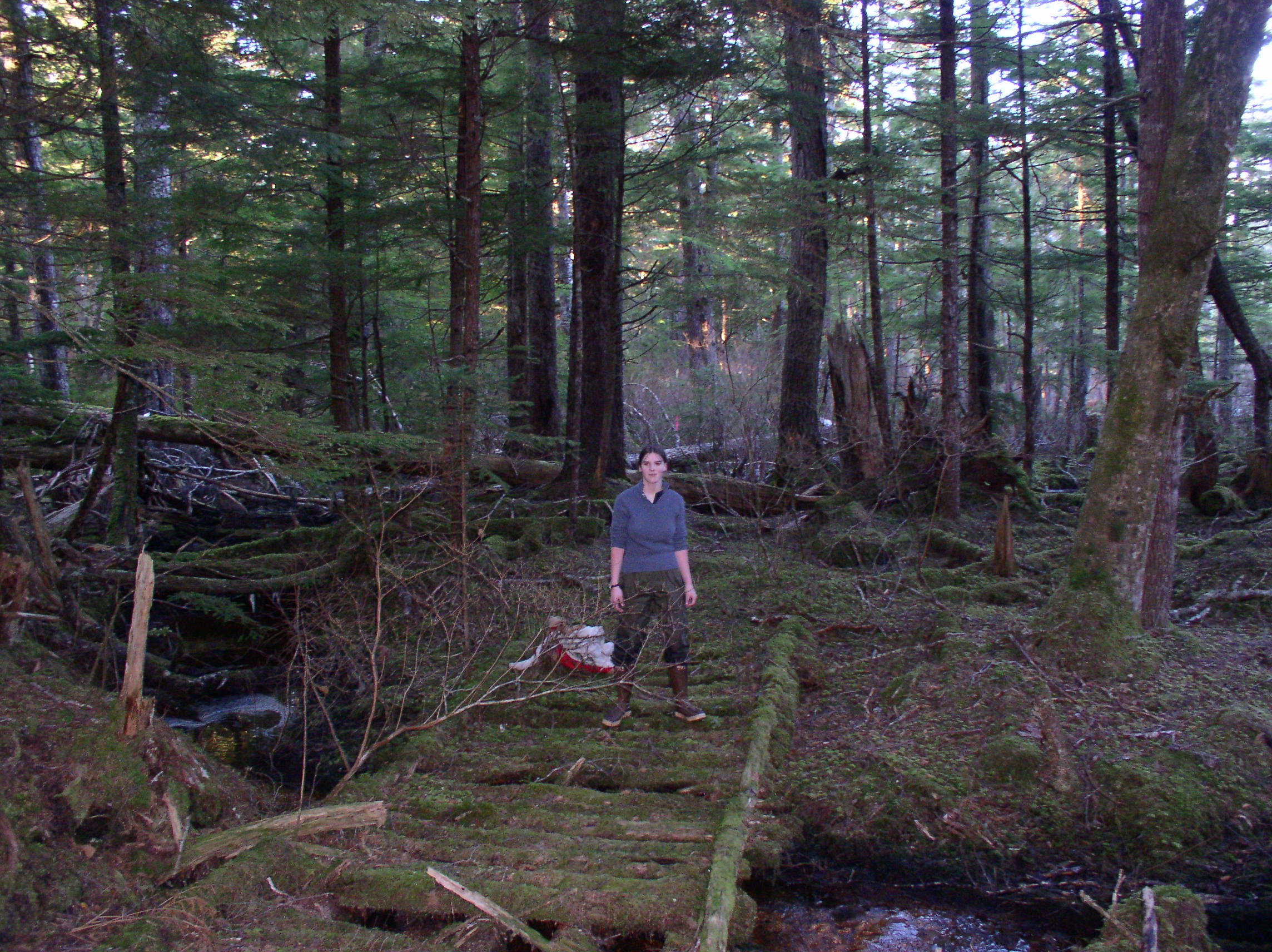
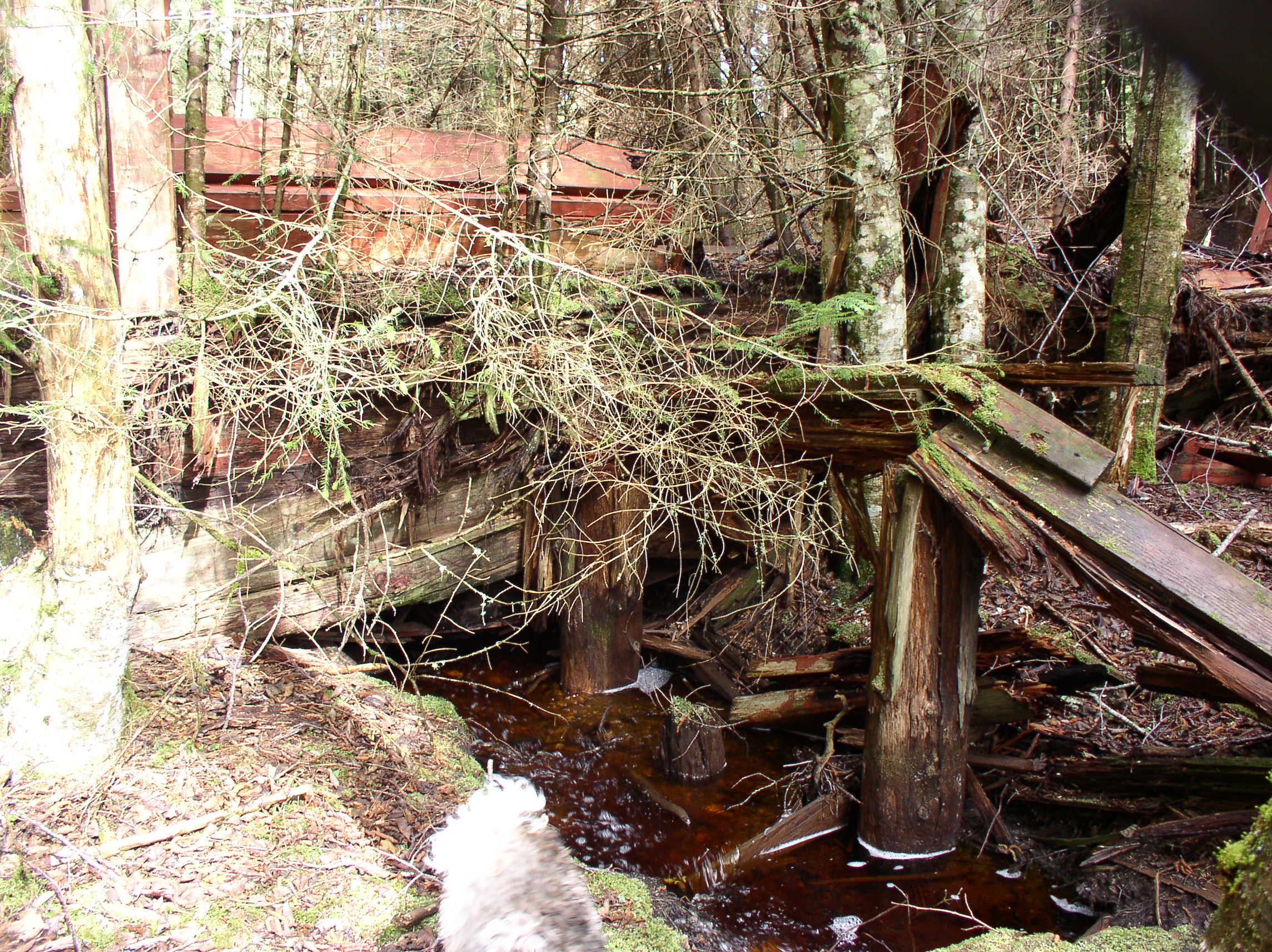
A bridge on the Dano road over a small stream:
OLYMPUS DIGITAL CAMERA

Not much is left of the road, most of the corduroy has rotted back into the ground cover. It’s still possible to follow it with some bushwhacking, but it’s not really a useful or passable trail. Beavers have dammed up parts of the muskeg along the way, flooding the route of the former road in a few places.
Higher on the mountain, a few more signs of the Dano Mine are visible. This is a cabin site near the mine’s upper tunnel (sometimes referred to as the Otteson Mine). There’s not much left of the cabin aside from some logs, metal bits, and stove parts.

OLYMPUS DIGITAL CAMERA OLYMPUS DIGITAL CAMERA OLYMPUS DIGITAL CAMERA

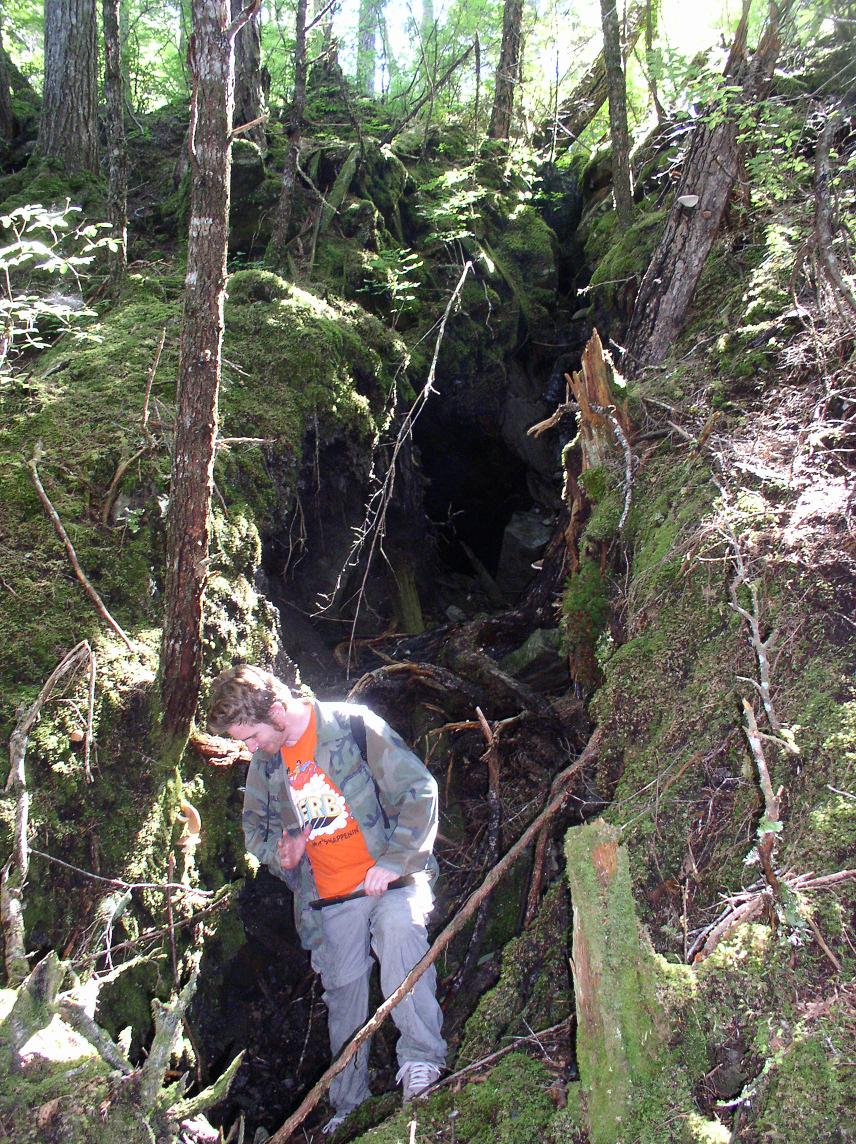
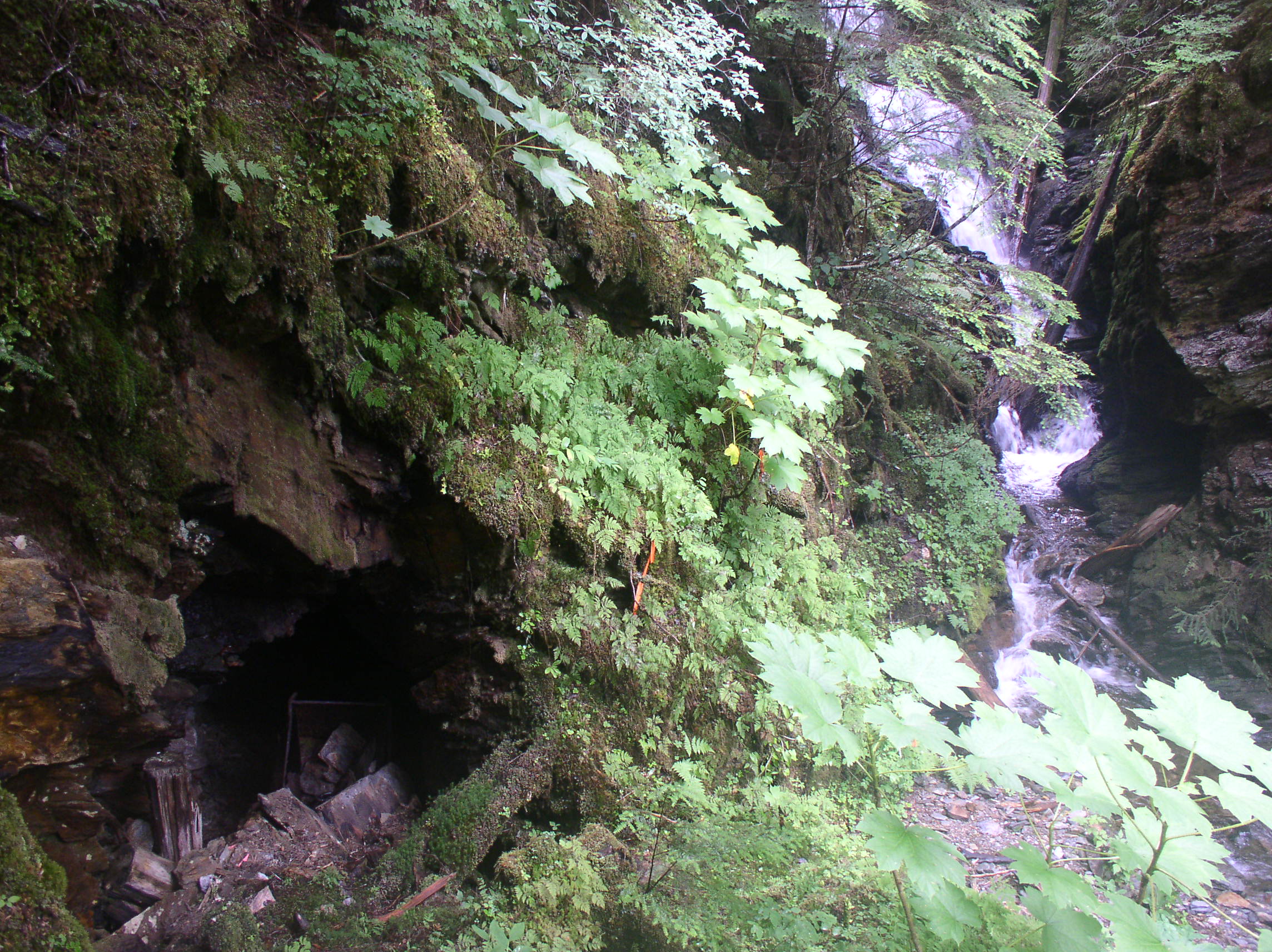
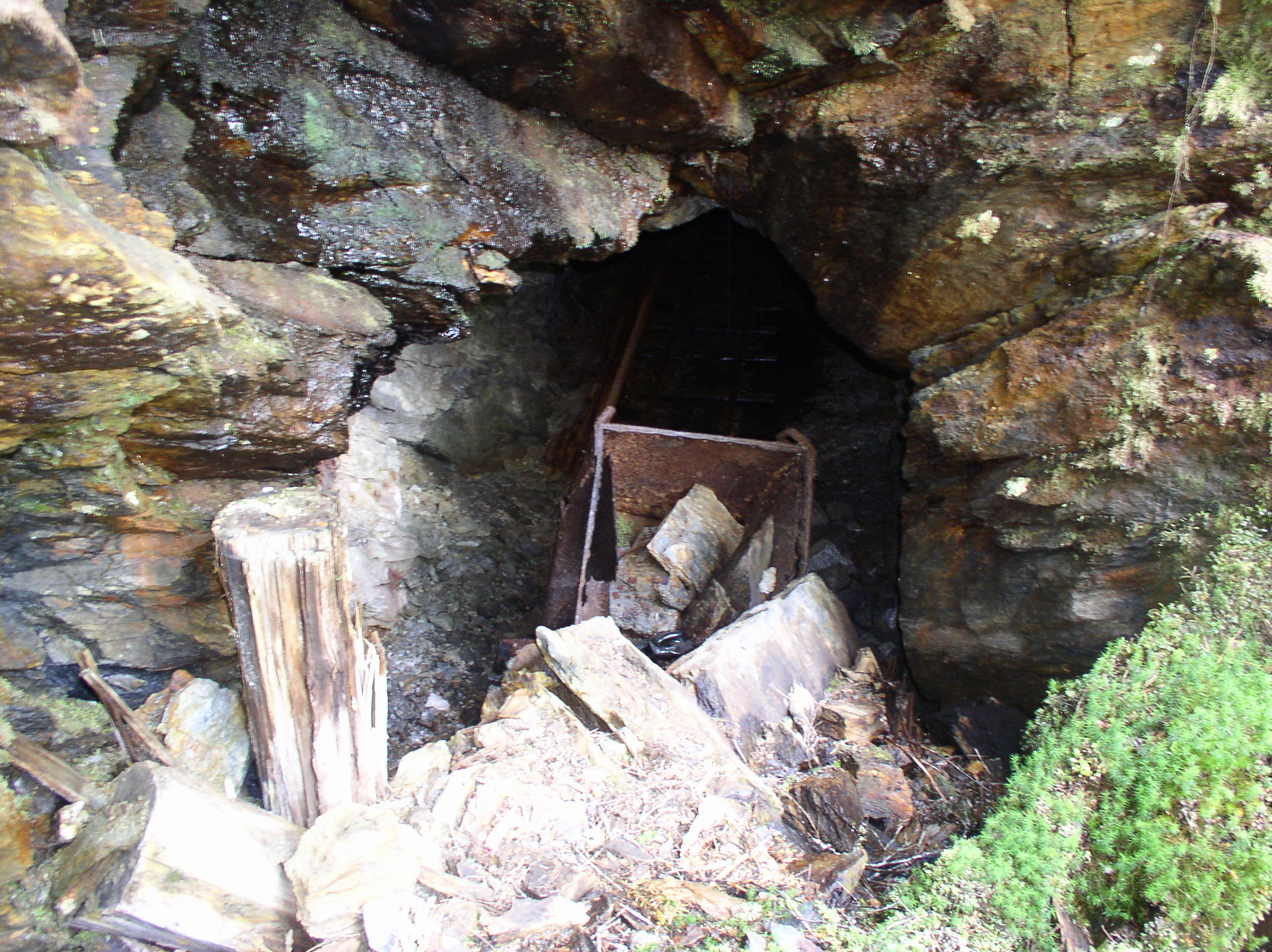
The mine adit (tunnel entrance) is immediately adjacent to Dano Creek. Mines in Southeast tend to be damp due to the high humidity and prevalent groundwater, but there is likely even more flow into this tunnel due to the stream. This has probably contributed to some of the collapse near the entrance.

(Note: I do not recommend that you go in any mine workings. They are often dangerous, unstable (as seen below), and many are still private property).

OLYMPUS DIGITAL CAMERA

The adit has collapsed somewhat, crushing this ore car:

OLYMPUS DIGITAL CAMERA

OLYMPUS DIGITAL CAMERA

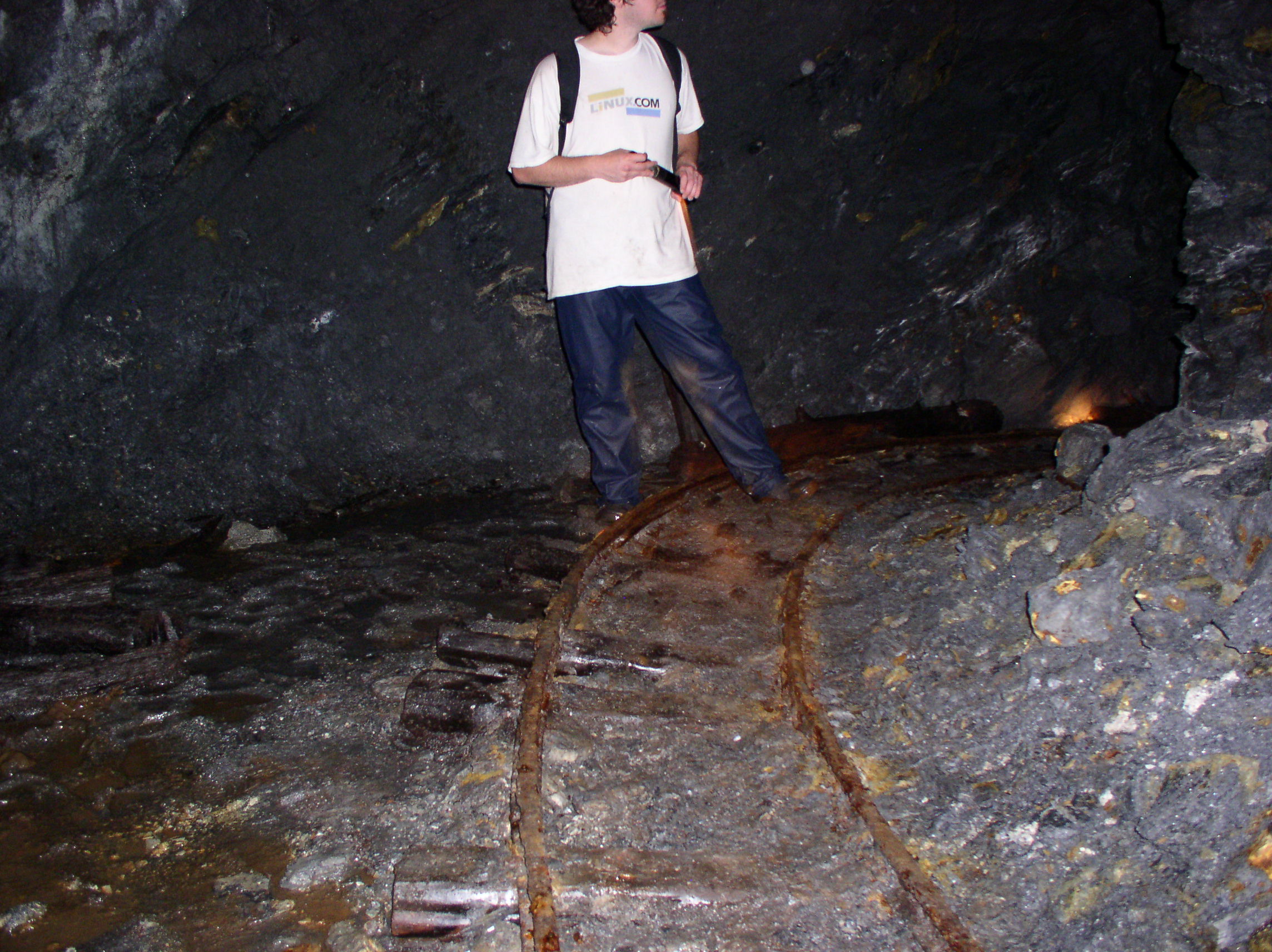
Inside the tunnel, tracks along the floor are still in decent condition, despite the high humidity:

OLYMPUS DIGITAL CAMERA OLYMPUS DIGITAL CAMERAOLYMPUS DIGITAL CAMERA

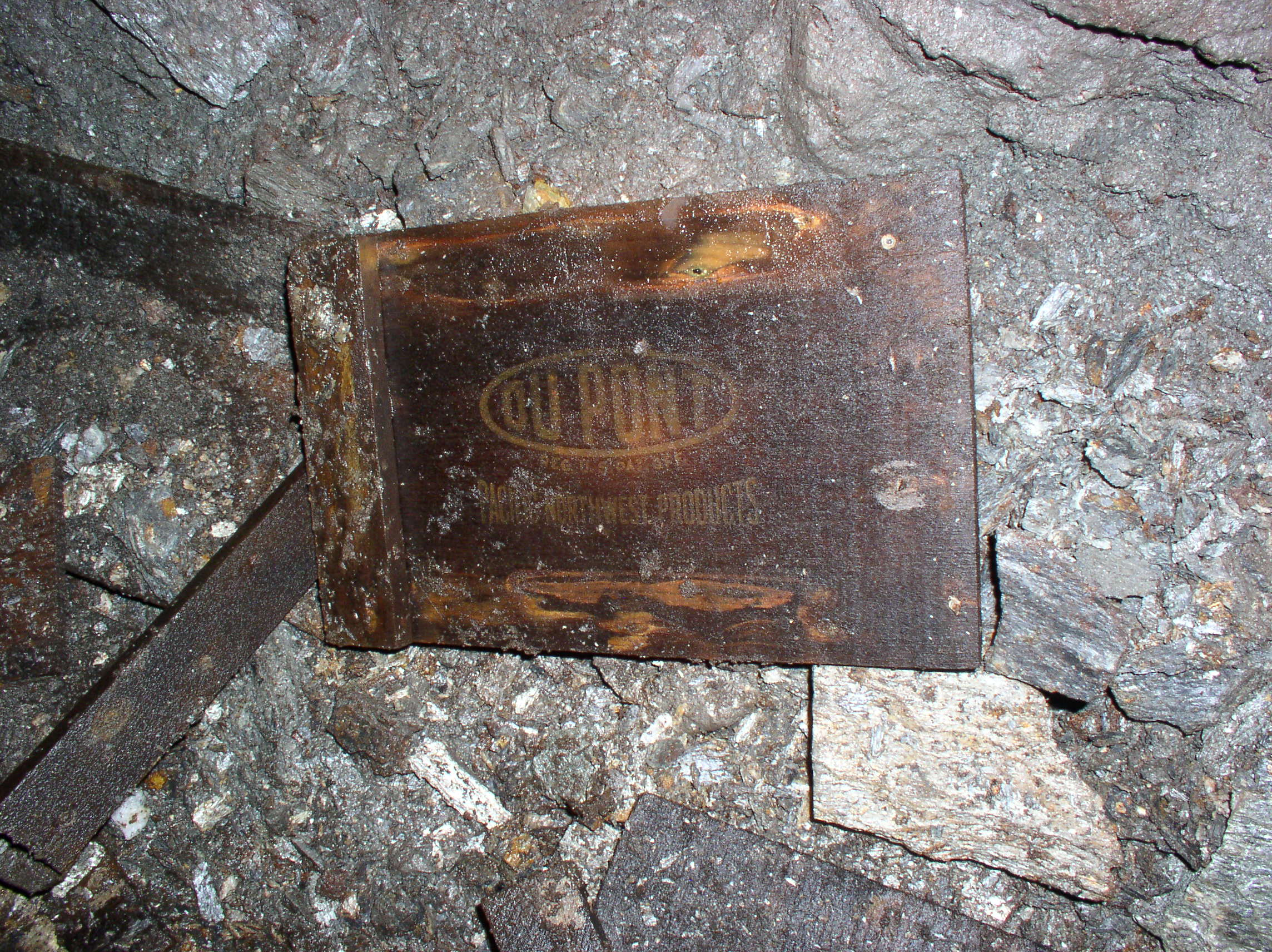
Part of a Dupont dynamite box:OLYMPUS DIGITAL CAMERA

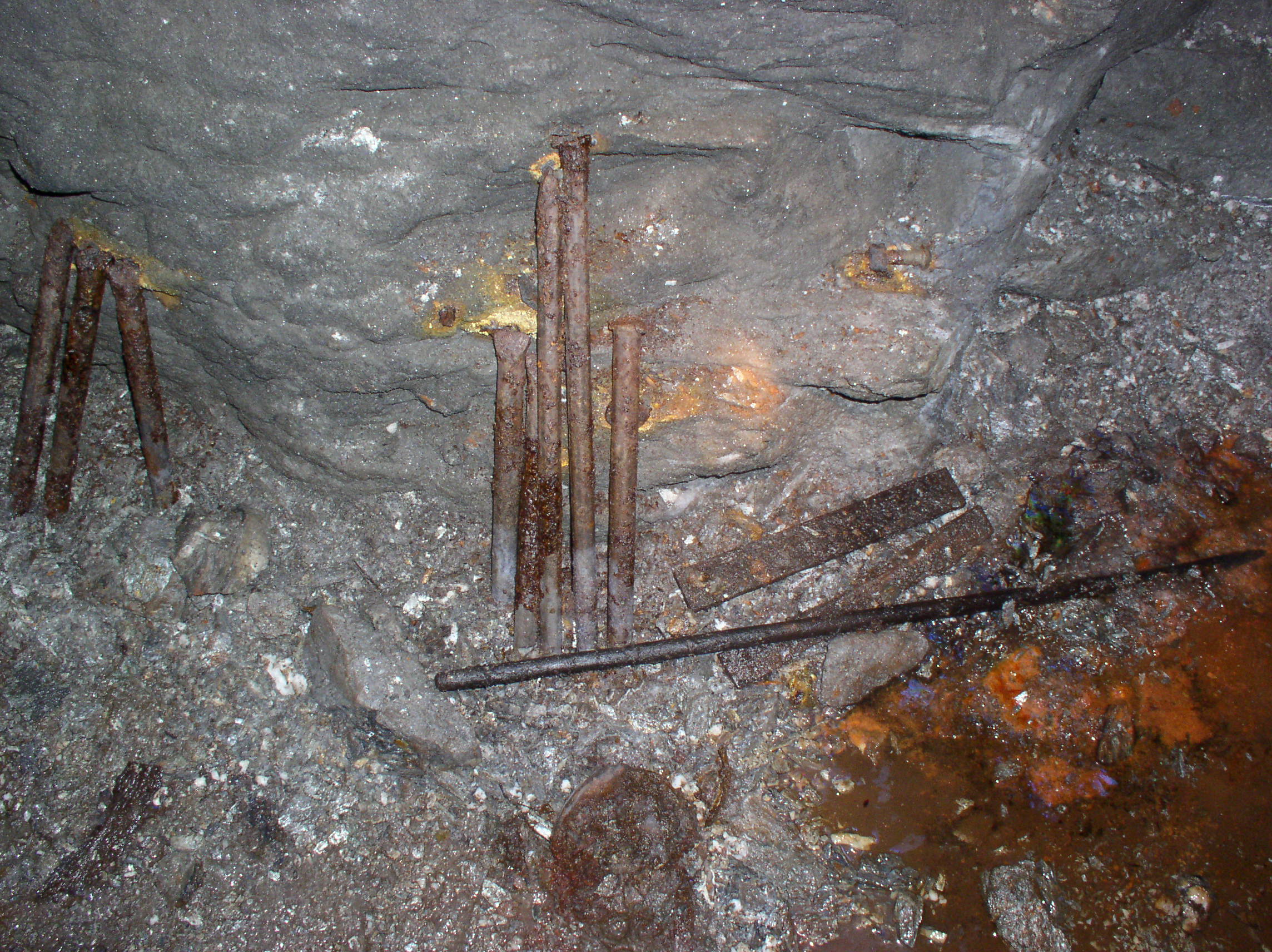
Tools and a rail bending jig (The C-shaped thing):

OLYMPUS DIGITAL CAMERA

Drill bits:

OLYMPUS DIGITAL CAMERA

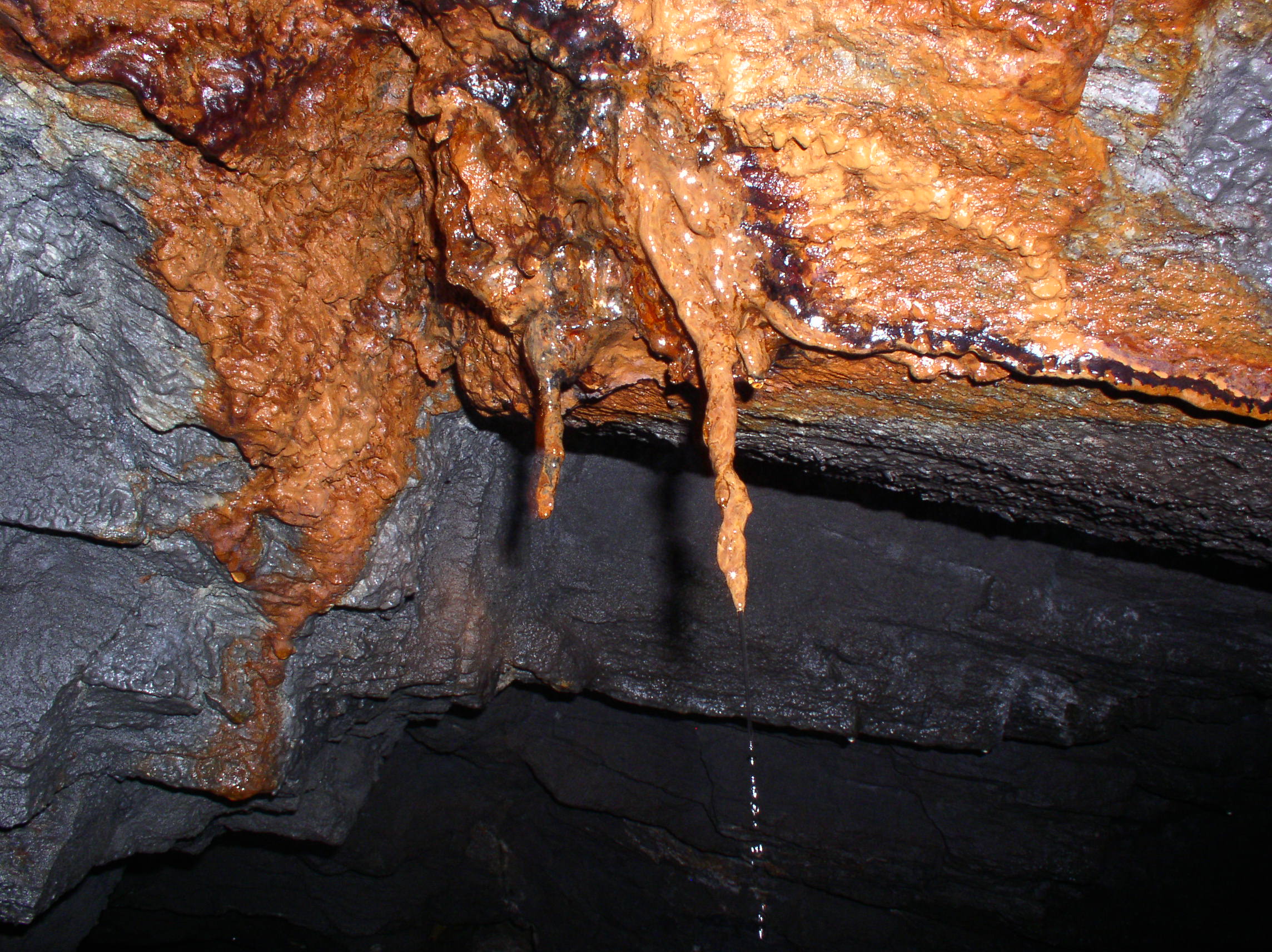
Iron leeching from a metal ore vein with water pouring off an iron stalactite:

OLYMPUS DIGITAL CAMERA

Below is one of the “fun surprises” of old mine tunnels; hidden shafts! You can be walking along, and suddenly the “rock” you think you’re standing on turns out to be a thin layer of mud or dirt over rotten boards and a deep pit. This one is flooded, so at worst you’d get a dunking, but others can drop you into a death trap:

OLYMPUS DIGITAL CAMERA

That’s all I have on the Dano mine for now!


Funter Bay History: Assorted Cannery Things

May 24, 2013

During my research on Funter Bay, I’ve come across a few bits and pieces that slipped through the cracks of earlier posts. Rather than going back and shoehorning them in, I figured I’d combine some of them into a mini-update. I’ll probably have more of these as more stuff shows up.
Here is a can of Peasant Brand pink salmon, packed at Funter Bay around 1909. This was found in an attic. Much thanks to Brian Mahaney for giving me permission to post his photos! His flickr page can be found here.
Peasant Can 1 medium Peasant Can 2 medium

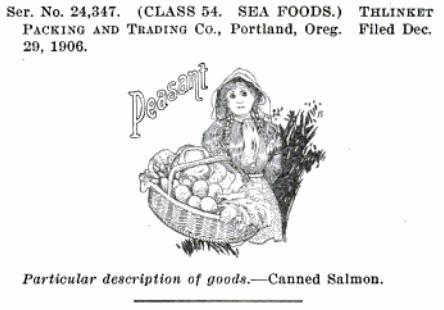
Note that the label art has changed slightly since the 1906 trademark filing (mentioned in an earlier post):
Peasant Brand 1906

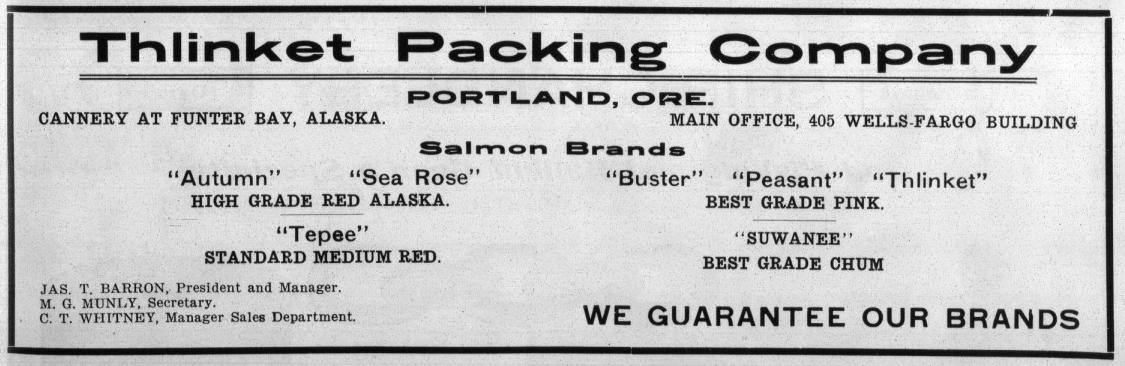
An advertisement for the Thlinket Packing Co’s brands from 1906, which appeared in various magazines such as Pacific Fisherman:

ad 1909

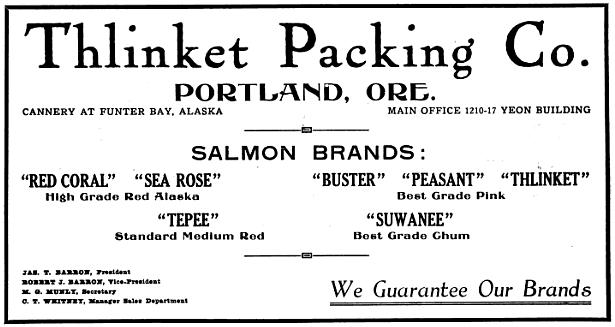
An advertisement from 1918, only slightly changed from the above:TP Co Ad 1918

As posted before, here is the 1907 can label for the “Buster” Brand, featuring Cannery owner Barron’s son Robert:
busterbrand

By the 1950s, the new owners (P.E. Harris Co) were still carrying the Buster brand, but the label had changed (Red, often with blue, seems to have been the standard color for most canned salmon of that time period:
Buster1950s

The Suwanee brand seems to have gone to the New England Packing Co. Here’s a mid-century example of that label.

Here’s a great write-up on Alaska salmon cans, from the Alaska State Musem.

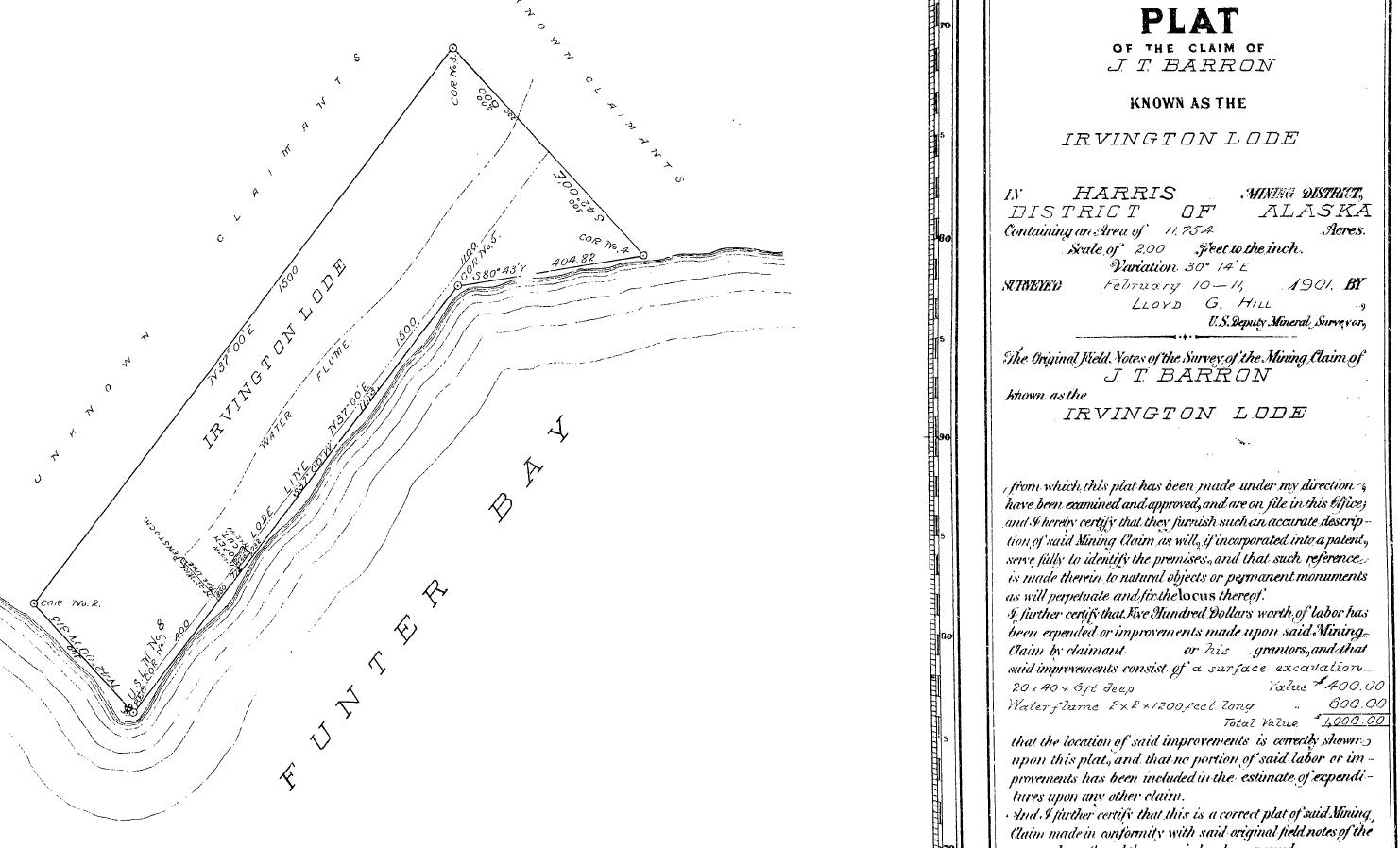
Moving away from cans and back to land ownership, below is an early draft of the survey for J. T. Barron’s “Mining Claim”. In 1901 he already had a water line and pipe at the property which was to become the cannery. He also had a small “Open Cut” prospect which was the basis of the mineral claim (although as mentioned, no actual mining was ever done).
1901 Irvington

And finally, here are some more bits and pieces of Funter cannery trivia:

The cannery tender Anna Barron had a new tail shaft (prop shaft) installed in August of 1916. James Murphy was the chief engineer on the steamer.

A 1918 news article reported that the first “C-O Engine” (Crude Oil engine) in Alaska had been installed in the cannery tender Barron F of Funter Bay. C-O engines predated diesel and could run on anything from used motor oil to butter!  More on the Barron F is here.

The cannery tender Fairweather, belonging to the P.E. Harris Co, sank at Cordwood Creek on July 18, 1930. Captain C. Nesset was in command, but one of the deckhands was steering, and the vessel hit a rock when he fell asleep at the wheel. Captain J.V. Davis refloated the vessel and towed it to Funter Bay for repairs the next day. (P.E. Harris bought the Funter Bay cannery in 1941).

The Anna Barron rammed the tug Henry Finch while docking at Douglas near midnight on July 22, 1930. There was some damage to the tug.

A 1932 report mentioned that there were two canneries at Funter Bay. They may have been referring to the fish buying station as a cannery, or they could have meant the saltery.