Funter Bay History: Museums, Collections & Science

July 29, 2016

Some of the feedback I get on my Funter Bay History posts involves people wanting to buy or collect old “stuff” (engines, artifacts, etc). In general I believe historic artifacts should be left where they are unless seriously threatened by decay, development, or vandalism. So for example, I’d like to see things like Funter’s big gas engines remain cool lawn ornaments, but the various steam locomotives upside down in creeks and ditches around Southeast Alaska would be better off in museums somewhere.

Artifacts from Funter Bay have made their way into a variety of museums, historic collections, and scientific archives over the years. Here are a few that I’ve come across during my research.

A rock sample from the Willoughby Mine, “Shore Group”, from a private collection:
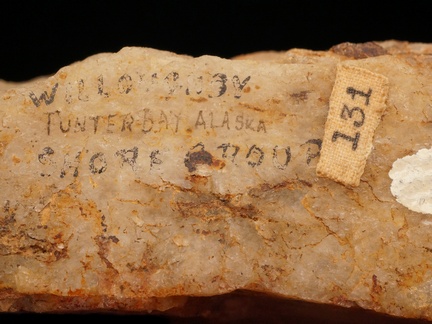
IF

A rock core sample from Borehole U-18 at Funter Bay, stored at the Alaska Geologic Materials Center.

Three pieces of Funter Bay Clay were exhibited in the Alaska Building at the 1904 Louisiana Purchase Exposition as part of James Lathrop’s private mineral collection.

The Alaska State Museum holds a number of mineral and rock core samples from Funter Bay, as well as a fossil ammonite and a stone pestle (native grinding tool) found there.
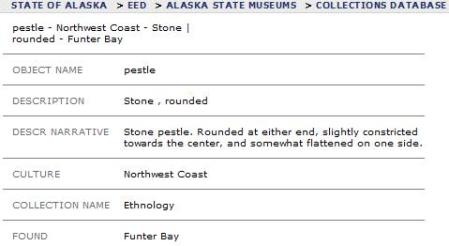
pestle

The Juneau-Douglas City Museum has a number of items from Funter Bay, including a gGrape soft drink bottle, a soda water bottle, a Pelton wheel part, and a small motor. They also have a number of Funter Bay documents, including  cannery and saltery applications, a canned salmon label I’ve previously mentioned, and various invoices and receipts for things like dynamite, transportation, and jury duty.

In addition, a number of research papers and scientific studies have involved Funter Bay:

In 1903, the Bureau of Fisheries steamer Albatross collected seabottom samples around Alaska, including near Funter Bay. Some data from these samples appears in several articles over the following decade. Many of these appear to have been found in a single dredge sample of mud hauled up from about 300 fathoms in Lynn Canal, just off Funter Bay.

In 1905 and 1908 articles on Polychetous annelids (marine worms), author J. Percy Moore noted many such worms in the seabottom mud near Funter Bay. These included plentiful specimens of Lagisca rarispina (Sars) Malmgren (now known as Harmothoe rarispinia), as well as specimens of Nephthys ciliata, Goniada annulata Moore, Ampharete arctica Malmgren, and Melinna denticulata Moore. The latter species was observed for the first time at the Funter Bay sample location. The distribution of this species is listed as “Funter Bay, Alaska”, and a specimen is held by the Smithsonian Institution.

Another creature first discovered near Funter Bay (collected by the same Albatross expedition) is Koroga megalops Holmes, a type of arthropod commonly known as a “sand flea”. This particular species has later been found all over the world.

Koroga megalops Holmes

A smaller arthropod known as Holophryxus alaskensis Richardson was also found in the Funter Bay samples, named after discoverer Harriet Richardson in 1905.

Also collected by the Albatross were a variety of fish and plankton including Stenobrachius nannochir (Commonly known as a Garnet lanternfish), Lycodapus grossidens Gilbert (Bigtooth eel), Holomesiella Anomala (a type of tiny shrimp),

A 1910 Bureau of Fisheries inventory collected 12 specimens of Pallasina barbata (tubenose poacher) from Funter Bay. These are frequently found in eelgrass and around dock pilings.

In 1921, the USDA’s Microbiological Laboratory collected samples of seawater at Funter Bay, and found Bact. aerogenes present (link, pg 85-109). It was assumed to be widely distributed through the region based on other samples. (While I am not an expert on microbiology, it appears this organism is now known as Enterobacter aerogenes and is a common gastrointestinal bacteria in animals and humans).

Researchers from the University of British Columbia visited Funter Bay in 1957 while conducting  a fisheries study. Several specimens were collected around Funter Bay, including Oligocottus maculosus (Tidepool sculpin), Pholis laeta (Crescent Gunnel), and Anoplarchus purpurescens (High cockscomb). When I was younger we would commonly catch these small fish in tidepools and under rocks.
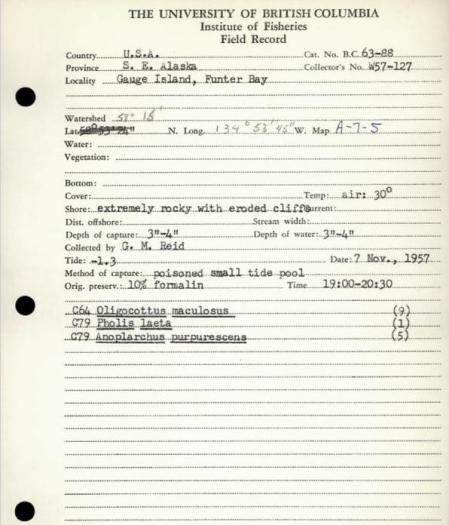
UBC Fisheries Record

Speciments of Agarum cribrosum Dumortier (a type of seaweed) were collected by the University of British Columbia at Station Island, in the mouth of Funter Bay, in 1980.

There is a type of soil classified as the “Funter Series” or “Funter Peat” under a 1991 soil classification survey. It is described as “very deep, very poorly drained soils that formed in fibrous peat underlain by loamy mineral materials. Funter soils occur in muskegs on floodplains and stream terraces. Slopes range from 0 to 5 percent”. This is found mostly in the meadows around Funter Bay.

Blackeye Goby and Kelp Perch were sampled at Funter Bay in 1998 by biologists at the Auke Bay Laboratory.

A specimen of Enypia venata (variable Girdle Moth) was reported at Funter Bay in a 2012 paper.


Funter Bay History: Cannery Shipping and Maintenance

June 30, 2016

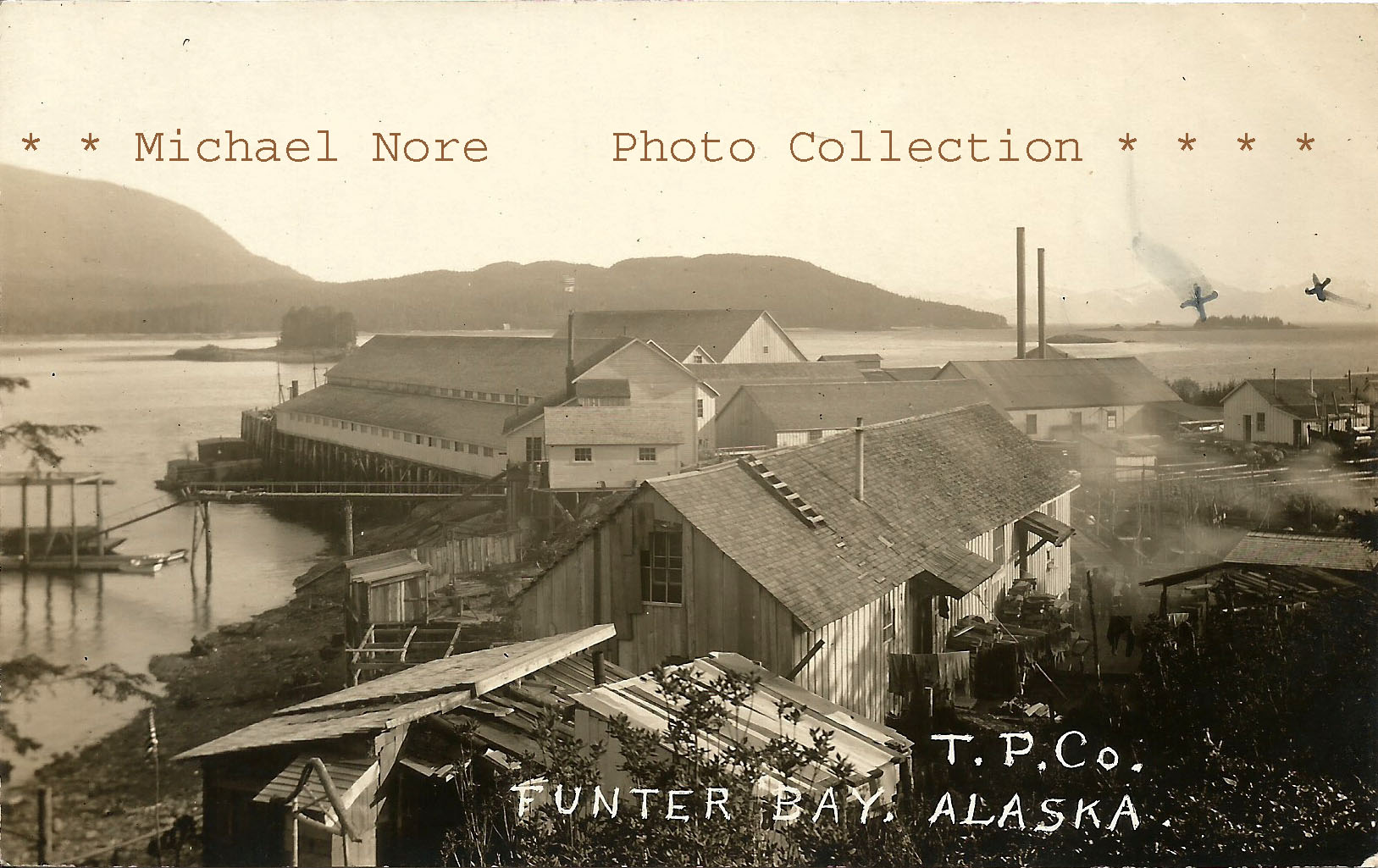
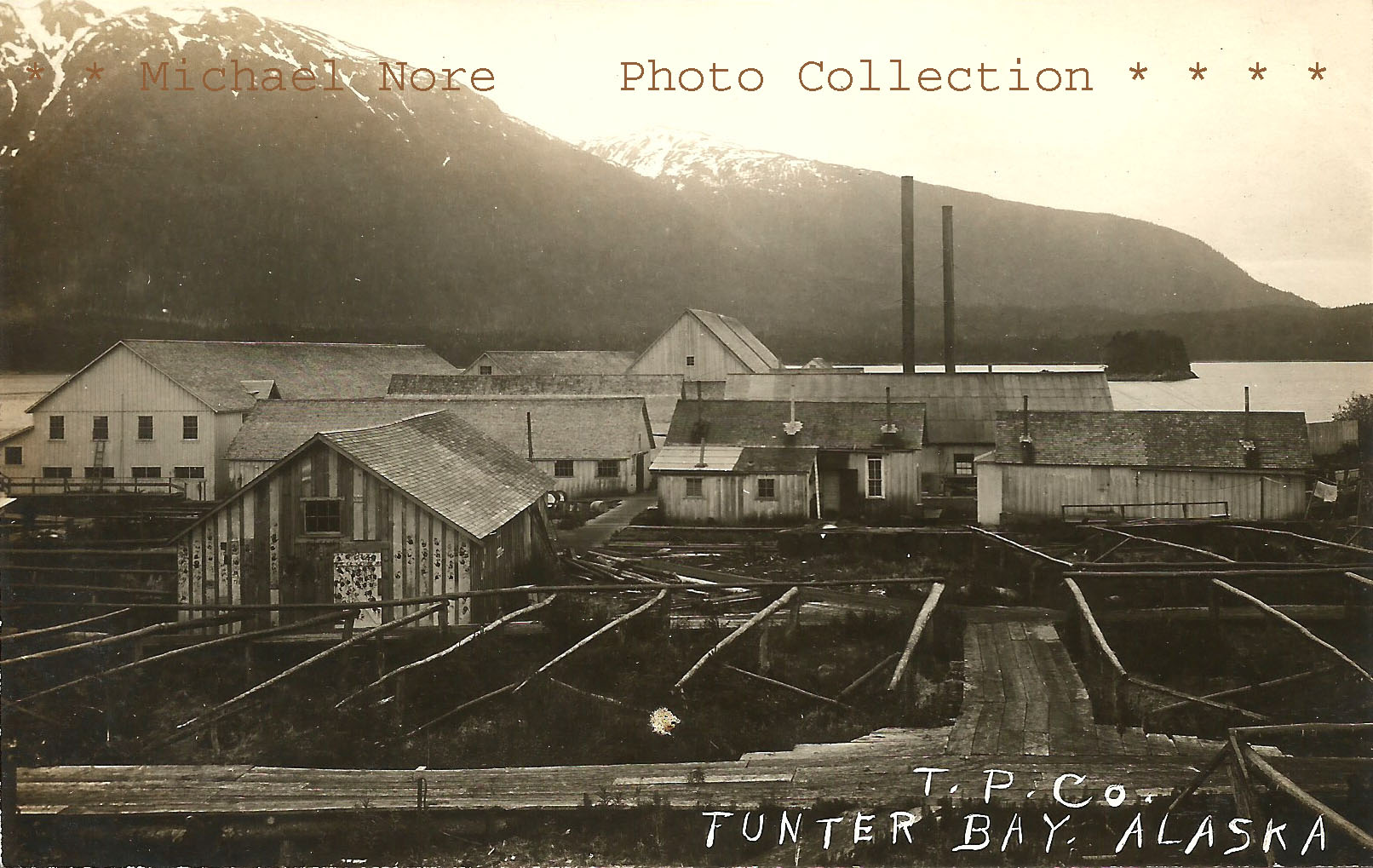
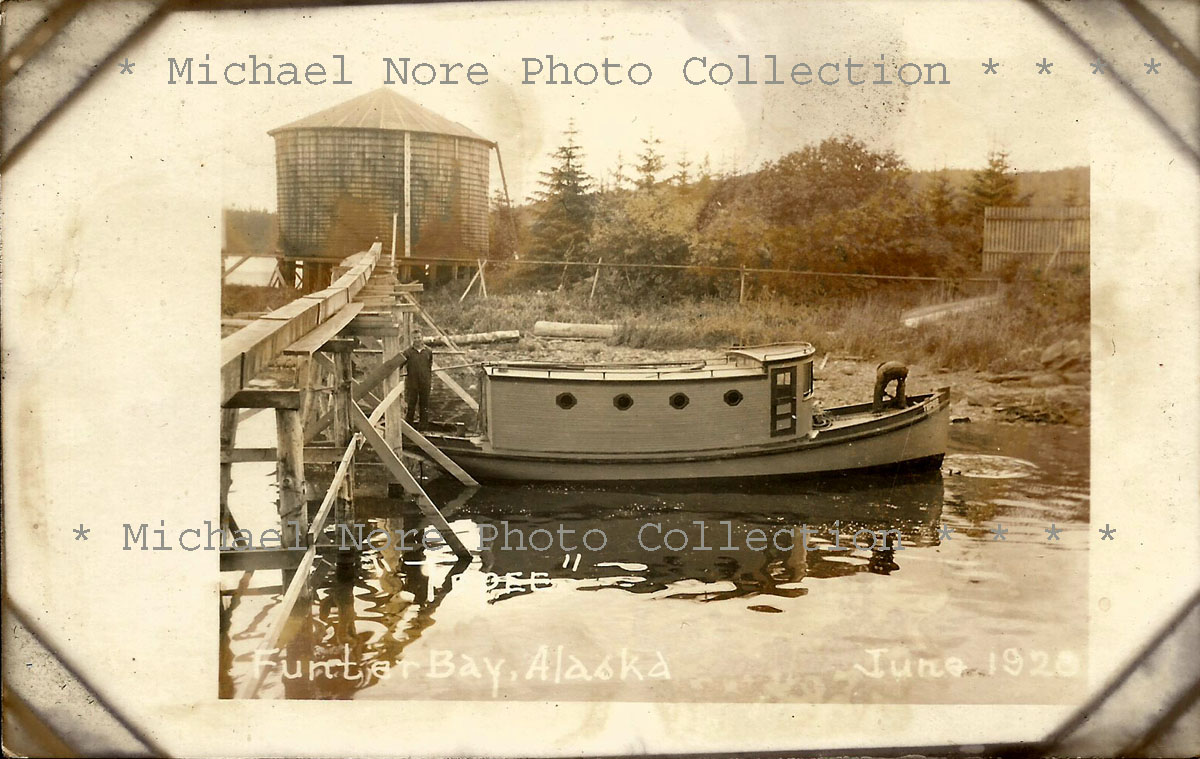
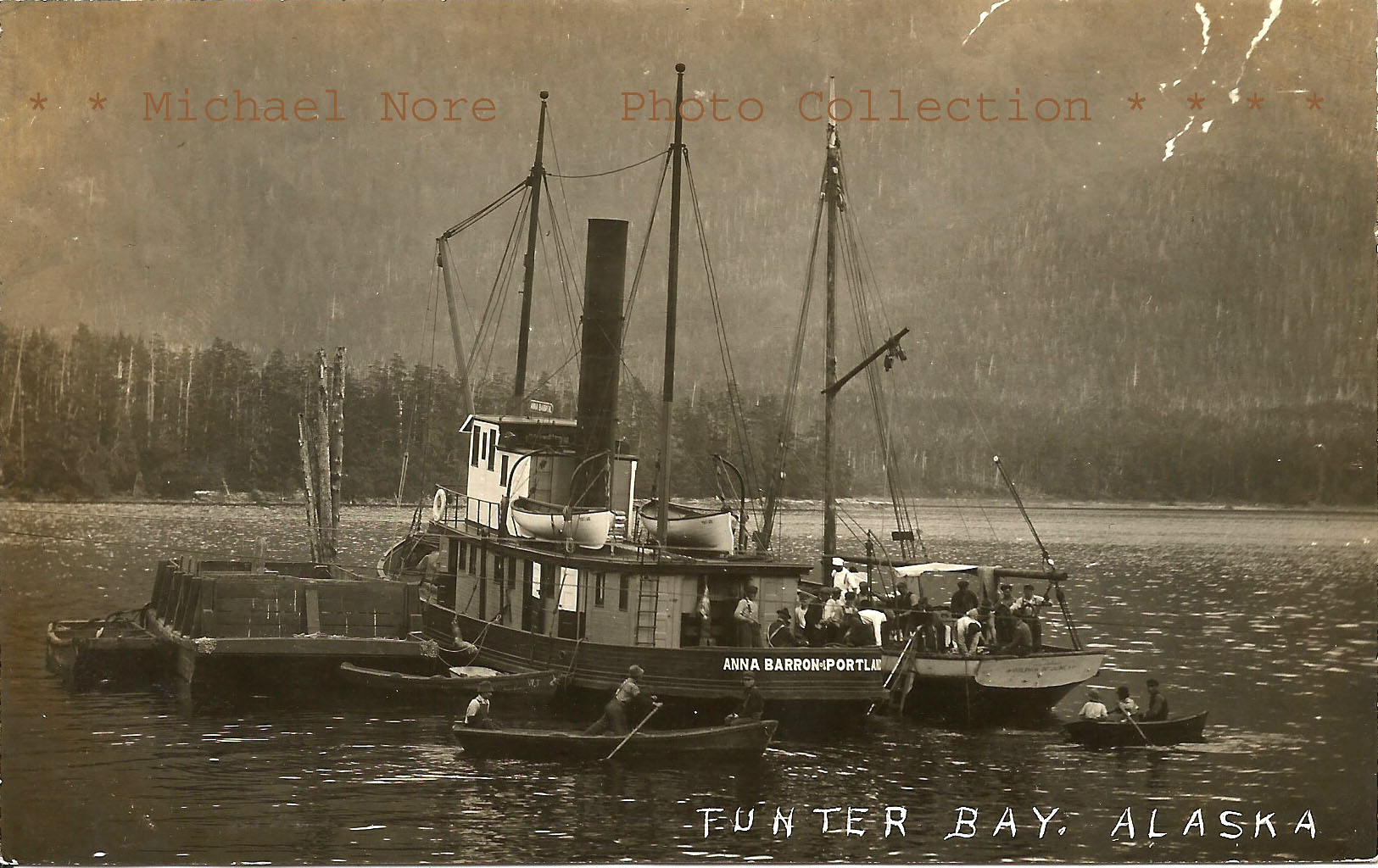
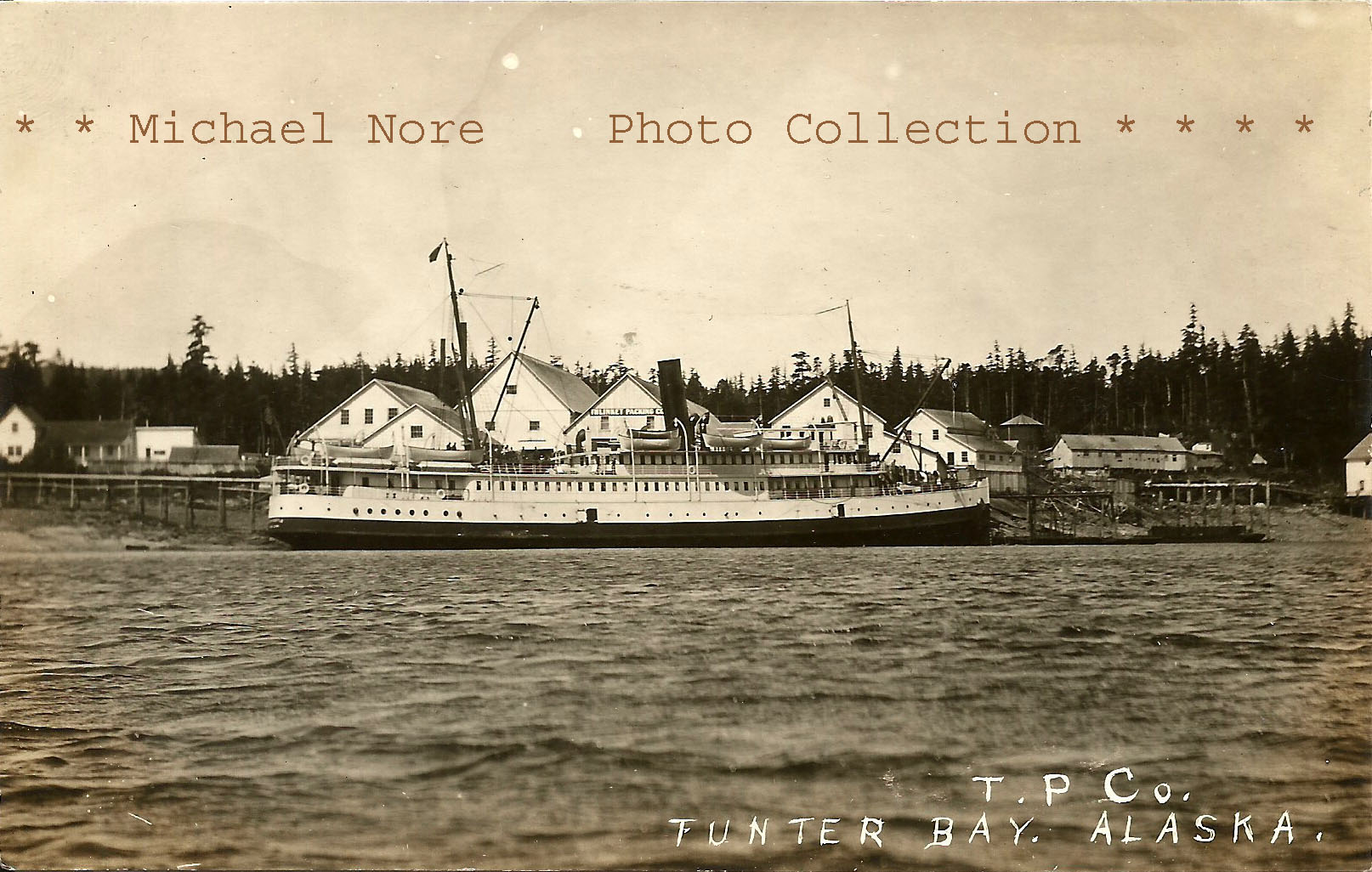
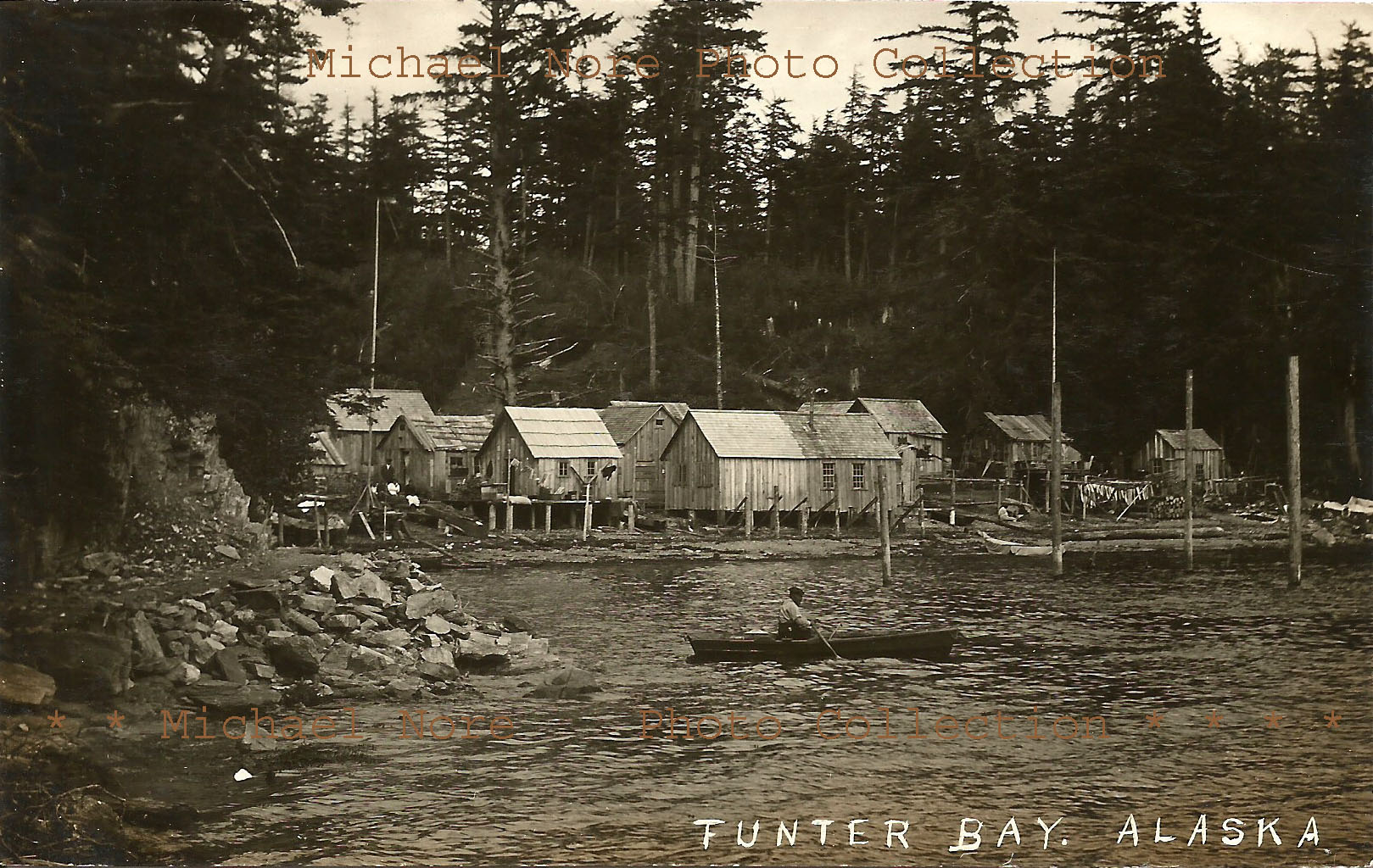
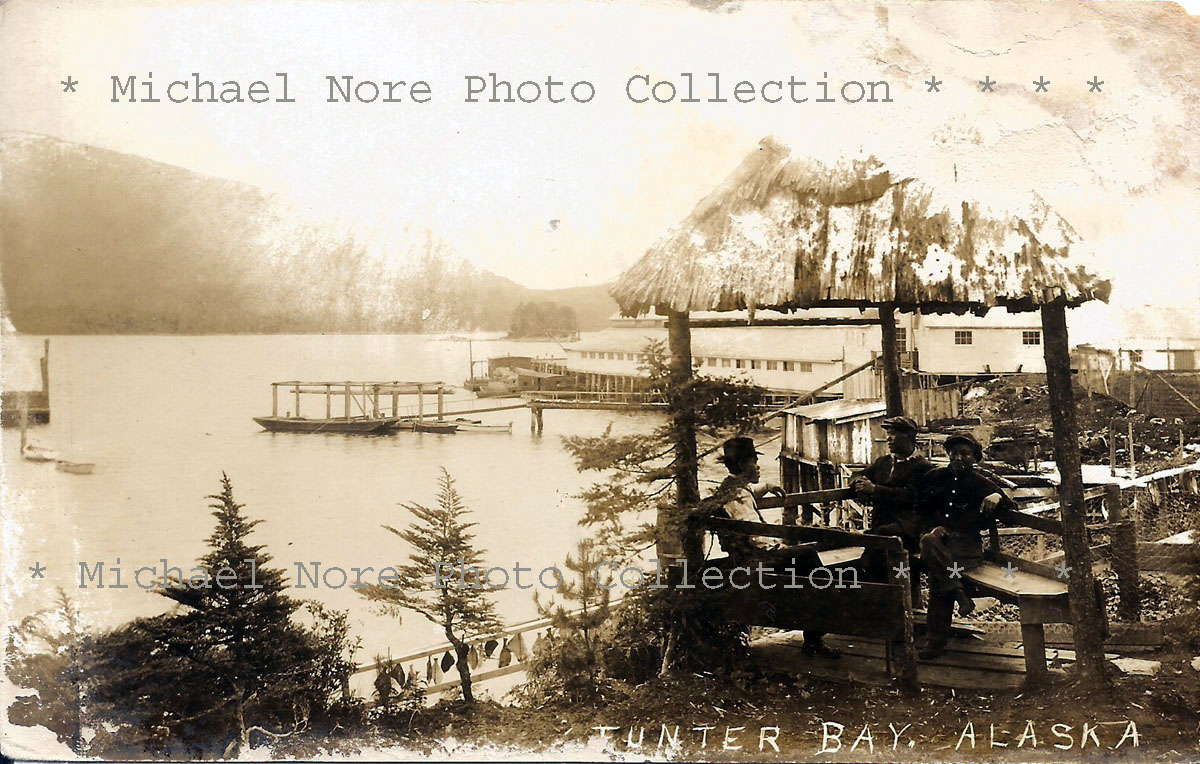
I recently received a few Funter Bay images from Michael and Carolyn Nore, collectors of historic Alaska postcards and photos. These show some of the Thlinket Packing Co’s operations between about 1914 and 1920. Most are prior to 1918 (based on the cards used), but some are from the same summer as the photos seen previously in this post.

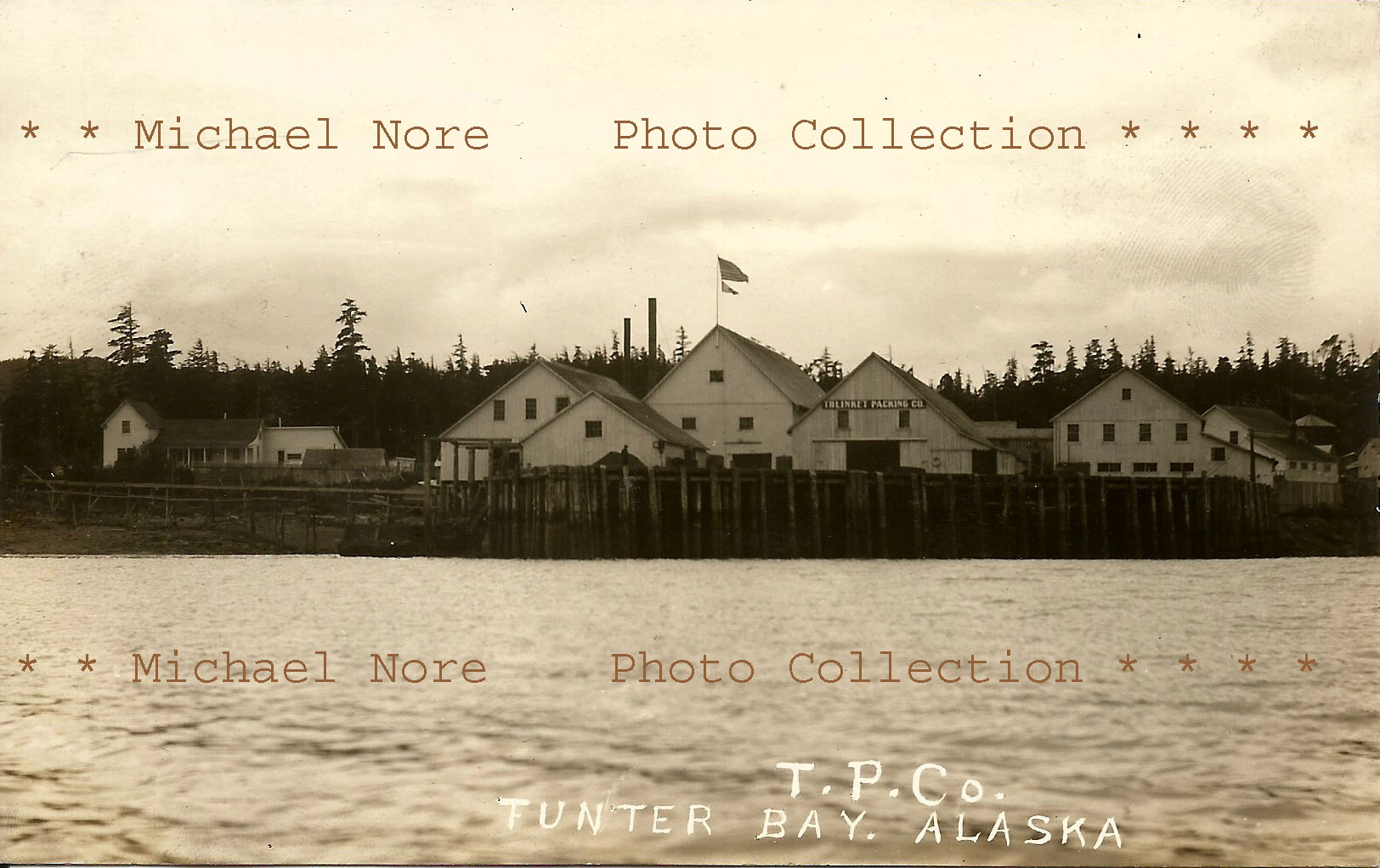
The first photo is a great shot of the Cannery wharf and main buildings, marked “Front View of Cannery”. The large “Thlinket Packing Co” sign is visible above the warehouse. The mess hall and store is barely visible in the rear right, and the Superintendent’s house with its large porch is seen on the left.

funter bay2 5-18-16 copy

Moving inland, a set of two images show the rear of the cannery buildings. The large chimneys were from the main boiler house.

funter bay6 5-18-16 copy funter bay4 back view of cannery 5-18-16 copy

The previous photo shows a number of handprints marking the foreground building. I am not sure what this building is, as it does not appear on either the 1964 or 1942 property maps.

Another set shows one of the cannery’s steam-powered pile drivers. I am not sure how many of these units the Thlinket Packing co owned, the remains of a smaller one is on the beach at Funter Bay. A large unit nearly identical to the one in these pictures appears in a 1926 photo at the mine wharf (seen on this page).

funter bay8 5-18-16 copy funter bay1 5-18-16 copy

Some scows, rowboats, and a gas boat are seen at the dock and wharf in the next photo. This is a little later than the others, dated May 21 1920:

funter bay11 6-29-16 copy

The photo below shows a gas boat or launch under the pipeline from the cannery’s oil tank, in June 1920.

funter bay9 6-29-16 copy

The next photo is labeled “One of the company tugs with a diver repairing her rudder”. It shows a sailing vessel alongside the cannery’s steam tug Anna Barron and a variety of smaller boats. Men on the sailboat are operating an air compressor and have lowered a ladder and several pipes and ropes over the side. What appears to be a diving suit is draped over the sailboat’s boom.

funter bay3 tug repair by diver 5-18-16 copy

Moving up in vessel sizes, the next photo shows the Pacific Coast Steamship Co’s City of Seattle at the cannery wharf. The appearance of the ship dates this to 1914 or later, as the City of Seattle was completely rebuilt that year and converted from coal to oil fuel. Prior to 1914 the ship had a different superstructure and the foremast was aft of the wheelhouse, as seen here. The re-built ship can also be seen here and a description of the refit is here. Like other commercial steamers, the ship would call at canneries as needed to transport supplies, products, and workers.

funter bay5 steamer city of seattle 5-18-16 copy

Next is a photo of the “Indian Village” located Northeast of the cannery. While postcards tend to call this a village, most accounts state it was not occupied year round. The area was more of a seasonal camp for native employees of the cannery who lived there in the summer.

funter bay7 indian village near cannery 5-18-16 copy

And the last photo shows an interesting gazebo on the hill behind the cannery, with some Tlingit employees relaxing on benches. What appear to be a number of halibut can be seen hanging from the boardwalk below. The date is not given but is probably between 1914-1918.

funter bay10 6-29-16 copy

Thanks again to the Nores for sharing these great images!


Research Sources for Alaska History

June 22, 2016

Updated 6/22/17

Here are some of the resources I use in my Alaska and Funter Bay history research. Specific source documents can also be found in the links embedded in my posts and write-ups.

Alaska’s Digital Archives – Excellent collection of digital photos and documents from Alaska history.

Alaska DNR Division of Geological and Geophysical Surveys – Mine and mineral publications for the state.

Alaska Land Records – Modern and historic land surveys and plat maps.

Alaska Resource Library – Archives of historic Alaska documents and government publications.

Alaska State Library DASH – Full text of several historic Alaska newspapers.

Bob DeArmond Alaska History Project – Searchable archive of Rober DeArmond’s articles in Juneau papers, including reprints of historic news snippets and details of Southeast Alaska historic topics.

British Columbia Archives – Documents and media from Western Canada and Alaska.

Coast Survey Historic Maps and Charts – Historic nautical charts and other maps.

David Rumsey Map Collection – Historic maps and atlases.

Google Books – Also contains old government reports and publications.

Juneau-Douglas City Museum Collections – Many photos of the Juneau area and Southeast Alaska.

Juneau Nature – A website which has many historic Southeast Alaska photos, including early aerial photo surveys.

Library & Archives Canada – Includes many photos of Alaska and Western Canada not found elsewhere.

National Archives – Digital copies of many Federal government publications.

National Archives Alaska Records Project – records from the AK division being digitized in Seattle. Evolving collection that is in progress as of 2016.

National Geologic Map Database – Can be helpful for locating mines and related infrastructure.

National Museum of Forest Service History – logging and recreation related photos in Alaska and elsewhere.

NOAA Hydrographic Surveys – The original surveys from which nautical charts were based, containing additional notes and information.

NOAA Photo Library – Collection of fisheries, wildlife, scientific, and other photos.

Northern British Columbia Archives – Photos and documents pertaining to Alaska and Northern BC

Northwest Digital Archives – Indexes & finding aids to historic photos and documents of the Pacific Northwest (in various libraries and collections)

Perry-Castañeda Library Map Collection – Older topographic maps of Alaska, and other material.

University of Alabama Map Collection – Older geologic and topographic maps of specific regions.

University of Washington Digital Collections – Another great collection of Pacific Northwest photos, magazines, and documents.

US Fish & Wildlife Service Digital Library – Many modern and historic photos of wildlife, fisheries, boats, and scientific research.

USGS Historic Topo Maps – Collection of old versions of topographic maps. Goes back generally to the 1940s or 1950s in AK.

USGS Photographic Library – High Resolution copies of photos from USGS publications

USGS Publications Warehouse – Contains many old documents and reports on mines and mineral prospecting.

Washington State University Digital Collections – Fewer photos that UW’s archives, but more newspaper and print articles.

Yukon Archives – Includes some Alaska photos and Alaska Highway construction photos.

This post/list may be updated as I come across more sources. Feel free to contact me if you know of something I’ve forgotten or overlooked!


Funter Bay History: Locomotive Headlamp

May 26, 2016

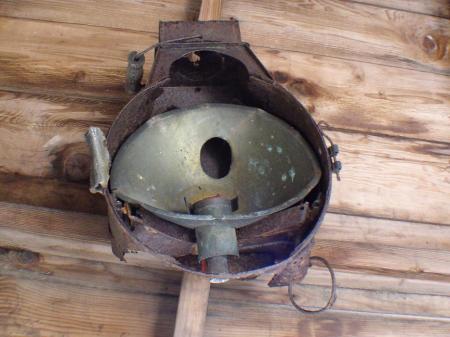
While researching Funter Bay history I often find things that are not in their original context. Rural Alaska is a great case study of creative re-use. The cost of new equipment leads many things to be salvaged and repurposed in ways they weren’t intended. A great example is this old kerosene lantern. It had ceased being used for its original purpose, was modified into an electric wall lamp, then was abandoned again.

OLYMPUS DIGITAL CAMERA

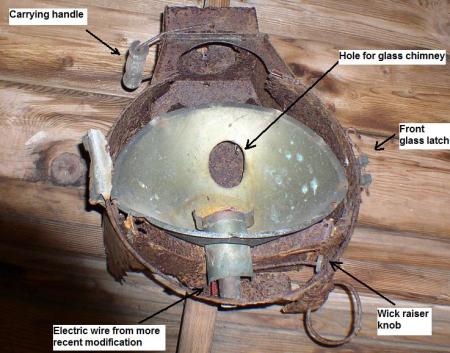
The lantern is in rather rough shape, but still recognizable as a type used for headlights on small industrial locomotives.

OLYMPUS DIGITAL CAMERA

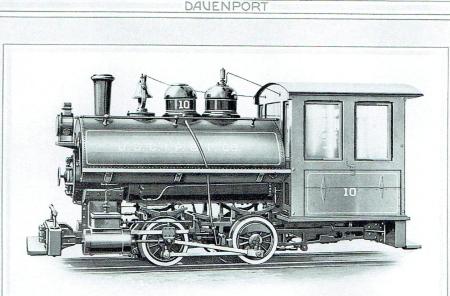
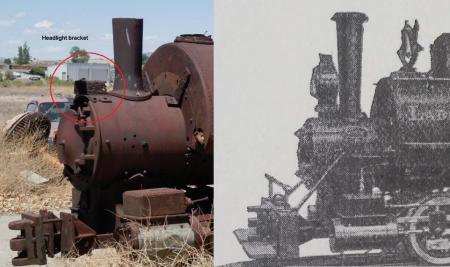
I suspect this lantern originally came from the Danvenport 0-4-0T steam locomotive used at Funter Bay in the early 20th century. The locomotive was abandoned around 1952 after a failed conversion to gas power, and most of the small parts were stripped between the 1950s and 1970s. The headlight may have become a decoration for one of the miner’s cabins, with a little work to allow an electric bulb to be added.

The locomotive from Funter Bay is seen below, compared to a Davenport drawing of a very similar model. The headlight mounting bracket is a U-shaped piece of sheet metal riveted to the boiler just forward of the smoke stack:

OLYMPUS DIGITAL CAMERA

Some details are labeled below. Intact locomotive headlights of similar design can be seen here and here.

OLYMPUS DIGITAL CAMERA

Keith Muldowney believes this may be from the Star Headlight Co, founded in 1889 and still in existence today as the Star Head Light & Lantern Co. Some of the company’s history can be found here. Star manufactured kerosene lights until about 1941, when they switched to primarily electric lights. Keith sent a great set of drawings for a similar Star headlight design:

headlight

Star Headlight. Courtesy of Keith Muldowney

Other possibilities for the lantern’s original use include on a ship or underground in the mine, although carbide lamps were more common than kerosene for mining. It could have also been used on the surface at the mine or by a fish trap watchman. The locomotive origin is attractive but by no means confirmed! Hopefully I’ll be able to track down more information on this interesting artifact in the future.


Monorails to New York

April 22, 2016

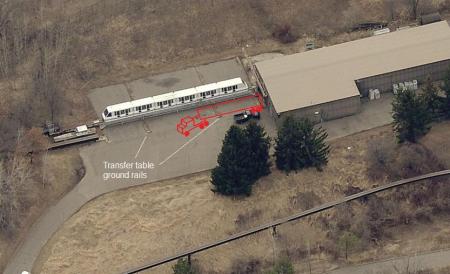
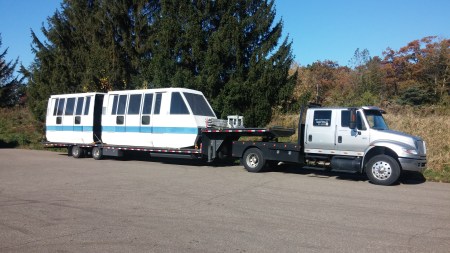
After I purchased a monorail train from the Minnesota Zoo, I was contacted by some folks from New York who plan to start a monorail museum. As I had apparently become an “expert” at getting 1970s monorail cars onto trailers, they asked me to help with the loading process once they purchased the remaining cars.

idea

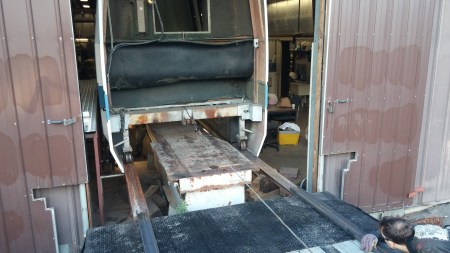
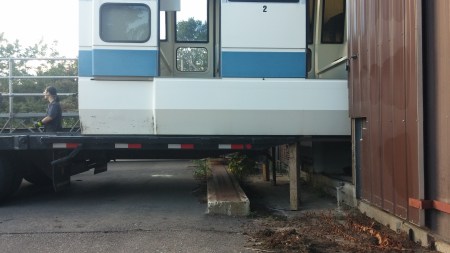
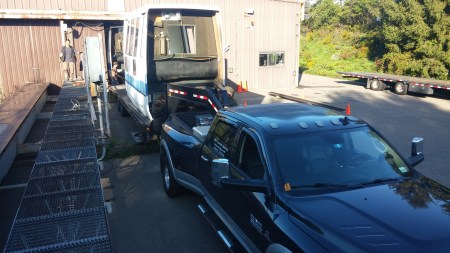
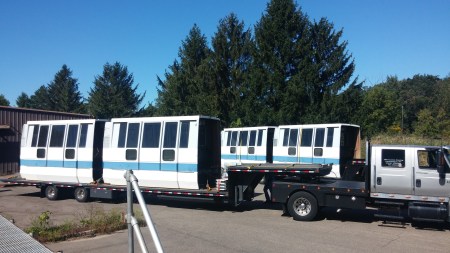
With larger commercial vehicles and powered winches available, the move went a lot faster! We were able to get 4 cars per load on two trailers.

0912150746 0912150800a 0912150843b

We moved out all 11 remaining cars in three loads this way. On the final trip they also picked up some wheel bogies to add to the museum display.

0912151024 0912151130 1017151116

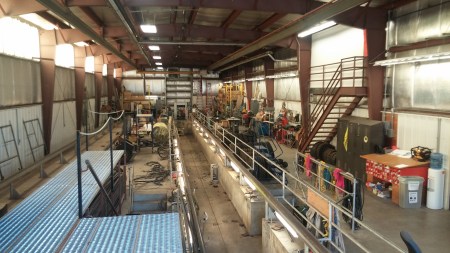
The service barn looks very empty now with no trains parked inside!

1017151156b

Kim Pedersen with the Monorail Society was instrumental in connecting me with the museum people. You can check out Kim’s new book here (it’s great, especially for reading while in a monorail!)

SONY DSC


More Monorail Extras

April 8, 2016

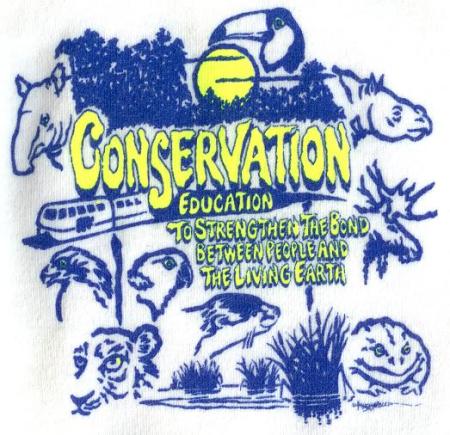
Recently I happened across the estate sale of a former MN Zoo employee. I was able to pick up a number of old zoo shirts ranging from the 1980s to more recently. A few of these have a neat little “Conservation” montage of zoo animals and the monorail:

shirt

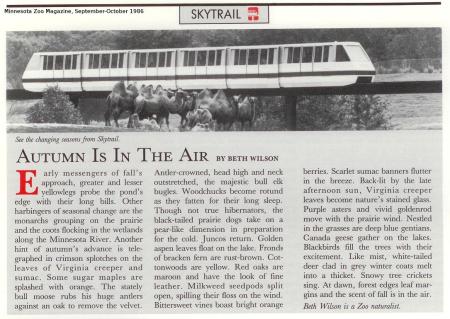
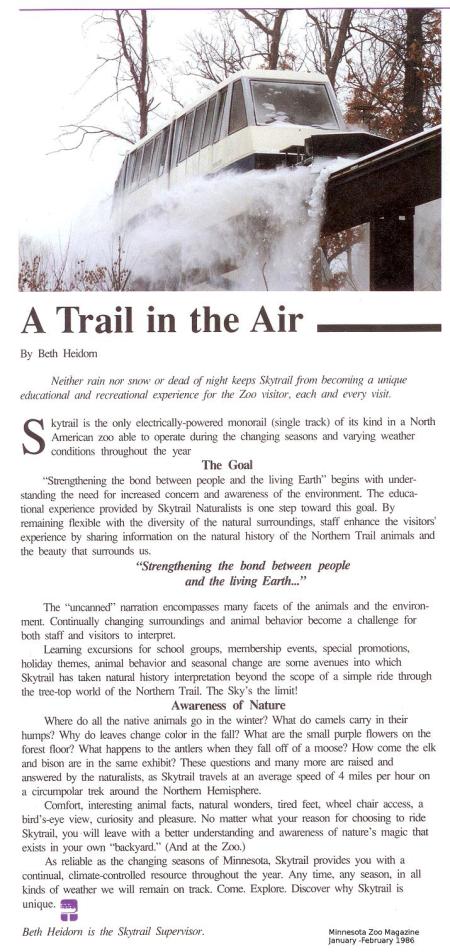
There were also quite a few issues of Minnesota Zoo Magazine from the 1980s. A few of them had monorail-related pieces, including a neat shot of the snowplow in action.

magazine1a magazine2a magazine3a

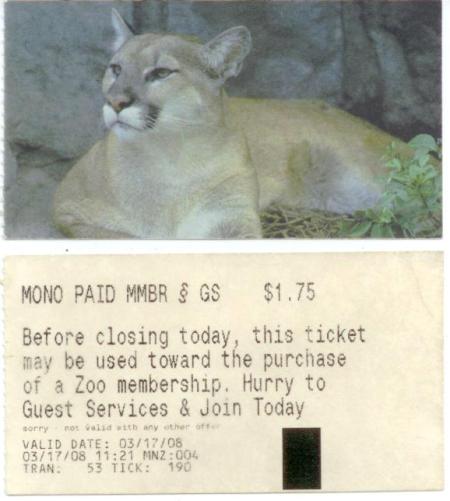
And we even found a monorail ticket from 2008! (Two-sided scan below)

ticket

Some of these will probably end up in my mini-museum in the monorail cab.


Funter Bay History: Special Agent Harold Merrin

February 16, 2016

In the 1930s Funter Bay was home to one Harold Merrin, a “Special Agent” with the “U.S. Division of Investigation”. While the title might suggest an affiliation with the FBI (which held that name prior to 1935), there was also such a division under the General Land Office. This was part of the Department of the Interior, and conducted investigations into all sorts of mineral and property rights for the US Government. Special Agents of the Land Office worked with everything from logging and grazing licenses to oil and gas surveys to mineral claims and property rights.

Harold Woodworth “Hal” Merrin was born in Ohio in 1893, to parents Ernest and Lenna. The family moved to Spokane by 1910. He grew up with a background in mining, as his father worked at various mines and was later director of the American-Scotia Mine in Orient, WA. Harold served as secretary-treasurer of this company while in college.

Merrin1

Harold attended North Central High School in Spokane, but WWI pulled him and many of his classmates away before graduation. Harold joined a trial officer’s training camp in 1918 and briefly served as a Corporal with the American Expeditionary Force in France (source). After returning to the US, Harold enrolled at the State College of Washington and received his Bachelors Degree in Mining Engineering in 1921.

Camp

After graduating, he worked as an assayer with the Santa Rita mining co, then as a land appraiser for the government land office in Portland and Santa Fe. By 1923 he was working as a government mineral examiner in Alaska and the Pacific Northwest. One of his jobs included investigating a “Mystery Metal” found in Oregon. In 1926 Harold married Bertha Thompson of Everett, WA.

In 1933 Congress authorized payments in the amounts of $124.35 and $35.90 to Harold Merrin for travel expenses to and from Alaska while under official orders. In 1935 he was reportedly working as a special agent for the U.S. Division of Investigation. In 1936 the Division of Investigations had him stationed at Funter. The WSU Alumni paper reported the birth of Harold and Bertha’s daughter Evelyn that year.

WU Alumni 2

I have not found the exact nature of Harold’s government work at Funter, but property and mineral issues would likely have kept him busy. Several mines were active at Funter, which would fall under Harold’s area of expertise as a mineral surveyor. Other activities could have included homestead claims, fish trap locations, hand logging, and cannery land use. Some of these industries had overlapping property claims and some were known to use mining claims for other purposes. Juggling the competing interests of Alaskan industries with each other and with the federal government was likely a full time job.

Harold’s government work appears to have led him into the private sector after a few years. In 1937 he was superintendent of the Alaska Empire Mine at Hawk Inlet, across the mountain from Funter (source). In 1938 he was back at Funter Bay, after “exposing his family to six months in the civilization of the outside world”.

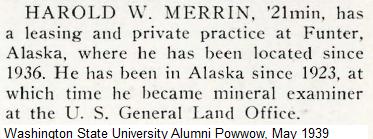
In 1939 the WSU Alumni update described Harold as having a “Leasing and private practice at Funter”.

Merrin 3

By late 1939 the Merrin family had moved to the Flagstaff Mine in Kasaan Bay, near Ketchikan. They soon moved back to Washington, and Harold passed away in Yakima in 1940 at age 47.


Monorail Phenology

January 13, 2016

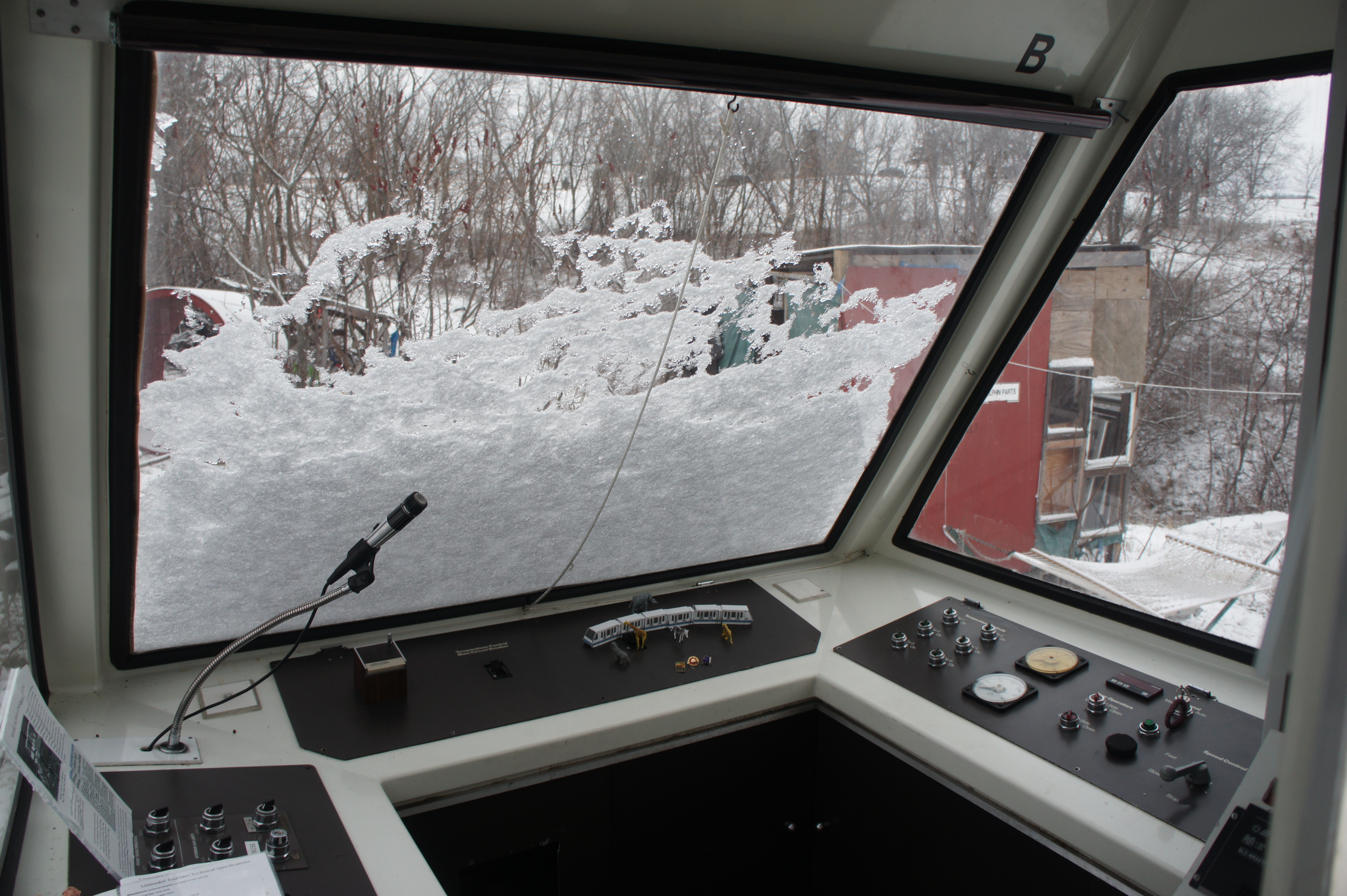
While cleaning out my monorail cars I came across a few interesting documents. Several notebooks marked “Phenology” describe local wildlife seen along the monorail track. Phenology is defined as “the study of cyclic and seasonal natural phenomena, especially in relation to climate and plant and animal life”. An article from 1979 explains these notebooks:

“The operator/tour guides keep their eyes open and when a phenlolgical event is spotted, they record this observation, its date and location in a phenology logbook kept by the stationmaster. This data is summarized each day on a report board in the station for all the MZG’s public to see.” (from MZG Newsletter, Minnesota State Zoological Board, 1979)

example

For those interested in reading these notebooks, I’ve scanned and uploaded PDFs here. There are a few torn and missing pages, so these are not 100% complete. There is also some water damage and fading from sitting in the train for a few years, some pages are hard to make out.

Phenology – Train 2 (Covers the period of 8/15/2001 to 8/30/2013)

Phenology – Train 3 (Covers approximately 7/4/2008 to 6/19/2012)

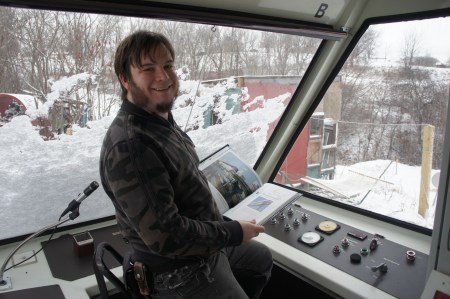
Also found in the monorail were several info sheets on various zoo animals seen along the route. These are probably cheat-sheets for the operator / guide staff to describe what passengers would see along the way.

info

I’ve also made a PDF of those sheets for archival purposes, available below.

Animal Info Sheets from Driver’s Cab


MNsure Rants

December 16, 2015
Minnesota is one of 13 states experimenting with a local healthcare exchange under the ACA (most states use the federal HealthCare.gov system). As a Minnesotan it’s been my misfortune to use our state insurance marketplace; MNsure.org.
Rather than writing a full review of the nightmare that is MNsure.org, I’ve collected some of my past frustrated emails to the organization. As there seems to be no centralized tech support or contact point, these have gone to an assortment of agency-related email addresses. I’ve occasionally received responses, typically more apologetic than helpful, but have yet to discover if any of my comments get to anyone who can do anything. This year I also got around to hassling the board of directors and my state legislators. Their contact info is at the bottom of this post, in case you’d like to share your own experience with Mnsure.

2013:

I’ve managed to lock my account on mnsure (after finally getting the site to work long enough to create one), and all of the security verification questions are useless.  The most memorable location in my life? Heck if I know, I can’t remember what I ate for dinner yesterday. My best friend from 3rd grade? I grew up in a ghost town. Where did my parents meet? I’d probably have to call them every time I forget my password. Please change it so users can select actual useful questions of our own, the kind that real people will actually know the answers to. Or you could offer the option to send a password reset email to the registered email address, like every other website does.
This time I’ll be sure to write down the password and all the BSverification questions and put it on a sticky note on my computer at work, where everyone can see it. I don’t even care how secure my password is, based on the quality of programming I’m just assuming the thing will be hacked in the next month or so. (actually I just looked that up and found that mnsure already emailed SSNs to random people last month, nice work).

2014:

I interacted with MNSURE again recently, to change my insurance after PreferredOne gave up on us. I have a few complaints/suggestions for the service. I hate to complain about site usability, since I’m a computer science graduate and have built websites myself… but this site has many obvious things missing:
-The enrollment process needs to be easier to start, with the links easier to find. Currently the page seems to go through two different “Sign in” screens, then one eventually finds their way to the enrollment inside a link past a sidebar menu and under a dropdown. Terrible navigation and terrible user interface.
-The security questions are too limited and not applicable to all persons. If I don’t like sports, am not in a relationship, do not know my grandfather (which one?), have a single parent, have never owned a car, and do not know where I’d like to retire, that eliminates most of the security question options. It would be better to let people enter their own or have more options (or I could just answer “banana” to each one and keep that on the sticky note with my password).
-There needs to be some confirmation code or proof that *something* happened after the enrollment process. I thought that I’d beat the rush on December 15th and get enrolled back in November. I eventually found the sticky note with my password and security questions, jumped through the hoops, clicked all the things that didn’t apply to me, and wasted a half hour on things I didn’t care about. The system told me I had no benefits, discounts, or tax credits coming, so I went ahead and selected the cheapest flavor-of-the-year for insurance providers…. Or so I thought. Now I log in again to find no record of a current enrollment. Instead, it seems I have a pending application for something or other. What did I apply for? What’s the status on this theoretical application? How do I actually enroll in something?
-The site could use better error-handling or retry options. My current session threw an “unable to contact the server” error, then eventually loaded a “Congratulations” page saying my enrollment is completed…. but I got the Congratulations page back in November and never received any follow-up from MNSURE or my chosen provider to indicate that the website had done anything at all. When I click the “done” button it goes to a mysteriously blank page, and the “Enrollments” link still shows no plans enrolled. Am I enrolled or not? It’s a mystery without some kind of confirmation.

-The site could explain itself better. For example, the application page states that I qualify “for help to buy health insurance through the exchange”, then says “$0 off/month” and “0% Reduction”. So, what is this “help” it’s referring to? Not financial help apparently. Does this “help” refer to a MNSURE staff member helping me through the process? If so, that’s not made clear.

-The page layout is also annoying. I have a large (24″) monitor, but the page still requires scrolling and won’t scale to less than 60% of my screen. It would be great if it could all fit in one reasonable space. I understand some people can’t read small text, but you could save a ton of screen real estate by shrinking your header bar, eliminating some of the white space at the top, and de-nesting some of the frames.

Personally, your entire site could be replaced by a big red button that auto-enrolled me in the absolute cheapest thing possible (and spit out a confirmation code). I suspect that would meet the needs of many MNSURE users as well.

And another from 2014:

Once again I made the mistake of using the MNSURE website, and was unsurprised to find it just as useless as every other time.This time I was trying to find a magic “MNsure ID Number” requested by the flavor-of-the-year lowest-cost insurer (who couldn’t even manage to create a real invoice for my first payment). I was hoping to find some kind of account information or settings, but the MNSure site appears 99% geared towards pipelining me into an application, so it took a while. The site still makes me click “sign in” twice in a row, then doesn’t take me anywhere useful once I do get signed in. About 60% of the time I get a blank screen, 30% I get a 403 error, and 10% I get dropped into a new application. I think I’ve completed 3 applications so far with no follow-up to indicate that they went anywhere or did anything.

Anyway, there really needs to be some way of getting to my user account or settings page once I’m logged in. (Yes, I previously stated that the whole site could be replaced with a “Enroll in cheapest thing possible” button, but if the insurance providers are so disorganized that they need me to supply my own account number, then there needs to be a way to extract that number from the site).

On the rare occasions when I can log in AND get to some sort of account information, there seems to be nothing there. No payments, no enrollments, and those three mysterious applications which have mysteriously been “processed” in some way.
I eventually found the magic ID number by accident, hidden in a PDF file under “Notifications”. Then I realized that these “Notifications” also have information about those mysterious applications. They don’t seem to be in any particular order, and are very slow to appear on the screen (if I didn’t click each one and wait around for a few minutes, I’d assume it’s blank like the “Enrollments” page). This is the first time I’ve stumbled across the notices, as I don’t think they’ve been emailed or snail-mailed to me. That’s some useful “notification” right there… I sure do feel informed and notified! Maybe at some point in the past I clicked on “online notifications only” or some such option… I must not have realized it would be the Douglas Adams method of “notification”.
On the plus side, the website is just barely functional enough that I was able to avoid hours on hold, hours which I can now use to whine about MNSURE online. I imagine I’ll be back to whine some more next year when the latest cheap insurer goes belly up and I have to fight the website again. Based on the quality of the site and the quality of the provider’s communications I can only assume the actual insurance, should I ever need it, will be of the same quality (so I’m expecting that if I ever make a claim, you’ll just mail me a brick).
And 2015:

Yay, it’s that time of year again when I have to use your horrid mnsure website, because flavor-of-the-year cheapest insurance company has raised its rates (at least this one stayed around for more than a year). And as usual, I get to do the annual dance with forgotten passwords and locked out accounts. Since there are no email contacts on the site to deal with the inevitable problems, I get to decide: is it more useful to spend 20 minutes on the phone, or 20 minutes looking up the personal email addresses of the board of directors so I can whine at them? (I actually managed to get access to my account this year with only two calls to customer service, which is a new record)

Please consider some of the following changes to the mnsure site:

1. Back off on the level of login security. My bank has less security than this, and I actually care if someone gets into that account. If someone is masochistic enough to sneak into my mnsure account then they’re welcome to it.

2. Make the “Get Help” button actually do something instead of a 404 error (specifically on the Password Reset Failed page)

3. Provide a contact in case of locked account. Right now it just says “The user account is locked or disabled. Please contact the System Administrator”, but doesn’t have a way to contact this mythical creature.

4. Make the password challenge questions something that anyone can remember, I don’t want to have to call my parents every time I need to log in, to ask what city they met in. I guess orphans or children of single parents aren’t eligible for MNSURE at all.

5. Have an email contact for help. I don’t have time to call the 800 number.

6. Just publish a list of insurers and prices on the front page, which is pretty much the only reason I go to the stupid website.

7. Do something useful with the “Notifications” part of the account. It’s hard to find, doesn’t make any sense, and doesn’t actually notify me of anything.

8. Do something useful with the rest of the account. I seem to have access to such pages as “Home”, which says “No messages”, even though I have unread notifications, “Payments”, “Activities”, and “Enrollments”, all of which are blank (so what are these sections for? Am I enrolled in something? Do I make payments?), “Applications”, which has some mysterious applications with no information (I apparently have to go to “Notifications” for actual information about applications), “Contact Information”: blank. “Notifications”: Appears blank at first but eventually offers cryptic PDF files. “Appeals”: Blank, and of course, “Assister” (apparently some special person who the state has to pay to decipher the website, because they forgot to pay the programmers or testers to make sure normal people could use it). Maybe you could provide some sort of guide or walk-through of what all these weird blank pages are supposed to be for, and why anyone would ever need to use them?
9. Delete the whole site and replace it with something more useful to the public, like an animated gif of a dancing potato.
By the time I managed to get into my MNSURE account this year (about a week after starting), I’ve forgotten why I wanted to, and even if I knew what I was looking for, I doubt I’d be able to find it.
And most recently; the letter sent to the board of directors and my congresspeople in 2015:

Hello, I’m writing about MNSURE, the state healthcare exchange under the Affordable Care Act. I was a supporter of the ACA, but am deeply disappointed in Minnesota’s implementation of the exchange system. I’ve been using the service and their website since it began, and have been repeatedly frustrated and inconvenienced by it. I would like to see an overall reform of the MNSURE website, either a total remodeling, or abandonment altogether and a move to the Federal system (I have no experience with the Federal system, but I expect anything at all would be better than what MNSURE currently offers).

I am a Computer Science graduate with professional IT experience, and have learned the importance of testing, end-user experience, and reliability when it comes to a website or software product. The MNSURE website displays none of these characteristics.

For example:

-The user interface is terrible. Upon login, users are pipelined into an application regardless of their reason for visiting the site. Finding the status of completed applications requires searching through an obscure subsection of the site which is not easy or obvious. Sections of the user account appear blank and/or do not have their purpose explained. Accessing account settings or other information is not intuitive. The layout is also awful, with outdated design elements like nested frames and gratuitous white space more appropriate to the late 90s than something programmed in 2013.

-The site seems geared towards driving users away from itself, and into the hands of telephone “Assisters”. It constantly offers to connect me with an Assister, to the point where I suspect it serves only to keep them employed. When I’ve attempted to contact MNSURE staff regarding website issues, they have also suggested I use an Assister, and shown little or no interest in making the website a usable resource. I am honestly not sure why the website exists, as it is nearly unusable by the general public (or even IT professionals such as myself). I realize there is a portion of the population who will not use any website, and will always prefer a call center. However, I wish MNSURE would realize that there is a portion of the population who avoids call centers, and will always prefer a website. I am one of the latter group. My day is structured in such a way that I do not have time to call in and sit on hold, but I do have time to use a website or online application (as long as its functional).

-There seems to have been little to no testing done, either in the pre-release development, nor during the 2+ years the site has been live. I have reported various bugs and issues to MNSURE in the past but have not seen any fixes or changes made. Certain sections of the site have broken links, HTTP 403 errors randomly occur, data is slow and/or unreliable to load, and the site seems unable to handle the expected number of users. During the application process I am told I qualify for discounts, then later I am told the discount is $0.00, 0%. On occasion I have completed an application, reached a “Congratulations” page on the site, then been informed months later via snail mail that I didn’t actually complete an application. The website gives the impression of having been programmed very hastily and without any quality control or follow-up maintenance.

-There is no obvious tech support contact or way to report issues or concerns. It is not clear who, if anyone, maintains or updates the site. I’ve started to assume it was programmed and then abandoned with no updates or maintenance done over the last 2-3 years. It feels like the state paid $12 million for the server, set it up in a closet somewhere, turned it on, and forgot about it. There are a few emails listed on the site, but I’ve never gotten useful responses from them regarding ongoing website issues. There seems to be a phone number I could call regarding the website, but I’ve never had time to try it.

-The site gives the impression of high security, but unfortunately this is to the point of inconvenience. Signing in takes several steps and is slow to load. Password resets are difficult, and security questions are not applicable to many users. Some of the few options for security questions include “where did your parents meet?” (what about orphans?), “What was your grandfather’s occupation” (which Grandfather, at which time in his life?), “Where would you like to retire” (what if I don’t know?)  and “What was the model of your first car” (what If I’ve never owned one?). There are so few choices for security questions that I am forced to pick at least one that I literally cannot answer. Despite all of these hoops to jump through with imaginary password security, I have zero confidence in the back-end database, encryption, or authentication. I can only assume these things were programmed just as poorly as the rest of the site. I fully expect that anything I enter into MNSURE will eventually be leaked online if it has not already (I notice that employees have already managed to leak private information: http://www.inforum.com/content/mnsure-looks-reassure-minnesotans-after-information-leak).

Just recently I read an article about MNSURE misusing $500,000 worth of Federal Grants for remodeling their office: http://www.startribune.com/mnsure-to-refund-500k-in-grants/362427261/ This frustrated me greatly, as I could imagine several ways that $500,000 could have been spent on the website. For example, 10,000 person-hours of Quality Assurance testing at $50/hr (hey, I just gave you an hour’s worth for free!). Or perhaps they could hire a full-time tech support person for 5 years with $100k salary. Or maybe a year of enterprise-level database hosting? It could even save money in the long run, if MNSURE put money towards creating a functional website instead of cushier office chairs, they could downsize their staff into a smaller office (with fewer chairs!) and pay cheaper rent and fewer salaries.

Overall, I am very disappointed with the incredible waste of money that is the MNSURE website (and I suspect, the entire organization). As an experiment in state-run healthcare exchange, MNSURE has failed. As an alternative to the federal system, it has failed. In performing any useful purpose in exchange for the tax money spent on it, it has failed. After nearly 3 years of failure, something needs to be done.

I would love to see the people responsible for the website fired (or, if they were contractors, barred from future MN government contracts). I would also love to see the entire MNSURE site erased, deleted, and replaced with something even fractionally more functional and user friendly. Failing that, it would be great to see an outside review, testing, and revamp of the site so that it can be used by Minnesotans in the way it’s intended. It would be amazing if the site were a legitimate way to purchase health insurance, and not just a neglected failure that confuses and frustrates people.

Thanks for your time and consideration.

Yours,
Gabe Emerson
St. Paul, MN

Finally, here’s some contact info pulled from government documents and other sources (I was not able to find emails for every board member). Share your love of MNsure with these fine folks:
MN Congresspeople: http://www.gis.leg.mn/OpenLayers/districts/
MNsure Board of Directors:
Allison O’Toole
MNsure CEO
allison.l.o’toole@state.mn.us
Pete Benner
MNsure Chair / Independent Consultant
pete.benner@state.mn.us
Kathryn Duevel, MD
MNsure Vice Chair
kathryn.duevel@state.mn.us
Tom Forsyth
General Mills VP of Global Communications
tom.forsythe@generalmills.com
Phil Norrgard
Fond du Lac Band of Lake Superior Chippewa Director of Human Services
Phil.Norrgard@fdlrez.com

Media contacts:

Shane Delaney, Director of Marketing & Communications
651-539-1365 / Shane.M.Delaney@state.mn.us

Joe Campbell, Deputy Director, External Relations
651-539-1334 / Joseph.J.Campbell@state.mn.us

Other MNSURE-related emails:

publicfeedback@mnsure.org (sometimes responds to emails)
outreach@mnsure.org (community outreach)
webmanager@mnsure.org (for website ADA issues?)
AEO@MNsure.org (for ADA issues)


Funter Bay History: The Old Man’s Draft

December 8, 2015

During WWII, the government required all males age 18-64 to register for the draft. Registrations were conducted in several rounds, the fourth of which was for those age 45-64, often referred to  as  “The Old Man’s Draft”. Registrants of this age group were not expected to serve in the military, but to be on hand in case their labor or skills were needed for the war effort.

K1K2

Even small communities had a draft registrar, and in fact Funter Bay had two. Postmaster Harold Hargrave handled registrations for local fishermen and miners, while Pribilof Island internees were registered by Lee McMillan, a Fish & Wildlife Service employee. Registration for the 4th round was begun in April of 1942, Funter Bay registrations seem to have occurred between May and September. I have found records for 29 individuals registered at Funter (again, these were only men age 45-64).

I’ve typed up the records from these draft cards below. The name in parentheses is the person listed as “Person who will always know your address”, if there is no last name in parentheses it is the same as the man listed in that record. If the card is noted “Deceased” or similar, I have also noted that after the names. Spelling of some of the place names is taken from the cards and is not always correct or consistent. The date of birth listed on the cards may not be 100% accurate, as people did not always recall their exact age. The last line of each record is the employer or business listed on the card.

Draft registrants at Funter Bay for the 1942 Old Man’s Draft were:

Peter Bourdukofsky (Alexandra) -Deceased
Born 11/22/1879, Pribilof Islands
F&WS Evacuation Camp

John Fratis (Anfesa Galaktinonoff)
Born 6/18/1886, Pribilof Islands
F&WS Evacuation Camp

Alexander Galanin (Mary) -Deceased
Born 9/11/1885, Pribilof Islands
F&WS Evacuation Camp

John Hanson (Frances Emanoff)
Born 4/7/1896, Pribilof Islands
F&WS Evacuation Camp

Nekita Hapoff (Prascodia) -Deceased 9/6/43
Born 9/27/1888, Pribilof Islands
F&WS Evacuation Camp

John A Harold (Douglas Ainsworth)
Born Nov 29, 1877, “Calumete Michigan”
Fisherman – Funter Alaska

Ernest Samuel James (H.J. Hargrave)
Born May 3, 1896, Eureka California
Fisherman – Funter Alaska

John Irwin Lee (H.J. Hargrave)
Born March 7, 1880, Brown County So. Dakota
Fisherman – Funter Alaska

Walter Kashevarof (Helena)
Born 7/3/1887, Belkofsky Alaska
F&WS Evacuation Camp

Theodore Kochutin (Maria)
Born 11/1/1888, Pribilof Islands
F&WS Evacuation Camp

Condrat Krukoff (Vassa)
Born 3/27/1890, Pribiliof Islands
F&WS Evacuation Camp

Theodore Kulchitzky (Nicolai Merculieff)
Born 1/22/1885, Sevoroye, Russia
Priest of Russian Church, Funter (St. George Native Community)

Anatoly Lekanof (Agnes)
Born 4/15/1890, Pribiloff Islands
F&WS Evacuation Camp

Serge Lekanof (Sophia)
Born 10/6/1891, Pribiloff Islands
F&WS Evacuation Camp

Nekifer Mandregan (Alexandra)
Born 2/18/1896, Pribilof Islands
F&WS Evacuation Camp

Nicolai Merculief (Angelina)
Born 5/18/1880, Pribiloff Islands
F&WS Evacuation Camp

Stefan Merculief (Agrippina)
Born 9/27/1890, Pribiloff Islands
F&WS Evacuation Camp

John Merculief (Mouza)
Born 1/19/1890, Pribiloff Islands
F&WS Evacuation Camp

Paul Merculieff (Alexandra)
Born 3/11/1890, Pribilof Island
F&WS Evacuation Camp

John Misikin (Natalia)
Born 9/28/1889, Pribilof Islands
F&WS Evacuation Camp

Isidor Nederazof (Alexandra)
Born 2/5/1891, Pribiloff Islands
F&WS Evacuation Camp

Paul Nozekof (Mary)
Born 7/11/1896
F&WS Evacuation Camp

Neil Oustigoff (Mary)
Born 9/30/1890, Pribilof Islands
F&WS Evacuation Camp

Vlass Pankoff (Moisey Shabolin) -Deceased
Born 2/22/1888, Pribilof Island
F&WS Evacuation Camp

Radoica Lazov Pekovich (W.S.)
Born ?/?/1881, Montenegro
W.S. Pekovich, Funter Alaska

Leonty Philemonof (Eoff)
Born 5/6/1894, Pribiloff Islands
F&WS Evacuation Camp

Vasilii Stepetin (Marva)
Born 2/8/1893, Pribilof Islands
F&WS Evacuation Camp

Paul Swetzof (Julia)
Born 6/8/1892, Pribiloff Islands
F&WS Evacuation Camp

Zachar Tetoff (Daria)
Born 5/21/1879, Pribilof Islands
F&WS Evacuation Camp