I’m continuing to poke at my Obscure Railroad list occasionally (perhaps to the detriment of my Funter Bay History, which has not been updated as much lately). I’ve been in contact with a few people regarding some research, including Randy Hees and Andrew Brandon of PacificNG.com, a site dedicated to Pacific Coast narrow gauge railroad history. I ended up writing an article for the site on the Apollo Consolidated Mining Co railroad. The article can be found here. I also made a KML file for their Google Maps collection of railroad routes. This railroad is somewhat less obscure, since it’s actually been mentioned in a few books, but I was able to track down additional details and route information.
Funter Bay History – Hunting
August 28, 2013While browsing through old newspapers I found quite a few references to hunting around Funter Bay. The area has many deer and bear, and has long been an important hunting ground for Tlingit natives. Subsistence hunting was important for local prospectors and fishermen, and sport hunting brought people from elsewhere in Southeast. Here are a few names and hunting stories that I found during my research.
A snarky article in 1907 listed a party of “cannibals, highwaymen, and Indian warriors” hunting at Funter Bay, including “Big Eatmuch of Oshkosh, Sitting Bull of Ohio, and Highbinder of West Virginia” (Highbinder was slang for either a gangster or a corrupt politician). An article a few days later mentioned that “Messers Page and Snyder, the two Skagway nimrods who put in a month at Funter Bay” had an excellent bag of game, this may have been the same party.
Snyder was mentioned again in November 1908, when he along with a Mr. Woodburn and a Mr. Kirmse (all of Skagway) accompanied the famous big game hunter Z.R. Cheney to Funter Bay.
In 1909 the Juneau Record-Miner reported that Abner Murray, E.E. Smith, L. Keist, and Billy Stubbins had gone hunting in the Funter Bay area. Smith wounded a deer, and Keist and Stubbins both shot at an eagle and missed. Others in the party were reported to be Messrs. Hopp, Fox, Judson, McWilliams, Dick McCormick, A. Baritello and A. Reidl.
Fred Hastings and Bob Evans were hunting in the Funter Bay area in 1909. Also in the area were Wm. Geddes “and a party of big game hunters”.
In Nov of 1909, Phil Snyder and Frank Page are mentioned again. Snyder was a Skagway Alderman, and the pair are reported as coming down every year with a pack of hunting dogs to spend a month in the Funter Bay area. They were reportedly after bear on the 1909 trip.
In December of 1909, a soldier from Fort Seward (at Haines) was injured while hunting and sent to St. Ann’s hospital in Juneau. His name is given as John Carr or Karr, and his injury reportedly was from “falling on the edge of an axe”. The unfortunate hunter tripped on a rock and landed neck-first on the axe, but fortunately a trained nurse happened to be at Funter Bay and was able to stitch the wound. Carr’s hunting party was already overdue after a storm, and were thought lost for a time.
In October of 1910 a hunting party consisting of Willie Winters, Geo Rose, Oliver Oleson and Lawrence Erickson became lost between Hawk Inlet and Funter Bay. They were forced to build a fire and spend the night in the woods, but found their bearings the next day.
Peter Williams Sr, a hunter from Sitka, died at Funter Bay in August of 1914 in a hunting accident. He had been carrying a deer and fell off a cliff.
Mr. and Mrs. E. C. Russell and Mr. and Mrs. Ray Stevens spent a week in Sept. of 1915 hunting and fishing at Funter Bay. Ray Stevens worked at the First National Bank.
Funter Bay resident and mine owner Charles Otteson related this story to the Daily Alaska Dispatch in November 1916:
“Shortly after the deer season opened – I was engaged in mining in the Funter Bay section – and one evening about nine o-clock, when a bright moon was shining, I went out to the little garden adjacent to our house on the mining property, accompanied by my wife, and there was a fine, big deer standing erect by the garden. I went within two feet of him and he did not move; I flashed a small search light several times in the animal’s face, and this did not disturb him in the least, he stood there just looking at us. I got my firearms with the intention of laying in a supply of venison, as we needed meat, but upon returning and going up close to the deer again I simply couldn’t muster up courage enough to fire. Who could?” (From “Couldn’t shoot the seemingly pet deer” Daily Alaska Dispatch (Juneau) 14 Nov 1916).
Not every hunter was so kind-hearted, there are stories of several other “pet” deer walking up to people in the woods and ending up in the freezer. Our neighbor Harvey Smith had a deer which learned how to open his door and would sleep inside by the fire. Lassie Ohman had a young deer which lived at their cabin and sometimes on their fish scow. Both of these “pets” later ran afoul of hunters.
“Bud” Walker, a friend of Funter Bay resident Max Dorman, went missing in October of 1942 while hunting grouse. The bears were reported to be “very irritable” that year due to poor salmon runs, and searchers feared the worst. Walker showed up a day later about 15 miles away in Hawk Inlet.
Funter Bay History – Fish Trap Locations
August 10, 2013I’ve talked about fish traps in several previous posts. Recently I came across a set of maps showing the locations of traps around Southeast Alaska in 1918. This is a fascinating series, part of a government report from that year on the Southeast Alaska fishing industry. An excerpt from the Lynn Canal and Stevens Passage map is below, highlighting the region around Funter Bay (click to view a larger version). I will link to the originals at the end of this post.
I have yet to find the original report which goes with these maps, so unfortunately there’s no key corresponding to the trap numbers. However, a quick glance at this map tells you a lot about where the salmon were to be found! The area of densely packed traps between Excursion Inlet and Point Couverden is known as Homeshore, and is still a popular fishing area today. Across all three maps in this set, covering most of Southeast Alaska, that one stretch of shoreline has the most fish traps per area.
Note that most of the traps shown on the map are the “permanent” pile-driven type. A 1919 report stated that the Thlinket Packing Co at Funter Bay had 21 traps that year, only 4 of which were floating traps. Pile-driven pound nets seem to have fallen out of favor towards the middle of the century, probably due to the expense of maintaining them and repairing winter ice and storm damage. By the time fish traps were banned at Alaska statehood, floating traps predominated.
I have previously noted some traps on the beach at Funter Bay in old aerial photos, floating traps were often taken ashore or anchored in shallow water for winter storage. The traps at Funter have all been beaten into individual logs by decades of storms, but I recently noticed a few semi-intact traps in Excursion Inlet. These are visible on the Alaska Shorezone project’s imagery.
The full versions of the 1918 trap location maps are available through the Office of Coast Survey Historic Map and Chart Collection. They are as follows:
Lynn Canal and Stephen’s Passage
Update on the cannery tender Barron F
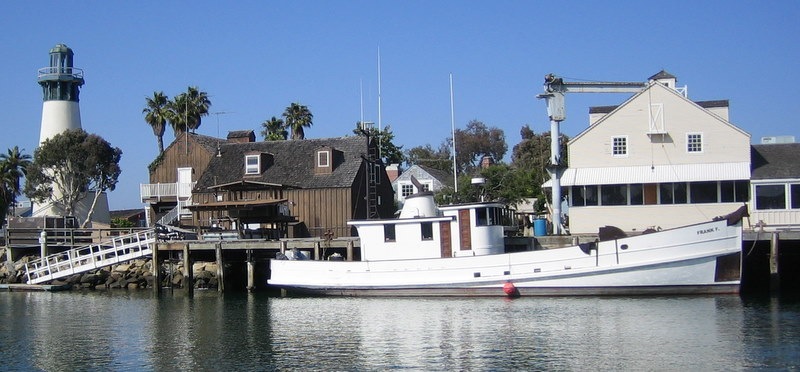
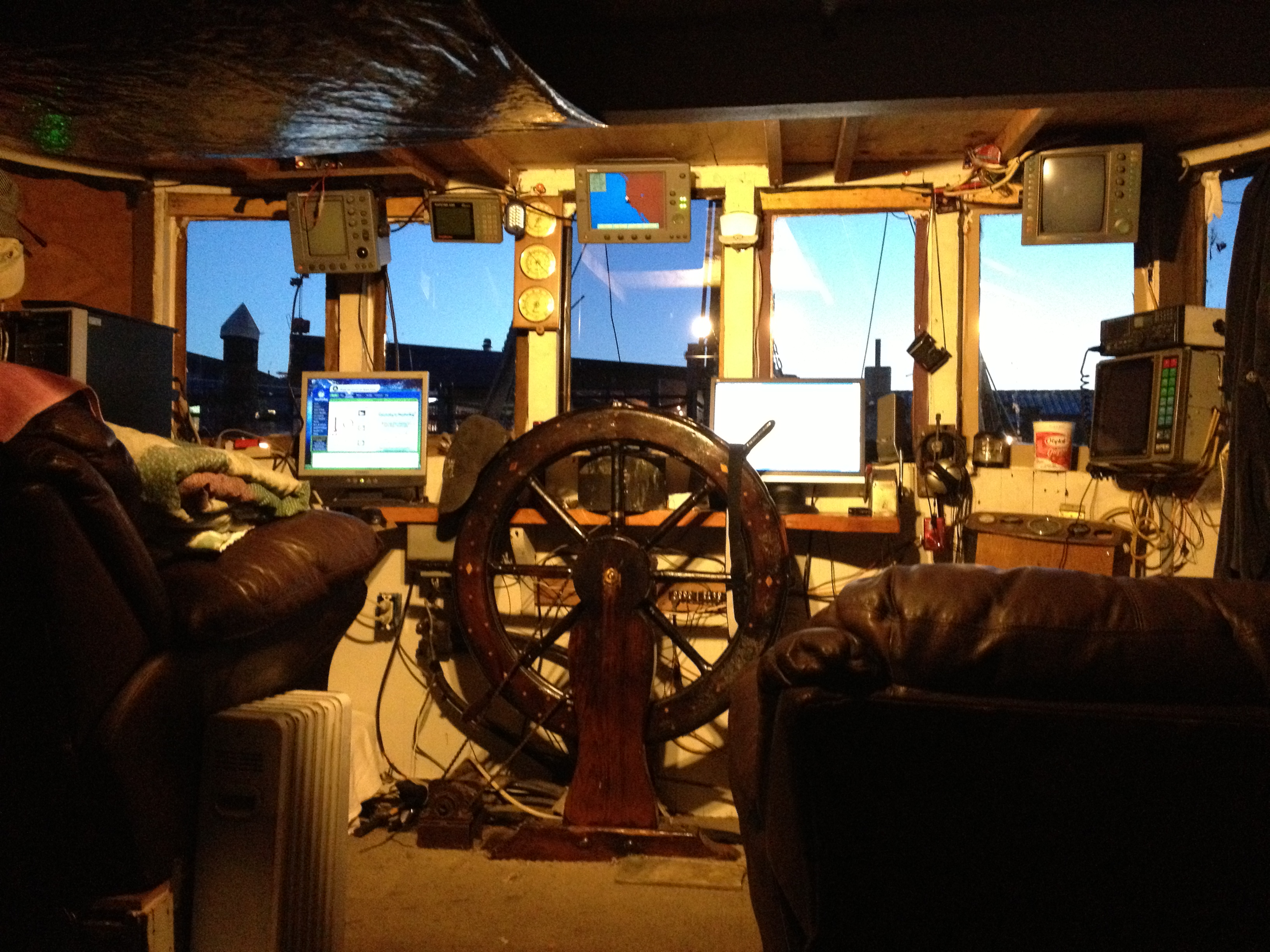
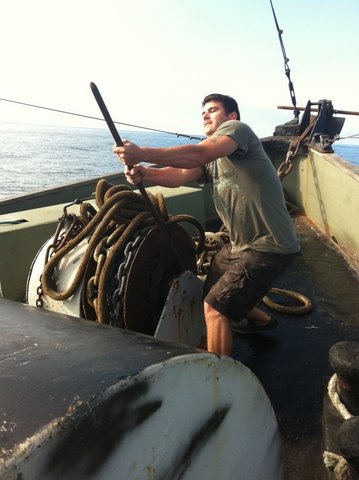
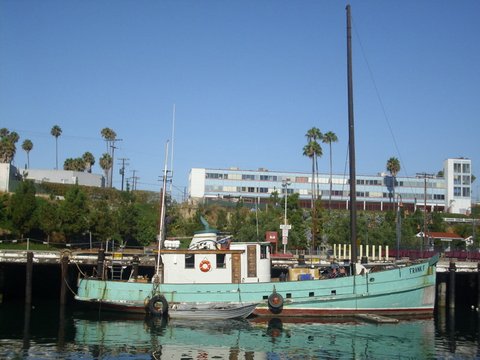
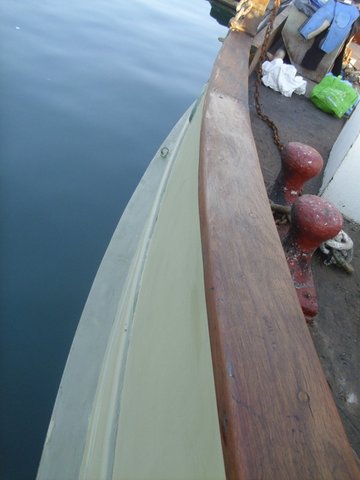
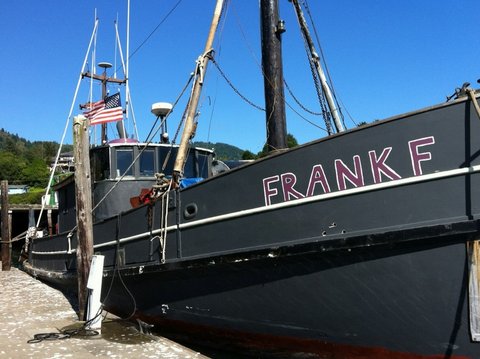
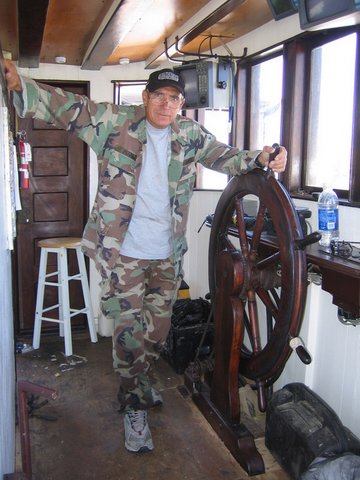
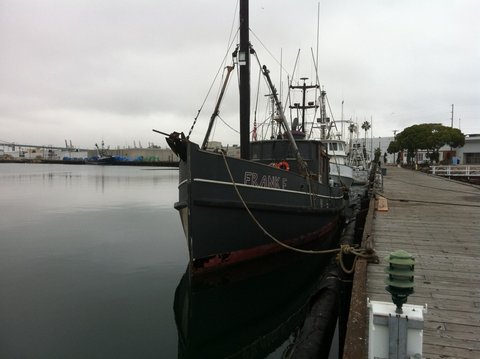
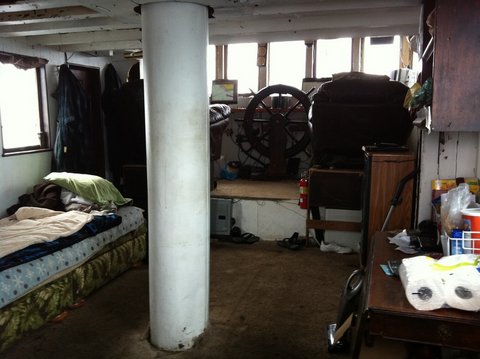
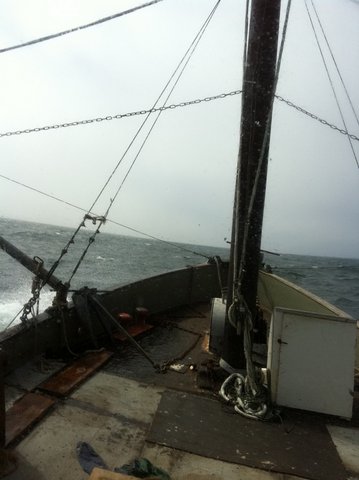
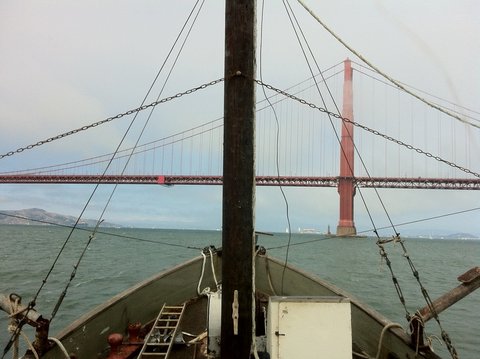
August 6, 2013I recently heard from the current owner of the Barron F, who very generously sent some photos of the boat. Steven Starnes is planning to drop the current name “Frank F“, and return the boat’s original name. He is hoping to bring her back to Southeast Alaska for her 100th birthday, and would like to see her in a museum.
I also found a few more details on the boat’s history, which I will post below. As I mentioned in some earlier posts, the Barron F was one of the Funter Bay cannery tenders owned by James T. Barron.
The US Merchant Vessel Registry from 1918 says the Barron F was built in 1917 in Seattle and home port was Portland, OR. 65.2ft long, 17ft beam, 7.3ft draft. Fishing service, crew of 7. 85hp gas engine. 50 Gross tons, 42 Net tons. In 1919 the home port is listed as Juneau.
The H. W. McCurdy Marine History says that the Barron F was built by the National Shipbuilding Co of Seattle. That company was founded on Jan 1 1917. Their 4-acre yard was located at 655 Gordon St in Seattle, and executive offices at 1023 Alaska Bldg. Officers were J.F. Lane, J.L. McLean, and Loren Grimstead. They had about 200 employees in the yard. (from Pacific Ports Annual, 1919).
In 1918 the owners pulled out the Barron F‘s 3-cylinder Atlas “distillate engine” and sold it, it was said to be installed in the spring of 1917 and only used for 3 or 4 months. It was listed for sale for $4,900. (from Pacific Motorboat, Vol 10)
In 1959 the Frank F was mentioned as the “old Barron F, a Nakat tender”. It was owned by Rollin Crump of Astoria and had been converted to a dragger working out of the Columbia River. It had an A-C 21000 (probably Aliss Chalmers 6-cylinder) with a Capitol 3.88 to 1 reduction gear, which got it up to 10 knots, noted as “a good two knots over any previous known speed for the boat”. During a 14-day trip the vessel used 1000 gallons of diesel. (From Pacific Fisherman Yearbook Vol 57).
Thanks again to Steven for letting me use his photos!
Funter Bay History – Cannery Employees
August 6, 2013The Thlinket Packing Co at Funter Bay employed a number of different people over the years in a variety of positions. Below is a partial list, gleaned from early 20th century newspapers. Keep in mind that consistent spelling of names in the early 1900s was somewhat optional!
_____________________________________________________________
James T. Barron – Owner and Manager, 1902 – ~1926. More on the Barron family here.
_____________________________________________________________
Judge Michael George “MG” Munly (1854-1923)
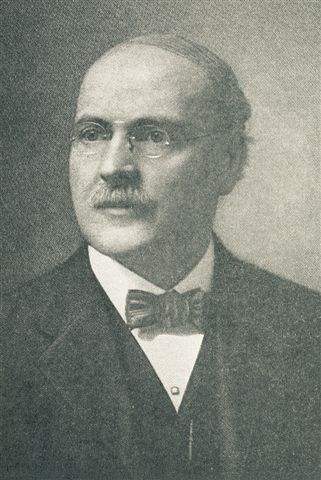
The family name was originally spelled “Munley”, but Michael later dropped the E. He was company Secretary and brother-in-law to James Barron. He married Mary Nixon, sister of James Barron’s wife Elizabeth. Munly was admitted to the Pennsylvania bar in 1882. He was deputy city attorney in Portland, and was appointed a judge of the Oregon circuit court from 1892-1894. Munly ran unsuccesfuly for mayor of Portland in 1909. Along with the Barron family, Munley and family were frequent visitors to the Funter Bay cannery.
Judge Munly’s grave and additional information.
1922 Biography of M. G. Munly
1928 Biography
_____________________________________________________________
C. F. Whitney was Sales Manager at the company, based in the Portland office. He seems to have rarely visited the Funter Bay operation. Prior to taking this position, Whitney had been sales manager of the New York Life Insurance Co.
_____________________________________________________________
Mr. and Mrs. Norton – Listed as winter caretakers at the cannery in 1903. Left in February to develop some timber claims in Oregon.
_____________________________________________________________
James Lawlor – (Sometimes spelled Lawler) was caretaker and winter foreman(?) from at least 1903-1909. He took over from the Norton’s in Feb 1903 and began preparations for the upcoming coming packing season.
_____________________________________________________________
Chris Houger (Sometimes spelled Hooger, Hugher, Hager, etc) was “Outside Foreman” at the Funter Bay cannery from at least 1903-1919. ?He was in charge of piling crews, trap installations, nets, etc. His wife was noted as being the cannery’s bookkeeper in 1914. In 1917 Western Canner and Packer referred to him as Manager of the Thlinket Packing Co.
_____________________________________________________________
Captain Haly of the Rainier – hired to bring up the “fishing steamer Barron” from the South for the 1903 season.
_____________________________________________________________
Mr. and Mrs. A. C. Bogarth – Operated fish traps near the Funter Bay cannery for several years around 1903.
_____________________________________________________________
Captain Crockett – skippered the Anna Baron during at least the 1904-1907 seasons.
_____________________________________________________________
Captain Mason was listed as skippering the Anna Barron in 1911.
_____________________________________________________________
Captain Martin Holdst (Also listed as Martin Olson) of the Belle was employed in the winter of 1909-1910 repairing the water and power systems at the cannery.
_____________________________________________________________
Pat. F. Mulvaney was the storekeeper at the Funter Bay cannery from at least 1909-1917 and listed as watchman in 1918 -1919.
_____________________________________________________________
Fred Barker (Or T. H. Barker) was listed as cannery superintendent in 1911. His brother “Billy” Barker was the assayer at the Perseverance mine.
_____________________________________________________________
Cannery employees listed as arriving in spring of 1911 were: H. H. Harvey, C. W. Young, G. W. Scott, E. A. Harriman, Thos. Redwood, F. Phelps, W. F. Brillian and H. Wills.
_____________________________________________________________
A. M. “Bob” Bell was listed as a canneryman at Funter Bay in 1912. There is also an A. E. L. Bell mentioned, and possibly another Bell who ran the Glacier cannery.
_____________________________________________________________
F. Hilder was an employee at the cannery in 1914.
_____________________________________________________________
George W. (or L.) Bowman was listed as cannery superintendent in 1914. He formerly worked for the Northwestern Fisheries company.
_____________________________________________________________
J. F. Bennett was listed as a cannery employee in 1915, his arm was caught in a rotating shaft in June and he required skin grafts at the Juneau hospital.
_____________________________________________________________
Harold W. Chutter (Or Chuttes or Chutte or Shutter or Chutler) is listed as the “popular superintendent of the Funter Bay Canning Co” in 1916 and 1917. In Feb. 1917 it was reported that “Mrs. Chutter, formerly of Funter Bay” had left to marry the former accountant for the Juneau Electric Light company. In December of 1917 it was reported that Chutter was closing up his affairs at the cannery and leaving for Bremerton to join the Navy. Sales Manager Whitney planned to come North from Portland to temporarily fill in as manager.
_____________________________________________________________
C.L. Cook is listed as bookkeeper in 1917.
_____________________________________________________________
G.C. Coffin, an employee of the cannery, was at the Juneau hospital in 1917 for eye treatment.
_____________________________________________________________
E. W. Hopper is described as the superintendent and/or manager of the cannery in 1918. His wife and daughter also resided at Funter in the summers.
_____________________________________________________________
Capt. John Maurstad skippered the Barron F. in 1918. According to the Kinky Bayers notes, he came to Alaska in 1909 and was a resident of Angoon. He did some logging and built a sawmill and Kasnaku Bay (Hidden Falls) in 1927. In 1940 he was in charge of a CCC crew building roads near Angoon. He may have died around 1942 at age 53.
_____________________________________________________________
D. J. Wynkoop, formerly of the Treadwell mine, was employed at the cannery in 1918.
_____________________________________________________________
Captain A. Woods is listed as running the Anna Barron in 1918. He fell from a 20ft ladder in February and was in St. Ann’s hospital expected to fully recover.
_____________________________________________________________
Chinese, Filipino, and Native Alaskan employees were usually only mentioned in passing, with no names given. A 1914 article lists the following “strange names” of Chinese workers bound for Funter Bay, but states that the purser of the steamship City of Seattle may have been kidding around: “Ten Pin, Hinge Lock, Wong Toon, Mop Dip, Wong Chuck, and Sam Lea“.
I’ve tried briefly looking into each of these people, but have not found any detail on most of them. I may try to come back to this post if more information becomes available. If you know anything about any of them, please feel free to contact me!
Alaska’s Historic Canneries Blog
August 2, 2013I was recently invited to write an article on the Funter Bay cannery for the Alaska Historical Society. The article is on their excellent blog of Alaska’s Historic Canneries, and can be viewed here:
http://alaskancanneries.blogspot.com/2013/07/the-funter-bay-cannery.html
I’d like to thank Anjuli Grantham of the AHS for getting this set up for me, and my sister Megan for proofreading.
More Railroad Updates
August 1, 2013I’ve been poking at my Obscure Railroads of Alaska page a bit more. It’s fairly unorganized at this point, being mostly a running list of trams and small railways that I’ve found. My hope is that it will help other rail and history enthusiasts like myself. Hopefully it can serves as a landing page and jumping-off point for further research on small town Alaska rails, I’ve tried to provide links to source documents when possible. When I started this (a bit by accident), I had never heard of many of these lines, despite having a long-running interest in railroads and Alaska history. The information is out there, it’s just buried a little beyond the scope of easy viewing and mainstream histories (As a kid I was always frustrated at how vague and incomplete things like Alaska Geographic’s railroad issue were).
Randy Hees of PacificNG.com is one of the people who’s been quite helpful on this topic. He recently mentioned my website in a blog post. He also discusses the challenges of tracing the overlapping and twisting history of Alaska and Yukon railroads.
Eventually I might try to break the railroad page up into sub-sections or sort it by region, length of line, or other useful statistics. I also hope to refine the details on some of these, often the source documents are a little “fuzzy” about dates, names, or routes.
While I’m at it, I would also like to thank the Alaska State Library’s Digital Archives collection for letting me use some of their material. I’m sure they are getting tired of me sending in permission forms!
Funter Bay History: Wreck of the Mariechen
July 26, 2013In late 1905, a German-registered tramp steamer named the Mariechen set out from Puget Sound to Vladivostok, Russia. The steamer was owned at the time by Diederichsen, Jebson & Co of Hamburg, and was known for running contraband to Russia and Hong Kong. In 1905 she was reported as planning to run a blockade on the Vladivostok Harbor.

Photo courtesy of the British & Commonwealth Shipping Company record website.
The ship was originally built in 1883 as the Clan Matheson of 3,917 tons. The ship had a history of problems, including fires on board and a prior grounding in the Suez Canal.
Traversing the outside coast of Alaska in December is a risky proposition even today. The ship ran into typical winter storms, then suffered an engine breakdown. Conflicting reports then state that the ship was either adrift for a month, or “beating around near Point Retreat” looking for an anchorage. The ship likely had customs issues which would have dissuaded the crew from seeking a port like Juneau or Skagway. Marine radio technology was fairly new and temperamental, and the ship may not have had a working wireless set. It’s possible the vessel was trying to use sails after the engine died, the first photo shows very tall masts and spars indicating square rigged sails, but some of the spars are missing in the post-wreck photos.
In late January of 1906, the ship finally went aground at False Bay, south of Funter on Chichagof Island. Excerpts from the wreck report note that the compass froze up, the steamer had no charts of the area, and visibility was low due to a snowstorm.

Courtesy of Alaska State Library, William R. Norton collection, P226-743
The master of the ship was listed as Captain Rudolph Heldt, with Chief Officer Charles Pruet. The crew was mostly Chinese, who were “rounded up and deported” after the wreck. There were apparently no fatalities, but the cargo was lost. One document blames “local Indians” for the loss of the cargo, but period articles mention many local vessels salvaging “Food, flour, and beer” from the hulk, and selling some of it in nearby towns. An article from December 1906 described a feud over “several loads” of beer looted from the wreck by Robert Reid of Tenakee. Local tough Norman E Smith demanded a cut of the loot, and threatened Reid’s family. Reid then killed Smith with a shotgun at Snyder’s store in Tenakee.

Courtesy of Alaska State Library, William R. Norton collection, P226-612.
After the wreck, the British Columbia Salvage Co had the contract to refloat the vessel and tow it South for scrapping. The salvage tug Salvor was sent to the area, and the crew used Funter Bay as their base of operations. The tug would periodically stop at the cannery for fresh water and safe anchorage during storms. A March article notes that the water pipes at the Funter Bay cannery were frozen, so the Salvor had to come to Juneau for water. In April of 1906 the Salvor finally got the Mariechen floating, and towed the hulk into Funter Bay. It was further patched at Funter before being towed to Juneau in May, then on to Victoria, BC.
“The German steamer Mariechen is again afloat on the high seas. The steamer Rustler brings word that she was floated and is now at Funter Bay where she will remain until patched up for her tow to Victoria, where a British firm has the contract to repair her.” (from Daily Alaska Dispatch [Juneau] 28 Apr. 1906)
A detailed report of the salvage operation, including a photo of the damaged hull in drydock, is available here.
Sources:
“Steamer For Sale.” Daily Alaska Dispatch [Juneau] 15 Oct. 1906
Daily Alaska Dispatch [Juneau] 19 Mar. 1906
Good, Warren. “South East Alaska Shipwrecks (M) ” Alaska Shipwrecks. Web. 16 July 2013. <http://alaskashipwreck.com/>.
“SS CLAN MATHESON Built by Napier Shanks & Bell Yoker.” Clydebuilt Ships Database. Web. <http://www.clydesite.co.uk/clydebuilt/viewship.asp?id=8212>.
“Clan Matheson.” The British & Commonwealth Shipping Company; A Record of The Ships And The People That Served Them. Web. <http://www.bandcstaffregister.co.uk/page542.html>.
“Salving the Mariechen.” Marine Review 34 (1906): 16-17.
The Funter Bay Railroad
July 17, 2013In the first half of the 20th century, Funter Bay had a small railroad running to mine workings at the base of Mt. Robert Barron (originally known as “Funter Mountain”).
A short mine railroad was first reported in 1895, when a newspaper article described plans for “about 1,000 feet of railroad track” running along the beach to various mine tunnels. This would likely have carried ore carts pushed by hand or pulled by draft animals.
Newspaper reports state that workers began laying 36-inch narrow-gauge rails towards the mountain in 1912. Originally, this track consisted of 4×4 wooden rails, spiked to an existing corduroy wagon road bed. The rails could have had strap iron on top, as did other wooden tramways in the area. A 1920 inventory of company assets describes the line as 4000′ of 36″ gauge surface tram, and a 1921 map labels it “wooden tramway”. It was elsewhere listed as a “tram road” (many of these terms are used interchangeably in describing small railroads). Initially four ore cars of about 3 tons were used, these had steel wheels and wooden boxes, and were hauled by mules along the wooden track. Although a “locomotive boiler 40hp with 40hp engine” is inventoried in 1920, this seems to have been connected to a sawmill at the time and not related to the tram.
Between 1920 and 1926, the track was upgraded with steel rails, laid on the same corduroy grade in between the existing wooden rails (which had become rotten by that time). The new line was approximately 25″ gauge, and seems to have used 20 or 25lb steel rails (30 tons of 20lb rails were purchased around 1926, along with frogs and switches, to supplement an existing stock of 11 tons of 20 and 25lb rail). Twelve additional all-steel ore cars were purchased second hand from the Gastineau Gold Mining Co in Juneau (which had shut down and begun selling off equipment in 1921). Also in 1926, consulting engineer A. A. Holland recommended that the track be straightened, graded, and ballasted to prevent derailing. Holland suggested that cars should be hauled by cable due to the grade near the mountain, noting that locomotive haulage would require new track to take the steepest part of the hill more gradually.
1926 photos showing wooden rails with and without steel rails laid between them:

Some of Holland’s suggested improvements were implemented over the next few years. A 1928 letter to Governor Ernest Gruening reported construction of a “surface railroad” and purchase of a locomotive and cars. The 1930 stockholder report describes “railroads, 24″ gauge, 20lb rails” and an 8-ton steam locomotive. Within a few years the wooden roadbed was replaced with gravel from mine tailings. The 1931 Annual Report to the company stockholders stated that; “The Railroad Bed leading from the main tunnel to the mill located on the shore, and which was constructed of corduroy, was found too weak for continuous heavy loads and therefore has been ballasted the entire distance with crushed rock derived from the various workings in the main tunnel. New 8″ x 8″ x 9′ long ties have been secured and thus the road made substantial for any load at present under contemplation”. The report also mentions a branch of the railroad along the shore to the wharf.
Beginning in the 1930s, the line is referred to on maps and documents as a railroad, vs a tramway. This distinction may have had two factors behind it. For one, many early tram/railroad lines in Alaska used wooden trestles or ungraded track for their entire length to avoid the cost of permanent gravel grades. The switch from corduroy to graded roadbed at Funter was a significant upgrade. Secondly, the use of a steam locomotive seems to have boosted the status of small operations. Short lines with locomotives were more often called “railroads” while longer horse-drawn lines often remained “tramways”.
The company acquired a used 0-4-0T “Dinky” saddle tank steam locomotive around 1928. It seems to have been built by the Davenport Locomotive Works and was categorized as an 8-ton engine. Unfortunately no identifying marks are left, so the construction number and year are uncertain. It is anecdotally reported to be surplus from the Treadwell mines, which used steam locomotives at least until 1912-1913. Treadwell suffered a collapse in 1917 and finally shut down the last shaft in 1922, then sold the remaining equipment and property to the Alaska Juneau mine in 1928. As the AJ used electric locomotives of different gauge, the surplus steam locomotives were probably made available at bargain rates.
0-4-0T locomotive from Funter Bay:

The locomotive may have looked something like this when operating.

The total height is about 6′ (Treadwell’s specs called for a 5’7″ maximum clearance). This would have been considered a “contractor’s locomotive”, a type frequently used on temporary track in construction sites, to move dirt or materials around before dump trucks became common. Mines found them convenient due to their light weight and ability to handle uneven, steep, or sharply curving rails. I am not sure if the locomotive had an open cab (as apparently did most of the steam locomotives at Treadwell), or if it had an enclosed or even removable cab (at least one Treadwell locomotive was ordered with a removable cab, and a wooden cab could have been added later). Southeast Alaska’s climate would make at least a roof desirable, other small locomotives in the area had standing-height cabs when there were no clearance restrictions.
Here are some similar locomotive configurations that could have resembled this one:
Davenport locomotive with enclosed cab (larger version than this one).
Small locomotive with open cab.
Similarly sized locomotive (this one a Porter) with low-profile cab.
Such locomotives and light railroad equipment could be mail-ordered new or used from catalogs or classified ads in industry magazines.
Front view of Funter Bay steam locomotive:

Eventually, the rail line from the beach to the mountain was 4100ft long. A branch of about 1500-2000ft ran parallel to the beach just above high-tide line, connecting older mine workings along the shore. A report from around 1915 mentions “several miles of railroad” running “along the shore and back into the various tunnels”, but this seems a bit optimistic. Below the surface, ore carts were hauled through the tunnels by mules, and later by electric battery locomotives. Several documents mention multiple electric locomotives purchased prior to 1956, including a 3-ton GE. The tunnels along the beach are now collapsed or flooded.
Two sizes of rail wheels and axles lying on the beach at Funter Bay, the larger gauge set may have been from the 36″ gauge mule tram:

Railroad trestle at Funter Bay in the 1920s:
The following picture shows some track along the beach and what might be a switch:
Today the beachfront track is mostly washed out, rusted away, or buried under decades of organic debris which are slowly forming new soil on top of the railway.
The steam locomotive was used until around 1951, when the owners seem to have decided it was inefficient. I am not sure if it was fueled by wood or coal, but feeding it would have been time consuming either way. The owners attempted to “modernize” the unit by converting it to a Plymouth gasoline engine. Such was sometimes the fate of other steam locomotives in Alaska and elsewhere. An untitled, undated (but probably from 1951 or ’52) note in government files mentions that the conversion cost $1,000. Another note in the file mentions work on a Plymouth engine cowling and head in April 1952. Another sheet mentions that “A steam locomotive for use on the surface tramway was being converted to gasoline power.” and that the $1,000 price tag included “Repairs to locomotive surface and aerial tram (haulage)”.
Since the front of the dinky locomotive was cast to the frame, it would have been hard to simply cut the boiler off. The miners used the old standby of Alaska repairs: If you don’t have the right tool, try dynamite! The story goes that they simply blasted the boiler off the frame, resulting in severe cracking to the front casting:
The gas engine conversion proved to be underpowered; the unit worked on level ground but was unable to make it up the hill between the waterfront branch and the main line to the mountain. The whole rig was abandoned until the early 1970s, when it was salvaged by railroad enthusiast Jim Walsh and moved to Nevada.
A map showing part of the former rail line. The beach section is not shown.
By the late 1950s, maps begin show the line as a road rather than a railroad or tramway, the mine having switched to trucks for transportation. Today there is essentially nothing left of the railroad at Funter Bay. The tracks have all become buried or salvaged for other projects (such as Ray Martin’s marine railroad and planned logging railroad). The land is privately owned and not generally open to visitors.
The locomotive is probably the last major artifact left from this line, and I am greatly appreciative of Jim Walsh’s time and generosity in letting me see it! I am still searching for additional information on this locomotive, such as the construction year, ownership history (Treadwell or otherwise), mechanical specifications, or even old blueprints, but I’ve been unable to track down many details (I spun off another page on small Alaska railroads based on information found during this research). If any readers know of a source for such information, or a possible line of inquiry, I would love to hear about it! As usual, my email address is (replace <AT> with @): gabe <AT> saveitforparts.com
Sidetracked: Obscure Railroads of Alaska
July 9, 2013So… while researching AK history I accidentally found a whole bunch of forgotten railroads that aren’t well documented (if at all) in official rail histories. Kind of like finding spare change in the couch, but with more rust! I managed to get myself totally distracted from my Funter Bay history, while I typed up a quick list of these lines. I’ve tried to include links to supplementary information, but it’s a work in progress, and any information anyone might have would be appreciated! Since it’s a long list, I’ve gone ahead and made it a separate page on the site, you can find it at the link below:
https://saveitforparts.wordpress.com/projects/lesser-known-and-obscure-railroads-of-alaska/
Posted by saveitforparts