Funter Bay History: Cannery in 1929

January 14, 2014

I recently received an oblique aerial photo from August of 1929, showing the Funter Bay cannery. This is part of a set of Navy survey photos of Alaska. A few other photos from this survey are online, and I hope to find more in archival collections.

(Very large original, click to view full size)1929 Aerial FS T12a

At the time this was taken, the cannery was owned by Sunny Point Packing, and would operate for several more years before ending the main canning operation.

A few things are notable in the photo. The China Bunkhouse is only a foundation to the right of the Filipino Bunkhouse. Both “Oriental Bunkhouses” reportedly burned in 1929, so the Filipino Bunkhouse seen above is probably newly-rebuilt, with the China Bunkhouse in the process of rebuilding. Another notable feature is the long wharf and dolphins extending from the left side of the point. I had not been aware of this wharf’s existence before seeing the  photo. My best guess is it was a fuel delivery wharf serving the bulk oil tank on the point. It would make sense to keep the oil handling facility separate from the fish handling dock. Yet another interesting feature are the two radio masts to the left and behind the Superintendent’s house. These would have supported a dipole wire antenna similar to the type shown here. I am not sure what kind of radio was in use at the time, the 1920s saw the beginning of “High Frequency) (3-30mhz) and voice technology, supplementing low frequency and morse code stations. Some photos and information on a cannery radio operator from Yakutat from around the same time period can be found here. The antenna masts were likely multi-step poles made by lashing logs together, in the same manner as a wooden ship’s mast. This allowed them to reach higher than the surrounding trees.

I’ve zoomed in on the main cannery property and labeled some of the structures below. (The 1960s survey map was helpful with this).

1929 Aerial labeled

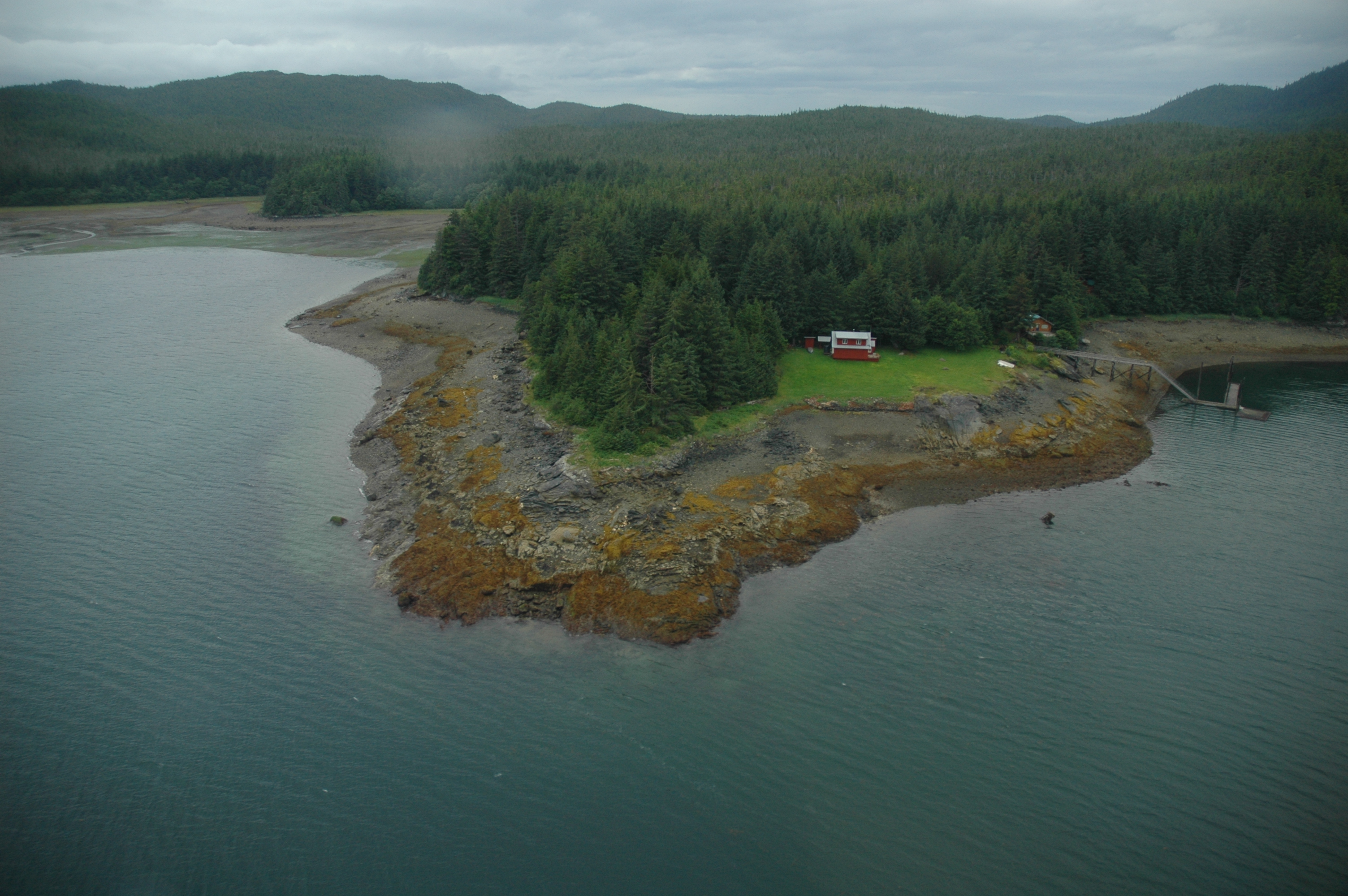
And for comparison, I’ve also included an aerial photo from a similar angle, taken in 2008. This is from a modern Alaska-wide aerial surveying project called Alaska Shorezone, a GIS mapping and aerial imagery project covering most of the coast (most photos in that set were taken at low tide, the 1929 image shows a higher tide).

2008 Aerial
The red house is a modern private residence, located approximately where the power plant stood. The green-roofed house is approximately where the mess hall stood. The only visible remains of the cannery in this photo are the floating dock and approach ramp (which have been updated and had sections replaced since 1929). The regrowth of spruce trees has obscured most of the formerly cleared land at the site.

I am very grateful to Mark Riley, Remote Sensing Coordinator for the Forest Service’s Alaska region, for tracking this down for me! I also received assistance from Shawn Younger, president of the WWII Archives Foundation, with another such photo. I may write about that one later.


Funter Bay History: Water & Hydropower Part II

December 22, 2013

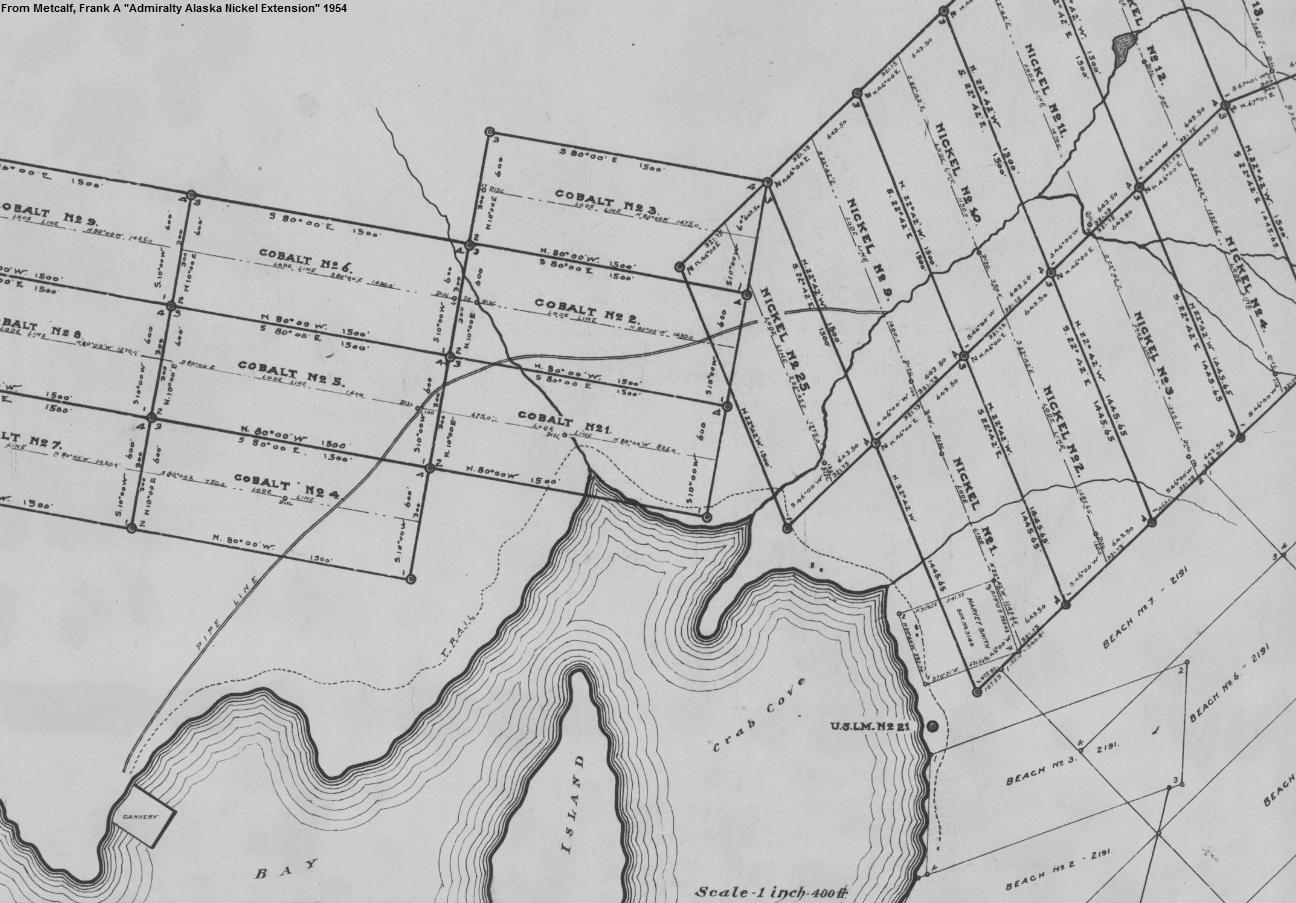
After previously writing about local water use for industry and power generation at Funter Bay, I came across a few more maps of such projects. The first, below, shows the pipeline from the Thlinket Packing Co cannery to “Nimrod Creek”, near “Pipeline Meadow” (local names). This creek is one of the larger and more reliable water sources convenient to the cannery. The grid lines on the map are old mining claims which have since lapsed. The small pond at the upper right is from a long-existing beaver dam which can still be found today.

pipeline

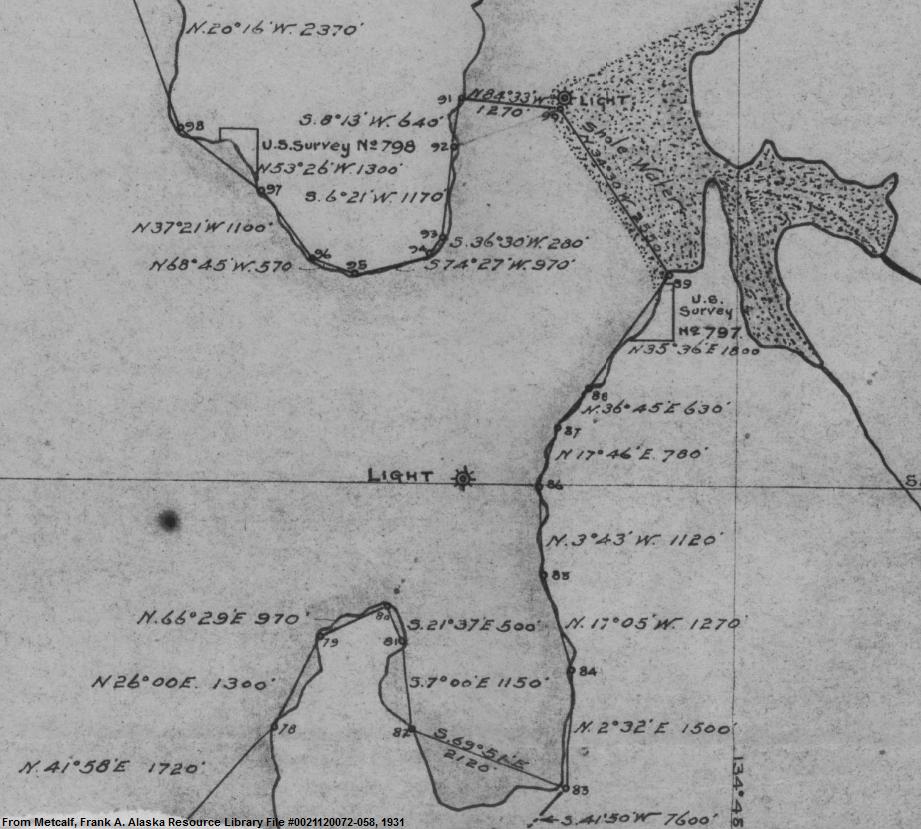
The Lake Kathleen project was a 1931 proposal to construct a hydroelectric station, fed by water from a tunnel. Power would be used at Funter Bay for an electric smelter.

kathleen

Electricity would have been transmitted to Funter Bay over lines strung along the beach for approximately 30 miles. The power line itself was considered relatively trivial once the necessary permits were acquired to use Tongass National Forest land and the tunnel had been dug. The major choke point would have been the crossing of Hawk Inlet, but this was planned to use a sandbar to build poles partway across the water.

kathleen2

The high flow and storage capacity available at Lake Kathleen outweighed the inconvenience of distance. Precedents for such a project included the Chichagof Mine at Klag Bay, as well as various other power projects around Southeast Alaska. Today many communities in Southeast Alaska rely on distant hydroelectric stations. Ultimately the Lake Kathleen project never materialized, either due to a lack of funding or other issues. Today the Greens Creek mine is located at Hawk Inlet much closer to this lake, but uses an underwater power cable from Juneau instead of local sources. Meanwhile, the Lake Kathleen area has been clearcut from the Cube Cove logging camp.

When large single sources of water were not available or practical to tap, another trick was to connect multiple sources with a lateral ditch. This technique was widely used throughout Alaska, from Nome to Fairbanks to Juneau. Engineers would pick an elevation contour and build a ditch at that level, exactly following the horizontal bends of the hillside while maintaining a slight vertical drop to keep the water flowing. Streams along the route were intercepted and diverted into the ditch, which eventually dumped their combined flow into a pipeline or another (previously smaller) stream where the water was needed. At Funter Bay, ditches and streams were sometimes daisy-chained, with one stream diverted to another, then that (now combined) stream diverted again farther down its course. This took advantage of different optimal contours for each leg.

Ditches were relatively cheap to dig, but had the disadvantage of needing constant maintenance. They were eroded by use, damaged by ice, blocked by fallen trees, and tended to fill in with silt, leaves, and other debris.

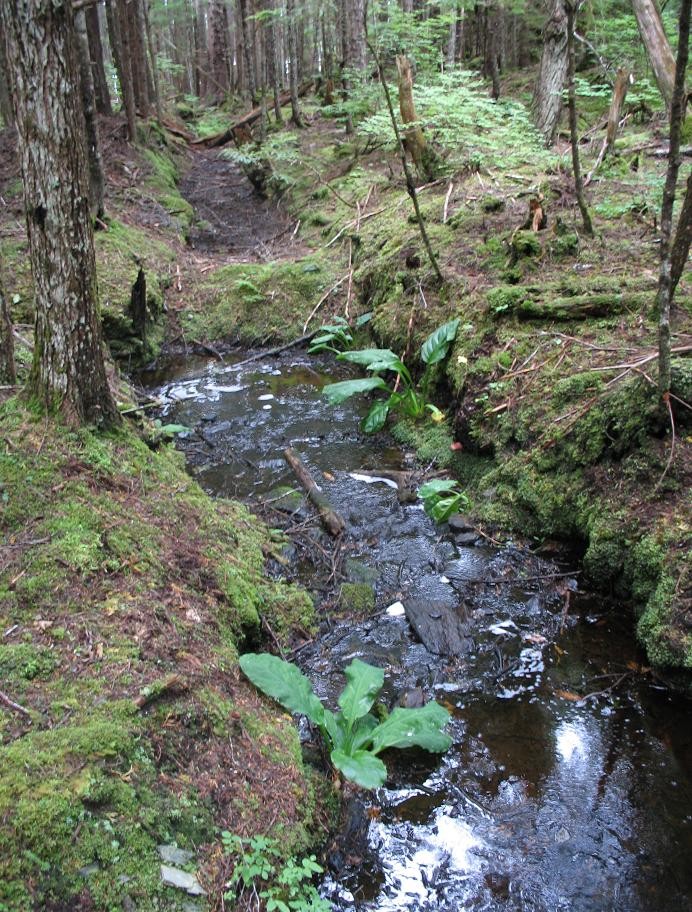
An abandoned ditch at Funter Bay, the water has found or made an easier path to the left, with the dry section beyond slowly filling in with organic debris:

ditch2


Alaskan Mine Names

December 12, 2013

I recently came across a large collection of mine names in Alaska. Names containing “Treasure”, “Rich”, “Jumbo”, “Bonanza”, etc are quite popular as a way to entice investors, but here are a few less enticing and perhaps more descriptive mine names!

Bum Cat
Horrible
Waterhole
Holy Moses
Wrongtrail
Troublesome Creek
Wicked Witch
Crazy Mountain
Pipedream
Singin’ Sam’s Rainbow Mine
Problem Gulch
Poor Chance
Slug Gulch
Whistlepig
Chickenlicken
Pooped
The Smell
Moonshine
Whiskey Creek
Smuggler’s Cover
Agony #1 & 2
Aching Back
Bruiser

And of course, a few named after wives, girlfriends, or perhaps local ladies of negotiable affection:

Lucky Lou
Clara Bea
Fanny Gulch
Nancy’s Hope Chest
Pricilla’s Delight
Darling Creek
Sweetheart Ridge
Little Sue
Lucky Nell
Lucky Lady
Maid of Mexico
Busty Belle
Double D Mining Co


Funter Bay History: Aircraft Mishaps

November 22, 2013

While Southeast Alaskan aviation is generally safe and efficient, the sheer number of planes in the area means there are the occasional accidents. Local preference for paint schemes on aircraft runs towards bright colors “so the search party can find it”. (Bright bottom paint is also popular on boats, so you can be found in case you wind up capsized).

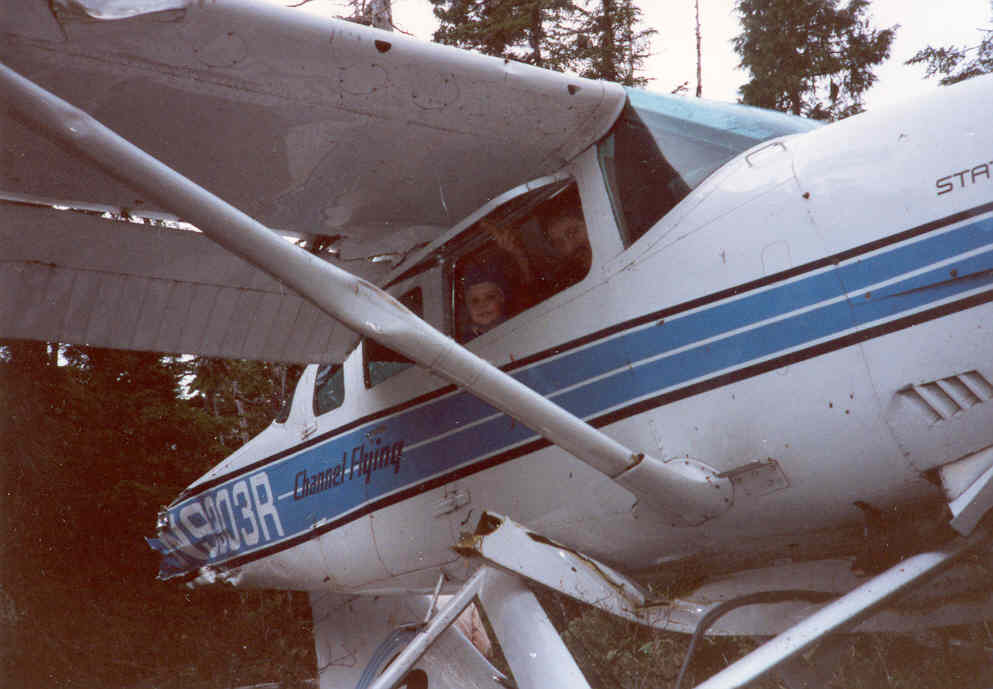
Here is a crashed plane that I visited when I was 5 (I’m in the little blue suit!) The damage looks severe, but everyone walked away. This is a Cessna 206 which was bringing a party of hunters back to Juneau, the pieces were later pulled out by a helicopter.

young-2 young-3

Below are a few more aircraft incidents from the Funter Bay area that I was able to compile from public data:

10/4/1979: An aircraft was reported “spiraling down” in the vicinity of Funter Bay, spotted by the fishing vessel Carol Ann. The Coast Guard and State Police located the crash and recovered three bodies. (Daily Sitka Sentinel)

4/29/1985: Piper 32-300 belonging to LAB became trapped between two snow showers, made emergency landing in Funter Pass. Plane damaged but no injuries: http://aircrashed.com/accident/SEA85LA099.shtml

10/29/1985: Amphibious Cessna 206 crashed at Funter Bay. Wheels failed to retract and plane nosed over during water landing. http://aircrashed.com/accident/SEA86LA019.shtml

11/30/1987: Cessna 206 belonging to Channel Flying took off with tailwind and was pushed into trees by downdraft. No injuries (this is the one I have pictures of).

5/25/1992: Piper 32-300 (Air Excursions of Gustavus) clipped a tree in the Funter pass. Was able to land at Juneau:  http://aircrashed.com/aircraft/aANC92LA079.shtml

8/6/1992: Cessna 207 operated by Alaska Juneau Aeronautics crashed in Funter Pass. Pilot turned to avoid cloud and hit mountain. 2 serious injuries.

2/28/2007: Cessna 207 operated by Wings of Alaska made an emergency landing on a beach at Funter after having engine trouble. The plane ran off the beach and sank, but the pilot and passengers were uninjured. An article and photo are here: http://www.kinyradio.com/juneaunews/archives/week_of_02-28-00/juneau_news_02-28-00.html


Funter Bay History: Tall Tales

October 29, 2013

One of the finest traditions of Alaskan culture is the Tall Tale or “BS Story”. Whether a heroic adventure, unlikely wildlife encounter, lost treasure, or exaggerated fish, Alaskans have made an art of far-fetched claims. These days they’re usually related in person, over the marine radio, or at the bar, but in the old days you could get them printed in the newspaper! Actually, you probably still can in certain less-rigorously-edited publications!

One common “BS” news story in the early 20th century was the ever-popular “Next Treadwell” mine. Newspaper editors knew that attracting outside investors to the state would help grow their small towns’ economies, so almost every mine, no matter how small, was compared favorably to Treadwell (an operation known to be highly profitable). The Sitka Alaskan of Feb 27, 1886 describes deposits in the Funter Bay area as “equally as large and rich [as the “great gold belt of Douglas island”]”. After Treadwell caved in and flooded in 1917, local editors had to come up with more general terms like “the great Juneau mines”.

Of the two Juneau papers at the time, the Daily Alaska Dispatch seemed to talk up Funter Bay the most, although the Daily Record-Miner was also favorably biased towards local mines. The Dispatch referred to Funter Bay as “One of the very best camps in the district” (May 8, 1903), “The best copper proposition in this district” (Apr 16, 1909), and as having “claims which will unquestionably become good producers within a short time” (Oct 15, 1915). A July 31, 1902 article describes a Funter Bay claim “richly impregnated with gold” as well as being “40% copper”, and being “highly mineralized all the way through” and “a great big chunk of the world’s wealth”.

Reading these articles leads one to think that Funter Bay was constantly poised to become a major competitor in the national economy, but the mines referred to in these articles were mostly one or two-man prospects that never got beyond 50ft of tunnel, such as the Mansfield Mine.

Otteson’s Dano mine was also mentioned in the Dispatch, described as having a “big and rich ledge” (3 Aug 1909) and producing “rich gold bearing samples” (27 July 1919). Despite all this richness, the mine did not develop into a major producer. The papers handled such delays in promised wealth with their usual optimism, an 1903 article mentions that barren rock encountered in the first 50ft of a mine at Funter must have been “all cap-rock”, and “a change has taken place… the values in the quartz now are very good”. Any mine which failed or went bankrupt, if mentioned at all, was promptly blamed on the incompetence of the prior managers, and never on the geology of the claim.

Another great tall tale appeared in the Dispatch on Sept 12, 1912.

Explores Unknown Region on Admiralty Island

W. C. Miller Finds Lake and River Alive With Mountain Trout and Tremendous Wall of Ice.
—————————
W.C. Miller, a well known Alaskan who has valuable prospects at Funter Bay, has just returned from an exploration of the “unknown country” of Admiralty Island, and this trip is believed to be the first exploration of that region. The country lies near the center of Admiralty Island, between Hawk Inlet and Seymour Canal. Mr. Miller was accompanied by his nephew, F. E. Koeper.
“The entire territory,” said Mr. Miller, “is worthless to the prospector. We found a little gold, but nothing worth while, except mountain trout.”
At the head of a river Mr. Miller found a lake four miles long and a mile wide, alive with mountain trout of unusually large size. “We had no bait but venison,” said Mr. Miller, “but a crowd of fish entered into competition for the hook as often as Koeper threw it in.” Miller and his companion came back by a shallow river, a hundred feet wide, and this stream was also alive with trout. No salmon were seen, and Mr. Miller believes that on account of the swiftness of the current the salmon are not able to swim a very great distance in it. Mr. Miller named the lake “Isaac Walton Lake” in honor of the great angler.
The explorers found a new glacier with a wall of ice sixty feet high, running along the top of the range for miles. (From Daily Alaska Dispatch, Sept 12, 1912).

For those unfamiliar with the area, Admiralty Island has no glaciers,  and mountain top snow of that thickness is unlikely in September . The size and location of the lake and river are also quite questionable!

On May 25th of 1937, lighthouse keepers at Point Retreat reported that they had seen a “Ragged wild man”. This was said to possibly be Bud May, a trapper from Funter Bay who had been missing for some time. However, a few days later, 65 year old Albert Miles arrived at Point Retreat and claimed that he is not “wild”, he had simply walked there after wrecking his boat near Cordwood Creek. Miles was later ruled to be insane (per Kinky Bayers’ notes).

I might have a few more of these lying around for a later update. If any readers have a contribution I would be glad to publish it! Names can be withheld or changed to protect the guilty!


Funter Bay History – Fish Trap Locations

August 10, 2013

I’ve talked about fish traps in several previous posts. Recently I came across a set of maps showing the locations of  traps around Southeast Alaska in 1918. This is a fascinating series, part of a government report from that year on the Southeast Alaska fishing industry.  An excerpt from the Lynn Canal and Stevens Passage map is below, highlighting the region around Funter Bay (click to view a larger version). I will link to the originals at the end of this post.

1918 Fish Traps

I have yet to find the original report which goes with these maps, so unfortunately there’s no key corresponding to the trap numbers. However, a quick glance at this map tells you a lot about where the salmon were to be found! The area of densely packed traps between Excursion Inlet and Point Couverden is known as Homeshore, and is still a popular fishing area today. Across all three maps in this set, covering most of Southeast Alaska, that one stretch of shoreline has the most fish traps per area.

Note that most of the traps shown on the map are the “permanent” pile-driven type. A 1919 report stated that the Thlinket Packing Co at Funter Bay had 21 traps that year, only 4 of which were floating traps. Pile-driven pound nets seem to have fallen out of favor towards the middle of the century, probably due to the expense of maintaining them and repairing winter ice and storm damage. By the time fish traps were banned at Alaska statehood, floating traps predominated.

I have previously noted some traps on the beach at Funter Bay in old aerial photos, floating traps were often taken ashore or anchored in shallow water for winter storage. The traps at Funter have all been beaten into individual logs by decades of storms, but I recently noticed a few semi-intact traps in Excursion Inlet. These are visible on the Alaska Shorezone project’s imagery.

beached traps

The full versions of the 1918 trap location maps are available through the Office of Coast Survey Historic Map and Chart Collection. They are as follows:

Lynn Canal and Stephen’s Passage

Clarence Strait Revillagigedo Channel and Portland Canal

Dixon Entrance to Chatham Strait Alaska


Update on the cannery tender Barron F

August 6, 2013

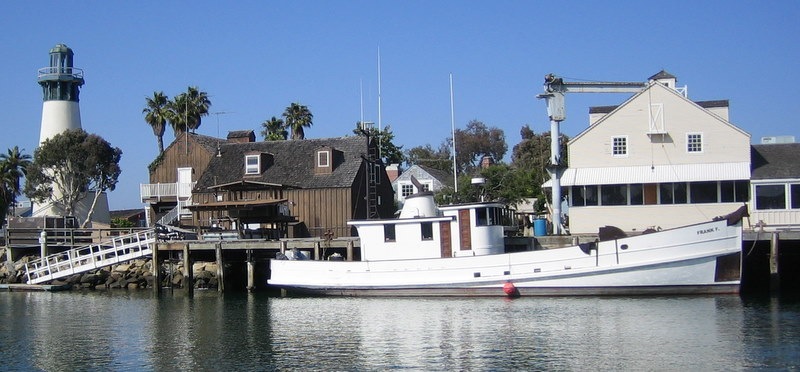
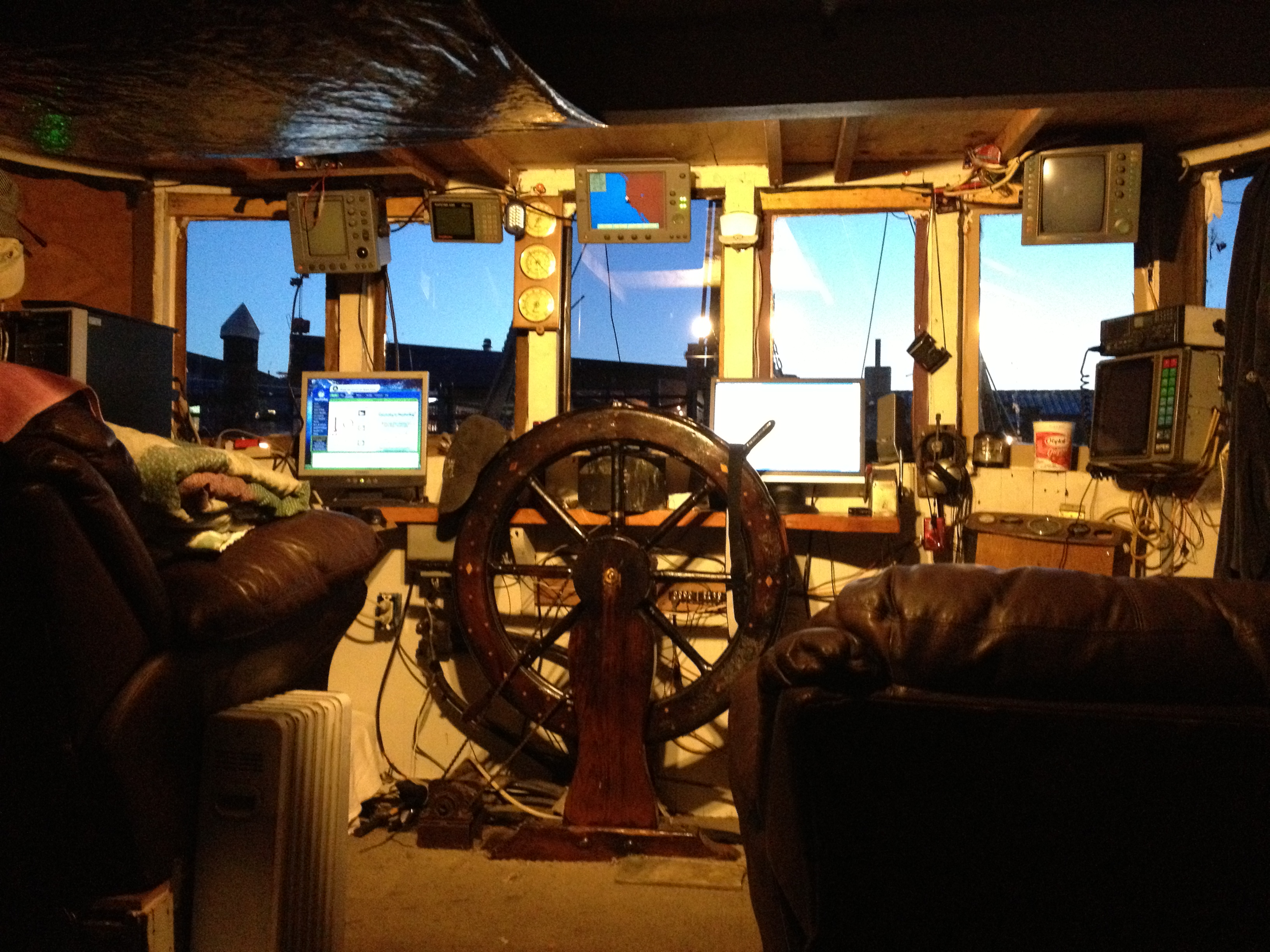
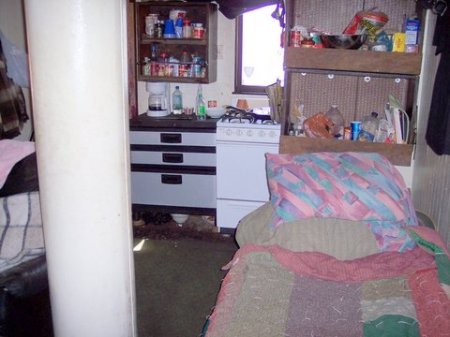
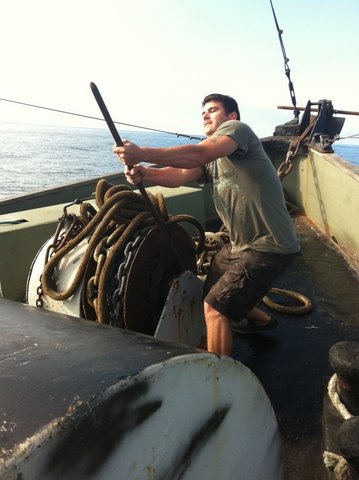
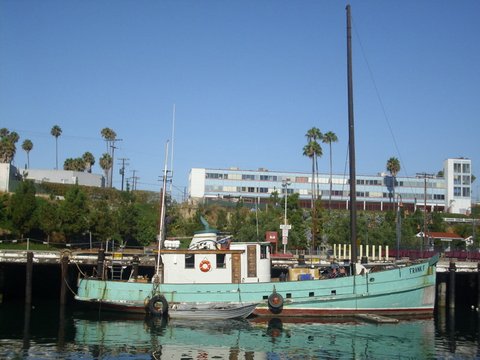
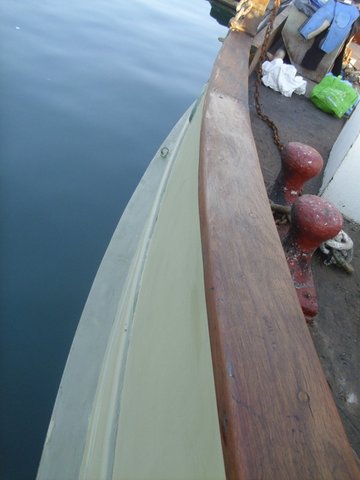
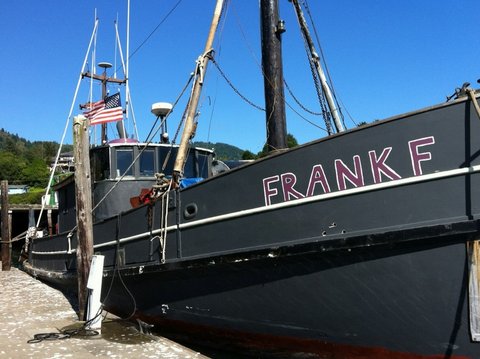
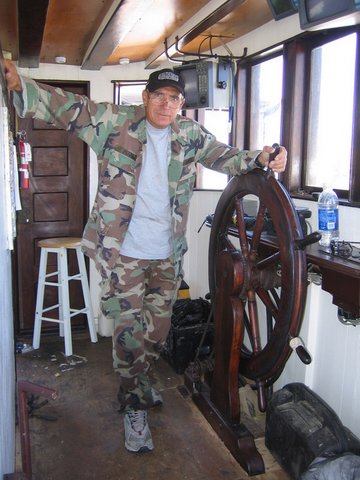
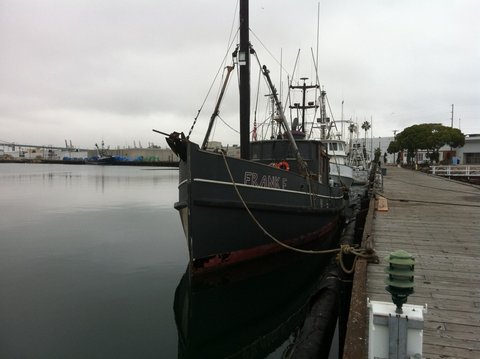
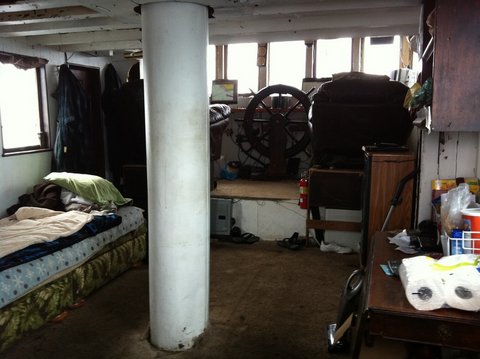
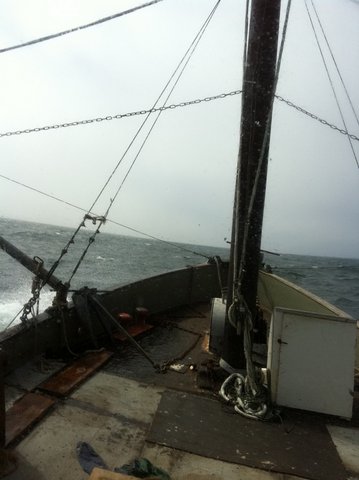
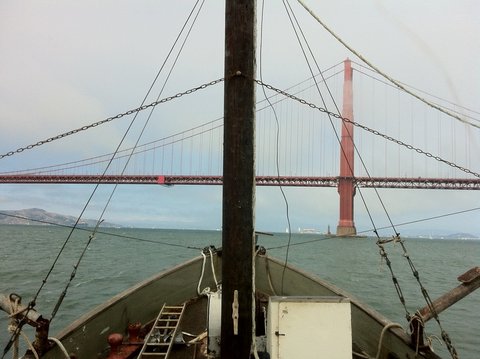
I recently heard from the current owner of the Barron F, who very generously sent some photos of the boat. Steven Starnes is planning to drop the current name “Frank F“, and return the boat’s original name. He is hoping to bring her back to Southeast Alaska for her 100th birthday, and would like to see her in a museum.

june2013 266

I also found a few more details on the boat’s history, which I will post below. As I mentioned in some earlier posts, the Barron F was one of the Funter Bay cannery tenders owned by James T. Barron.

iphone 2 371 home apple 5 497 DSCI0883 DSCI0970 IMG_3773   Picture 117-001 Picture 248 Picture 340 Picture 480 Picture 553

Swat_-_COASTAL_CONSULTANT_-_CARD_1.05 (1)

The US Merchant Vessel Registry from 1918 says the Barron F was built in 1917 in Seattle and home port was Portland, OR. 65.2ft long, 17ft beam, 7.3ft draft. Fishing service, crew of 7. 85hp gas engine. 50 Gross tons, 42 Net tons. In 1919 the home port is listed as Juneau.

The H. W. McCurdy Marine History says that the Barron F was built by the National Shipbuilding Co of Seattle. That company was founded on Jan 1 1917. Their 4-acre yard was located at 655 Gordon St in Seattle, and executive offices at 1023 Alaska Bldg. Officers were J.F. Lane, J.L. McLean, and Loren Grimstead. They had about 200 employees in the yard. (from Pacific Ports Annual, 1919).

In 1918 the owners pulled out the Barron F‘s 3-cylinder Atlas “distillate engine” and sold it, it was said to be installed in the spring of 1917 and only used for 3 or 4 months. It was listed for sale for $4,900. (from Pacific Motorboat, Vol 10)

In 1959 the Frank F was mentioned as the “old Barron F, a Nakat tender”. It was owned by Rollin Crump of Astoria and had been converted to a dragger working out of the Columbia River. It had an A-C 21000 (probably Aliss Chalmers 6-cylinder) with a Capitol 3.88 to 1 reduction gear, which got it up to 10 knots, noted as “a good two knots over any previous known speed for the boat”. During a 14-day trip the vessel used 1000 gallons of diesel. (From Pacific Fisherman Yearbook Vol 57).

Thanks again to Steven for letting me use his photos!


Funter Bay History – Cannery Employees

August 6, 2013

The Thlinket Packing Co at Funter Bay employed a number of different people over the years in a variety of positions. Below is a partial list, gleaned from early 20th century newspapers. Keep in mind that consistent spelling of names in the early 1900s was somewhat optional!

_____________________________________________________________

James T. Barron – Owner and Manager, 1902 – ~1926. More on the Barron family here.

_____________________________________________________________

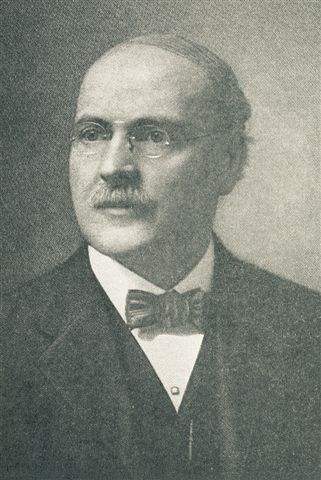
Judge Michael George “MG” Munly (1854-1923)
Munly

The family name was originally spelled “Munley”, but Michael later dropped the E. He was company Secretary and brother-in-law to James Barron. He married Mary Nixon, sister of James Barron’s wife Elizabeth. Munly was admitted to the Pennsylvania bar in 1882. He was deputy city attorney in Portland, and was appointed a judge of the Oregon circuit court from 1892-1894. Munly ran unsuccesfuly for mayor of Portland in 1909. Along with the Barron family, Munley and family were frequent visitors to the Funter Bay cannery.
Judge Munly’s grave and additional information.
1922 Biography of M. G. Munly
1928 Biography

_____________________________________________________________

C. F. Whitney was Sales Manager at the company, based in the Portland office. He seems to have rarely visited the Funter Bay operation. Prior to taking this position, Whitney had been sales manager of the New York Life Insurance Co.

_____________________________________________________________
Mr. and Mrs. Norton – Listed as winter caretakers at the cannery in 1903. Left in February to develop some timber claims in Oregon.

_____________________________________________________________

James Lawlor – (Sometimes spelled Lawler) was caretaker and winter foreman(?) from at least 1903-1909. He took over from the Norton’s in Feb 1903 and began preparations for the upcoming coming packing season.

_____________________________________________________________

Chris Houger (Sometimes spelled Hooger, Hugher, Hager, etc) was “Outside Foreman” at the Funter Bay cannery from at least 1903-1919. ?He was in charge of piling crews, trap installations, nets, etc. His wife was noted as being the cannery’s bookkeeper in 1914. In 1917 Western Canner and Packer referred to him as Manager of the Thlinket Packing Co.

_____________________________________________________________

Captain Haly of the Rainier – hired to bring up the “fishing steamer Barron” from the South for the 1903 season.

_____________________________________________________________
Mr. and Mrs. A. C. Bogarth – Operated fish traps near the Funter Bay cannery for several years around 1903.

_____________________________________________________________

Captain Crockett – skippered the Anna Baron during at least the 1904-1907 seasons.

_____________________________________________________________

Captain Mason was listed as skippering the Anna Barron in 1911.

_____________________________________________________________

Captain Martin Holdst (Also listed as Martin Olson) of the Belle was employed in the winter of 1909-1910 repairing the water and power systems at the cannery.

_____________________________________________________________

Pat. F. Mulvaney was the storekeeper at the Funter Bay cannery from at least 1909-1917 and listed as watchman in 1918 -1919.

_____________________________________________________________

Fred Barker (Or T. H. Barker) was listed as cannery superintendent in 1911. His brother “Billy” Barker was the assayer at the Perseverance mine.

_____________________________________________________________

Cannery employees listed as arriving in spring of 1911 were: H. H. Harvey, C. W. Young, G. W. Scott, E. A. Harriman, Thos. Redwood, F. Phelps, W. F. Brillian and H. Wills.

_____________________________________________________________

A. M. “Bob” Bell was listed as a canneryman at Funter Bay in 1912. There is also an A. E. L. Bell mentioned, and possibly another Bell who ran the Glacier cannery.

_____________________________________________________________

F. Hilder was an employee at the cannery in 1914.

_____________________________________________________________

George W. (or L.) Bowman was listed as cannery superintendent in 1914. He formerly worked for the Northwestern Fisheries company.

_____________________________________________________________

J. F. Bennett was listed as a cannery employee in 1915, his arm was caught in a rotating shaft in June and he required skin grafts at the Juneau hospital.

_____________________________________________________________

Harold W. Chutter (Or Chuttes or Chutte or Shutter or Chutler) is listed as the “popular superintendent of the Funter Bay Canning Co” in 1916 and 1917. In Feb. 1917 it was reported that “Mrs. Chutter, formerly of Funter Bay” had left to marry the former accountant for the Juneau Electric Light company. In December of 1917 it was reported that Chutter was closing up his affairs at the cannery and leaving for Bremerton to join the Navy. Sales Manager Whitney planned to come North from Portland to temporarily fill in as manager.

_____________________________________________________________

C.L. Cook is listed as bookkeeper in 1917.

_____________________________________________________________

G.C. Coffin, an employee of the cannery, was at the Juneau hospital in 1917 for eye treatment.

_____________________________________________________________

E. W. Hopper is described as the superintendent and/or manager of the cannery in 1918. His wife and daughter also resided at Funter in the summers.

_____________________________________________________________

Capt. John Maurstad skippered the Barron F. in 1918. According to the Kinky Bayers notes, he came to Alaska in 1909 and was a resident of Angoon. He did some logging and built a sawmill and Kasnaku Bay (Hidden Falls) in 1927. In 1940 he was in charge of a CCC crew building roads near Angoon. He may have died around 1942 at age 53.

_____________________________________________________________

D. J. Wynkoop, formerly of the Treadwell mine, was employed at the cannery in 1918.

_____________________________________________________________

Captain A. Woods is listed as running the Anna Barron in 1918. He fell from a 20ft ladder in February and was in St. Ann’s hospital expected to fully recover.

_____________________________________________________________

Chinese, Filipino, and Native Alaskan employees were usually only mentioned in passing, with no names given. A 1914 article lists the following “strange names” of Chinese workers bound for Funter Bay, but states that the purser of the steamship City of Seattle may have been kidding around: “Ten Pin, Hinge Lock, Wong Toon, Mop Dip, Wong Chuck, and Sam Lea“.

I’ve tried briefly looking into each of these people, but have not found any detail on most of them. I may try to come back to this post if more information becomes available. If you know anything about any of them, please feel free to contact me!


More Railroad Updates

August 1, 2013

I’ve been poking at my Obscure Railroads of Alaska page a bit more. It’s fairly unorganized at this point, being mostly a running list of trams and small railways that I’ve found. My hope is that it will help other rail and history enthusiasts like myself. Hopefully it can serves as a landing page and jumping-off point for further research on small town Alaska rails, I’ve tried to provide links to source documents when possible. When I started this (a bit by accident), I had never heard of many of these lines, despite having a long-running interest in railroads and Alaska history. The information is out there, it’s just buried a little beyond the scope of easy viewing and mainstream histories (As a kid I was always frustrated at how vague and incomplete things like Alaska Geographic’s railroad issue were).

Randy Hees of PacificNG.com is one of the people who’s been quite helpful on this topic. He recently mentioned my website in a blog post. He also discusses the challenges of tracing the overlapping and twisting history of Alaska and Yukon railroads.

Eventually I might try to break the railroad page up into sub-sections or sort it by region, length of line, or other useful statistics. I also hope to refine the details on some of these, often the source documents are a little “fuzzy” about dates, names, or routes.

While I’m at it, I would also like to thank the Alaska State Library’s Digital Archives collection for letting me use some of their material. I’m sure they are getting tired of me sending in permission forms!


Funter Bay History: Wreck of the Mariechen

July 26, 2013

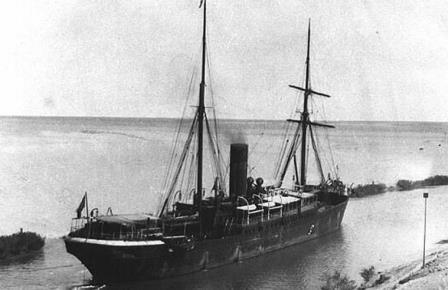
In late 1905, a German-registered tramp steamer named the Mariechen set out from Puget Sound to Vladivostok, Russia. The steamer was owned at the time by Diederichsen, Jebson & Co of Hamburg, and was known for running contraband to Russia and Hong Kong. In 1905 she was reported as planning to run a blockade on the Vladivostok Harbor.

wp718d5a94_05_06
Photo courtesy of the British & Commonwealth Shipping Company record website.

The ship was originally built in 1883 as the Clan Matheson of 3,917 tons. The ship had a history of problems, including fires on board and a prior grounding in the Suez Canal.

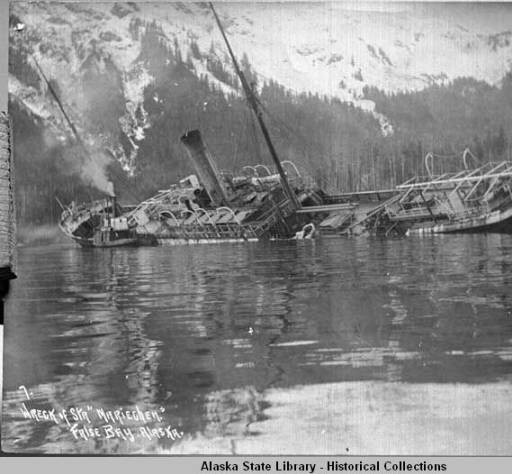
Traversing the outside coast of Alaska in December is a risky proposition even today. The ship ran into typical winter storms, then suffered an engine breakdown. Conflicting reports then state that the ship was either adrift for a month, or “beating around near Point Retreat” looking for an anchorage. The ship likely had customs issues which would have dissuaded the crew from seeking a port like Juneau or Skagway. Marine radio technology was fairly new and temperamental, and the ship may not have had a working wireless set. It’s possible the vessel was trying to use sails after the engine died, the first photo shows very tall masts and spars indicating square rigged sails, but some of the spars are missing in the post-wreck photos.

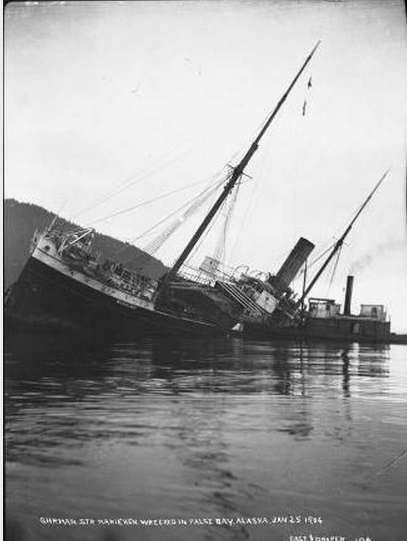
In late January of 1906, the ship finally went aground at False Bay, south of Funter on Chichagof Island. Excerpts from the wreck report note that the compass froze up, the steamer had no charts of the area, and visibility was low due to a snowstorm.

mariechen
Courtesy of Alaska State Library, William R. Norton collection, P226-743

The master of the ship was listed as Captain Rudolph Heldt, with Chief Officer Charles Pruet. The crew was mostly Chinese, who were “rounded up and deported” after the wreck. There were apparently no fatalities, but the cargo was lost. One document blames “local Indians” for the loss of the cargo, but period articles mention many local vessels salvaging “Food, flour, and beer” from the hulk, and selling some of it in nearby towns. An article from December 1906 described a feud over “several loads” of beer looted from the wreck by Robert Reid of Tenakee. Local tough Norman E Smith demanded a cut of the loot, and threatened Reid’s family. Reid then killed Smith with a shotgun at Snyder’s store in Tenakee.

mariechen2
Courtesy of Alaska State Library, William R. Norton collection, P226-612.

After the wreck, the British Columbia Salvage Co had the contract to refloat the vessel and tow it South for scrapping. The salvage tug Salvor was sent to the area, and the crew used Funter Bay as their base of operations. The tug would periodically stop at the cannery for fresh water and safe anchorage during storms. A March article notes that the water pipes at the Funter Bay cannery were frozen, so the Salvor had to come to Juneau for water. In April of 1906 the Salvor finally got the Mariechen floating, and towed the hulk into Funter Bay. It was further patched at Funter before being towed to Juneau in May, then on to Victoria, BC.

“The German steamer Mariechen is again afloat on the high seas. The steamer Rustler brings word that she was floated and is now at Funter Bay where she will remain until patched up for her tow to Victoria, where a British firm has the contract to repair her.” (from Daily Alaska Dispatch [Juneau] 28 Apr. 1906)

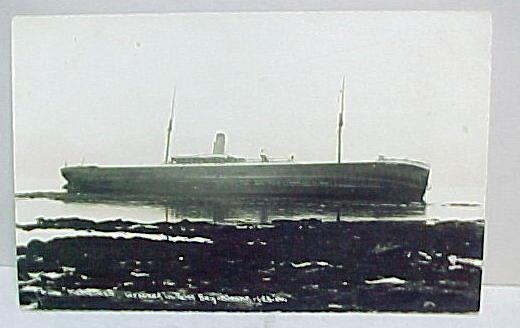
Postcard of hull from beach.

A detailed report of the salvage operation, including a photo of the damaged hull in drydock, is available here.

Sources:

“Steamer For Sale.” Daily Alaska Dispatch [Juneau] 15 Oct. 1906

Daily Alaska Dispatch [Juneau] 19 Mar. 1906

Good, Warren. “South East Alaska Shipwrecks (M) ” Alaska Shipwrecks. Web. 16 July 2013. <http://alaskashipwreck.com/&gt;.

“SS CLAN MATHESON Built by Napier Shanks & Bell Yoker.” Clydebuilt Ships Database. Web. <http://www.clydesite.co.uk/clydebuilt/viewship.asp?id=8212&gt;.

“Clan Matheson.” The British & Commonwealth Shipping Company; A Record of The Ships And The People That Served Them. Web. <http://www.bandcstaffregister.co.uk/page542.html&gt;.

“Salving the Mariechen.” Marine Review 34 (1906): 16-17.